
茶 FIRST IMPRESSIONS
茶 REVIEW OF BOOKS & FILMS
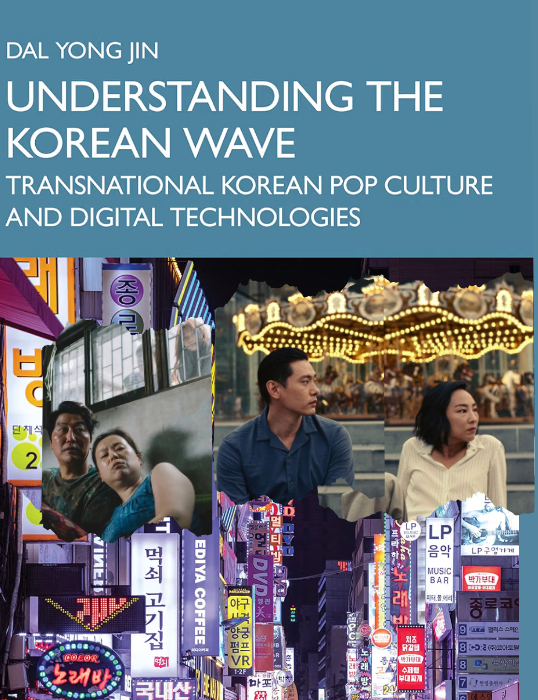
[REVIEW] “Acknowledging the One-Inch Line of Subtitles: On Dal Yong Jin’s Understanding the Korean Wave” by Sahar Othmani
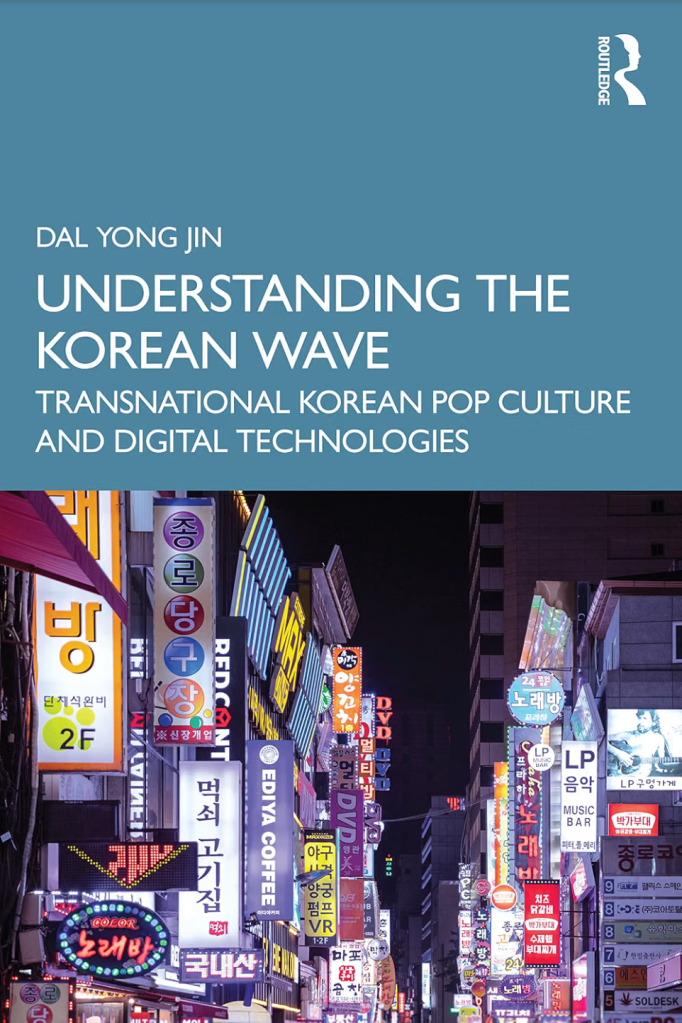
Dal Yong Jin. Understanding the Korean Wave: Transnational Korean Pop Culture and Digital Technologies, Routledge, 2023. 294 pgs.

In October 2024, Han Kang made history by winning the Nobel Prize in Literature, becoming South Korea’s first ever laureate in this category. Long before this momentous occasion, however, South Korea had embarked on one of the most remarkable transnational cultural campaigns in history. Yet one of the most significant factors in its dissemination is overlooked in this otherwise invaluable account of the phenomenon.
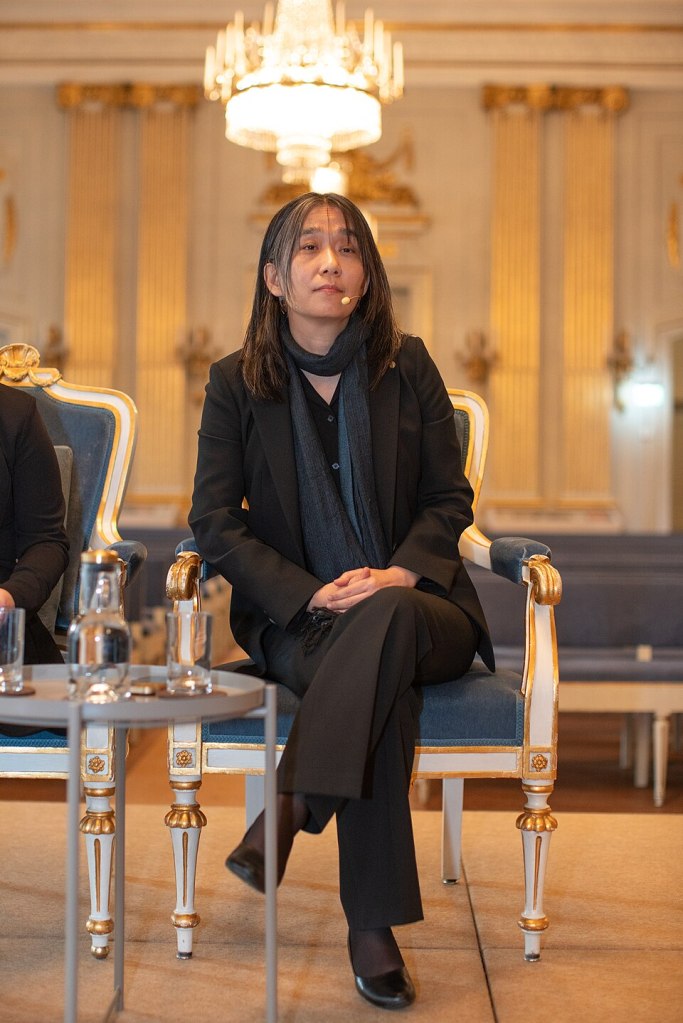
Han Kang, Nobel laureate in Literature, 2024
Dal Yong Jin is one of the most prolific scholars in Asian studies. In Understanding the Korean Wave: Transnational Korean Pop Culture and Digital Technologies, Dal expands on his concept of “platform imperialism” as he foregrounds the need to move beyond understanding Hallyu as a detached cultural phenomenon. Instead, he invites readers to consider it a convergence of cultural content and digital technology, shaped by state policies, industry and global fandoms. The book serves as a starting point for understanding the origins and timeline of the creation of the Korean Wave, or Hallyu. In the introduction, the author explicitly remarks on the book’s usefulness to students of media, communications and cultural studies.
The book is divided into fourteen chapters across three parts, each focusing on a different theme connected to the creation and continuation of the Korean Wave. Each chapter closes with a set of questions for further discussion.
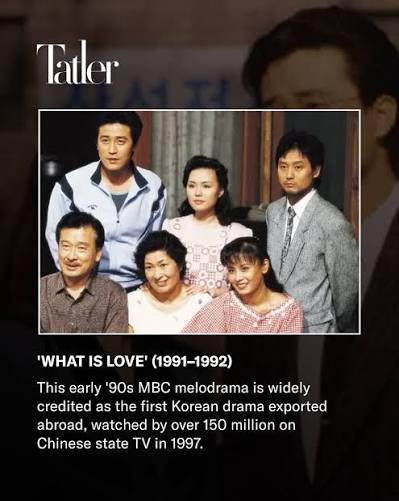
The first part addresses the history and theoretical contexts that have shaped the Korean Wave. Here, the author identifies three eras of the Wave. In seeking to establish where the starting line can be drawn, Dal notes that the first marker of Hallyu 1.0 can be found in the popularity in China of the Korean drama What Is Love? (p. 133) when it was first broadcast there in 1997. The first era, Hallyu 1.0, therefore begins in 1997 and ends a decade later. The second era begins in 2008 and continues for another decade, until 2017. The third era begins in 2017 and extends to the present day. This is perhaps the most frequently referenced section, and the most useful contribution, of the book. In this section, Dal also proposes the term “transnational proximity” to replace the older model of cultural proximity. This entails revisiting the cultural policies, soft power and cultural industries that shape, and enable access to, this proximity.
The second part of the book engages with the theoretical framing of translational identities within the context of these eras, against the backdrop of globalisation and sociopolitical conditions. The concept of transnational proximity is examined through the lens of media and culture: Korean dramas in the Netflix era, K-pop fandoms, cinema, games and e-sports. Each of these is anchored by a case study, such as Squid Game, BTS, Parasite and Battlegrounds.
The final part brings the central arguments to light by problematising the phenomenon through the “K” in K-everything, be it the diaspora, BTS fan nationalism or webtoons as transmedia intellectual property.
Strength in Breadth
The book’s breadth is more than a matter of coverage. By placing games, e-sports, policy and media labour alongside dramas, film and K-pop, the author renders Hallyu legible as an industrial and political system rather than merely a fan phenomenon. He enriches the field with a clear periodisation and an original concept, transnational proximity, against which he tests his case studies with considerable success. Indeed, one of the book’s greatest strengths is its practical division of Hallyu’s progression into historical periods (p. 45). He also covers a pre-Hallyu period and consistently demonstrates that Hallyu was never driven by a single cultural form. His chapter on Netflix makes the notion of political economy more concrete through its discussion of contracts and intellectual property ownership. Furthermore, he is more willing than a soft-power account would be to criticise the state (p. 84), the notion of cultural nationalism and the limits of Korea’s reach, suggesting that the “K” “should not suggest the supremacy of Korean popular culture” (pp. 143-146).
On the questions of labour and agency, the author rightly argues that alongside the celebrated creators of the Wave there exists a parallel workforce of below-the-line labourers. This is represented by the “primary labour force” (p. 120): the crew and media workers who function as cultural creators behind the scenes. Interestingly, the author argues that the Korean diaspora around the world, chiefly in the US and Canada, acts as an active agent of cultural dissemination rather than as a community of migrant consumers.

Diasporic lives become part of the third wave of Hallyu in Celine Song’s Past Lives (2023)
The Book through a Translational Lens:
The One-Inch Barrier as a Wall
Dal’s central theoretical argument, the case for “transnational proximity”, functions by removing language entirely from the critical equation. In chapter 3, he reduces linguistic proximity to a by-product of fan enjoyment. The book treats language and translation as a solved problem. Yet every mechanism of circulation it describes relies on a translational infrastructure: Netflix, Viki, Soompi, fan work and LINE Webtoon all depend on the labour of translators. While the book does acknowledge translation, it does so in four guises: as fan labour, as a platform service, as a technical glitch, or as a marker of authentic Koreanness through the untranslatability of certain contexts. Translation is never shown to play a part in the creation of meaning or value, or in the negotiation of power. In chapter 3, the author notes that most global fans did not speak Korean when they began, and that they learn it as their interest develops. He thus sets aside linguistic proximity in favour of cultural proximity in Hallyu audiences (p. 54).
This matters for the author’s argument. His critique of platform imperialism in chapter 7 would be sharper still had it examined who creates subtitles, in which languages and at what rate of pay. The book’s one gesture in that direction is its acknowledgement of the English words in K-pop lyrics as a relay, a mediator between the culture and its global audience. In the example he gives, the author claims that fans “do not care about linguistic barriers”; instead, they understand lyrics through the English words embedded in them. Thus, for a band such as BTS, the fact that its music reaches No. 1 on charts worldwide is taken as proof that language is no longer a barrier (p. 60).
Final Thoughts
This book was written to fulfil the pedagogical needs of a multifaceted topic. Each chapter pairs a thematic argument with a widely recognised case study. The prose is highly accessible, and each chapter concludes with helpful guiding questions.
To its credit, the book acknowledges translation and language. It names language as a barrier, even a wall, yet it does not cross the metaphorical one-inch line of subtitles, as it fails to name the very people who dedicate their careers to enabling such proximity. World-renowned translators such as Anton Hur and Deborah Smith, who have worked with authors including Nobel laureate Han Kang and Man Booker Prize finalist Bora Chung, are nowhere to be found in this conversation. Darcy Paquet, who subtitled Parasite, goes uncredited. Sharon Choi, Bong Joon-ho’s interpreter, was the one who rendered his famous remark on linguistic proximity legible in English. These individuals would have sat well within the book’s discussion of media workers as cultural mediators, and would have sharpened its central argument. Nevertheless, this limitation shows that there is still much to be uncovered about the role translation plays in facilitating Hallyu and other such cultural movements.
How to cite: Othmani, Sahar. “Acknowledging the One-Inch Line of Subtitles: On Dal Yong Jin’s Understanding the Korean Wave.” Cha: An Asian Literary Journal, 27 Sept. 2026, chajournal.com/2026/09/27/korean-wave.


Sahar Othmani holds a PhD in Translation from Queen’s University Belfast. She specialises in literary translation between Korean and Arabic. She is a visiting fellow in Media and Translation at the University of Loughborough, an assistant editor at The Translator, and a Junior Postdoctoral Fellow at the MENA Social Sciences Laboratory. She is a published poet and translator, and her work has been nominated for the Pushcart Award in Poetry (2023) and Wasafiri’s New Voices in Translation (2025). Her latest publication is an Arabic translation of the late Helen De Cruz’s Wonderstruck (Princeton Press & MBRL Books, 2026). You can find Sahar through her website: https://saharothmani.com

