
茶 FIRST IMPRESSIONS
茶 REVIEW OF BOOKS & FILMS
[REVIEW] “Green Trojan Horses: Trees, Power, and the Chinese State in Cheng Li’s Contested Environmentalisms” by Jennifer Eagleton
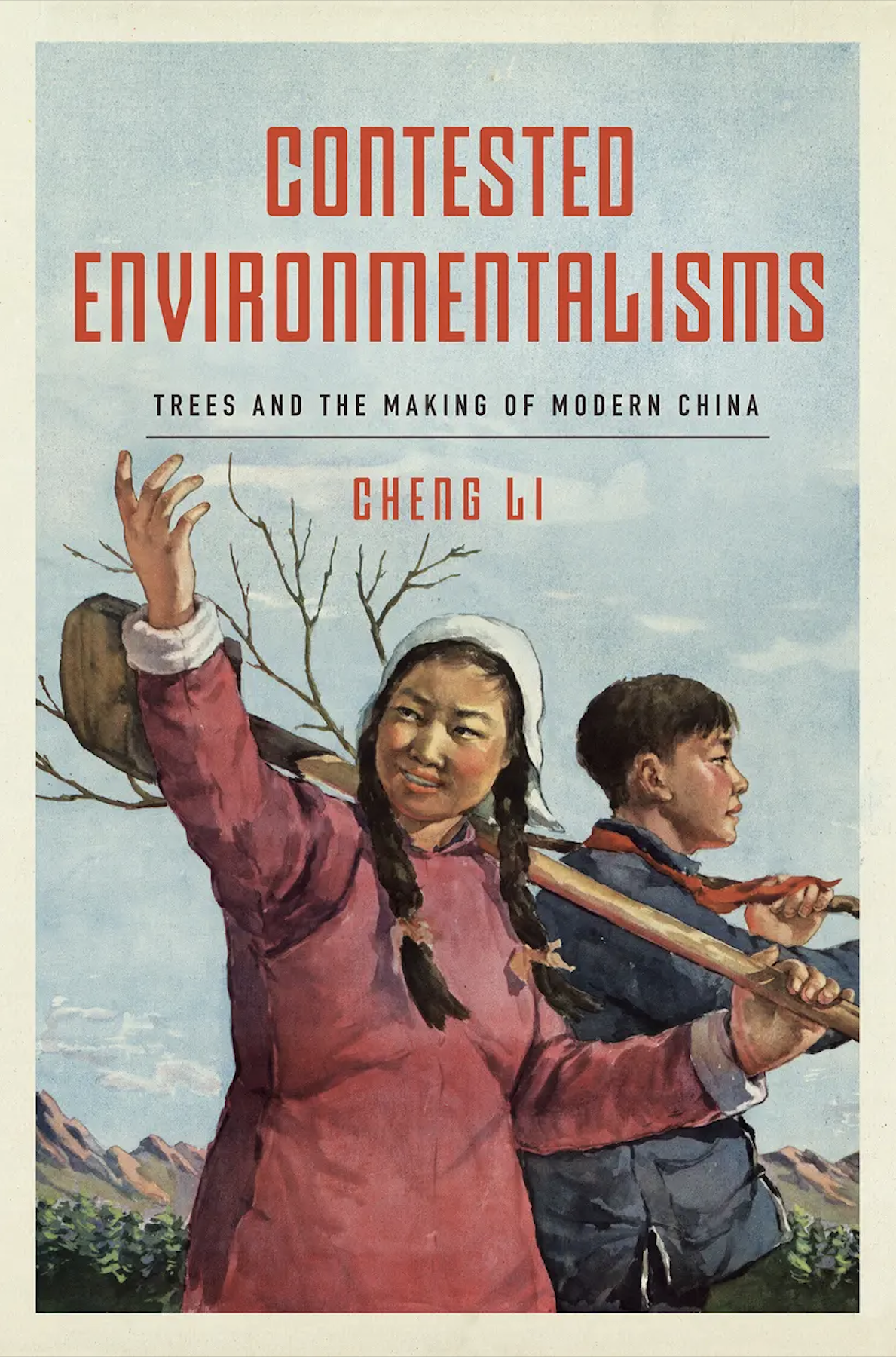
Cheng Li. Contested Environmentalisms: Trees and the Making of Modern China. Stanford University Press, 2025. 294 pgs.


When one considers Chinese thought about the natural world, fengshui (a set of views on the arrangement of the natural and built environment) readily comes to mind. According to tradition, wealth, prosperity, and happiness would come to those who observed its precepts. Throughout classical literature, poetry, and philosophical texts, trees have long served as metaphors and as symbols of moral and political teaching. Cheng Li’s Contested Environmentalisms, a substantial and meticulously researched academic work, examines how trees and forestry campaigns have shaped Chinese conservation and political culture from the early twentieth century to the present. The book also reveals how elements of traditional thinking about nature, and about trees in particular, persist in the background.
Li argues that Chinese environmentalism is defined by its flexibility, adaptability, and inherent contradictions. Rather than embodying a single, unified ideology over time, trees in China represent simultaneous and competing imperatives: they must be protected and treasured, yet also efficiently exploited for nation-building and industrial development. Hence the “contestation” between these two poles. Li demonstrates that conservationist ideas acquired political and cultural power precisely because they could be endlessly adapted to serve changing governance policies, political campaigns, and shifting global-local dynamics.
The book comprises an Introduction, five chapters, and a Coda, spanning the Republican era and the Mao period through to the contemporary Xi Jinping administration. It draws upon a vast range of sources, including official archives, school textbooks, films, novels, and digital data.
In the Introduction, Li offers several explanations of how trees can be simultaneously exploited and protected in the service of the nation-state. Exploitation and conservation are regarded not as mutually exclusive, but as equally necessary for modernisation. Li asserts that “contestation endows Chinese environmentalism with its vitality and tenacity”. Because the language surrounding tree planting is highly flexible, it furnishes a rich “cultural repertoire” capable of accommodating these contradictions. Environmental ideas can therefore be repeatedly redefined and repurposed across different political eras and for different social groups to suit varying needs. Moreover, as the chapters of this book demonstrate, trees can be many things at once: a romanticised locale, a militarised zone, an economic resource, or a site that draws the populace together. Trees thus function as metaphors.
Chapter 1 addresses the Republican era, exploring early tree-planting initiatives and contrasting symbolic national gestures with actual afforestation. It also examines the controversies surrounding tree planting, paying particular attention to the establishment of Arbor Day (National Tree-planting Day). Chapter 2 considers the shift between static and dynamic ecological models of nature from 1949 to 1961, focusing on disputes between the forestry and hydraulic administrations over the management of the Yellow River and flood control. Forests were felled in pursuit of rapid industrial production, yet this destruction occurred alongside Mao’s highly coordinated nationwide “Greening the Motherland” campaign (1956), which sought to popularise the scientific importance of afforestation among the masses. Both endeavours were framed as patriotic duties essential to building a strong socialist nation.
Chapter 3 analyses state-led afforestation within ethnic and border policies, which may be understood as a form of both bureaucratic and cultural expansion by the Han majority. In other words, it may be regarded as a “green Trojan horse” concealed beneath the guise of environmental conservation. Here, tree planting becomes a medium for “planting” and imposing ostensibly “universal” environmental values upon local ethnic groups. These “universal values” operate as an invisible form of political control. Promoting tree planting in harsh environments thus indirectly legitimises ownership of the land.
Chapter 4 turns to literature and science fiction from the 1960s to the 1980s, in which forests were framed both as romantic ideals and as perilous landscapes harbouring political enemies (the “militarised forest”). A military mindset also plays a role in promoting the protection of trees and forests, suggesting, somewhat paradoxically, that the Communists’ efforts to preserve forests involve the elimination of threatening human adversaries. Chapter 5 examines the tensions between native traditions and imported Soviet or Western conservation frameworks, as expressed through ecological science and the Chinese conservation literature of the 1980s (“the Great Green Awakening”). In this chapter, Li contrasts two strands of post-Mao conservation writing: the inward-looking “green nativism” and the outward-oriented “green Occidentalism”.
Finally, the Coda explores contemporary consumer and digital environmentalism through Alibaba’s Ant Forest app, illustrating how modern arboreal campaigns sustain the state’s long-standing role in fostering civic responsibility, now through digital technology.
Ultimately, Li convincingly demonstrates that environmentalism under authoritarian rule in China endures not by enforcing a single, comprehensive ideology, but by occupying the space between shifting ideology and evolving thought and practice, particularly where contradictions operate in concert to sustain state power. “Contested environmentalism” is an apt description of this dynamic. Extensive endnotes and references, together with a diverse range of sources, make this a valuable academic work that shows how environmentalism and changing attitudes towards the natural world can affect wide-ranging aspects of a state.


How to cite, Eagleton, Jennifer. “Green Trojan Horses: Trees, Power, and the Chinese State in Cheng Li’s Contested Environmentalisms.” Cha: An Asian Literary Journal, 27 Sept. 2026. chajournal.com/2026/09/27/contested.


Jennifer Eagleton, a Hong Kong resident since October 1997, is a close observer of Hong Kong society and politics. Jennifer has written for Hong Kong Free Press, Mekong Review, and Education about Asia. She has published two books on Hong Kong political discourse: Discursive Change in Hong Kong(Rowman & Littlefield, 2022) and Hong Kong’s Second Return to China, A Critical Discourse Study of the National Security Law and its Aftermath(Palgrave Macmillan, 2025). Her poetry has appeared in Voice & Verse Poetry Magazine, People, Pandemic & ####### (Verve Poetry Press, 2020), and Making Space: A Collection of Writing and Art (Cart Noodles Press, 2023). [All contributions by Jennifer Eagleton.]