
茶 FIRST IMPRESSIONS
茶 REVIEW OF BOOKS & FILMS
[REVIEW] “Mommy Makes the World Go Round: The Boy and the Heron v. When Marnie Was There” by William Carlo Antonio Sanchez
Click here to read all entries in Cha
on The Boy and the Heron.
❀ Hayao Miyazaki (director). The Boy and the Heron, 2023. 125 min.
❀ Hiromasa Yonebayashi (director). When Marnie Was There, 2014. 103 min.
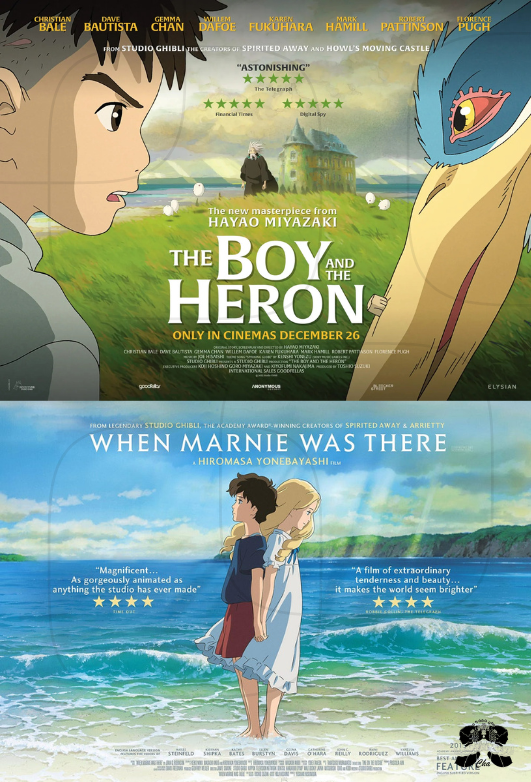

Mommy and daddy issues are inherently cinematic. A parent is a child’s first teacher, as the saying goes. So, picture the drama when a parent fails to fulfil that duty, or, to be even more dramatic, doesn’t live long enough to get a chance to (spoiler alert!). Combine that strong narrative potential with the award-winning animation and voice acting of a Studio Ghibli film, and you get two heartfelt, soulful Ghibli stories worth exploring.
Stepmommy makes the world go round
Stop me if you’ve heard this premise before: a quiet, emotionally withdrawn child is sent to rural Japan to recover from recent traumas. There, they quickly find an abandoned structure populated with supernatural forces tied to their rather complicated family history. Through these encounters, the child enjoys much-needed time with lost loved ones, but makes peace with the fact that there is no changing the past and, thus, returns to reality with a much more hopeful outlook on both life and death.
If you’ve identified the above as Hayao Miyazaki’s Academy Award-winning The Boy and the Heron (2023), you’d be correct. It makes sense; it came out not that long ago, was in awards contention almost immediately, and of course, it’s Miyazaki! In his most heartfelt, most autobiographical outing yet! Despite all the praise over the years, I’ll be honest enough to admit that I did find it overstuffed.
Most reviews point to its dreamlike, surrealistic fantasy world as its biggest strength, in the sense that it feels like anything can happen, anything. First, it’s talking birds, then talking frogs, giant fish! Whoa, that’s one tall tower. Look at how colourful those parrots are!
In some alternate universe out there, however, there’s a stripped-down, more laser-focused version of the film. Despite emphasising the heron in its title, the film’s emotional core is actually the protagonist Mahito coming to terms with his mother’s untimely death and learning to embrace love from his aunt and now stepmother, Natsuko. Don’t get me wrong, I actually understand why the film is structured as it is; it began as Miyazaki’s tribute to Ghibli co-founder Isao Takahata, represented as the powerful “Granduncle” figure. Takahata’s unfortunate passing in 2018 made it emotionally difficult for Miyazaki to continue the film’s original arc, hence the clear pivot in the final version.
Somewhere out there is a version of The Boy and the Heron that primarily explores more of Mahito’s dynamic with Himi, a pyrokinetic younger version of his late mother whom he meets in an alternate world. This would mean that all the captivating visuals are kept, but Mahito’s processing of his loss and, therefore, acceptance of a new life isn’t as abrupt as it is in the final film. As it stands, some underdeveloped elements remain, remnants from a world we won’t see.
Grandmommy makes the world go round
Funnily enough, Studio Ghibli’s Academy Award-nominated When Marnie Was There (2014) has almost none of the issues I’ve listed above. Comparison is the thief of joy, and in no way do I intend to prop up one film by bringing down the other. They’re both Ghibli films, sure, but they have different crews, casts, and definitely different source materials. Still, that premise from earlier? A quiet child, rural Japan, supernatural family? It fits Marnie perfectly too.
A coming-of-age psychodrama, When Marnie Was There follows Anna, a shy 12-year-old sent to live with her stepmother’s relatives after an asthma attack at school. “For a bit of fresh air,” says the doctor. It’s from here that the film reveals its true nature as a ghost story, when Anna quickly discovers a mysterious mansion with a young blonde girl inside, the titular Marnie, who later turns out to be, spoiler alert, the spirit of Anna’s long-dead grandmother.
Every set-up has a payoff, every prop serves both character and plot progression. For example, Anna’s sketchbook isn’t just to say, “Oh, she loves drawing.” Rather, it becomes a symbol of her unspoken identity crisis, the kind she’s had since discovering the stipend her foster parents receive for taking care of her. Throughout the film, Anna has a problem with people looking at her work without her consent, and understandably so. Anyone who’s ever created something out of passion knows that the resulting work is basically the truest part of your character, and to have that work be seen is to basically be seen yourself.
So, when Marnie takes the sketchbook and praises Anna’s drawings, it’s impactful. When Anna hence feels seen, and safe, for the first time in the whole film, it’s impactful. When all this leads to Anna making peace with her tragic heritage and accepting her new family, believe me when I say, it’s impactful.
The film does a phenomenal job of maximising every element it has, to the point that whenever Marnie’s not on-screen, you feel it. It achieves this through animation and achingly quiet background scores that highlight just how lonely and socially exhausted Anna is without Marnie. You find yourself asking: Where’s Marnie? What happened to her? Wait, was that her? I could’ve sworn it was her. When’s she coming back? Oh God, oh God, will she even come back? Marnie, please, please come back!
This hits even more when you consider British author Joan G. Robinson, who wrote the 1967 novel on which the film was based. Her story, also titled When Marnie Was There, was inspired by her own troubled relationship with her mother. Some could say that knowing a creator’s intentions is never needed to understand a piece of work and, in fact, we consume most media without knowing why that media exists at all. Still, in this story’s case, I’d argue that knowing why doesn’t just enhance the narrative, no; knowing why completes it.
Mommy makes
the world go round
To successfully explore a theme as complex and sensitive as parental longing is a feat. To do it twice is a landmark achievement, not just in animation, but in storytelling as a whole. Mommy and daddy issues are, and always will be, cinematic. Still, every now and then, you need a talking bird, or two. Maybe a frog, a fish, colourful parrots while you’re at it.
You need a tower, a mansion, maybe bearded granduncles and blonde little ghost girls. Ghibli proves it: whatever the tale, whatever the medium, first you need an idea. From there, you’ll need heart and, above all, you need soul.
How to cite: Sanchez, William Carlo Antonio. “Mommy Makes the World Go Round: The Boy and the Heron v. When Marnie Was There.” Cha: An Asian Literary Journal, 23 Sept. 2026. chajournal.com/2026/09/23/mommy.


William Carlo Antonio Sanchez is an aspiring novelist and lifelong horror fan from Butuan City, Philippines. His surrealist poetry and prose have appeared locally and internationally, notably in The Archipelago Press (California), Voice & Verse Poetry Magazine (Hong Kong), CultureCult Magazine & Press (India), TAKÓS: An Anthology of Gendered, Queered, Literary Genres, and Heritage Youth in his home country. He graduated magna cum laude with a BA in Communication from the University of the Philippines Cebu in 2024 and currently works full-time as a layout artist and production staff member at Father Saturnino Urios University. [All contributions by William Carlo Antonio Sanchez.]

