
茶 FIRST IMPRESSIONS
茶 REVIEW OF BOOKS & FILMS
[REVIEW] “Between the Rabbit and the Not-Rabbit: Yoo Heekyung’s Surrealism in Winter Night Rabbit Worries” by San Kwon
Yoo Heekyung (author), Stine An (translator). Winter Night Rabbit Worries, Ugly Duckling Press, 2026. 80 pgs.
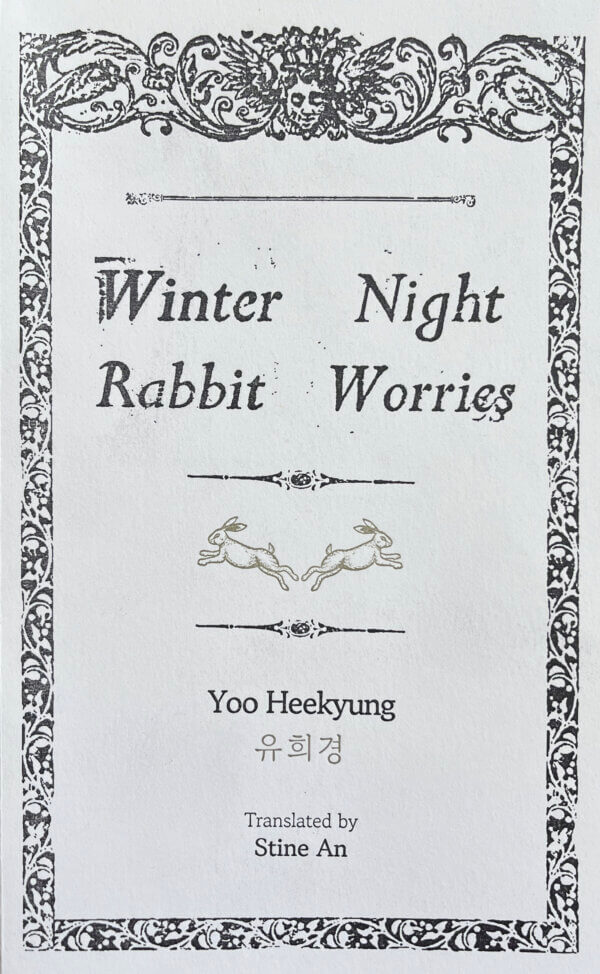
First published in 2023, Yoo Heekyung’s poetry collection Winter Night Rabbit Worries is now available in English, translated by Stine An. With the exception of one poem, every poem in the collection takes the form of a “Story,” the majority of which are written as prose poetry. In describing the nature of his stories, Yoo writes in his last poem “Story—Unwinding” that his stories “are just stories and aren’t stories, aren’t anything at all.” By this, he means that barely anything actually happens in them. And yet, they are nonetheless able to induce trance-like wonder in readers who are left to ponder what, exactly, they have just read.
This is the case, for instance, of the titular poem “Story—Winter night rabbit worries.” In it, the narrator looks out of the window and is unable to discern whether the “small white object” that he sees under the streetlamp is a rabbit or not. Yoo writes:
At that moment, I looked outside the window. Under a streetlamp, a dime a dozen and so dim, bordering on darkness as if better suited for startling someone, there was a small white object. I thought the object to be a rabbit. It was a rabbit and became even more still a rabbit, with long ears and red eyes, hop-hopping around. It was that kind of rabbit, I’m certain of it. […] The form of the rabbit with the eyes of a white pebble and the long ears of a bread bag sits still under the streetlamp, and so I become filled with doubt—it can’t not be a rabbit, it couldn’t possibly be a rabbit, could it—until at last—Everyone, that isn’t a rabbit, that’s no rabbit. But there’s no one around, and now it grows dark outside the window. I am so torn between the rabbit and the not-rabbit—I had even resolved to no longer stare out the window. But still, on bitter winter nights, when a stubborn wind visits to rattle the windows and you’re too chilled to the bone to fall asleep, when a night like this visits, I can’t help but worry about the rabbit—is it too cold outside, is the rabbit safe and sound—I get the urge to glance out the window.
End of story.
The grammatical logic of Yoo’s poems is most often agrammatical. In the case of the poem above, it is worth noting the subtle shift in tense. The story begins in the past tense (“At that moment, I looked outside the window”), yet towards the middle one finds that the tense has shifted to the present (“The form of the rabbit… sits still under the streetlamp…”). Upon realising the shift in tense, the effect is almost like waking from a dream: what had seemed so immediate mere moments before now appears to belong to a distant past. But the poem’s agrammaticality manifests not only temporally but also in the grammar of objects, as the title itself seems to put into play: where does the rabbit end and the worry begin?
Yoo’s stories are fleeting and elude domestication into sensible narratives. Indeed, the poems themselves feel like tender creatures that have been gracious enough to offer earthly readers a glimpse into worlds disjunct from conventional intuitions of time and space. One particularly striking poem in this respect is “Story—What isn’t repetition but exists immediately before repetition without repetition, something like the origins of repetition.” Even as the poem describes a different being, a black bird, it also seems to possess a creaturely vitality of its own, animated by a broad circular movement that brings its ending back to its beginning.
On top of the wall a single black bird sits He gazes at the bird He knows nothing of birds Just as he doesn’t know anything about life beyond the wall While he knows nothing of the black bird the black bird doesn’t fly away The morning light moves towards the black bird […] At this point the black bird must fly away He must then gaze at the empty wall And then he must draw his gaze The morning light slowly very slowly illuminating into a shape where the bird once sat It must then become an afternoon when the only thing remaining is his floor And yet the black bird doesn’t budge and the wall continues to be unempty and from the floor something black is crawling out The thing looks like a person or perhaps a bird and it is slow So slowly it is morning On top of the wall a black bird sits tirelessly He gazes at the bird
This poem exemplifies several traits common across the collection: the surrealist blurring of objects, bodies, and their backgrounds; the use of plain language reminiscent of bedtime stories; and, often, a kind of wittiness at the end that crystallises an image of an idea or a thought. Indeed, Yoo himself writes in the final poem of the book, “I think the black and white image is the final shape of the story.” Yet to compare stories to images is by no means to flatten them. Rather, the stories’ “images” seemingly contain pluralities within singularities, as one poem describes of shadows: “I couch down low / to count and count / a single sheet of shadow / as if it has many layers.”
There is also a kind of bizarre corporeality to many of Yoo’s stories. “Story—All of us victims of the especial shape we come in” narrates the transformation, or metamorphosis, of a character into a desk on a rainy day (“He became a desk, and it began to rain”), who laments the fact that he could not transform into an umbrella instead. In “Story—Full Moon in April,” Yoo writes, “The ear listens. The ear doesn’t speak,” something that would not be so odd were it not so literal. And in “Story—The Person Buried Under Books,” a person finds themself literally buried under books. Winter Night Rabbit Worries is fantastical precisely through its literalisation of words, in which words do not simply describe but are worlds.
Ultimately, not much really happens in the stories of Winter Night Rabbit Worries, at least in a conventional narrative sense. But of course, the same is true of many of the things that preoccupy and delight us in life: watching the sun set from a park, observing strangers pass, or even catching sight of a rabbit (or not-rabbit) on a cold winter night.
How to cite: Kwon, San. “Between the Rabbit and the Not-Rabbit: Yoo Heekyung’s Surrealism in Winter Night Rabbit Worries.” Cha: An Asian Literary Journal, 1 Jul. 2026, chajournal.com/2026/07/01/winter-night-rabbit.

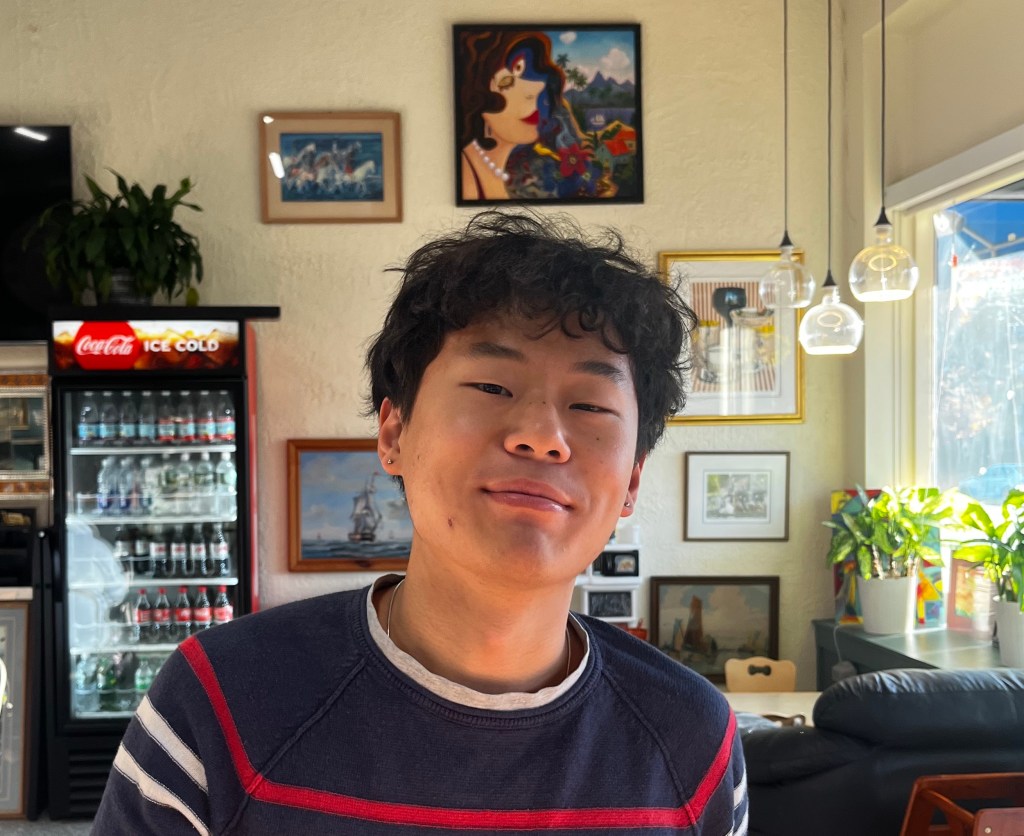

San Kwon is a writer and critic based in Ho Chi Minh City, Vietnam, where he contributes to the digital publication Saigoneer.
 Cha
Cha 