
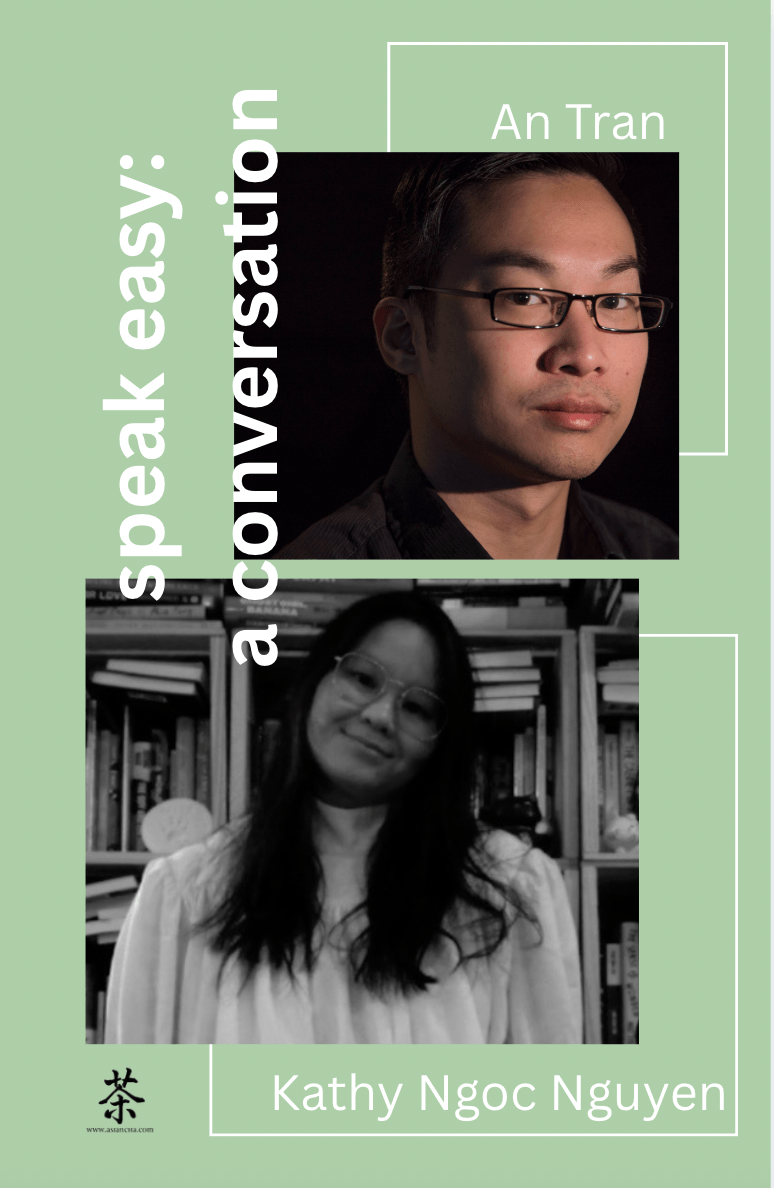
[CONVERSATION] “speak easy” by Kathy Ngoc Nguyen and An Tran
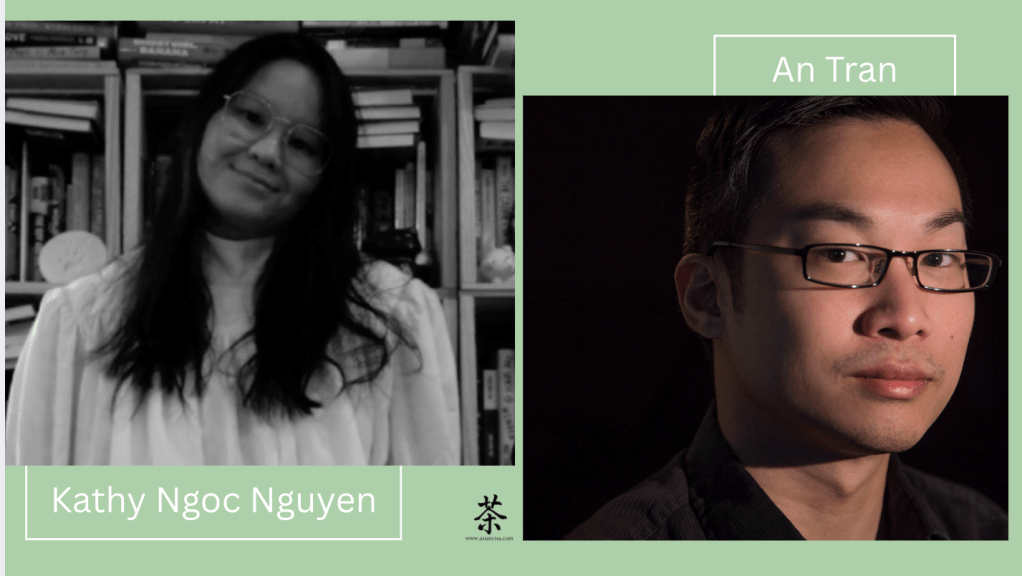
Kathy Ngoc Nguyen’s introduction: Before meeting and getting to know An Tran, I was a fan of his collection of short stories, Meditations on the Mother Tongue (C&R Press, 2017), twelve distinct stories that heighten sound and language. The titular story has since lingered and influenced my own writing and centring of feminist and queer hauntology in the diaspora during a time when dissertating felt isolating.
Much has been written about the diacritical changes and subtle intonations in the Vietnamese language, but it is perhaps An’s story, accompanied by my own disfluency in Vietnamese, that led me to read more closely into the tonal complexities of Vietnamese.
Ba was also the word for ‘three.’ Family members were seldom called by name; numbers had a magic property and every person had a designation. Bao was the older brother, called Anh Hai, or ‘the second brother.’ Phuc, Anh Ba, ‘the third brother,’ was two years younger. Bao had uncles and aunts he never learned the names of, only knowing them as Uncle Eight, Aunt Six, and so forth.
When the class arrived at the six variations of the word ma, Bao thought about how, in Vietnamese, the words for ‘mother’ and ‘ghost’ were distinguished only through pitch; the former was sang in high jubilation, while the latter was a despondent drone.” (9)
Years later, I met An at a writing retreat and continue to be inspired by his thoughtful, restrained yet complex approach in stories that complicate dualisms, fragmenting them into displaced, complex realities and language rendering: stories that still resonate, a collection that needs to be read. To this day, I regret forgetting to ask An to sign my copy of Meditations on the Mother Tongue.
An Tran’s introduction: When I first read Kathy’s work, I was instantly enchanted by her creative use of form and her attentive exploration of bilingual characters’ interiority through their sensory experiences, and by her astute observations of all the ways in which language and sound transmute through the medium of the body into emotion, and vice versa. Her writing is fresh and daring, yet steeped in a nostalgia that persists throughout her work, and is able to capture the experience and trauma of second-generation immigrants in achingly vivid detail. I have been awaiting this chapbook’s release for a long while and am incredibly excited to discuss it, and her approach to writing and bilingualism, here.

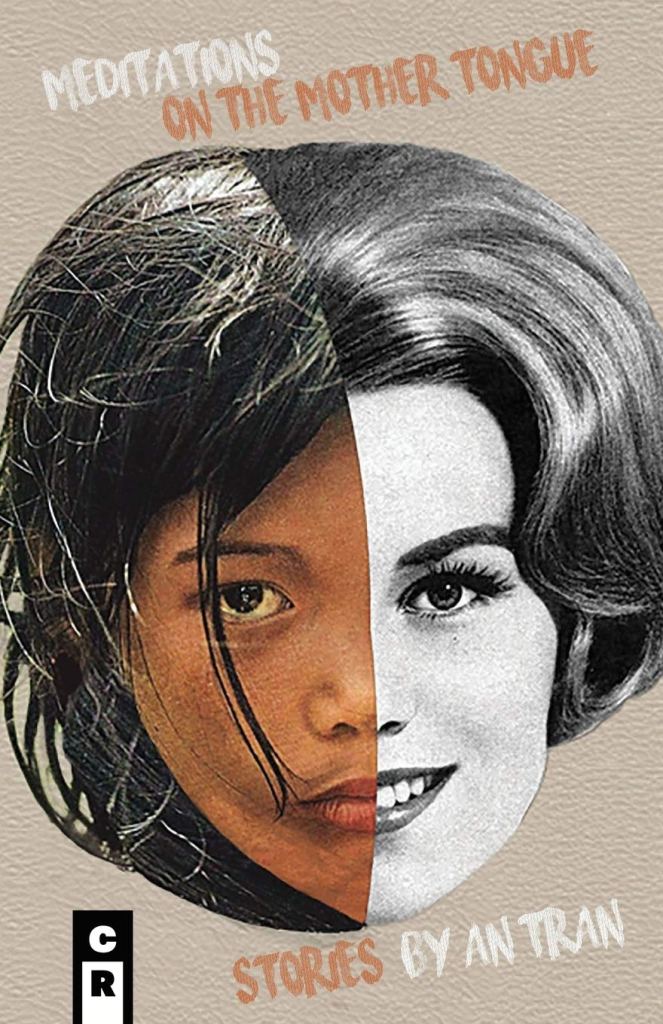
Kathy Ngoc Nguyen: A very rudimentary question that I’ve been meaning to ask but never had a chance to, because it didn’t feel organic to inquire about it then, when we first met. I’m still curious and want to finally ask: what inspired you to write such twelve distinct stories? The story begins with Bao and the difficulty in rolling and rendering Vietnamese, through to Lily’s experience of being deaf and never understanding why her father played records, until she “positioned herself on the ground very near to the speakers and felt upon her flesh a magical confluence of vibrations, the bass, in short staccatos, reverberating through the hollow of her spine and the harmonics of the treble licking at her skin like static shocks” (p. 59).
Tonal shifts, whether in and through sounds or language, permeate your writing. Do they somehow symbolise the loss or alienation of language, or your own bi-multilingual experience?
An Tran: Yes, I’ve always felt the through-line for all the stories in this collection has been different ways of expressing what my experience with multilingualism has been, and using different imagery to symbolise what my relationship to Vietnamese specifically was like in my twenties, that is, nearly evaporated entirely, only able to grasp at meaning in incomprehensible bits.
When I wanted to represent in imagery the dislocation I felt between myself and my father, a man who seldom ever speaks a word to anyone, the story of Lily and her father arose out of the complexity of those feelings. The deepest moments of connection I think we have ever shared have been through the transmission of bits and pieces of his family’s martial arts lineage, which he was able to pass down to my siblings and me, largely without speaking; Lily’s understanding of her father’s love of music through physically feeling harmony vibrating in her bones was a mirror of this, this moment of deep and visceral connection with someone you love, whom you cannot communicate with, whom you can only ever interact with through bodily movements, gestures and facial expressions.
… for many, many years I had been deeply ashamed of being Vietnamese, and that I had whitewashed my identity.
The title story became the collection’s title because each of these stories, for me, reflected in some form the messy, complex, contradictory feelings I had in relation to the Vietnamese language and, in turn, my feelings about my Vietnamese identity. Most of these stories were written in my early or mid-twenties; I had just become an adult, and, I honestly don’t remember what had instigated this, but I had suddenly come to the realisation that for many, many years I had been deeply ashamed of being Vietnamese, and that I had whitewashed my identity. I had taken on this foreign, Western name like a mask (“Andy”) because Americans cannot pronounce my actual name (Ẩn), and I had almost completely lost my native language in the process.
The stories in this collection served as my process of working through that realisation, and of finding a way to balance and harmonise the dual consciousness of being Vietnamese American. I thought that if I could translate these really complex feelings into imagery, into these narrative scenarios, and then thrust parts of my psyche into them, I could gain some insight into where that shame was coming from and how to heal it. I think most or all of the stories end right at a critical moment of insight for the protagonist; they have a sudden flash of insight into what has been causing all the tension in their lives, into their inner turmoil. I wanted the stories to feel like meditations for the reader, because for me that is what they were: meditations on Vietnamese language and identity, on what it should mean for me to be Vietnamese when I have largely been unable to speak the language.

An Tran: How did this work for you? I think we have both centred a lot of our creative writing on our relationships to the Vietnamese language, and you are able to occupy that space of a bilingual mind in translation really well. Kirstin Chen is another writer who I think does this incredibly well, where you write from that space in between languages; even the narrative voice is not quite inside or outside the character. You are able to telegraph information to the reader that is not possible if the characters were not bilingual, and you are able to move a narrative forward just by showing how a character has to approach translating for certain family members, and the decisions a person might make in the process of translation. Can you speak a little to how you approach bilingualism and translation as literary devices in your work, and what it is in your relationship to the Vietnamese language that motivates your approach?
Kathy Ngoc Nguyen: I might have had a different, or similarly shared, experience with Vietnamese, even if minute. Do you remember the Azn Pride era, or movement, during the late nineties to the early aughts, when the Internet became branches of subcultural forums and threads? There was a brief, intense period when my older brother was very immersed in Vietnamese, and more broadly Asian, culture, and his immersion transferred over to me, enveloping me in it. At that time, I did not understand it was about Asian Americans building communities to simultaneously contend with and navigate their ethnic identities while intimately rediscovering Asian cultural spaces. In my own naive way, I prioritised the visual aesthetics and sounds of Asian pop culture.
… and to this day I desperately grasp onto Vietnamese because it is my parents’ native language.
During that time, I listened to a lot of Vietnamese music, and still do occasionally, if only to hear Vietnamese spoken whenever I do not speak it much. In a way, I felt that listening to Vietnamese music, or watching Hong Kong series dubbed in spectacularly clear Vietnamese, something I often reference in other pieces, retained my Vietnamese, and to this day I desperately grasp onto Vietnamese because it is my parents’ native language. There is a fear of losing it, or of either witnessing it regress into functional fluency or not being able to speak to my parents at all because of their limited English fluency, which exacerbates that innate fear of inhabiting a familial silence and language loss. Who wants to inherit that silence?
Much like your writing, language, and being bilingual, creates tension, whether inward or outward, physical or emotional. I weave both, often describing the difficulty of forming certain vowels or words in Vietnamese because it does not come naturally sometimes. My parents always relied on my siblings and me as interpreters because there was no one else, and professional interpreters were not readily available for doctor’s appointments; I think there was also a distrust of discussing medical issues and records outside the family, so we were constantly present, translating and interpreting. These experiences become ingrained whenever I communicate.
I found myself, and still do, in constant translation mode: if my parents said something in Vietnamese, I would inwardly process it into English for clarity. English dominated my mind, and I recognised that and feared language attrition. That fear remained when I relocated to Texas during my doctorate, where English dominated my tongue and mind. But whatever I experienced or observed, I would translate it into Vietnamese and call my parents to tell them about my day. It was an automatic, forced process. In some conversations I noticed how stilted things got, particularly my Vietnamese. Although my parents thought, and think, my Vietnamese was fluent and clear, I noticed my register in Vietnamese has a minute change in inflection whenever I speak it with strangers. My voice sounds hesitant, much more uncertain, but it sounds almost crystal clear, according to my mother, when I am conversing with family. Those noticeable changes in inflection feel jarring, and they disorient me; a familiar language spoken since childhood suddenly becomes unfamiliar.
Mistranslations are recurring and omnipresent in my writing, and in the minutiae of life. These days, when I speak with my mother, we are constantly asking each other how to translate a word into Vietnamese or English; that is just a part of our conversation, not the entirety, but to me it feels stilted on my end. One of my favourite Vietnamese songs, and song titles, is “Hai Lối Mộng,” which, reduced into transliterated English, means “Two Dreams, Two Paths.” I referenced it in one of my short stories, “Tender Raging Love: A Requested Playlist.” Once it was published, I read-sang it in my most terrible, dramatically off-key Vietnamese karaoke voice, then slowly read out how I had translated the referenced lyrics into English to my mother. She informed me it was decent enough but sounded a bit too simple for her liking, then asked, “Doesn’t mộng mean dreams?”
For some reason, I had translated “Giờ hai lối mộng hai hướng đi” as “Now, there are two paths, two directions” instead of “Now, there are two dreams, two directions.”
She asked, “Why did you repeat yourself? Paths and directions are essentially the same.”
“Isn’t reduplication used in Vietnamese for emphasis?”
Her response: “Yes, but I thought you knew mộng means dreams. It’s the song’s title.”
“I didn’t take it literally. I thought the title meant two differing directions, or something akin to disillusioned paths.”
Her final verdict: “You’re partially right, since that’s the story being conveyed, but you’re focusing on each individual word. Actually, that might be your issue: you’re not reading the entire context but choosing to process each word rather than thinking about the context as a whole.”
“Dreams can also be translated as chiêm bao or giấc mơ, yes?”
“Yes, there might be a lot of Vietnamese words to choose from for a single English word. But you still translated that part wrong.”
It is a perpetual conflict between attempting to avoid transliteration and forgetting or mistranslating.
It is a perpetual conflict between attempting to avoid transliteration and forgetting or mistranslating. That one conversation with my mother revealed the tension within my own grasp of how Vietnamese is analytic. It should be simple, yet I never realised I was always translating each word based on my limited ability to fully grasp and comprehend how I should focus on the flow and compound of words to attempt a more accurate translation. It is that precarious bilingual liminality that became a focus in my writing. I really focus on the fears of attrition and mistranslation because I believe I mistranslate more than I translate accurately, since I am either too transliteral or mistranslate the nuances in favour of a simple context that makes sense to me.
I am practically useless when challenged with English medical terms, and can only describe symptoms with superfluous imagery that confused my parents. This tired, stiff tongue reappears in two stories in my chapbook: in “Speak Subtitles, Hear Dub,” where one character gives up her Vietnamese, allowing English to dominate her tongue; and in “Anatomy of an Insomniac,” where a character forces herself to stay awake to closely listen to and monitor her father’s movements so she can take care of him, while also obsessing over clear dubbed voices in Hong Kong films. Throughout the night, she guiltily recognises how she speaks in translations to communicate with her father. This happens when Sam tries to translate a Hong Kong actress’s name, stringing out each word individually in Vietnamese, confusing herself and her father in the process.
The tensions between inward translation, materially sounding it out, and its bodily impact are images I return to, mainly because of what I witnessed when my father gradually lost his voice after his stroke, and a surgery that never allowed him to recover. It is probably a linguistic haunting that I feel looms over me. Language is lonely.
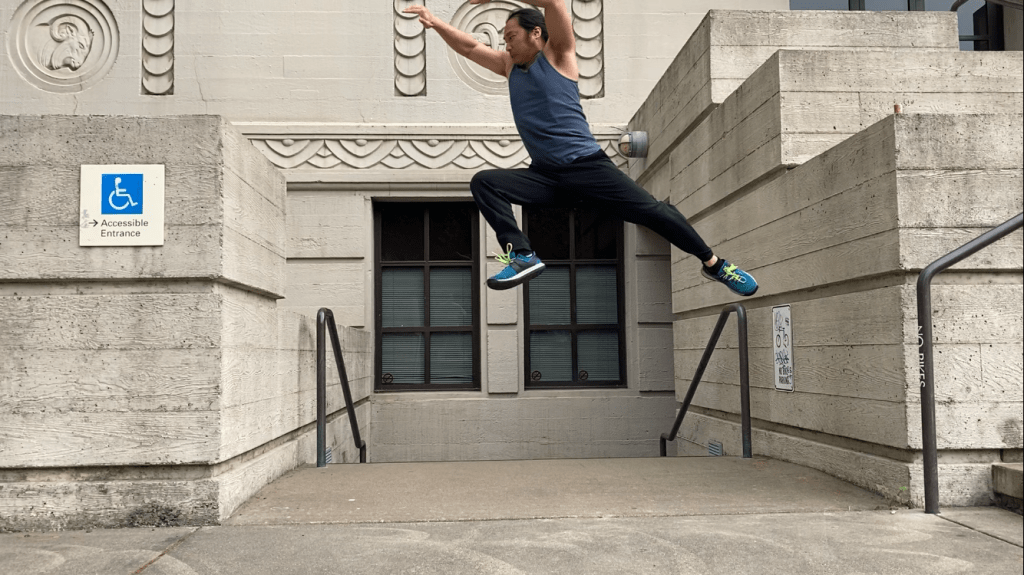
Kathy Ngoc Nguyen: Since getting to know you, you’ve referenced and written about parkour quite a bit, being a parkour athlete yourself. At the writing retreat, you also gave a demonstration in martial arts, which was a highlight for me, because I am always in when it is martial arts related. Going back to the story “Meditations,” Bao is in awe when watching the documentary Parkour: Generations, because one person is speaking in Vietnamese while he ruminates on losing his Vietnamese. These brief moments are vivid to me. I am reminded of scenes from wuxia series and films where opponents silence themselves, not speaking to each other, in order to meditate, inwardly concentrating on mapping and imagining attacks that would accurately inflict injury or death. While not similar to those cinematic extremes, your writing frames corporeality and linguistic liminality, focusing on descriptions where the body willingly exhausts and physically limits itself to retain and return. It feels like constant movements of navigation, only to be stalled by stilted language. Can you speak about that? Do you think there was a focus on centring the intense physicality of parkour and its connection to the strains of language?
An Tran: The descriptions of Quinn losing her Vietnamese in “Speak Subtitles, Hear Dub” were really visceral for me, because they echoed so profoundly my own experience, an experience common, I think, for many second-generation immigrants. You know that you are losing something important, something that connects you to your ancestors, and it can feel like a process you are unable to stop once you realise it is happening. When you wrote, “Language can’t return after years of neglecting it. The tongue hardens when linguistic patterns become unfamiliar,” I felt that like lead dropping in my gut.
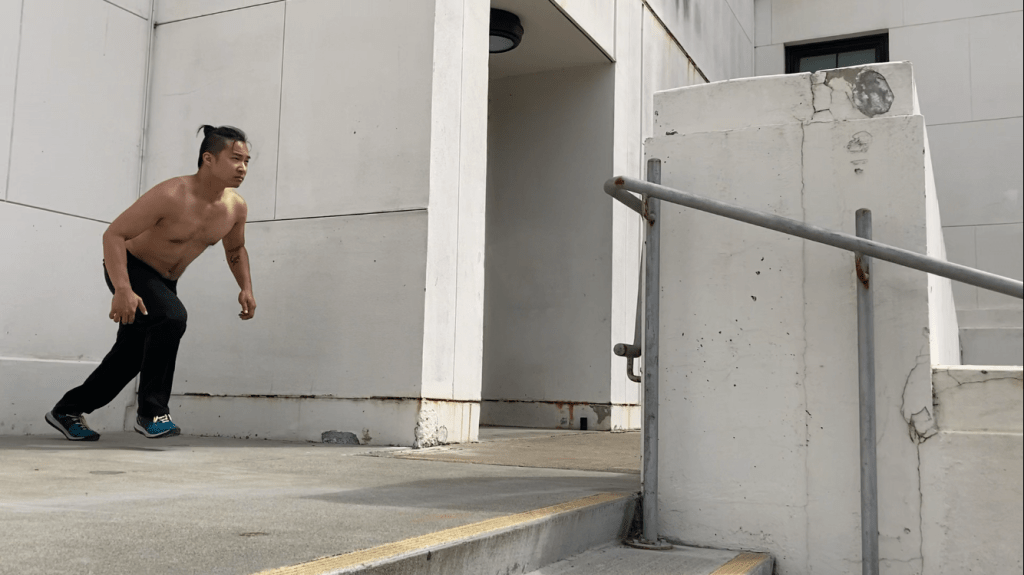
With “Meditations,” I was also writing around this theme of language loss. I was one of the early adopters of parkour in North America, and always had an idea for a story in which the protagonist has this deep sense of alienation from his Vietnamese identity, and perhaps grasps through parkour at this tertiary connection to that identity, because half of the core founders were of Vietnamese descent. When Bao discovers this, he senses that the training of his body to move in their likeness can be a sort of expression of ancestor worship; the way that martial arts, Buddhism and similar practices are transmitted in Vietnamese culture is deeply woven with the folk practices of ancestor worship, and parkour is also like this for Bao. But in the same moment that he discovers this connection to his Vietnamese heritage in his parkour, he also discovers that he has lost his Vietnamese. And when he tries to express this to his mother, he lacks the language capacity to do so, and she is unable to understand what he is trying to communicate to her. It is in the final act of the story, in this bodily gesture and cultural language, of bowing to the ground, making the body fixed at a single point, that the built-up tension between Bao and his mother’s failures to communicate is relieved. Movement and gesture are languages too, and can communicate where speech fails.
… we believed everything could be trained.
I had not intentionally thought of the wuxia and xuanhuan tropes of cultivation when writing the story, but a lot of it is actually embedded in parkour culture to begin with: we believed everything could be trained. If you failed a jump or your muscles gave out, you did a smaller jump hundreds and hundreds of times, pushing further and further, centimetre by centimetre, and in a few weeks you would have conquered the challenge. If you were having trouble with a tight sequence of obstacles, you might map it with your mind and visualise how the sequence of movements would feel in an embodied way, contemplating where to place each foot, how many steps to take, how much power to push into each bound and leap. Now it makes me wonder if any of those parkour founders of Vietnamese descent watched old Hong Kong wuxia films growing up, as we did.
You know, if this were a wuxia, I think you and I might be each other’s foils. I do remember the Azn Pride movement, and my experience of it sounds like an inverse of yours. It was my older sister, rather than brother, who got really involved in the movement, but this manifested through her involvement with the Vietnamese-centric street gangs of the era, which would eventually lead to some association with Vietnamese organised crime in the Mid-Atlantic. I was very young at the time, and did not understand that my sister was, as you note, learning to build community and renavigate Asian identity and cultural spaces. What I knew of it was incredible violence: tales of her friends being jailed, stabbed, shot or killed. So when I became a teenager, I did not want anything to do with my Asian identity, and the Azn Pride movement actually resulted in me feeling a deep sense of shame in being Asian. I threw myself into white-dominated spaces, got into metal music, and only allowed myself to express my Asian identity either at home or privately, with the one friend in my social circle who was also of Asian descent. He and I would go to a clearing behind my house and practise meditation and martial arts, or watch kung fu films and wuxia serials together.
You point out that there is a very imperialistic component to the dubbing of Hong Kong films and serials.
An Tran: You also bring up wuxia serials in “Speak Subtitles, Hear Dub,” with Quinn reflecting on the poor quality of English dubs we got over here, before she launches into a series of meditations on dubbing and language. You point out that there is a very imperialistic component to the dubbing of Hong Kong films and serials. At one point, Quinn even contemplates whether Cantonese will disappear as a language, when she realises the “original language” for a film she is watching on DVD is a Mandarin redub. In those brief remarks, you are able to show this tense relationship of global power through the competitive sphere of dubbing these cultural products of Hong Kong; it is not lost on me that Hong Kong, at this point in history, is still a colony of the United Kingdom. And in “Anatomy of an Insomniac,” you return to imagery of VHS tapes, VCR recordings, and Hong Kong action and wuxia films. I have noticed that you often evoke this image of audio-video media as language-liminal sites. How are you thinking about recording technology and the relationship between language and the body when you are writing? How do you conceive of analogue media, like VHS and cassette, compared to digital media, like DVDs, when employing them as literary devices in your work?
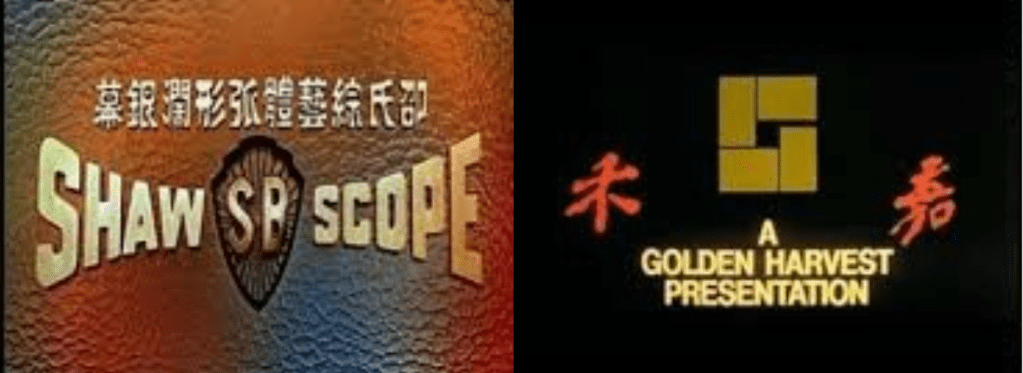
Kathy Ngoc Nguyen: Some of my earliest cultural and language-liminal encounters began at home. Fixed in a sedentary position on the sofa, consuming them for hours like Saturday morning cartoons, my family used to constantly watch dubbed martial arts films produced by Wu Tang, Shaw Brothers and Golden Harvest, wuxia films, Bruceploitation films, Asian wuxia serials (TVB productions being preferred at one point), and Hong Kong action and triad films produced during the eighties and nineties. The earlier films were horrendously dubbed in American voices, where characters, both men and women, either had very high-pitched modulations or comically, racially exaggerated deep voices (women especially), or were professionally dubbed by familiar Vietnamese voice actors from the 1980s to 2000s whom I grew to recognise.
For the longest time, I watched Asian films based on my parents’ audio preferences, which were almost always in Vietnamese.
For the longest time, I watched Asian films based on my parents’ audio preferences, which were almost always in Vietnamese; if Vietnamese-dubbed versions were not available, they would watch the lesser-quality English dubs. Regrettably, after his death, I realised I never asked my father what his audio preferences were, but my mother made it loudly clear that it was either Vietnamese dubs or English dubs, because she refused to listen to a language she was not, and never would be, familiar with, or to attempt to read subtitles, because it is too difficult to follow.
You also briefly but effectively do this in “Meditations,” where Bao covers the subtitles; there is an intertextual relationship with the body and how it perceives language that feels disorienting. I referenced this in “Speak Subtitles, Hear Dub,” where the mother cannot adapt to subtitles because they appear and disappear too quickly for her to grasp. For that character, even with her limited English fluency, “the very least I can do is listen and try to process,” which parallels Quinn’s own experience of letting the colonial language dominate her tongue, replacing her parents’ native language. When writing the story, what did you see as the differential impact between a character who willingly displaces their native language in favour of linguistic assimilation, and another who understands the connection between colonial languages and survival?
When I was writing “Anatomy of an Insomniac,” I wanted to focus on eye movements and strains. Indeed, the chapbook as a whole really focused on specific body parts, to centre the horrific, traumatic ways in which multiple organs gradually fail after a stroke retraumatises the body. I originally wanted the subtitle to be “Family Parts,” but that sounded too macabre; the story ended up being an intimate meditation on grief and multiple losses that feels anticipatory while the family witnesses the father and husband losing his voice and mobility. This image has stayed with and haunted me, because of what my father went through during his second stroke. To lose not only your mobility but your voice, and to have to rely on family to interpret you based on your reactions and actions, restricted by your disability: this image serves as a reference in the story, where Sam watches a girls-with-guns Hong Kong film that her father had taped on VHS, and remembers her obsession with Vietnamese dubbers while also contemplating the connection between violence and language.
Fluency does not mean you are articulate; perceived fluency can sound regionally jarring to others.
It is this ventriloquist interaction with the media that serves as the ambiguity of language, as if the tongue stills itself into stiffness as the body maintains a distant contact with a language that is either forgotten or spoken somewhere between stilted fluency and inured disfluency. You obsess over the voice so much that you do not recognise the dubber, the speaker, or the face. Some characters are just distantly imitating voices in order to communicate again. I think that is why Chris, my editor, formatted the dialogue in a font that mimics those used in international films, where the options are subtitles with the original language, the original language itself, or dubbing into several languages. Fluency does not mean you are articulate; perceived fluency can sound regionally jarring to others.
There is that existing disconnect between the body and the voice that is difficult for me to reconcile, which is probably why I focused on detailing, like medical notes or charts, the difficulty of describing the body in pain. A question hospital doctors and rehabilitation therapists asked my father every single day was, “How is your pain today, on a scale from zero to ten, with zero being none and ten being the worst?” I found myself haltingly interpreting that question for him and then answering on his behalf. But how does a numerical scale balance the weight of constant pain and bodily trauma after a stroke? Medical professionals were always looking at my father, searching, while he was unable to speak, his voice never recovering. At a distance, you could hear my voice speaking for him, on his behalf, while his lips visibly moved.
Of course, it is inevitable that all technology will upgrade and update itself, converting into the most current, dominant, “versatile” format, because, like language, material items will become lost in time. But I often return to nostalgic images of VHS tapes, because I have such vivid memories of my father using old tapes, or newly purchased ones from Walmart, to copy, or dub over, films or wuxia series so the family could enjoy rewatches. There was an entire industry that capitalised on this, until it faded from memory once media could be streamed, or once people willingly purchased pirated DVDs because they were much cheaper. Pirated copies may be the only opportunity for people like me and my mother, who prefer watching TVB series dubbed in USLT, or by Vietnamese dubbers from California.
I briefly mention this in “Anatomy of an Insomniac,” where dubbing technology feels like a replayed, interminable loop. This references how some second-generation Vietnamese children born in America interact and speak in Vietnamese only with family and friends, but these interactions are limited within the family; parents often bring home VHS tapes, cassettes, DVDs and CDs for their children to minimally interact with and engage in. Nhi T. Lieu writes about this: how music “provided solace for the exile community” and how “the audiovisual capabilities of the [VCR] changed people’s relationship to these cultural forms.” It somehow records, archives and perceives a sense of ethnic identity, for the sake of parental or genealogical nationalism. But this, too, feels isolating. What gets lost when voices and stories are endlessly dubbed, redubbed and dubbed over so many times? And then what happens when that language gets lost? They eventually disappear over time unless replayed somewhere in the present, and even then it is rendered obsolete.
What is the language for loss when nothing but silence is heard?
Kathy Ngoc Nguyen: Speaking of pain, like several writers, grief and loss are palpable in our writing and stories. Rereading your stories again, I am struck by how your writing oscillates between intense isolation and withdrawal between continents, and melancholic reconnection to identity, non-humans and objects. In “The Golden Turtle God,” Mr Le returns to Hanoi in search of a mythical turtle. The images you evoke, such as how the lake “had become noxious in its pollution,” parallel Mr Le’s grief, how he witnessed his wife dying of cancer and how it changed her body until her death, while biologists “worked to restore the creature’s health.” Then “old broken toys” become material and immaterial residue after a mother’s death in “Extinction with Residue Remaining,” and Binh’s frustration that his parents “didn’t love us or get to know us” produces the lines that felt most reflexive to me, simple but succinct: “They didn’t talk to us or tell us anything about themselves.” I was the opposite; I never asked my parents anything until my father’s death. Was there a focus on the language and non-languages of grief in these stories? Do you see any connections between translating grief onto non-humans and objects, and familial or cultural alienation and estrangement? What is the language for loss when nothing but silence is heard?
An Tran: “The Golden Turtle God” relates to the legendary story of Việt Nam’s final independence from China, in which a giant turtle emerges from Lake Hoàn Kiếm, gives a magic sword to a peasant, and that peasant leads a revolution and becomes the first king of the Later Lê dynasty. Are you familiar with this story? When I was in high school, I was really into cryptozoology: Bigfoot, the Loch Ness Monster, Mokele-mbembe and so on. In researching all these mysterious creatures across the world that may or may not have any factual basis, I came across this legend in Vietnamese folklore, along with a string of reports of people in Hanoi spotting the turtle, Kim Quy, over the past decades. But nobody really believed the turtle was real, and no one thought a creature that large could possibly live in such a polluted lake. Then, over the course of 2011, it suddenly began to be spotted frequently; now, for sure, the giant turtle god of Vietnamese myth was real, but the sightings were disturbing, the turtle displaying lesions all over her body. The government in Hanoi ordered her capture for medical treatment. That is when I started writing the story, becoming fascinated with this image of a legendary creature of folklore symbolising the very idea of the nation transitioning from the mythical to the material in an instant.
Mr Le was based on a man who used to work with my mother at a printing press for government documents outside DC. He had been a chemist in Saigon, but his degree was not recognised in the US, and so he now worked the guillotine and glue binder at that press. Our parents’ generation is locked into this nostalgia for a Việt Nam that no longer exists, and perhaps never existed; at the same time, they grieve the loss of the Republic as this mythical entity, yet are also very upfront about the rampant corruption and authoritarian oppression. With Mr Le, he returns to Việt Nam searching for this mythical turtle, a literal god, and there is a sort of false optimism in him that if he can see the turtle for himself, this grief could be overcome. America, for him, represents everything he has lost. The mythical turtle of Việt Nam returning brings hope that something lost can be restored. But while the mythical god is golden and pristine in our imagination, it enters the material world pockmarked with lesions, unable to escape the destiny of deterioration common to us all. Four years after the story was first published, Kim Quy died, the last known specimen of her species.
Our generation of Vietnamese Americans saw our parents carrying this constant grief with them, grieving the loved ones they had lost, the nation…
Getting back to your question, I think our generation of Vietnamese Americans saw our parents carrying this constant grief with them, grieving the loved ones they had lost, the nation, the sudden separation from their culture and language, always looking back toward Việt Nam like the surface of the lake, hoping this divine being would emerge to offer up a magic sword they could use to restore everything they had lost. My parents never communicated this grief to me, never really let any of us into their internal worlds, but you could see it weighing heavily on their spirits. I was absolutely there, putting into language the non-verbal grief that emanated constantly from my parents and their peers as I was growing up. I imagined Mr Le with the posture, mannerisms and speech patterns of the older generation that raised me, and the rest of the story manifested out of imagining what the interiority of that outward display of grief was like.
This leads directly into the final story of the collection, in which three siblings resent how that part of their parents’ lives had never been shared with them. At one point in the story, the siblings recount the stories Binh brought home of working with their father at the printing press; I do not think I intended Mr Le to be their father in writing this story, but both characters are based on the same person, and how their father was the workplace prankster, despite his stern stoicism at home.
A lot of these stories are like letters to my parents, trying to express things to them I am unable to say directly.
A lot of these stories, I suppose, are like letters to my parents, trying to express things to them I am unable to say directly. Here, I hoped they would get a sense of how painful it is not to know their parents’ interior lives or stories, other than through gossipy whispers from extended family and whatever material scraps of their lives they are hoarding in their basements. While the parents were still grieving the loss of their nation, their children were already grieving their absence. But even together, the siblings are not able to discuss the grief they experience; they fixate on their shared resentment verbally, but communally act out their grief through this archaeological project, excavating the contents of their parents’ home and packing everything into boxes. You might think for a moment that this is healing and cathartic, but when the time comes again for real intimacy, they are still stuck, unable to break through the silence to connect or comfort one another. There is just loss, silence, and three lonely siblings. We have this sense that if we can just overcome the language barrier between generations, we will be able to connect and love deeply and intimately, and everything will be magically resolved, but you can remove the language barrier and the family dynamics remain the same. The barrier preventing our families from connecting at a deeper level is not language; it is trauma.
An Tran: It is really interesting; I think your writing in Nonfluent Bodies, Switchable Tongues depicts characters who are much more skilful at negotiating this language barrier than my own characters, but it is still traumatic. In the title story, the final story of the chapbook, there is also this focus on material tokens of traumatic memory kept in drawers and closets: the boxes of the father’s belongings and a lifetime of his hoarding. You write of grief being hoarded in the body and in the home, “accumulated trauma that began in Việt Nam and continues now, here.” You then describe the mother as containing “decades’ worth of trauma, emotional scars, and pain that still blemish her body” and “remain untranslated.” I see this map you are drawing between unspoken trauma, the material medium of artefacts as a manifestation of trauma, and the body as the original source of that material manifestation, mirrored in the process of language and translation between generations. Can you speak a little about how you were thinking about the parallel structures between the unspoken-language, material-clutter, bodily-marks triad, and the family dynamic that emerges when the younger generation is forced into a translator role for the older generation?
Kathy Ngoc Nguyen: Despite the weight of it, and the negative connotation of a “bà tám,” I like the description “gossipy whispers.” The things my parents shared with each other, perhaps open secrets we never questioned, and with their friends, the fluidity of their exchanges, even if there was some resentment, pain or anger between each word, each line, are also themes I attempt to weave into my stories. I wrote a piece observing as a familial outsider, staring at ghosts and remembering when my parents would share stories about their past, the volume changing depending on what past was being retold. I described these interior and outsider conversations as “a few secrets that followed and haunted you two from there to here.”
Besides some untold familial secrets haunting the house we lived in, my father began collecting and filling his room, never anywhere else in the house, just the confines of his room, with miscellany. My first MSW internship was at a long-term and short-term rehabilitation facility for ageing adults with cognitive or physical decline. I reviewed extensive notes about long-term care patients and their hoarding behaviour, with some social workers visiting their houses and discovering instances of it. Perhaps because I had seen objects amassed in my father’s room, things he had purchased at thrift stores over the years, such as retro cartoon figurines, small toys or magnets, I do not necessarily think he was hoarding; however, it is a theme I find myself returning to in my writing. I once asked him his reasons for collecting random objects, but he would always deflect, never offering any clarity into his interior life.

I do remember him purchasing at least two vintage 1980s Californian Raisins figurines, the ones holding musical instruments. If I am not misremembering, I recall seeing some of them standing somewhere in the house, until they were discarded, along with the toys and other objects our parents had purchased when we were children, once we had grown out of them, only to return for the sentimental reasons that nostalgia offers. I alluded to this in “Anatomy of an Insomniac.” Sam might have finally realised her father did not really speak of his past, mostly because his children had never closely listened, but he was quietly in constant search of it. He shares more in common with objects than with his family.
… how objects become emotional or unspoken actants, projected onto and anthropomorphised by humans.
I agree; I think we are foils, at least in terms of our stories and characters. Your question was something I pondered when I rewrote “Nonfluent Bodies, Switchable Tongues” (the story was much different). I thought about Jane Bennett’s book, which I read during graduate school, Vibrant Matter: A Political Ecology of Things, aleatory materialism, and how objects become emotional or unspoken actants, projected onto and anthropomorphised by humans. Rather than pathologising hoarding behaviour, which is clinically all too common, I wanted to see whether the clutter, I appreciate how you used that word, on the exterior would unravel the fragile interior that entombed unknown genealogies, timelines and histories. Still, after the decluttering, and the hope of recovering their father’s absence through his hoarded collection, histories and untold stories remain buried, rooted in the room he inhabited for decades.
For the mother, the wife, who experienced and endured similar trauma, she enumerates his personal items as reminders of their shared non-origins, displaced in another country, his grief remaining imprinted on her body. I detailed how she would keep his personal items, inheriting his hoarded memories and accumulating them with her own. I did not write any specific interactions between the husband and wife because I wanted to allude to how age and their own traumas had eventually created a distance between them, which is why I wrote her as rather methodical in the last story, her grief continuing to accumulate after his death. But at what point does grief harden the body, to the point that the weight becomes too unbearable and hinders communication? The mother recognises this and often holds her tongue, because she has been silent, and silenced, for most of her life. Translating her grief probably will never be enough, and it should not have to be.
Children of first-generation refugees, I feel, are expected to act and speak like adults for their parents, and it becomes exhausting as the children grow up.
This probably parallels what your characters experience: parents often never tell their children anything until death, because they are unable to reconcile how to communicate with their children about the past, or perhaps are unwilling to, because language has affected how they communicate with each other. And yet there is this immense expectation that children will translate and interpret for their parents, even when their Vietnamese is not nearly as fluent as their parents believe. This feels like a form of parentification, since children of first-generation refugees, I feel, are expected to act and speak like adults for their parents, and it becomes exhausting as the children grow up, because this expectation is, I think, culturally ingrained. Resentment brews on both sides until it erupts and causes distance, and communication stalls, unless it is a few strained but anticipated phone calls a week. It is another unresolved resentment, or perhaps a quiet resignation not yet truly reconciled, that permeates the stories, which is why characters like Sam and Quinn become obsessed with the dubbing or accuracy of subtitles. It is this irreconcilable conflict of being tasked with constant translation in order to communicate with their parents, alongside their desire to recover a language they displaced in order to reconnect with them. How much grief can be expressed and translated through the body alone, through non-verbal cues, when language fails? That is a question I will continue to revisit.
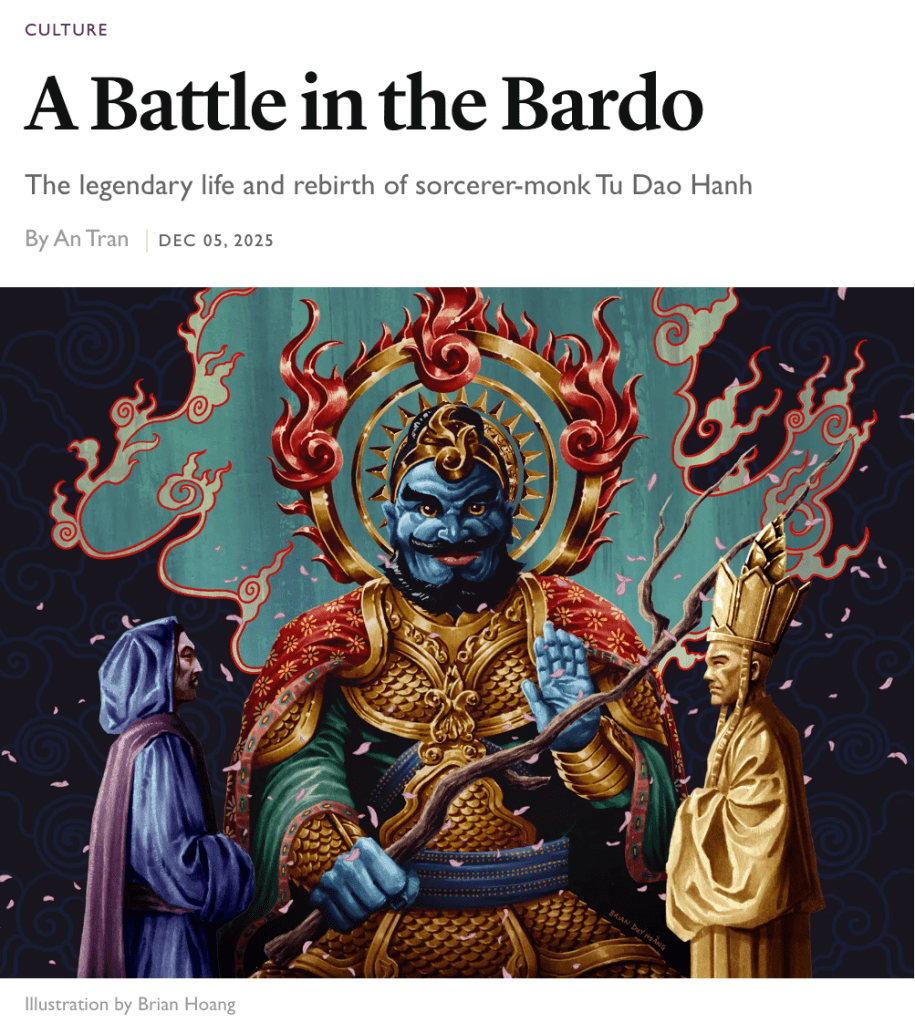
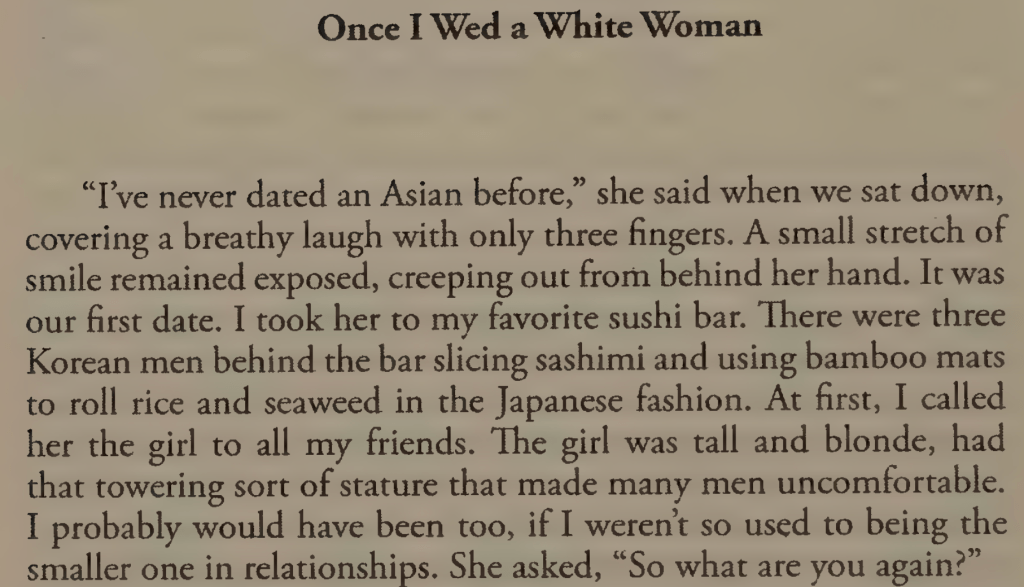
Kathy Ngoc Nguyen: I have shared this with you before, and I want to reiterate it once more here. I learned a great deal about obscure Buddhist history from the pieces you wrote, specifically “A Battle in the Bardo,” and philosophy. Buddhism is woven into several of your stories as well, and sometimes the characters, or what they long for when confronted with absence, shapeshift into ghosts or Buddhist gods and figures. In “Once I Wed a White Woman,” the narrator remembers a former partner and ruminates on Buddhist concepts and stories about materiality, on how “the Buddha encourages his disciple Subhuti not to cling to concepts, but to accept the nature of reality as change itself.” Reincarnation is referenced in the coda. Then, in “The Golden Turtle God,” you write of Mr Le’s grief and meditation so poignantly during his pilgrimage after his wife’s death. The simultaneity of absence and presence permeates your writing, and there is a poetic irreconcilability that haunts your characters. Were the references to Buddhist scripture and philosophy intended to blur this absence and presence with ghosts and gods? Do they somehow decipher or complicate the contention between language displacement, untold grief and unspoken absence, or even material and immaterial displacement?
An Tran: In Thiền, or Zen, it is said that all reality is made of mind, and the whole of the six realms is reflected within us; the heavenly and ghostly realms are states of mind. But they are also as real as this material world, because the human realm is itself just this conjuration of the six senses. I am really fascinated by how this dialectical tension between being and non-being, interior and exterior, and so on, can be used in a literary context, and how the meaning of the imagery within a contradiction changes as a character’s relationship to, and understanding of, that tension changes.
Existence can only manifest in dialectical tension with non-existence.
In East Asian Buddhist thought, contradiction is the very basis of reality itself. In Abrahamic thought, contradiction violates the nature ordained by God, but for us this logic does not hold. Existence can only manifest in dialectical tension with non-existence. Even in Western dialectics, the contradiction must always be resolved into a synthesis, but the non-dual concept of logic in East Asian thought pushes back against this and asserts that the infinite possibilities of the universe rely on the flux and tension of contradiction. Suffering, cognition and the whole of the six realms result from our inability to accept the contradictory nature of reality as it is. Emptiness, the fundamental nature of reality in Buddhist thought, exists because being and non-being are locked in dialectical tension with one another; they originate in dependence on one another. The question for each of these characters, I think, is whether or not they are able to recognise that all their suffering is as real, and as unreal, as the realms of the gods and the ghosts. Or, conversely, can they recognise the unreality of this human realm? The stories emanate from that, whether characters are moving toward or away from insight. So there is certainly some intentionality behind Buddhist doctrine in my process, but often I am using Buddhist concepts as a vehicle to drive the plot forward, as far as intentionality goes.
An Tran: Lastly, what are you working on now?
Kathy Ngoc Nguyen: It is that novella I was working on during our writing retreat, the one I told you about when we were corresponding. But I am experiencing some stagnation with it after three chapters, so I took a break from it and started working on a new short story.
I always write the ending first, because I need to know what it is before I can develop the story’s rhythm from the beginning.
Perhaps I have been inspired by some of your recent pieces, because I realised I have subtly framed a few Buddhist themes in that story. At first, I wanted to write a postwar reckoning story dealing with a nameless character navigating the contention between nihilism and survivor’s guilt, a plot partly inspired by the vignette “The Tunnel” from Kurosawa’s Dreams (1990), and a few episodes of The Twilight Zone, which I have been rewatching. Although I am still working on that story, I have already written the ending. It is my usual writing process; I always write the ending first, because I need to know what it is before I can develop the story’s rhythm from the beginning. That ending led to another story I am currently outlining, one that veers into the absurd. Perhaps it will lead to a collection of interrelated short stories and flash fiction.
Kathy Ngoc Nguyen: And you? Can you share any new or forthcoming projects?
There is so much of our Buddhist tradition that has never been accessible to the West.
An Tran: Recently, much of what I have been working on has to do with sharing obscure Vietnamese Buddhist stories, histories and texts in English. There is so much of our Buddhist tradition that has never been accessible to the West, like the folk story on which “A Battle in the Bardo” is based, because nobody has ever bothered to translate this material or transmit these tales into English. Unfortunately, this also means that a lot of second- and third-generation Vietnamese in the diaspora, having lost connection with the Vietnamese language, become disconnected from their cultural roots.
Right now, I am working with my master, Thích Chân Pháp Từ, on translating a Zen meditation manual called Khóa Hư Lục (Instructions on Emptiness), written by Emperor-Monk Trần Thái Tông. It is a short text, and many sections survive mostly in fragments, but it is an incredibly important one in the pedagogy of the Thiền tradition. This is just the first of a list of little-known Vietnamese Buddhist texts that Master Pháp Từ and I hope to bring into the Anglosphere.
I am also in the early stages of outlining a novel about another Trần dynasty monarch, Emperor Trần Nhân Tông, who victoriously defended the nation against two Mongol-Yuan invasions, then abdicated the throne to become a Zen monk, later establishing a new, unified national school of Buddhism. I want to borrow from the American novel tradition and the wuxia and gongting novel traditions, and see what happens when I syncretise them all together. I think there are many parallels between the American Dream adventure novel and the wuxia genre, both of which often present narratives of rugged individualism and self-cultivation, as well as between the “romance of the divide” style of American novel and the gongting, or “Imperial Court intrigue,” genre of historical fiction, each representing the tensions and dynamics of their respective nations through the microcosm of a family drama.
I think it was alienation from our culture that caused my sense of shame in my youth, and I want to help ensure that the next generation does not have to feel alienated from Vietnamese culture or spirituality because they cannot speak the language.
How to cite: Nguyen, Kathy and An Tran. “speak easy.” Cha: An Asian Literary Journal, 1 Jul. 2026. chajournal.com/2026/07/01/speak-easy.

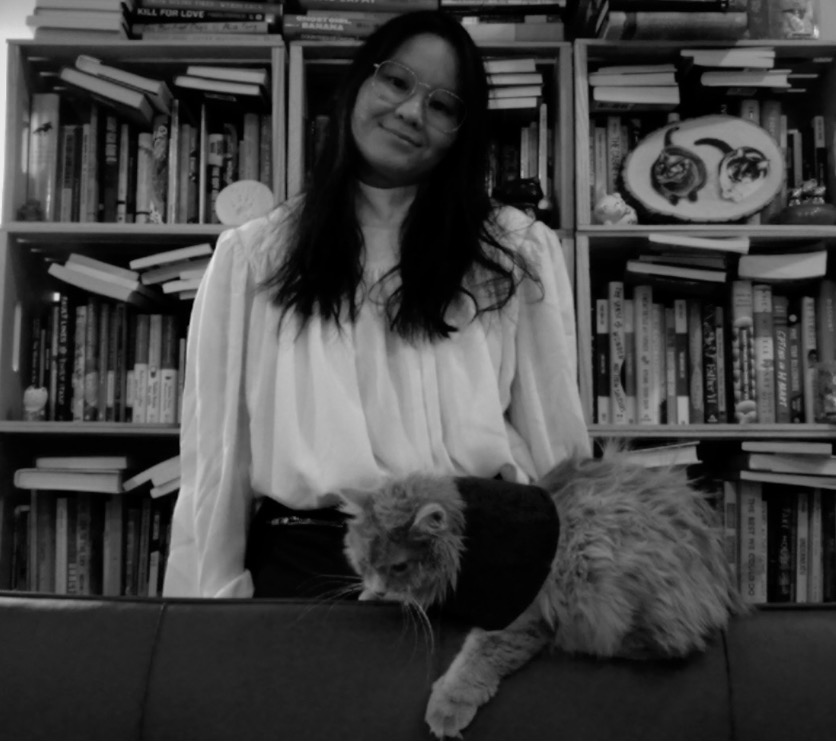
Kathy Ngoc Nguyen received her PhD in Multicultural Women’s and Gender Studies from Texas Woman’s University and she is currently an Assistant Professor of Ethnic and Gender Studies at Metro State University in Saint Paul, Minnesota. Her works have appeared in Gulf Coast, Drunk Monkeys, Short, Vigorous Roots: A Contemporary Flash Fiction Collection of Migrant Voices, which is a 2022 Foreword INDIES Finalist for Anthologies, Food of My People: The Exile Book of Anthology Series, diaCRITICS, Kartika Review, FIVE:2:ONE, Fearsome Critters, which was selected as the Editors’ Choice for Top Contributor in Hybrid Work, The Activist History Review, and elsewhere. She was a former Short Fiction Section Co-Editor at CRAFT Literary. She is interested in the political origins, renderings, and the poetic yet nostalgic stagnations of pre-1975 nhạc vàng. Broadly, in her writing, she is interested in further exploring the precarious hierarchical structure of language and its connection to people living in an indefinite threshold that oscillates between translatable and untranslatable words. Her chapbook Nonfluent Bodies, Switchable Tongues is forthcoming. [All contributions by Kathy Ngoc Nguyen.]

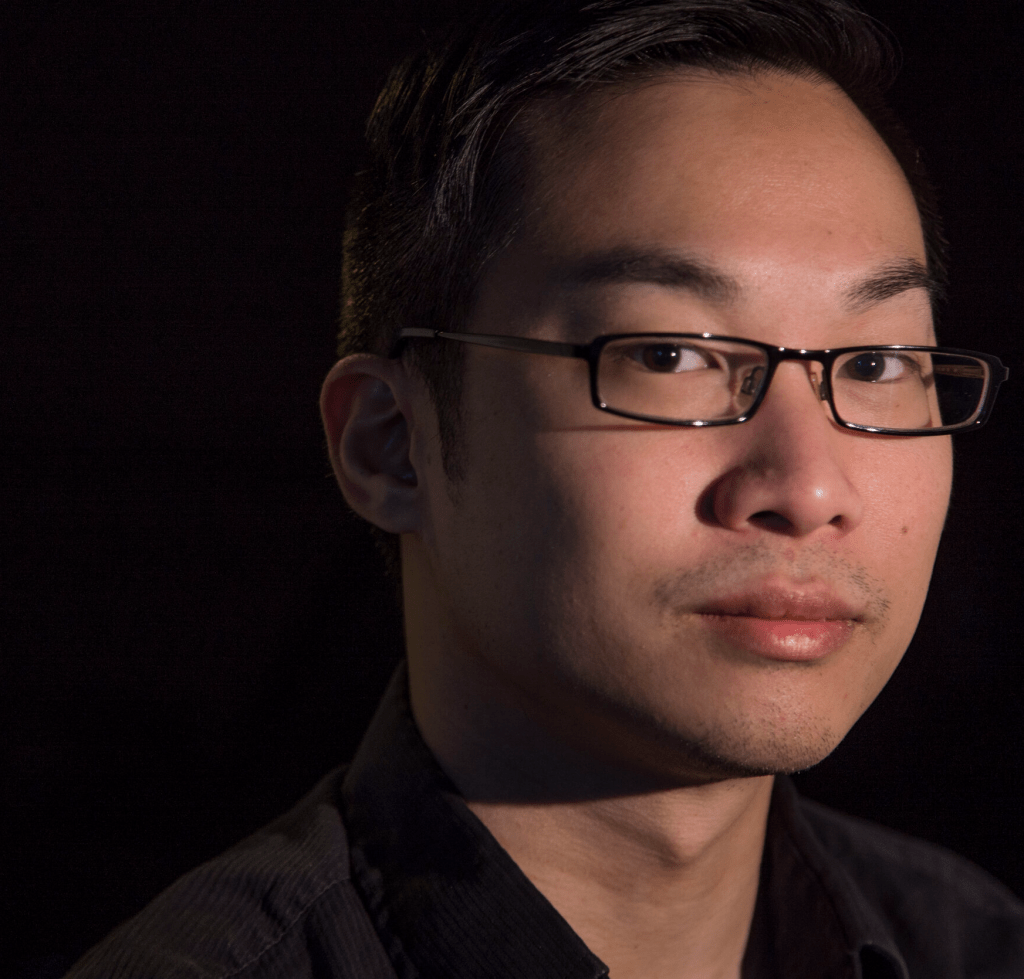
An Tran is the author of the short story collection Meditations on the Mother Tongue. He was formerly a nationally ranked powerlifter with USAPL. His fiction and essays have appeared in Southern Humanities Review, Gargoyle Magazine, The Carolina Quarterly, LitHub, Tricycle, and elsewhere, and have received “Distinguished Work” distinctions from Best American Short Stories and Best American Essays. Visit his website for more information.
 Cha
Cha 