
茶 FIRST IMPRESSIONS
茶 REVIEW OF BOOKS & FILMS
[REVIEW] “Insignificant Moments, Significant Lives: Xu Xi’s Horizon Hong Kong” by Jennifer Eagleton
Click HERE to read all entries in Cha
on Horizon Hong Kong.
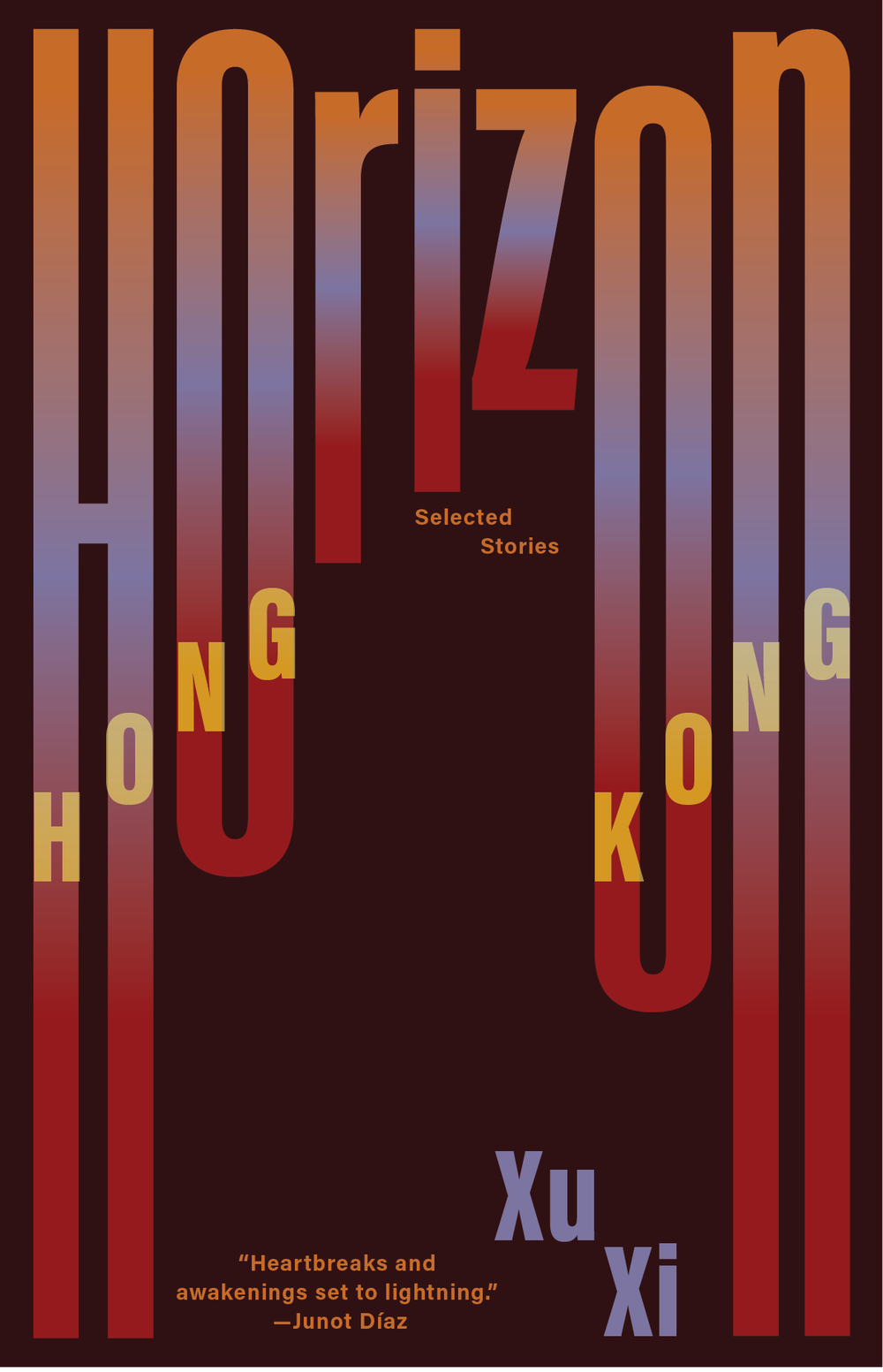
Xu Xi. Horizon Hong Kong: Selected Stories, Gaudy Boy, 2026. 288 pgs.

The stories in Horizon Hong Kong provide a showcase of Xu Xi’s work over the course of her writing career. Twenty-two stories from five different books published between 2001 and 2022 cover people and events against the backdrop of the 1960s to the present day. They address the demands of modern individuality set against the obligations of memory, family, history, politics, and, most distinctively, place: Hong Kong, a city caught in a marginal space between East and West, in many respects reflecting Xu Xi’s own experience as an Indonesian-Chinese writer, growing up and working in Hong Kong, then working in corporate New York, with conflicting feelings about moving between these two worlds.
)

History’s Fiction (2001) engages with Hong Kong’s history through fiction, setting personal narratives within the important events and places that have marked recent decades. In “Chunking Mansions,” the narrative captures the innocence of local children playing and pretending to be adults, contrasting sharply with the gritty adult realities of the sex trade unfolding in the shadow of the mansions. A child’s perspective is used to examine societal taboos in Hong Kong, whilst illuminating how global events such as the Vietnam War reverberate through daily life. “Democracy” uses childhood to explore the friction between traditional meritocracy and modern democratic ideals, following a group of schoolgirls participating in a Girl Guides election. The girls experience the intensity of a youthful contest, raising questions about merit versus popularity as democratic voting methods are introduced. The internal politics of the schoolyard directly mirror the real-world anxieties of the era, framed by the 1966 Star Ferry protest. In “The Yellow Line,” a new subway opens in Hong Kong in the 1970s, and a child’s imagination takes a leap towards what lies beyond that line, leading to a life-threatening act with lasting consequences. This may be read as an allegory for Hong Kong’s own leap into an uncertain future, as negotiations over the city’s fate loom on the horizon.
“Insignificant Moments in the History of Hong Kong” is set on the cusp of July 1997 and the handover to China, exploring the complex and varied emotional landscape of Hong Kong citizens during the transition from British to Chinese rule. The narrative follows a local protagonist, Lam Yam Kuen, as he navigates two vastly different social spheres: an unpretentious visit to his uncle’s Chinese restaurant, and a high-society dinner party at a private club, populated by wealthy expatriates, mixed-race couples, and corporate professionals. Though the 1997 handover was a momentous geopolitical event, here it is framed through the “insignificant” everyday routines, casual jokes, and private anxieties of ordinary people as they carry on as usual. By contrasting the working-class restaurant environment with the elite private club, Xu Xi highlights the deeply fractured opinions Hongkongers held towards China.
)

Overleaf (2004) takes us around the globe in its enquiry into the predicament shared by overseas Chinese: what does “Chinese” mean once one’s ancestors have left the homeland? In “Famine,” a fifty-one-year-old single English teacher has spent her entire life in Hong Kong under the strict, oppressive rule of her abusive parents. After their deaths, she abruptly quits her job, packs her belongings, and flies first class to New York City for a week of extravagance, checking into a luxury hotel suite with the specific intention of spending an entire week gorging herself on the finest food imaginable. As she eats, the physical abundance triggers deep flashbacks: she recalls the severe scarcity of her childhood, her parents’ obsessive fear of starvation, and how they restricted her to a meagre diet of rice and tofu. She comes to realise she cannot simply eat away her grief or escape her past. “Rubato” (a musical term meaning “robbed time”) explores the complex psychological and cultural identity of a Hongkonger living in the United States, attempting to adapt to a new home whilst remaining tethered to the old one. The narrative focuses on the internal adjustments, cultural friction, and emotional negotiation required to adopt a new national identity, and underscores how personal truths do not necessarily change with geographical distance. “Citizenship” further explores the complex and bureaucratic nature of transnational identity.
)

Access: 13 Tales (2011): In “Iron Light,” the narrative follows a career-driven, middle-aged woman who travels to Europe for a clandestine romantic meeting with her boyfriend, a married man. When her lover fails to appear, she finds herself stranded and takes a long, solitary walk through the back streets of Stockholm. The unexpected abandonment prompts a deep internal monologue regarding the trajectory of her life, her choices, and the isolating reality of her independence. The story explores the particular emotional and societal pressures faced by high-earning, unattached Asian women approaching middle age. “To Body to Chicken” focuses on a massage girl named Teresa Teng Lai-sin and her encounter with a generous American customer whom she calls Tennessee, and on the English she acquires through lessons. The story addresses the social misconception that a massage girl (the “massage” being the “to body” of the title) is necessarily involved in prostitution (“chicken” being Cantonese slang for “prostitute”).
)

In Insignificance (2018), the protagonists cannot help but recall their former Hong Kong existence, one that shimmers with both beauty and pain, and the collection is preoccupied with questions of Hongkonger identity. Xu Xi wrote these stories before relocating to the United States, and they carry an implicit question: does Hong Kong’s future resemble its past, or is nostalgia a dangerous indulgence? “Off the Record” explores the conflicted feelings of a sixty-two-year-old journalist who returns to Hong Kong to care for his ageing parents during the 2014 Umbrella Movement. The story navigates his complex relationship with his home city, juxtaposing his personal life with the broader political unrest unfolding on the streets. “Kaspar’s Warp” is a meditation on yearning, grief, and the struggle to relinquish lost dreams. To process his grief, the teenage narrator attempts to write a fictional story about a dead person suspended in a state of limbo, yet sharply criticises his own writing within the text, dismissing his creation as hackneyed and unoriginal.
Two stories in this collection take a surreal turn. In “Ants,” narrated from the perspective of an evolving ant colony, the story functions as an extended comic fable comparing Hong Kong citizens to insects and serves as a direct metaphor for the 1997 handover. Written in a slipstream and fantastical style, it traces the behaviour, survival instincts, and shifting nature of the colony to mirror how Hongkongers have had to adapt and navigate their identities under changing sovereign powers. In “All About Skin,” the characters decide to alter the colour of their own skin upon learning that they are able to do so. The story treats racism as a disease that might be “cured” through medical intervention, playing with notions of beauty, consumerism, and relations between nations.
)

In Monkey in Residence (2022), the most recent of Xu Xi’s collections, the title story “Monkeys in Residence” serves as the anchoring tale. It employs an absurd, surreal premise to satirise academic politics and real-world political posturing. The Hong Kong government establishes a prestigious endowed academic chair and, in lieu of a human scholar, appoints a talking, emotionally unstable monkey to rotate through the city’s colleges and universities as the official “Monkey in Residence.” The narrative follows the frantic jockeying for power, prestige, and academic standing amongst university officials, the monkey’s attendants, and a highly chaotic group of student activists, offering a pointed parody of institutional obsession with status and bureaucracy.
)
One can see that these stories reflect the cultural fluidity and uncertainty of a Hong Kong population caught between empires, and examine how its people cope, or fail to cope, with the changes around them. Everyday life appears to continue regardless of the wider forces that shape it, forces over which ordinary people frequently have no say. Such stories seem to be appearing with increasing frequency in contemporary publishing, as political upheaval provides the backdrop to daily life, quietly revealing what official accounts often obscure. History and fiction are, in many respects, natural companions: fiction offers a way of telling the past that is both accessible and free from the official narratives that shift with political expediency. History books remain essential, but they are best read with fiction close at hand.
How to cite, Eagleton, Jennifer. “Insignificant Moments, Significant Lives: Xu Xi’s Horizon Hong Kong.” Cha: An Asian Literary Journal, 1 Jul. 2026. chajournal.com/2026/07/01/horizon.


Jennifer Eagleton, a Hong Kong resident since October 1997, is a close observer of Hong Kong society and politics. Jennifer has written for Hong Kong Free Press, Mekong Review, and Education about Asia. She has published two books on Hong Kong political discourse: Discursive Change in Hong Kong(Rowman & Littlefield, 2022) and Hong Kong’s Second Return to China, A Critical Discourse Study of the National Security Law and its Aftermath(Palgrave Macmillan, 2025). Her poetry has appeared in Voice & Verse Poetry Magazine, People, Pandemic & ####### (Verve Poetry Press, 2020), and Making Space: A Collection of Writing and Art (Cart Noodles Press, 2023). [All contributions by Jennifer Eagleton.]