
茶 FIRST IMPRESSIONS
茶 REVIEW OF BOOKS & FILMS
[REVIEW] “Now and Now and Now and Now: Abyssal Form in Yiyun Li’s Things in Nature Merely Grow” by Ronny Chan
Yiyun Li. Things in Nature Merely Grow, Farrar, Straus and Giroux, 2025. 192 pgs.
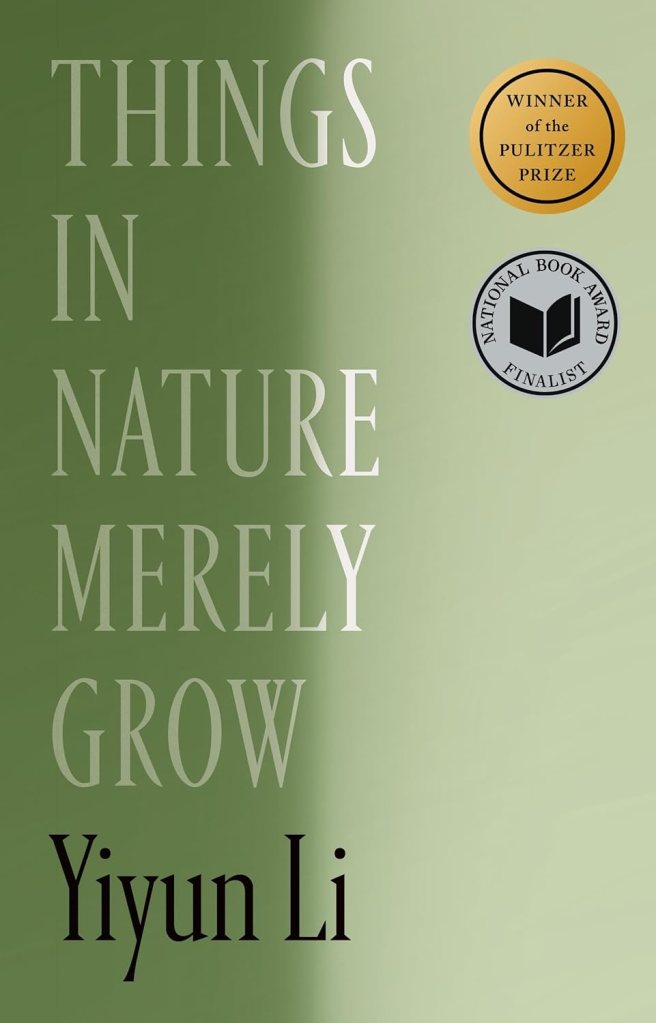
“Children die, and parents go on living” (p. 58), and the mother goes on writing. But what form does writing take when loss threatens to swallow every form and shatter every structure?
In Things in Nature Merely Grow (2025), a memoir dedicated to her younger son James, who, like his brother Vincent, died by suicide, Yiyun Li adopts what we may term “abyssal form” to respond to “life’s extremities” (p. 25) and approach what lies in formlessness itself.
On one hand, the book rejects cathartic narratives of trauma and refuses sentimental performances of grief made easily consumable for mainstream readers. As Yinqi Zhou observes of Li’s preceding works, her “affective flatness” disrupts the “dominant mode of expression prescribed for bereavement, often soaked in anguish and oozing with bleakness” (p. 26). With pared-down, precise language, Li’s writing short-circuits, to borrow Xine Yao’s words, “the compulsory norms” that dictate “the appropriate expressions of affect that are socially legible as” a grieving mother (p. 7).
On the other hand, the book does not disintegrate into chaos. Written in an unadorned, undramatic style, it contemplates “from a particularly abysmal place” (p. 25) what it means to live after losing one’s children. It spirals into similar images and questions again and again, deepening with each return. It sits with ambivalence and paradox, stillness and movement, presence and absence, proximity and distance, without collapsing them into oneness. It reaches towards its subject, death, loss, the children, asymptotically: almost there, but never quite. Central to abyssal form is its metatextual dimension: it interrogates how the extremity of losing two children hollows out language, forcing one to rework it in order to communicate the incommunicability of being in the abyss.
)
To live in the abyss is to recalibrate time, forgoing expressions of futurity and dwelling in a dilated present.
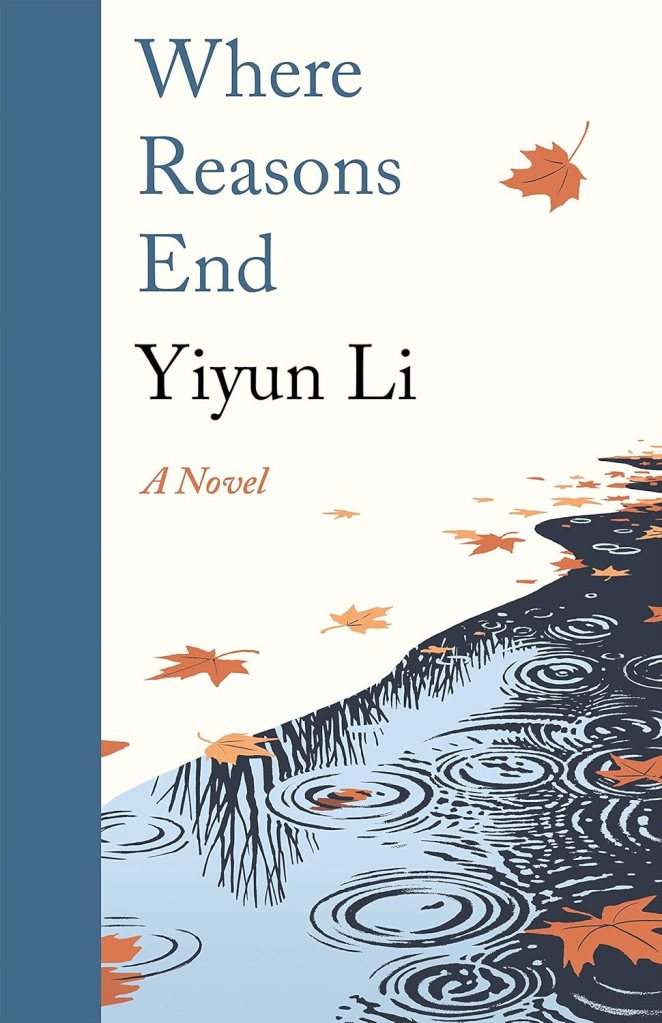
To live in the abyss is to recalibrate time, forgoing expressions of futurity and dwelling in a dilated present. In her earlier novel Where Reasons End (2019), written after Vincent’s death, the narrator banishes adverbs of frequency, “never, always, forever” (p. 42), words that smooth over time’s capriciousness by pretending it can be sealed and stretched by human logic.
In Things in Nature Merely Grow, Li sharpens this meditation by insisting on the “now”: “There is no now and then, now and later; only now and now and now and now” (p. 101). The phrase eerily echoes King Lear’s cry, “Thou’lt come no more, / Never, never, never, never, never” (5.3.306-307), as he cradles Cordelia’s corpse. But where Lear’s “never” closes time with tragic finality, its staccato rhythm dramatising the disintegration of his grandiose aspirations, Li’s “now and now and now and now” collapses time into a bloated present that swells with past memories and swallows future possibilities. The near-monosyllabic sentence strips time of rhythmic variation; the repetitive “and” produces a “now” that accumulates without climax or catharsis. Within the abyss, “time, no longer nimble-footed, no longer winged, is for us to carry” (p. 68).
Here lies the paradox of stillness and movement: it is no longer time that carries us, but we who carry time, dragging its weight in suffocating stagnancy. It is within this expanded present that Li holds onto the absent contours of her two children, refusing the demand, embedded in words like “grieving” and “mourning,” that one must move towards resolution (p. 26).
)
As time ceases to move forward, verbs die; adjectives grow flabby; only nouns remain in their motionless form.
With abyssal time comes abyssal grammar. As time ceases to move forward, verbs die; adjectives grow flabby; only nouns remain in their motionless form. In a sentence anchored by a colon and a semicolon, Li materialises the detachment of nouns from verbs: “Mothers are always mothers: some, now buried, can no longer mother their children; some, having lost their children, have no one to mother” (p. 100). The word “always” here does not so much erase time’s capriciousness as expose the cruel remainder of death. The near-symmetrical clauses hold two impossibilities in tension: the mother dead, the child alive; the mother alive, the child dead. In both cases, the verb “mother” freezes. What remains is merely the noun, taxidermic, stripped of animacy. “Dead verbs” become “bees and ants and butterflies enfolded by the amber of time” (p. 100).
Within the abyss, nothing springs or sprouts. Adjectives, too, become redundant. Readers of Li’s earlier work may recall the debate over nouns and adjectives in Where Reasons End: the son, Nikolai, favours adjectives as his “guilty pleasure” (p. 6), but the narrator counters that “adjectives are opinionated words” (p. 66). To Li, adjectives judge, modify, and embellish. After losing her two children, they become extraneous: they qualify what cannot be qualified. Only nouns remain, naming unadorned facts without the consolation of interpretation or the distortion of feeling. “Children die, and parents go on living: this, too, is a fact that defies all adjectives” (p. 171). Such a noun-heavy, adjective-sparse prose reveals that abyssal form works through subtraction and refusal rather than addition and plenitude. To strip language of ornament is to stare squarely at the abyss and lay bare reality as it is, with no promise of “hope or regeneration” (p. 80).
But no matter how Li warps language, the bond between reality and representation frays and falls apart. Her writing is merely “a placeholder, no more, no less” (p. 83). In an accumulating passage, the construction “X is a placeholder” piles up with variation, folds back upon itself, and nears the heart of her children’s death without ever reaching it. A placeholder does not fill what is missing; it designates a space of absence, a form that holds the void without attempting to close it. Self-reflexively, “Writing a sentence again and again until it feels right is a placeholder” (p. 84). The process of iteration and revision folds into a loop spiralling around an unreachable absence, each time approaching, never arriving.
Li further extends the placeholder from writing to existence itself: “What I did for my children once made placeholders of their lives; what I couldn’t do, keep them alive, is the most important placeholder of my life: my children, in their absence” (p. 84). This near-symmetrical syntax, a signature of Li’s writing, holds presence and absence in tension. The first clause suggests that even her actions during her children’s lives were placeholders: she could act beside them but never live their lives for them. The second clause reveals a double absence: the death of her children, and then their absence itself becoming a placeholder that now structures her life, replacing what was once present with a void. Later, the placeholder condenses into a corporeal image: “Little did James know, and little did I know, that someday I would live with a black hole inside me, the precise shape of my two children” (p. 99). A placeholder made flesh, the black hole marks an embodied void that takes up physical space. To inhabit the abyss is to carry this placeholder and go on with the absent contours of her loved ones, now and now and now and now.
)
To write from the abyss, then, is to refuse the sleight of hand that converts loss into regeneration. As Irving Goh writes in his article, Li refrains from turning “failures” “into a reparative object or pedagogy in the service of a collective project to overcome failure” (p. 541). The word “failure” is a problematic measure, calibrated against the dominant norm of success, but Goh’s broader insight holds: Li rejects the consolations of catharsis, closure, and collective pedagogy. Bottomless and spiral-like, abyssal form approximates formlessness without dissolving into it. It collapses linear time into a dilated present, hollows grammar into taxidermic nouns and dead verbs, and turns writing into a placeholder that demarcates a void without filling it. Yiyun Li’s work bodies forth abyssal form as both an aesthetic strategy and an inhabited condition. Ending her memoir, Li returns to a bodily gesture that recurs throughout the book:
Sometimes a mother and a child are like two hands placed next to each other: only just touching, or else with fingers intertwined. Then the world turns, and one hand is left, holding on to everything and nothing that is called now and now and now and now. (p. 172)
The two hands exist only in proximity, beside, around, near, but never coalesce into a single image. One hand reaches out, approximating yet never fully achieving an understanding of the other. Then the world turns, and the other hand vanishes. What remains is a single hand, clutching the paradox of everything and nothing. All one can do is hold on, stay in the abyss, and live on without arrival. As readers, we can merely touch the book, brushing its surface or pressing our fingers against its pages, asymptotically: almost there, but never quite.
Bibliography
▚ Goh, Irving (2023). “Shared Unshareability, Suicidality, and the Melodrama of Living on after Failure in Yiyun Li,” MFS: Modern Fiction Studies, vol. 69, no. 3, pp. 539-562.
▚ Li, Yiyun (2019). Where Reasons End: A Novel. Random House.
▚ — (2025). Things in Nature Merely Grow. Farrar, Straus and Giroux.
▚ Shakespeare, William (1993). King Lear. Edited by Barbara Mowat and Paul Werstine. Simon & Schuster.
▚ Yao, Xine (2021). Disaffected: The Cultural Politics of Unfeeling in Nineteenth-Century America. Duke University Press.
▚ Zhou, Yinqi (2024). Minor Feelings and Minor Aesthetics in Asian American Literature. MA thesis, Duke University.
How to cite: Chan, Ronny. “Now and Now and Now and Now: Abyssal Form in Yiyun Li’s Things in Nature Merely Grow.” Cha: An Asian Literary Journal, 15 Jun 2026, chajournal.com/2026/06/15/merely-grow.

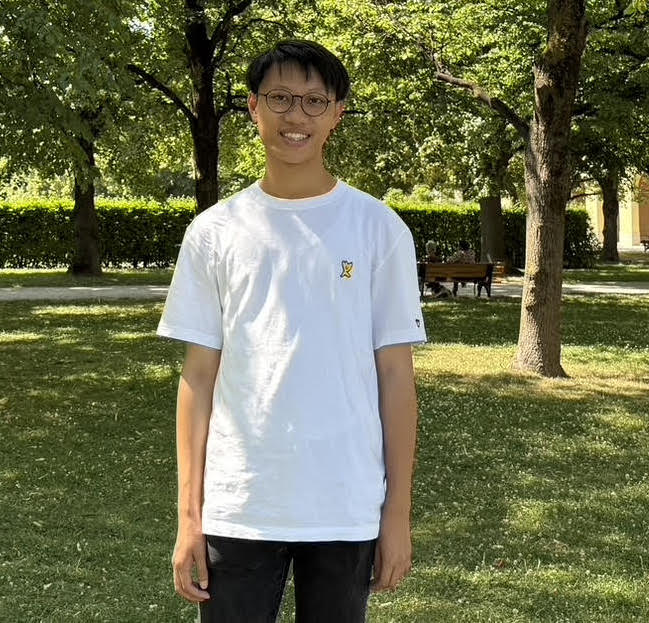
Ronny Chan is a writer and researcher based in Hong Kong. They are completing an MPhil thesis on queer literature from postcolonial Hong Kong, alongside a secondary project on queer experimental approaches to life writing. [All contributions by Ronny Chan.]
 Cha
Cha 