
茶 FIRST IMPRESSIONS
茶 REVIEW OF BOOKS & FILMS
[REVIEW] “Bodies and Landscapes in Flux: Displacement, Placemaking, and Agency in Mai-Linh Hong’s Continental Drift” by Shui-yin Sharon Yam
Click HERE to read all entries
on Continental Drift.
Mai-Linh Hong. Continental Drift, Trio House Press, 2026. 108 pgs.
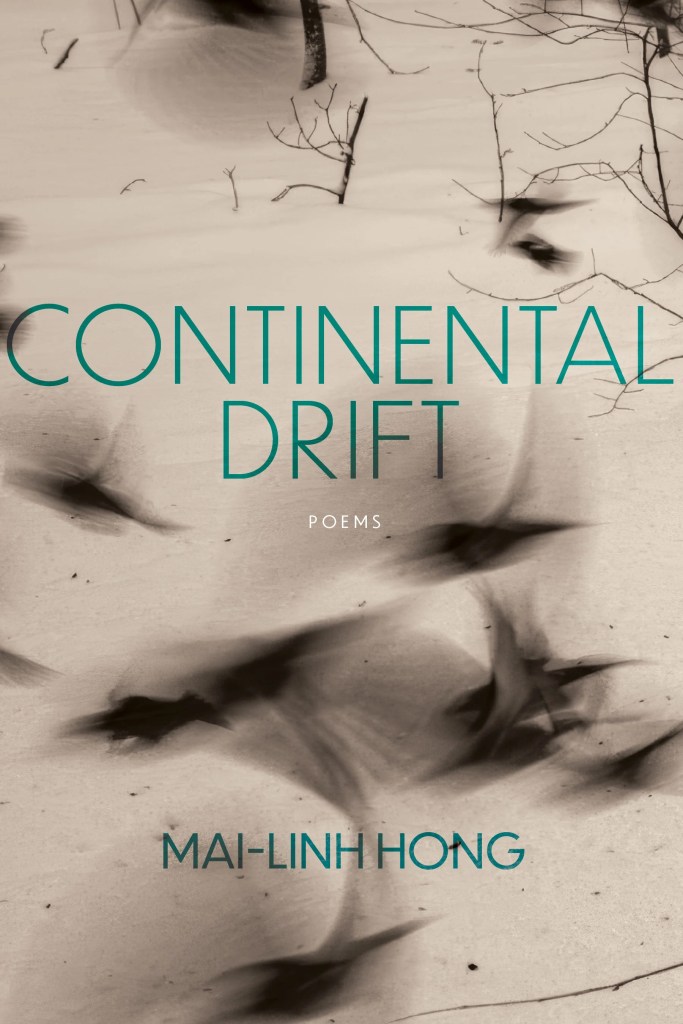
Mai-Linh Hong’s Continental Drift remembers, grieves, and unyieldingly marks the transnational lives of displaced Vietnamese people across generations. Published during the second half of 2026, this collection is both a salve and a rallying cry against the horror of state-sponsored violence in the United States against immigrants and people of colour. Across five movements, in the drifts, faults, estuaries, and in the aftermath of displacement and resettlement, Hong traces how she and diasporic Vietnamese people across generations make home in flux.
Born in Vietnam and raised in the United States, Hong brings a diasporic sensibility and an attunement to the non-linearity of time and space that suffuses the collection. Juxtaposing the natural movements of plants, landscapes, waters, and tectonic plates with the forced displacements of Vietnamese people by wars and statecraft, Hong’s poetry restores agency to a people who have been repeatedly dispossessed. In “Field Notes from Aliens Who Float,” for instance, Hong conjures the image of displaced migrants as aquatic organisms languidly navigating the ocean: “seaweed sinew urchin spine & shiver / before us forest bottle green / beneath us faults not yet seen / terrain we nevertheless / named.” Later, Hong juxtaposes the names of algae and seaweeds with the sensorium and haunting of a displaced people. Without sensationalising the trauma of being made adrift, Hong beautifully illustrates the histories of Vietnamese refugees who “still / can chart / a way.”
)
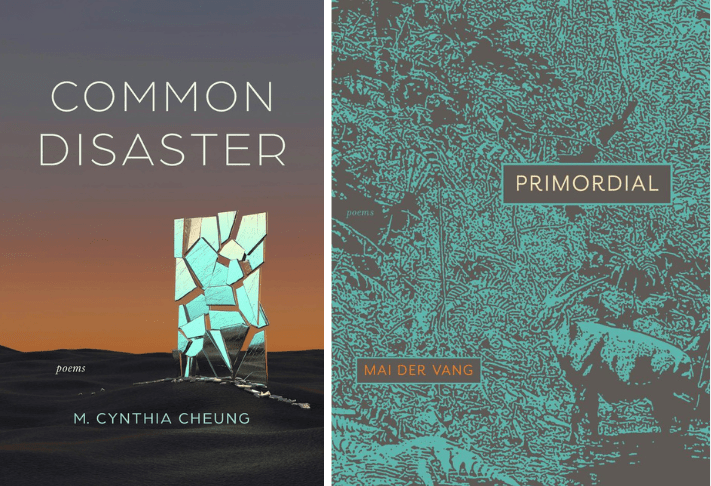
I read Hong’s Continental Drift alongside Cynthia Cheung’s Common Disasters and Mai Der Vang’s Primordial, two other collections crafted by Asian-American women poets who deftly situate and juxtapose intergenerational geopolitical and anthropocentric violence with the expansiveness and mysticism of nature.
This body of work blends environmental poetics with the historical trauma and haunting of loss, war, and displacement, illustrating the different scales of destruction and regeneration in the Anthropocene. Drawing a delicate line through landscapes, animals, and peoples who have been systematically displaced across generations, these collections hauntingly illuminate different manifestations of violence: the incremental, slow violence that leads to the extinction and displacement of humans and animals alike; the organised neglect visited upon people whose deaths are deemed acceptable collateral damage; and state-sponsored dispossession across generations of migrants and refugees.
)
In the sparse and formally inventive poem “Chesapeake Bay x Gulf of Thailand,” for example, Hong connects the disappearance of blue crabs in Chesapeake Bay to the forced migration of Vietnamese refugees in the Gulf of Thailand, where the latter became crabs that float and make home “among the reeds… / and learn again the breathe.” In this myth-like migration poem, the displaced and dispossessed are rendered deft and magical against the horror of violence.
While Continental Drift paints an unflinching picture of geopolitical violence across space and time, it offers solace by situating the intimacies of a diasporic life amidst the overwhelming largesse of nature and geology. “Did you know / continents move at the same rate / fingernails grow,” Hong asks, “We are drifting / toward a future not where we imagine / because while we migrate / continents do, too.” There is comfort in knowing that despite the loneliness and grief we experience after loss, after dispossession, and after separation, we are still held in the vastness of the Earth.
Despite the magnitude of the ocean and earth that courses through the poems, Hong never trivialises personal loss and intimacy. Rather, she situates them alongside natural calamities, climate crises, and oppressive power structures that cut across time and space. While some poems chart an intergenerational saga across multiple borders, others reveal a more private intimacy and grief in the poet’s own home and family. In the prose poem “I enter the room where the dead still sew.,” sewing is both an embodied act and a metaphor that stitches together intergenerational intimacies, despite, or perhaps in spite of, loss and death. In “Casey Kasem and the Cannibals,” Hong weaves her own childhood memories with those of her elders, culminating in her grief over infertility and the overwhelming love and terror she feels towards her child during the pandemic: “Parenting, it turns out, / is fucking terrifying and will unanchor / every single ghost you thought / you had thrown to the seafloor,” the seafloor that has held the bodies and ghosts of the poet’s ancestors, thus sustaining an intergenerational loop of unresolved haunting and love amidst immensely difficult conditions.
Hong does not flinch from the vulnerability of personal loss. “[untitled]” documents the loss of her second pregnancy through a series of vignettes in which Hong witnesses the prolonged rescue of a group of Thai boys trapped in a cave by water, a force of nature and a recurring motif in the collection that simultaneously highlights people’s powerlessness and agency in the face of calamity. Despite continual displacement and dispossession, the Vietnamese people are never rendered passive in Hong’s work. In the end, it is resilience and defiance that drowns out subjugation, a rallying cry that displaced people most need to hear at this political juncture: “For losing refuge / over and over, but most of all/ for its revival, / my refusal— / my next, great, / growling / no.”
How to cite: Yam, Shui-yin Sharon. “Bodies and Landscapes in Flux: Displacement, Placemaking, and Agency in Mai-Linh Hong’s Continental Drift.” Cha: An Asian Literary Journal, 14 Jun 2026, chajournal.com/2026/06/14/continental-drift.


Shui-yin Sharon Yam is a diasporic HongKonger and Professor of Writing, Rhetoric, and Digital Studies at the University of Kentucky. She is the author of two books—Inconvenient Strangers: Transnational Subjects and the Politics of Citizenship and Doing Gender Justice: Queering Reproduction, Kin and Care (co-authored with Natalie Fixmer-Oraiz). Her poetry can be found in the McNeese Review, Radical Catalyst, So to Speak, Salvation South, among others. [All contributions by Shui-yin Sharon Yam.]
 Cha
Cha 