
[ESSAY] “Hot Pot: A Queer East Asian Play About A Meal, Four Friends and What Remains Unsaid” by Hongwei Bao
Click HERE to read all entries in Cha
on Hot Pot.
Hongwei Bao (playwright). Hot Pot: A Queer East Asian Play About A Meal, Four Friends and What Remains Unsaid. Directed by Namoo Chae Lee. Produced by Auka Productions. UK Tour, 16 June-5 July 2026.
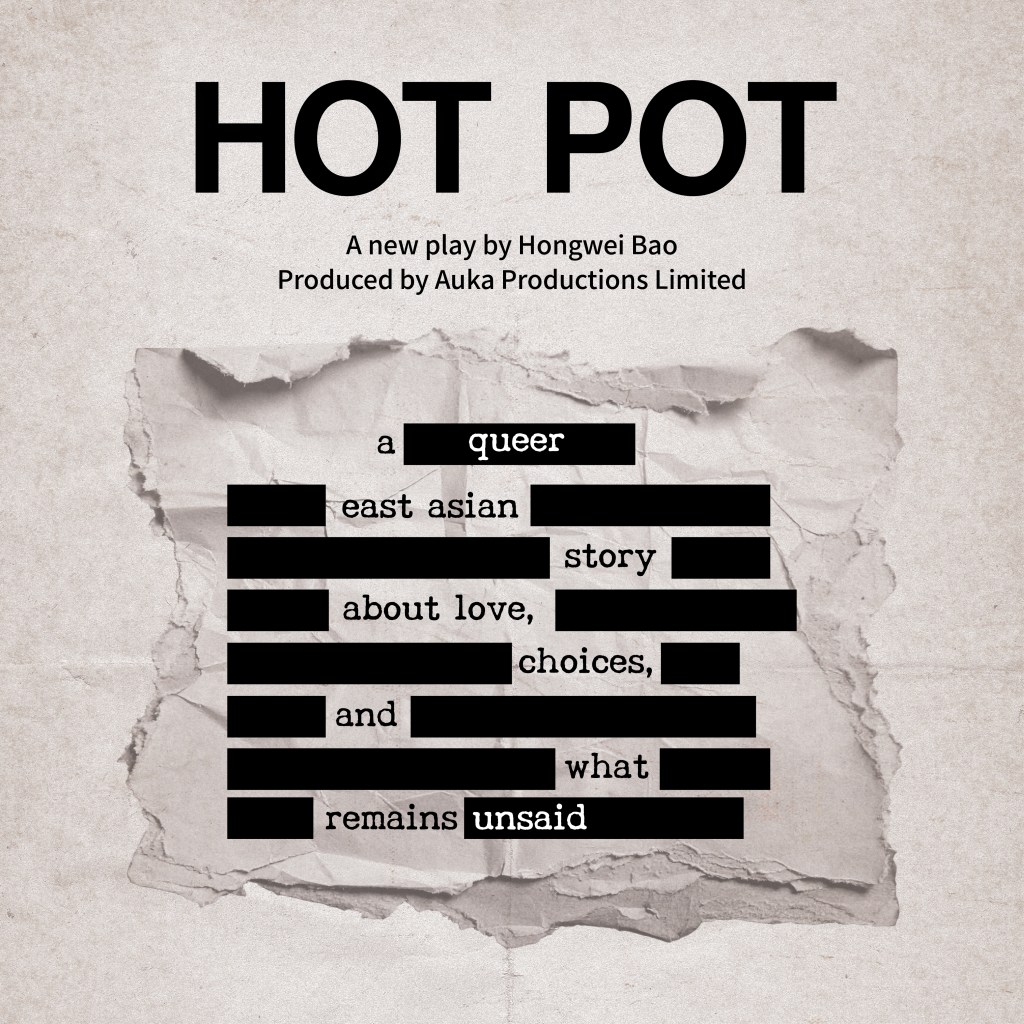
From 16 June to 5 July 2026, the play Hot Pot will be on a three-week première tour of UK theatres, travelling to London, Nottingham, Leeds, Bristol, Derby, and Langton Green. Hot Pot has been over three years in the making, appearing first as a short story titled “Reunion” and later adapted into a stage play. Hot Pot is my debut full-length play. As a first-time playwright, I have learned enormously from the process. I feel both honoured and nervous that the play is currently in production, ready to face the audience. I am extremely grateful to all the people who have made it possible, including the production company Auka Productions and the play’s fantastic cast and creative team.
The short story “Reunion,” from which Hot Pot is adapted, was written in late 2022 during one of the UK’s Covid lockdowns. At that time, there was much debate about whether, and to what extent, pandemic lockdowns were necessary. In the West, some commentators stressed the importance of personal freedom and civil liberty. Paradoxically, Covid deniers and conspiracy theorists also invoked the language of “freedom” to justify their behaviour. In Asia, while many people appeared broadly supportive of the strict quarantine measures their governments imposed, dissident voices argued that these measures went too far and served to entrench authoritarian control over civil society. Among my friends, Covid became so sensitive a topic that some even severed ties with others over their disagreements. I found this an extraordinarily rich historical moment, charged with political and social tension. What if we placed four friends from different backgrounds together and allowed them to talk through their pandemic experiences and articulate their views on lockdown? This question became the starting point of the story.
What would four friends do when they got together? Sharing a hot pot dinner seemed the natural answer. As a popular Asian meal, hot pot creates a shared, communal, and collaborative experience, representing togetherness and reunion. The simmering and boiling of the pot mirrors the intensity of emotions and arguments among the friends. The hot pot is therefore a useful theatrical device, bringing the characters together while adding sensorial dimensions to the play.
As a queer writer, I wanted the story to centre on the LGBTQIA+ experience. There are multiple queer characters in the play, each taking a different stance towards coming out and being gay. Set in Asia, where LGBTQIA+ rights are not officially recognised in most places, the queer characters in Hot Pot may not be able to come out, and many have perfectly valid reasons for remaining silent. Some must conceal, or avoid discussing, their sexual identities, even among family members and close friends. What if the four characters are of mixed genders and sexualities, some of them in love with one another, and such love cannot be openly expressed? The silences and circumlocutions surrounding queerness make for compelling theatre. In many ways, Hot Pot portrays both the challenges and the agency of LGBTQIA+ people in contemporary Asia.
But Hot Pot is more than a queer play. It is also a metacommentary on gender in contemporary Asia, bringing together people of different genders and sexualities: gay men, “left-over women,” danmei writers, feminist activists, and heterosexual women who feel compelled to marry early and have children. In other words, the play concerns sexual and gender minorities as well as majorities, and their shared struggles under heteronormativity and patriarchy. In Asia, heteropatriarchy is frequently reinforced by nation states and neoliberal capitalism. The play offers a critique of gender norms and of the structures that consolidate them.
Hot Pot is ultimately a philosophical meditation on freedom, understood in multiple senses: personal, sexual, social, cultural, and political. It seeks to challenge the myth of freedom as an abstract or self-evident concept. The play situates freedom in specific social and cultural contexts, asking what the term means in practice and how it might be achieved. Each of the main characters approaches these questions in their own way. My aim is not to offer a single definitive answer, but to raise important questions, invite the audience to step into the shoes of the protagonists, and arrive at their own conclusions.
East and Southeast Asian stories are under-represented on the UK stage, and queer East and Southeast Asian stories are especially so. Hot Pot is among the first queer East and Southeast Asian plays to be produced and toured in the UK, supported by a predominantly East and Southeast Asian cast and creative team. With this play, I hope to amplify East and Southeast Asian voices in the UK and internationally, and to showcase the talents of some wonderful East and Southeast Asian theatre professionals.
The playscript of Hot Pot will be published by Poetic Edge for research, teaching, and future performance purposes. The book includes “Reunion,” the short story from which the play is adapted, two poems, “Magic Pot” and “The Passion of the Rabbit God,” used in the production, as well as full production information for the current show.
How to cite: Bao, Hongwei. “Hot Pot: A Queer East Asian Play About A Meal, Four Friends and What Remains Unsaid.” Cha: An Asian Literary Journal, 15 Jun. 2026, chajournal.com/2026/06/15/hot-pot.


Hongwei Bao is a queer Chinese writer, translator and academic based in Nottingham, UK. He is the author of Queer China: Lesbian and Gay Literature and Visual Culture under Postsocialism (Routledge, 2020) and Queering the Asian Diaspora (Sage, 2025) and co-editor of Queer Literature in the Sinosphere (Bloomsbury, 2024). His poetry books include The Passion of the Rabbit God (Valley Press, 2024) and Dream of the Orchid Pavilion (Big White Shed, 2024). [All contributions by Hongwei Bao.]
 Cha
Cha 