
茶 FIRST IMPRESSIONS
茶 REVIEW OF BOOKS & FILMS
[REVIEW] “Pot Noodles and Power: Junko Takase’s May You Have Delicious Meals” by Anna Nguyen
Junko Takase (author), Morgan Giles (translator). May You Have Delicious Meals, Penguin Random House, 2025. 133 pgs.
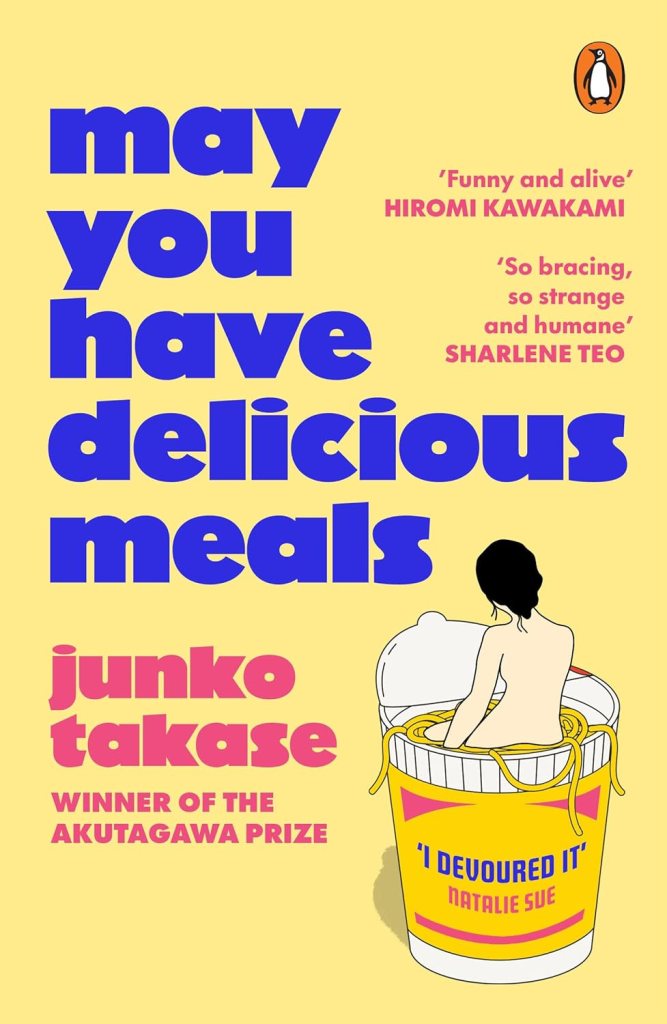
The ritual of the workplace lunch is established immediately in the opening paragraph of May You Have Delicious Meals. A boss in the sales division tells his employees that he is in the mood for noodles and beckons them to join him. Some oblige, but Nitani, one of the novel’s central characters, stays behind and prepares himself a pot noodle, his habitual lunch. As he does so, he reflects further on his food politics. He observes that the boss is inconveniencing those who have brought their own lunches yet expects them to follow regardless. He recalls a previous invitation in which an employee’s refusal prompted the boss to call them anti-social, the invitation hardening into a demand when, with “forced joviality,” he declares: “Boss’s orders!” (p. 1).
The boss’s insistence on communal lunches finds further expression in one of his recurring catchphrases: “Everything tastes better when everyone’s together” (p. 1), a sentiment Nitani does not share.
Nitani’s food of choice is the pot noodle: easy to prepare, reliably filling.
Tellingly, Nitani’s disdain is not confined to the power dynamic between boss and subordinate. While he and his colleague Fuji remain behind to eat their own bento lunches, Nitani is quietly contemptuous of Fuji’s meal. Fuji is eating an omelette that is “not the yellow, smooth, homogenised kind Nitani often bought premade from the supermarket, but one you could tell was homemade from its colour, all white and yellow and speckled with brown” (p. 2). Though Nitani confesses to a flicker of envy, assuming that someone else prepares Fuji’s food and that he “can just live without even having to think about eating” (p. 3), he concedes that everything about food “seemed like a real pain in the arse” (p. 3). Nitani’s food of choice is the pot noodle: easy to prepare, reliably filling. He laments that pot noodles are said to be unhealthy “if you eat nothing else … I wish I could eat pot noodles three meals a day and still meet all the dietary requirements for a healthy life” (p. 3). He goes further, expressing a wish for a pill taken “once a day that had all the nutrients and calories you needed.” Such a pill would be sufficient for subsistence. “Food would still exist, just as a luxury product” (p. 3).
Takase’s novel offers an incisive critique of the workplace lunch and the presumed pleasures of eating.
Takase’s novel offers an incisive critique of the workplace lunch and the presumed pleasures of eating. Nitani’s idiosyncratic attitude towards food also calls to mind Rob Rhinehart’s view of the kitchen as a dirty space and cooking as banal. In an infamous personal blog post, the Soylent founder wrote about extreme sustainability and his revulsion at the act of cooking. “Repeating the same labor over and over for the sake of existence is the realm of robots,” he writes. Unlike Nitani, whose attitude towards food is one of thoroughgoing contempt, Rhinehart concedes that his reliance on Soylent has made him better appreciate dining with friends and exploring his city’s restaurants.
There is also a significant difference in their professional contexts. Rhinehart’s vision of eating reflects the Silicon Valley discourse of biohacking, productivity, and efficiency, a set of attitudes we tend to associate with corporate America. May You Have Delicious Meals gestures instead towards a longstanding Japanese cultural framework in which food is entangled with hierarchical respect and unyielding reciprocity. This is why Nitani’s views remain largely internal. As the plot develops, his feelings about food become inseparable from the gender politics of his workplace. Nitani is drawn to timid, feminine women. When he begins dating his colleague Ashikawa, they eat out at restaurants. Ashikawa is enthusiastic about Italian-style omelettes and Brazilian-style steaks. At an izakaya, she exclaims over the deliciousness of an omelette. Nitani responds, with concealed sarcasm: “You really do know how to make everything seem delicious” (p. 21).
… surveying the bin, he observes with distaste how much waste Ashikawa generated in the course of preparing dinner.
When Ashikawa begins cooking for Nitani, he watches her not with admiration but with detached puzzlement at the seemingly innocuous ingredients she selects. He wonders why she has chosen a carrot to make pickled carrots to accompany white rice with corn and mackerel, and notes that he has never tasted corn in white rice before. That night, while she sleeps, Nitani slips out of bed to make himself a pot noodle, so that he might feel as though he has finally eaten dinner. He recalls the first time Ashikawa visited his apartment and noticed the stacks of pot noodles on top of his refrigerator. A brief but pointed exchange follows about the role of pot noodles in their respective lives. With a “strangely troubled look on her face” (p. 32), Ashikawa admits she almost never eats ramen. As Nitani meticulously cleans the kitchen so that no trace or smell of the pot noodles remains, he has what one might call a Rhinehart moment: surveying the bin, he observes with distaste how much waste Ashikawa generated in the course of preparing dinner.
A third central character, Oshio, provides a contrast to Nitani’s relationship with Ashikawa. Oshio is cast in the mould of the intelligent, glacial corporate woman, and she and Nitani become drinking companions who commiserate together. Unlike with Ashikawa, Nitani is candid about his relationship with food in Oshio’s company. At an oden restaurant, he asks whether she is “one of those people that’s into food?” (p. 61). She muses that she cannot imagine anyone disliking food, at which Nitani laughs darkly and admits: “I hate the idea of arranging my life around eating food” (p. 62).
The novel’s intense focus on food becomes a revealing lens through which its characters are examined. Food is a site of contest and tension. Following a workplace harassment incident, Ashikawa requests a specific accommodation: she cannot work overtime. By way of apology, she begins bringing meticulously prepared homemade cakes and desserts to share with her colleagues. Nitani observes his coworkers’ effusive expressions of gratitude as they eat, and as he eats his own slice in silence, the description of the sweet cream and fruit is rendered with unease. The cream “penetrated to the back of his teeth and into the space partitioned off by the gums above his molars” (pp. 81-82). Both Nitani and Oshio grow irritated by these cakes; Oshio, in particular, resents being expected to absorb additional work to accommodate Ashikawa simply because she brings in desserts. Together, they conspire to humiliate her, secretly depositing her beautiful cakes in a prominent bin where everyone can see.
May You Have Delicious Meals is an unsettling novel that satirises the compulsory camaraderie demanded by office life through the medium of food. Takase’s treatment of the assumed comfort of food and food writing is genuinely provocative, connecting the object of food to the performance of toxicity within a surveilled space in which everyone must play their part, even at the table. What is most admirable about the novel is its brevity. The characters’ motivations are largely contained within the work environment. Though interactions do occur elsewhere, in homes and in the novel’s many restaurant scenes, the characters’ lives are ultimately consumed by the twin acts of working and eating. And these repetitive acts may be joyful to some, and deeply unjoyful to many more.
How to cite: Nguyen, Anna. “Pot Noodles and Power: Junko Takase’s May You Have Delicious Meals.” Cha: An Asian Literary Journal, 14 Jun 2026, chajournal.com/2026/06/14/delicious-meals.

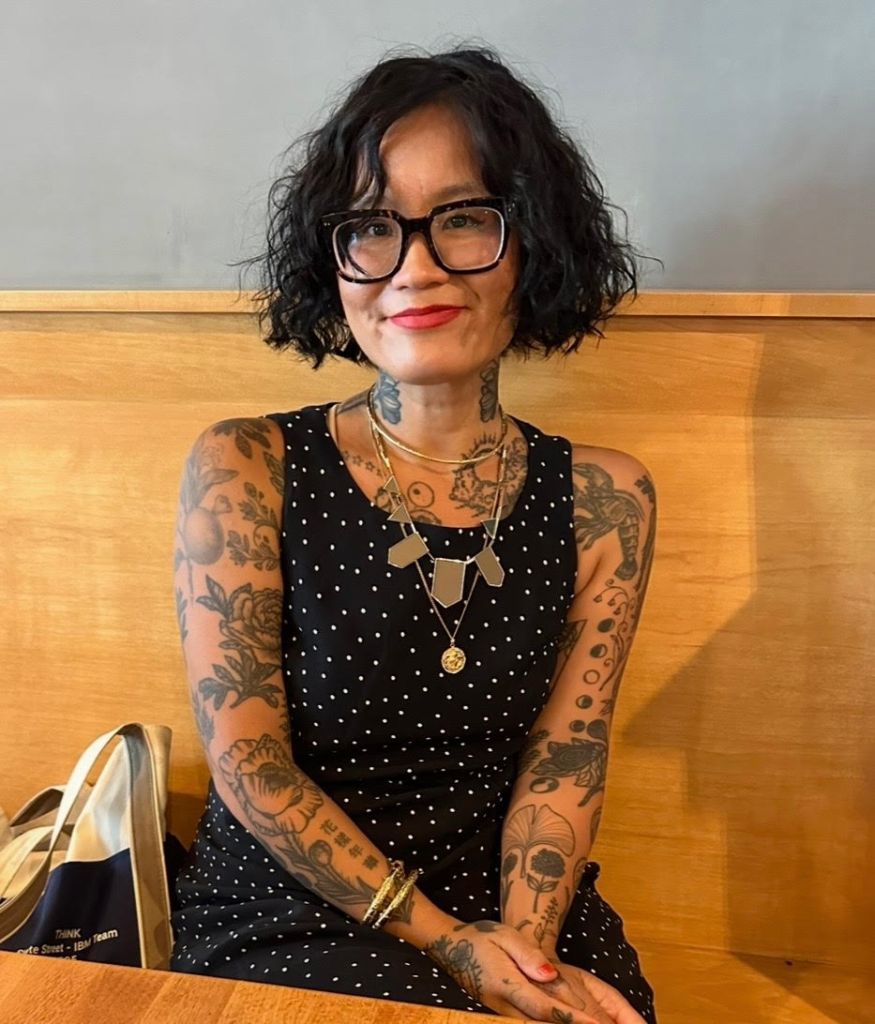

Anna Nguyen left her PhD programme and reworked her dissertation into a work of creative non-fiction while studying for an MFA at Stonecoast, University of Southern Maine. Her work brings together literary analysis, science and technology studies, and social theory to examine institutions, language, expertise, citation practices, and food. She is currently undertaking a second MFA in poetry at New England College, where she also teaches first-year composition. She is the host of the podcast Critical Literary Consumption. [All contributions by Anna Nguyen.]
 Cha
Cha 