
茶 FIRST IMPRESSIONS
茶 REVIEW OF BOOKS & FILMS
[FIRST IMPRESSIONS] “Hong Kong, Then and Now, Through the Eyes of Simon Elegant” by Susan Blumberg-Kason
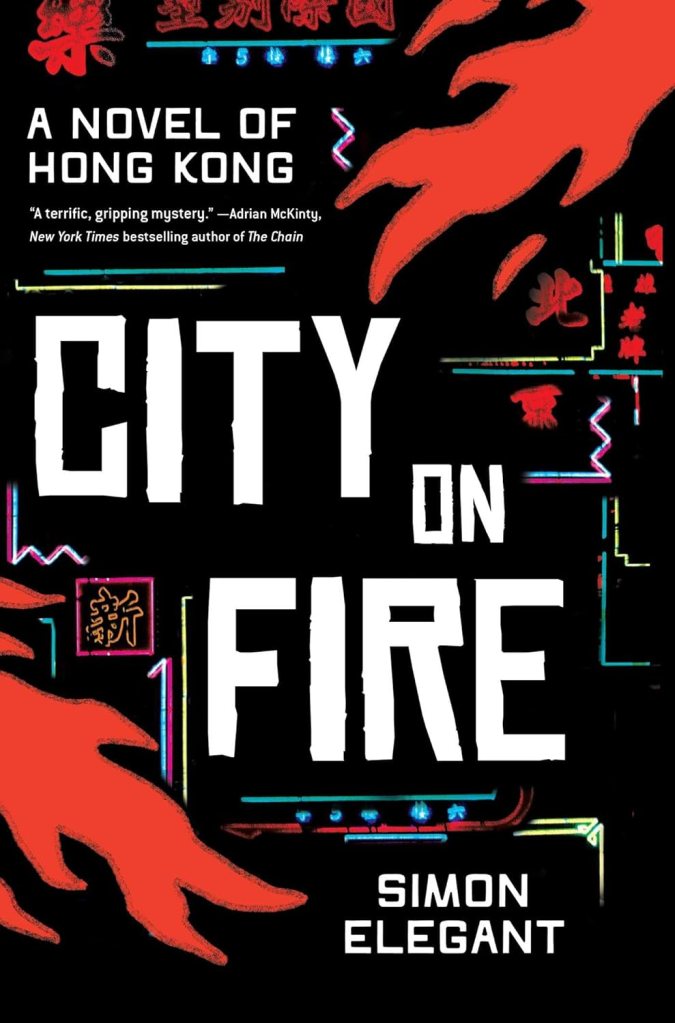
Simon Elegant. City on Fire: A Novel of Hong Kong, Pegasus Crime, 2026. 288 pgs.
The summer I returned to Hong Kong to begin graduate school, I rarely bought books. It was a luxury I could not afford, especially since I had no income apart from teaching English once a week at a cram school in Yau Ma Tei. But when I noticed Simon Elegant’s novel, A Chinese Wedding, in the old South China Morning Post bookstore at the Star Ferry Pier, something about it piqued my interest and I splurged on the purchase.
The protagonist was also a young American woman who had moved to Hong Kong after graduating from university. I was single when I bought the book, but the character of Amy arrives in Hong Kong because she has married her college sweetheart, who wished to return to his home city. He promised her a comfortable life, yet Amy struggles to get along with both her husband’s family and Hong Kong as a whole, and the husband proves far less supportive than expected. I devoured the book in a couple of sittings and still remember the story today, more than thirty years later.
I ended up in a similar marriage a year after I read A Chinese Wedding, and often thought about this story during the five years I was married to my first husband, drawing some reassurance from knowing I was not alone. Besides the insightful cross-cultural lessons Elegant imparts in that novel, he also demonstrated a profound feel for Hong Kong in the early 1990s. He now has a new novel, City on Fire, a police thriller that pays tribute to the complexities of Hong Kong in the contemporary era.
)
City on Fire joins other Hong Kong police novels such as those by Chan Ho-Kei, John Burdett’s The Last Six Million Seconds, and William Marshall’s Yellowthread Street series. In Elegant’s book, Killian Tong is a Cantonese-speaking British police superintendent who was raised by his Chinese stepmother and took her surname. When the story begins, Killian has been placed on administrative leave after accidentally shooting a protestor during the 2019 pro-democracy movement. He is confined to his station up in Deep Bay. Elegant establishes the noir ambiance of the narrative from the outset.
The area leading down to the sea had mostly been cleared in the seventies to make spotting refugees easier. But since vegetation had returned and it was now covered by small trees and bushes, it had become an unofficial headquarters for Hong Kong’s malcontents: the homeless, the dispossessed, a few petty criminals. He could often smell the woodsmoke of their cooking fires drifting up on the shore breeze. They were harmless. He let them be.
Killian also faces conflict within his own family, as his half-sister Jun is a protestor who has become involved with a more revolutionary faction planning acts of violence against government buildings. Yet this dichotomy between yellow and blue is not so clearly defined, for Killian is no dogmatic police superintendent, and Jun is no fundamentalist either. Although the protests form a strong part of the narrative, the story’s central tension derives from the bizarre murder that Killian is put in charge of investigating, despite being on leave. A severed body turns up encased in plastic wrap, entirely without identifying features. It falls to Killian to find out more, and what he uncovers has nothing to do with the protests.
)
Elegant’s treatment of Hong Kong in both City on Fire and A Chinese Wedding lends his books an extra dimension of suspense. In the earlier novel, the Handover looms only a few years away, and there is much to ponder about the city’s future. In City on Fire, Hong Kong’s future is once again deeply uncertain.
Killian warns his sister Jun about the serious consequences she faces if caught attempting to firebomb a government building. With the impending national security law, he fears she could be sent to a mainland prison, never to be heard from again. Jun fights as much for freedom of speech as she does for the five demands of the protest movement: complete withdrawal of the extradition bill, retraction of the characterisation of protests as riots, the dropping of all charges against protestors, the establishment of an independent commission to investigate police brutality, and the implementation of universal suffrage.
In the six or seven years since the protests took place, it is not difficult to see that the fictional Killian’s fears were not unfounded. Having reviewed other books about the 2014 and 2019 protests, I was recently denied two types of visa to enter Hong Kong. It is not the extradition or imprisonment that Killian warned Jun about, but it is nonetheless a sign that a book like City on Fire may not be especially welcome in Hong Kong today, even though it is most certainly a love letter to the city that many of us have called home.
How to cite: Blumberg-Kason, Susan. “Hong Kong, Then and Now, Through the Eyes of Simon Elegant.” Cha: An Asian Literary Journal, 13 Jun 2026. chajournal.com/2026/06/13/city-on-fire-novel.



Susan Blumberg-Kason is the author of Bernardine’s Shanghai Salon: The Story of the Doyenne of Old China, a 2023 Zibby Awards finalist for Best Book for the History Lover. She is also the author of Good Chinese Wife: A Love Affair With China Gone Wrong and the 2024 Zibby Awards winner When Friends Come From Afar: The Remarkable Story of Bernie Wong and Chicago’s Chinese American Service League (University of Illinois Press, 2024). She is the co-editor of Hong Kong Noir and a regular contributor to the Asian Review of Books, Cha and World Literature Today. Her work has also appeared in the Los Angeles Review of Books and PopMatters. Visit her website for more information. (Photo credit: Annette Patko) [Susan Blumberg-Kason and ChaJournal.]
 Cha
Cha 