
茶 FIRST IMPRESSIONS
茶 REVIEW OF BOOKS & FILMS
[REVIEW] “One Script, Many Languages: The Journey of Chinese Writing Across Asia” by Gabriel Corsetti
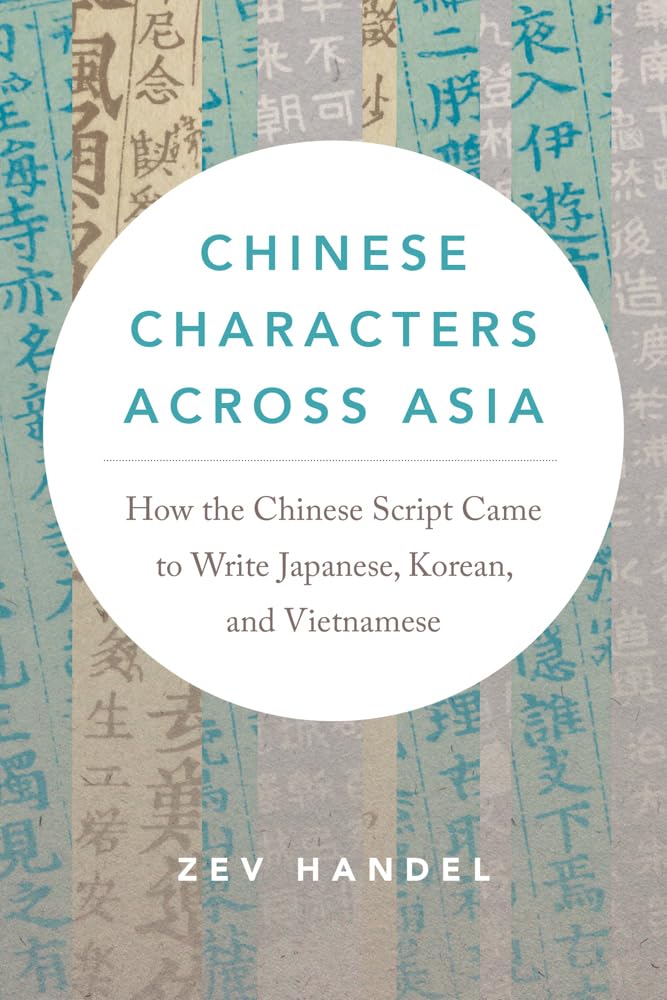
Zev Handel. Chinese Characters across Asia: How the Chinese Script Came to Write Japanese, Korean, and Vietnamese, University of Washington Press, 2025. 276 pgs.
Many aspects of Chinese culture tend to be heavily mythologised, and the Chinese writing system is no exception. A widespread myth holds that Chinese characters represent meaning rather than sound, and that this property allows them to act as a unifying force between speakers of entirely different languages.
It is often claimed that Chinese characters have historically allowed speakers of different languages across East Asia, such as Korean, Japanese, and Vietnamese, to understand one another in writing. A more politically charged myth, widespread in China today, is that the characters have been a foundational unifying force for the Chinese nation, allowing speakers of mutually unintelligible varieties of Chinese, such as Mandarin, Cantonese, and Hokkien, to communicate fluently in writing and share an identical written heritage.
Chinese Characters across Asia, by University of Washington linguist and Sinologist Zev Handel, is an accessible and informative book that thoroughly debunks these and other misconceptions about the nature of Chinese writing. As someone who has lived in China and studied Chinese, I found it an enlightening read; I am certain it will be even more fascinating for those new to the topic.
)
The book opens with an examination of the basic nature of the Chinese script. Handel points out that a writing system representing only ideas or meaning is an impossibility. Human writing is always linked to particular spoken utterances; this is what distinguishes it from pictures.
This brings us to a valuable insight: while most writing systems in use today are alphabetic or syllabic, Chinese writing is morphographic. In other words, the characters do not represent ideas, as is often assumed, but morphemes, the smallest units of meaning in a language. While morphemes are frequently linked to an idea or concept, they also carry specific, unchanging pronunciations. All of this is fairly obvious to those who know Chinese, but I had never seen it laid out so clearly.
Handel traces the history of Chinese writing, from the 3,000-year-old oracle bones, representing the oldest available examples of written Chinese, through to the reforms and simplifications of the twentieth century. None of this will be new to those well-read on the subject, but it is all explained in a clear and comprehensive fashion.
Along the way, Handel dispels several further misconceptions, among them the notion that learning Chinese requires memorising tens of thousands of characters. In fact, several thousand characters suffice to read most texts in modern Chinese. Over its 3,000-year history, Chinese has accumulated many more characters that are either obscure or mere variants of more common ones, but learning these is entirely unnecessary for achieving literacy in the language.
)
After this preamble, the book moves on to its central theme: how Chinese characters came to be used across a vast swathe of Asia. As Handel explains, Chinese writing was brought to what are now Korea and Vietnam following Chinese imperial expansion into those regions over 2,000 years ago. It was introduced to the Japanese later, probably via Korea.
These areas had no native scripts, and Classical Chinese became the sole system of writing used there, even after Chinese rule ended in Korea and Vietnam. This meant that, until the early twentieth century, people from all these regions were able to read the same Chinese texts, even whilst speaking entirely different languages. It was this state of affairs that led Matteo Ricci, Francis Bacon, and other Europeans to propagate the myth of Chinese characters as conveyors of “pure meaning,” capable of bridging the gap between different spoken languages.
In reality, the reason speakers of so many different Asian languages were able to understand one another in writing was simply that they had all learnt to read the same language: Classical Chinese. They were not writing their own languages in characters, but writing in Chinese. The situation is analogous to that of mediaeval Europe, where literate people everywhere learnt to read and write in Latin, regardless of their spoken language.
Although they continued using Classical Chinese for official purposes until the twentieth century, the Koreans, Japanese, and Vietnamese soon felt the need to write down their own languages, particularly for the transcription of poetry and other less formal texts. Chinese characters had been tailored to Chinese, however, and were ill-suited to representing these structurally and grammatically unrelated languages. Accordingly, the characters had to be significantly adapted and modified.
A comparable situation existed within China itself, where speakers of the various varieties of Chinese all learnt to write in Classical Chinese, although in time a written form based on spoken Northern Chinese emerged, eventually forming the basis of modern standard Chinese. To this day, the official position in China is that all regional varieties of Chinese, officially referred to as “dialects,” share a single, unified writing system, despite sounding entirely different.
In the last two centuries, however, a vibrant written form of Cantonese has developed.
The reality is that the different varieties of Chinese have distinct word orders, structures, and grammars, and most have never been committed to writing. In the last two centuries, however, a vibrant written form of Cantonese has developed, making use of specialised characters to represent morphemes with no equivalent in Mandarin. Handel mentions this in passing, though his principal focus is on the way the characters have been adapted to represent non-Chinese languages.
)
Handel’s book offers a detailed account of how the Chinese script was adapted to write four languages: Japanese, Korean, Vietnamese, and Zhuang. The focus on Zhuang is certainly one of the book’s most original contributions. The Zhuang are today China’s largest ethnic minority, concentrated in the south-western province of Guangxi, and their language is related to Thai.
While the histories of Japanese, Korean, and Vietnamese script have been well documented, far less is known about the Zhuang language and its written tradition. Unfortunately, Handel devotes less space to Zhuang than to the other three languages, in all likelihood owing to a scarcity of relevant records and sources.
As Handel explains, Korean and Japanese possess structural features that set them apart from Chinese. Most crucially, both languages make abundant use of grammatical suffixes, as do European languages, whereas in Chinese word forms are invariant. This meant that certain Chinese characters were adopted for their phonetic value alone, to represent Korean and Japanese grammatical endings. In Japanese, the characters used phonetically were stylised and simplified, eventually giving rise to the katakana and hiragana syllabaries still in use today.
Vietnamese and Zhuang, by contrast, are structurally far closer to Chinese. Both also feature invariant word forms, single-syllable morphemes, and tonal distinctions. As a result, the Vietnamese and the Zhuang adapted the Chinese script differently, creating new characters by combining existing ones in order to distinguish between native words and loanwords from Chinese.
)
After guiding us through these processes of adaptation, Handel turns to the present-day status of Chinese characters across the region. Apart from China itself, only Japan still makes common use of Chinese characters, in combination with the local syllabaries. In Vietnam and Korea, they have been gradually abandoned in favour of phonetic scripts. The Zhuang language is now written with a phonetic script developed by the government of the People’s Republic of China, and the old character-based script survives only in ritual contexts.
These outcomes were partly the result of political decisions.
One criticism I would raise is that Handel might have devoted more space to explaining why Chinese characters met such different fates in each country, remaining in widespread use in Japan, surviving in Korea as a subject of study but falling out of everyday use, and being almost entirely forgotten within the span of a century in Vietnam. These outcomes were partly the result of political decisions, and it would have been instructive to learn more about how they were reached.
For instance, Vietnam was colonised by the French, yet it was the Vietnamese independence movement that chose to adopt a Latin-based script and abandon the characters. Was this a consequence of European influence, or primarily a matter of practical considerations? It would also have been illuminating to learn more about why the Chinese government decided to create a new script for the Zhuang language, and how state policy bears on the continued vitality of this minority language. In the case of Zhuang, the sociopolitical context receives scant attention.
)
The book closes with an engaging discussion of the future of Chinese characters. Handel observes that, while Westerners often assume alphabetic writing to be the logical endpoint of human progress, the characters have proved well-suited to modern life and fully compatible with new technologies, including computers and smartphones. They also afford endless scope for creativity and the coining of new characters, something that continues to occur regularly.
The Chinese script is the only one still in active use, a remarkable testament to its resilience and adaptability.
Handel notes that of the four writing systems independently invented by humanity, namely Sumerian cuneiform, Egyptian hieroglyphics, Chinese characters, and Mesoamerican hieroglyphics, the Chinese script is the only one still in active use, a remarkable testament to its resilience and adaptability. His thoroughly reasonable conclusion is that there is no cause to suppose that the Chinese and Japanese will not continue writing in characters well into the future.
How to cite: Corsetti, Gabriel “One Script, Many Languages: The Journey of Chinese Writing Across Asia.” Cha: An Asian Literary Journal, 14 Jun 2026, chajournal.com/2026/06/14/chinese-characters.


Gabriel Corsetti lived in Beijing for fifteen years. Born and raised in Italy, he moved to China to study before working in academia and civil society organisations. He is currently based in Bangkok, Thailand, where he works as a consultant. He writes regularly about China’s foreign relations, civil society, and environmental policies.
 Cha
Cha 