
茶 FIRST IMPRESSIONS
茶 REVIEW OF BOOKS & FILMS
[REVIEW] “Every Puddle a Reflection: On Dorothy Tse’s City Like Water” by Jennifer Eagleton
Click HERE to read all entries in Cha
on City Like Water.
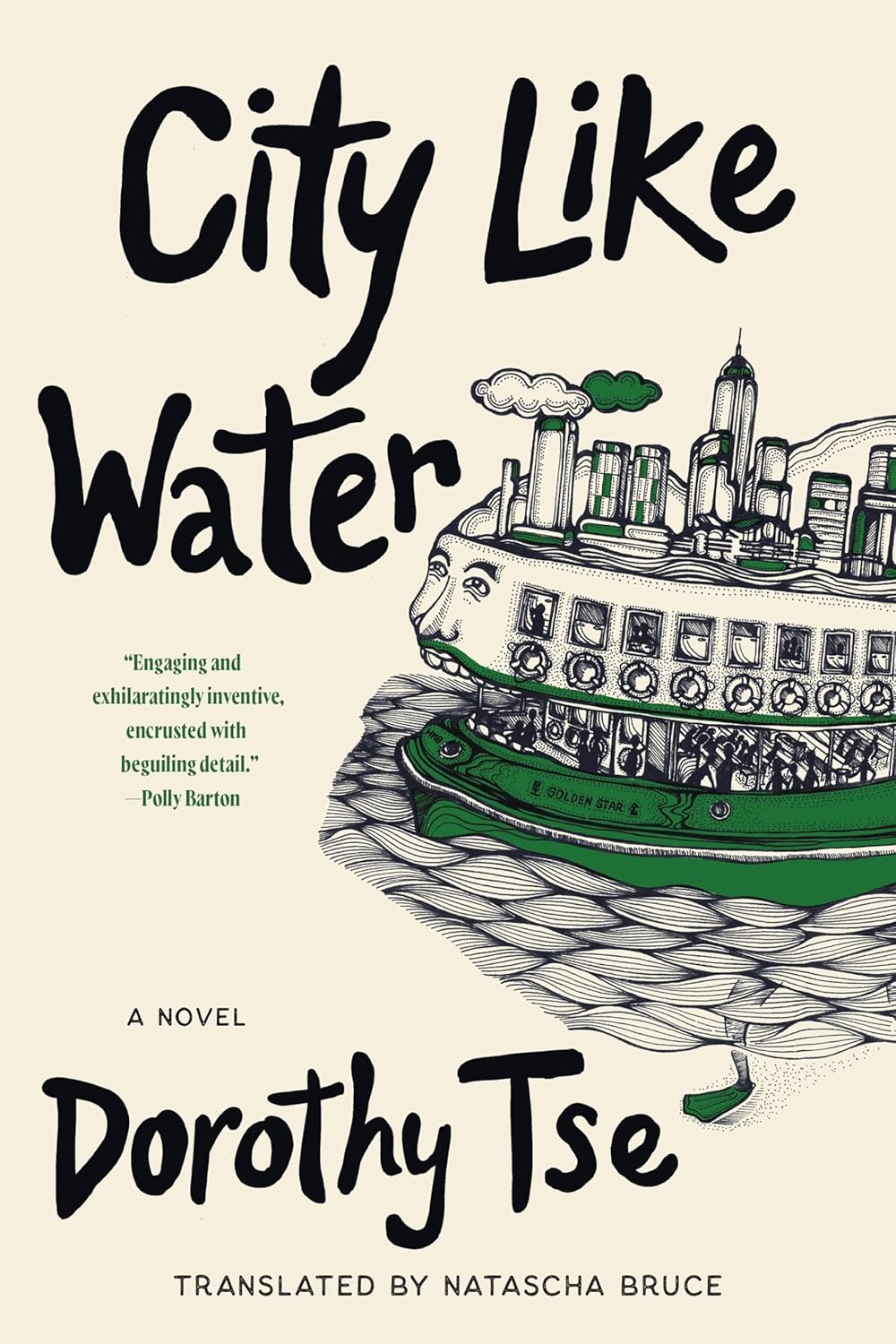
Dorothy Tse (author), Natascha Bruce (translator). City Like Water, Graywolf Press, 2026. 112 pgs.
Hong Kong over the past few years has been both distressing and fascinating for what it reveals about those of us who live, or who have lived, here. I found myself “enjoying” Dorothy Tse’s City Like Water for both these reasons. The book is a remarkable exercise in deploying style and surrealist technique to explore psychological disruption; it concerns an unnamed city, and to one long resident of that city, it can be no other city than Hong Kong.
I am not certain whether readers unfamiliar with Hong Kong will catch the references to recent events there, and may perhaps read these short pieces as a series of dystopian fables of the present (the original Hong Kong Chinese readership would probably have grasped the underlying meaning of each). However, the reader will perhaps apprehend the idea of state repression, the crushing of dissent, people fighting back, and the transformation of the built environment into a “secure zone” where structures or objects undergo false “harmonisation.”
)
City Like Water consists of nineteen brief tales that appear to deal with discrete themes, but one soon realises they link up to tell the story of a disrupted family experiencing extraordinary events in their city. The narrator’s mother becomes involved in a protest movement led by housewives, who are enraged at having been sold lotus roots engorged with blood at the local wet market. The narrator’s father recedes into the living-room sofa, then recedes further into the state-issued television he is watching; in its programmes, he appears only ever as a silent extra, wholly irrelevant. The narrator’s sister is missing, perhaps dead; the narrator herself seems to occupy a liminal space as she goes on protests and navigates the city’s strange new order.
I do not wish to explain the stories in blow-by-blow fashion, as that would spoil the process of discovery for the reader; I want them to make the connections for themselves. With that caveat, I shall cryptically offer some clues drawn from seven of my favourites in this collection.
)
In “Confusion TV”: a vast new television appears in the family home, replacing their much smaller one. It takes up an entire wall, completely concealing all the family photographs and ancestral tablets. “When the television was asleep, I could still recognise the place I’d lived for so long; when the television woke up, I felt as if I was in a whole new space-time dimension.” One must ask oneself: can such a television ever truly be switched off?
In “Paper into Rock”: the narrator learns the art of paper-crafting, and is constantly turning “all the people and things I couldn’t manage to forget” into paper, “just to amuse myself.” She sees paper spouses granting their left-behind partners the strength to overcome grief. Paper becomes “rock-like,” but is it strong enough to overcome grief indefinitely? One is reminded of the Asian practice of consigning paper effigies to the netherworld after a loved one passes. Paper decays; it does not ultimately become rock.
In “Ears like Butterflies”: bloody butterflies seen in the sky are not butterflies at all but ears borne on the wind. People’s ears fall in the street; they panic, pick them up, and “simply grab two, regardless of colour or size, and rush to the nearest hospital.” “Do they grow back again? I think that they are artificially attached. Transplanted organs are not as good as ones that have always been there.” The narrator’s ears remain intact until she encounters some noodle-eaters who reveal their animal-like form, whereupon they fall.
In “To Eight Thirty-One”: during every commute, the narrator comes across the same man who wishes to go to Station 831, yet neither he nor anyone else seems able to get there, despite the excellence of the mass transit rail system. One cannot go to this station because it no longer exists; the authorities have removed it. “Sorry for any inconvenience caused,” they say. Occasionally, on the walls of the city where I live, numbers such as 831 used to be scrawled, to record what had occurred at such stations.
In “The Law Comes at Night”: in anticipation of a visit, the citizenry buys padlocks and piles them on security grilles; others clean their homes and make up guest beds; they are uncertain what colour they should paint the guest room. At a loss, they begin “concocting their own versions of the Law, vehemently arguing about whose interpretation was correct, going round and round until the only solution was to punch each other.” As one who writes and analyses this Law, I understand why some may be uncertain about what to do; yet I press on in my attempt to make a kind of “sense” of the personality of this Law’s visitor in a way that does not “threaten” the Law itself.
In “Island on My Thigh”: the narrator develops an “island-shaped tumour” that drifts across her body, and says to herself: “If, one day, all my jumbled memories sink to the bottom of the sea, at least I’ll have this island, as a kind of proof.” Whilst in a public bathhouse, she notices a “familiar island” on a man’s shoulder blade, and in a “thin, barely audible voice” the man says: “Have you carried it a long way too?” We carry our significant places almost like engravings upon ourselves. I felt quite moved reading this tale.
In “City Like Water,” the final tale in the collection, water sloshes through the ear canal and the eardrum trembles. Fountains spurt to familiar tunes, and the refreshing spray is transporting, evoking long-ago afternoons. “Every rainy day, the city breaks up into so many puddles, and every puddle contains a reflection, and every reflection is the reflection of another reflection.” The city is like water; umbrellas emerge, do their work, disappear, and lie “in a cupboard full of junk,” having “long since been girding their limbs, sharpening their spikes.” Perhaps one day they will be ready for an outing.
In summary, amongst numerous passages relating to destruction or loss, I was also struck by the one below, on how people handle disappearances. It is important to remain alert to what is happening, both incrementally and suddenly, to find hope through one’s observations, and to resist being lost to cynicism or indifference.
If I’m honest, a couple of rooms have been off limits since I started working here. You’ve probably heard the story of Bluebeard, but I’m telling you, in real life people just aren’t that curious. Why would they be? They’re staying in this gorgeous hotel. Every day there’s another amazing banquet for them to feast on. Why would they care about the one or two rooms they’re not allowed to enter? Maybe that’s where it all started, though. Maybe that’s why the hotel has ended up in such a state. (From “Thin Day Hotel”)
This book may also be skirting close to a “softer” kind of resistance that can still deftly step over red lines. Although the city can no longer shout out loud, silence should not be an option. There are ways and means, as demonstrated by Tse’s City Like Water and other recent works of Hong Kong fiction.
)
I read the following passage in City Like Water and it brought back a memory of my own.
I think of the lotus root again. The lotus not-root. The root that’s a kind of flute, a piccolo, black and filled with a muddy sound. Blow it, and it tastes like rain. I walk a long way just to buy a postcard of a slice of lotus root. Full of black holes. I want to tell my little sister that it’s a silly face with too many nostrils.
A few years ago, I met a man who had a fear of holes: “Trypophobia refers to disgust or fear of a pattern of holes. Seeing clusters of holes in foods, flowers and everyday items like sponges can trigger feelings of revulsion. Trypophobia is gaining recognition as an anxiety problem that can affect quality of life.”
I had asked him whether he had seen the new Yayoi Kusama exhibition at the M+ Museum in Hong Kong. Of course not, he said, explaining his condition.
Testing him, I showed him the picture below. He recoiled.

Photo by Jennifer Eagleton
How to cite, Eagleton, Jennifer. “Every Puddle a Reflection: On Dorothy Tse’s City Like Water.” Cha: An Asian Literary Journal, 28 May 2026. chajournal.com/2026/05/28/tse-city.


Jennifer Eagleton, a Hong Kong resident since October 1997, is a close observer of Hong Kong society and politics. Jennifer has written for Hong Kong Free Press, Mekong Review, and Education about Asia. She has published two books on Hong Kong political discourse: Discursive Change in Hong Kong(Rowman & Littlefield, 2022) and Hong Kong’s Second Return to China, A Critical Discourse Study of the National Security Law and its Aftermath(Palgrave Macmillan, 2025). Her poetry has appeared in Voice & Verse Poetry Magazine, People, Pandemic & ####### (Verve Poetry Press, 2020), and Making Space: A Collection of Writing and Art (Cart Noodles Press, 2023). [All contributions by Jennifer Eagleton.]
 Cha
Cha 