
茶 FIRST IMPRESSIONS
茶 REVIEW OF BOOKS & FILMS
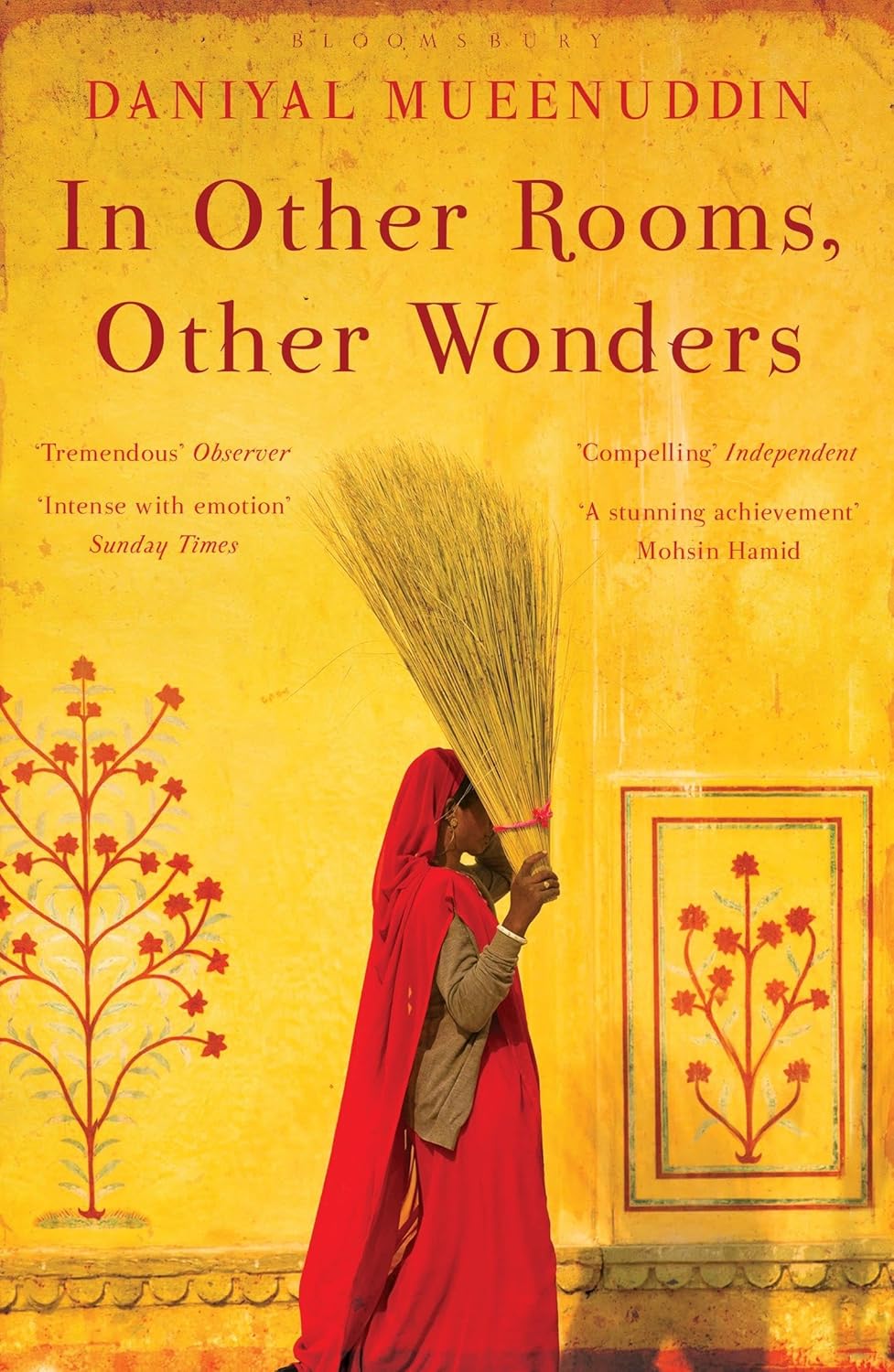
[REVIEW] “How Daniyal Mueenuddin’s In Other Rooms, Other Wonders Makes Class Feel Inescapable” by Abhinav Tulachan
Daniyal Mueenuddin. In Other Rooms, Other Wonders, W. W. Norton & Company, 2009. 237 pgs.

More often than not, the novels I end up enjoying most are those recommended by a friend or family member. The most cherished stories in my collection all arrived through this process.
Regular readers of my reviews may already recall Samrat Upadhyay’s Mad Country, a suggestion from my father and one of my favourite story collections to date. The same holds for books such as Parajuly’s The Gurkha’s Daughter, another recommendation from my father, alongside the well-worn copy of The Five People You Meet in Heaven that I own, which a friend gave me long ago in seventh grade. These are among the most profound literary works that I still revisit as part of my own small annual tradition.
I greatly appreciate recommendations (especially given that my own reading list grows ever shorter), but at times I cannot help feeling that they can carry a certain weight that becomes rather cumbersome.
)
Now, do not misunderstand me: recommendations carry a special kind of intimacy. But what does one do when one feels obliged to read and to respond favourably? I cherish these books, I truly do, but often when someone gives me one, I feel I am levied with a certain expectation to love it, or at the very least to offer a thoughtful response, and that can somewhat hinder the reading experience.
That was partly the feeling with which I opened Daniyal Mueenuddin’s In Other Rooms, Other Wonders, recommended to me by a university friend: that burden of meeting non-existent expectations even before turning the first page. Such concerns seem hardly worth dwelling on now.
In Other Rooms, Other Wonders is a collection of short stories, much to my initial delight, interlinked around the life of a wealthy Pakistani landowner by the name of K.K. Harouni. Harouni himself, however, is rarely the central focus. Rather, the collection offers a closer examination of the highest and lowest rungs of Pakistan’s class system, as each story centres on the servants, workers, and family members of the household, whose lives are all interconnected and shaped by the same hierarchy under which they live and labour. Beyond the format itself, I particularly admired how Mueenuddin renders Pakistan’s social structure through this web, in which everyone, from the landowner to the electrician, from the young relative to the ageing gardener, is bound to the other by threads of obligation, ambition, and fear. It gratifies the reader’s instinct for pattern and connection whilst simultaneously placing each story within a larger, shared world. What emerges is a portrait of Pakistan’s class system as something deeply ordinary, and therefore all the more difficult to escape.
The stories that stayed with me most were those that most clearly dramatise this logic: those led by characters who teeter on the very edge of the system. These are the first and last stories in the collection. “Nawabdin Electrician,” the most memorable for me, immediately draws the reader into Pakistan’s social world through the figure of a clever and resourceful man whose most prized possession is a motorbike granted to him by Harouni.
Nawabdin is the breadwinner of a family of thirteen children, and he earns his keep by repairing electric meters and cultivating the favour of his master, which he does with considerable shrewdness. His pride lies in his cleverness and in his beloved motorbike, which he takes with him everywhere. But that same motorbike eventually forces him into a tense and morally charged situation, compelling him to make a decision no one should ever have to face. I shall not disclose the precise details, leaving those for the reader to discover, but the story, for all its brevity, is densely and tensely plotted. In a few short pages, it felt as though I had witnessed a man’s entire life: his hopes, his aspirations, his fears, all contained within the span of a few minutes’ reading. Upon finishing it, I felt I had just moved through a small novel rather than a handful of pages. Another reviewer has called it “one of the best stories I have read in a long time,” and I find no reason to disagree.
“Saleema” engages a similarly emotional arc, albeit from a different angle. It is the story of a young woman who flees a drug-addicted husband and takes up work as a maid in Harouni’s household, seeking to improve her station in life. Slowly, however, she, and we alongside her, come to understand that the life she is attempting to build is barely held together, and that her future rests entirely upon the whims of a man.
It is a cruel yet realistic and necessary depiction of the absence of choices available to a poor woman, or indeed to any common person, and that depiction grows all the crueller when even those limited choices are exhausted. It is a reminder of how profoundly the lives of ordinary people depend upon those above them, and how easily, how heartlessly, that hand can withdraw.
At this juncture, readers familiar with South Asian literature may notice a recognisable pattern emerging in Mueenuddin’s Pakistan. Class, it appears, regardless of the society in which it operates, tends to burden the poor whilst elevating the wealthy, and Mueenuddin’s Pakistan proves no exception. Pakistan’s feudal class system, India’s caste hierarchy, Nepal’s own entrenched networks of corruption: the terminology differs, but the structural logic persists.
It prompts one to wonder how many other such systems govern our lives, our choices, and our very perception of the world, operating under different names but to the same end.
)
I mentioned previously that my personal favourites from this collection were the first and last stories, and the latter, I believe, most clearly crystallises everything the collection has been saying about class. “A Spoiled Man” centres on Rezak, an elderly gardener who lives in a portable tin hut and has learned, over a lifetime, to expect nothing from the world. He is then put to work for an American woman, and a single act of kindness on her part brings him a measure of happiness he has never previously known.
The difficulty, and it is a difficulty that surfaces in varying forms throughout this collection, is that such kindness was never designed for a man like Rezak. In a world that tolerates the poor only so long as they remain poor, even the smallest gift, however nobly intended, can brand a man a thief and unmake him entirely. Rezak is arrested by the police on false suspicion of theft, ruthlessly beaten, and left in far worse circumstances than those from which he began. What stings most is that no one here is acting with deliberate cruelty: Rezak’s mistress means well, and the officers who arrest and beat him are merely enforcing what everyone understands to be the natural order. The tragedy lies in how structural class operates: even well-intentioned actions yield devastating consequences, and class persists as a lingering presence that shapes every mindset, every action, until it governs the very social fabric in which these characters exist.
There is much to unpack, but what lingers longest from In Other Rooms, Other Wonders is the weight of a system that assigns value to some and precarity to others so seamlessly that even kindness becomes a threat. One scarcely registers how suffocatingly narrow the choices are for so many individuals, because the system was constructed precisely to obscure this fact. Reading the collection, one inhabits a world that punishes invisibility and visibility alike, and by the final page, it becomes clear that survival itself is a rigged game for those born on the wrong side of the line.
Such is what I have come to understand. And to the friend who recommended this remarkable collection: even if it was not your intention, and even if you were not anticipating a detailed analysis, I sincerely hope that these thoughts have done your gesture some justice.
How to cite: Tulachan, Abhinav. “How Daniyal Mueenuddin’s In Other Rooms, Other Wonders Makes Class Feel Inescapable.” Cha: An Asian Literary Journal, 30 May 2026, chajournal.com/2026/05/30/in-other-rooms.


Abhinav Tulachan is an undergraduate student in the Department of English Language and Literature at Hong Kong Baptist University. He loves reading, writing, and sharing the knowledge he has gained through his academic journey. [All contributions by Abhinav Tulachan.]