
茶 FIRST IMPRESSIONS
茶 REVIEW OF BOOKS & FILMS
[ESSAY] “Remixing Memory, Forgetting Politics: On Wong Kar-wai and the Limits of Bricolage” by Anna Nguyen
Click HERE to read all entries in Cha
on Remixing Wong Kar-wai.
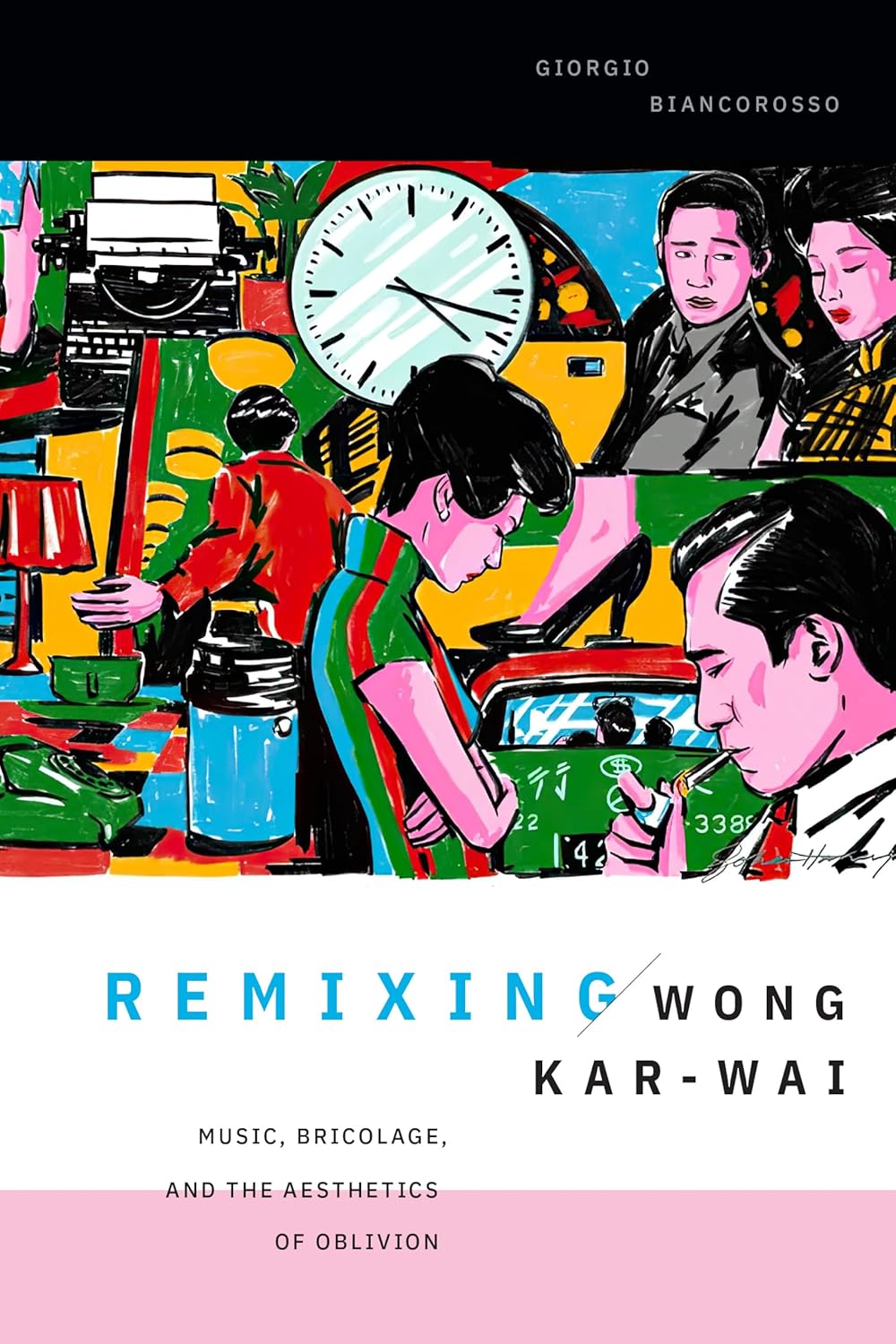
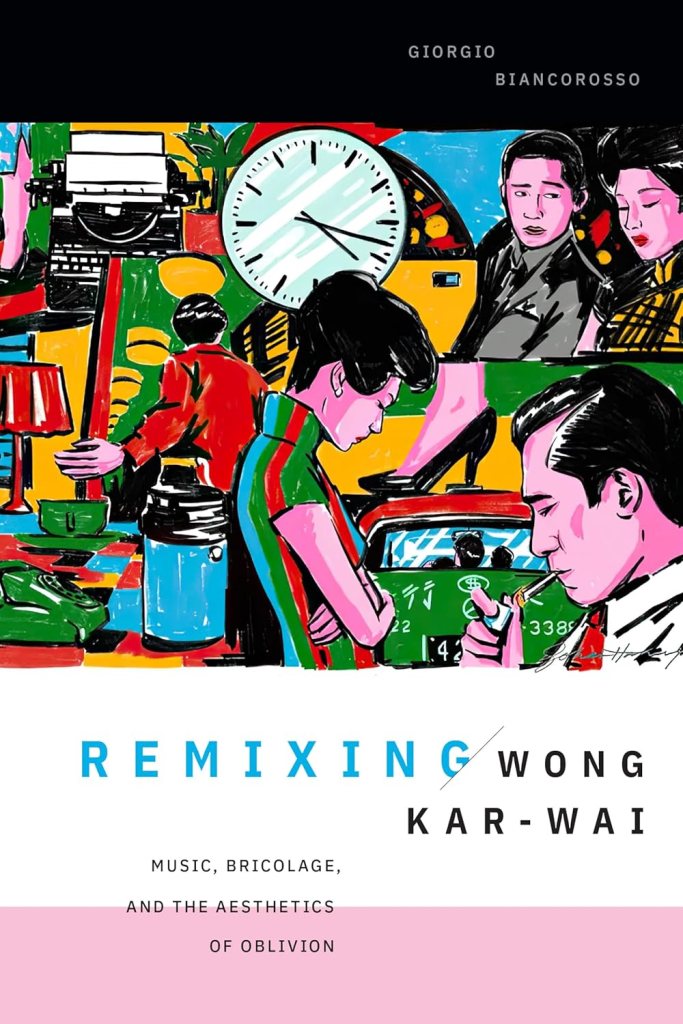
Giorgio Biancorosso. Remixing Wong Kar-wai: Music, Bricolage, and the Aesthetics of Oblivion, Duke University Press, 2025. 240 pgs.
There is a 1992 TVB show I recently watched in dubbed Vietnamese. I know it as Đại Thời Đại, though it is perhaps more widely recognised as The Greed of Man, starring a pre-Hong Kong film star, Lau Ching-wan. When episode 36 played, I looked up, interrupting my writerly thoughts, to strain my ears in order to catch the singing. Because I find these dubbed dramas on YouTube, the original soundtrack is almost always obscured or removed for copyright reasons. As Yammie Lam’s Lo Wai-ling character is dying, Faye Wong’s distinct vocals, in Cantonese, are heard. She sings “容易受傷的女人”, which I have seen translated as “Easily Hurt Woman” or “Vulnerable Woman”. The song continues as the scene ends and the credits roll.
“容易受傷的女人” / “Easily Hurt Woman”
The melody of this song holds significant meaning for me. When I was a young child growing up in the southern United States, the Vietnamese singer Như Quỳnh performed “Người tình mùa đông” in 1994 on the stage of Asia Entertainment, a Vietnamese-American music production company based in California. As a child unaware of the politics of language and translation, I did not attend to the telling signifier of lời Việt (a crude translation might be “Vietnamese words”) when the song was introduced and simply assumed that “Winter Lover” formed part of Vietnamese culture.
Both Faye Wong’s and Như Quỳnh’s versions are covers of the Japanese original, translated as “Rouge” and performed by Naomi Chiaki in 1977, a piece of trivia I would learn much later in life.

I was reminded of the lineage of these songs while reading Remixing Wong Kar-wai: Music, Bricolage, and the Aesthetics of Oblivion by music scholar Giorgio Biancorosso, who examines the famed director’s musical sensibilities and decisions in order to rethink and re-theorise borrowing, appropriation, and repurposing of original scores, or what Biancorosso terms “remixing”.
Biancorosso’s original contribution turns to the auteur’s idiosyncratic use of pre-existing music in his soundtracks.
In his introduction, Biancorosso notes that Wong Kar-wai’s films are lauded for their visual appeal, restrained dialogue, and keen attention to an atmospheric 1960s Hong Kong (p. 4). These are the clichéd appraisals of any Wong Kar-wai film, yet Biancorosso’s original contribution turns to the auteur’s idiosyncratic use of pre-existing music in his soundtracks, connecting his creative approaches to both film and music. Biancorosso argues that directing films “turns Wong Kar-wai the music lover and end user into a bona fide composer or re-composer of the very repertoires he explores, the listener as bricoleur” (p. 5). The author further describes the bricoleur as “the urban dweller and media consumer conjuring worlds from the detritus of the mediascape” (p. 5). Thus, bricolage refers to Wong’s practice of eschewing original composition in favour of existing music in order to construct his soundtracks.
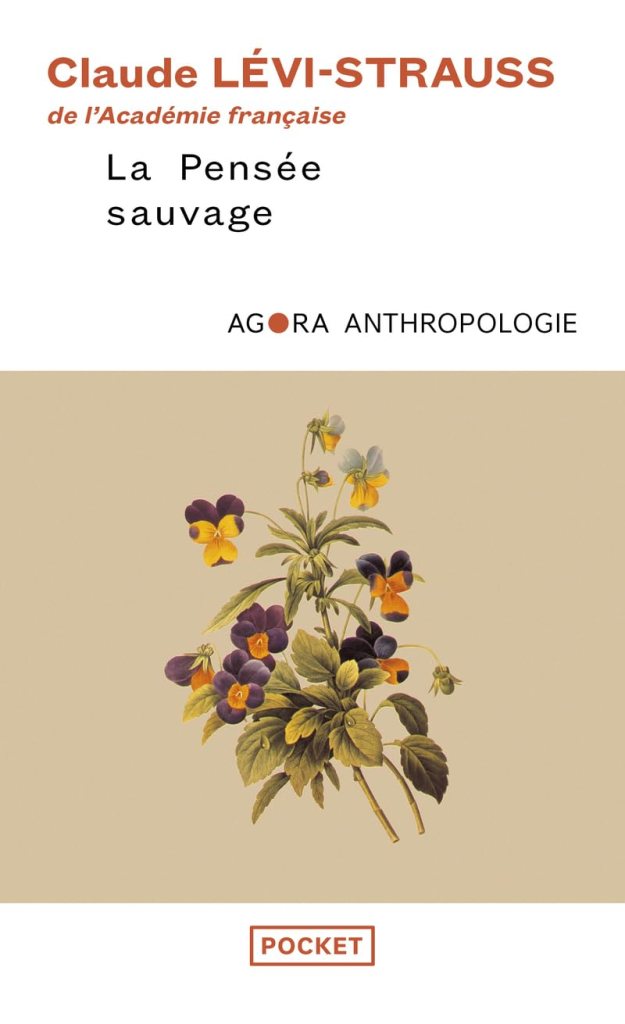
Biancorosso’s conceptual lineage draws from Claude Lévi-Strauss, who introduced bricolage “to capture a dimension of mythical thought, the metaphor of bricolage initially gave a new impetus to the study of style in fashion and the emergence of subcultural movements such as punk” (p. 6). The author laments that bricolage has since receded in artistic discourse because of deconstructivist critiques from Jacques Derrida, Gilles Deleuze, and Félix Guattari. Derrida, in particular, challenges Lévi-Strauss’s metaphorical “engineer”, who “has a precise goal in mind and builds out of raw materials or components made or sourced” (p. 6), arguing instead that “it is both practically and logically impossible for anyone to be ‘the absolute origin of his own discourse’” (p. 6). The myth of the engineer, as conceptualised by Lévi-Strauss, is itself produced by the bricoleur.
)
Biancorosso revisits this philosophical debate in order to revitalise bricolage, an approach that proves apt in evaluating Wong’s work, especially as critics frequently claim that the auteur is overly attached to the past. The author describes Wong as “a postcolonial subject coming to terms with a colonial past” (p. 17), most evident in his 1960s trilogy, namely Days of Being Wild (1990), In the Mood for Love (2000), and 2046 (2004). However, this provocative claim is somewhat weakened when Biancorosso cites filmmakers such as Stanley Kubrick, Quentin Tarantino, and Sofia Coppola rather than Wong’s contemporaries within Hong Kong cinema, many of whom similarly engage with postcolonial anxieties and national identity. Nevertheless, the comparison remains instructive, as these filmmakers likewise employ bricolage in their soundtracks.
The audiovisual poetics (p. 21) in Wong’s work are tied to a citational mode of reflection. Where many critics invoke the notion of genius when describing Wong Kar-wai, Biancorosso seeks “to demystify the idea of the author as the sole source of an artwork that has informed the emergence of intertextuality in literary studies” (p. 24). He argues that Wong does not merely cite borrowed music but actively recomposes it in order “to create a participatory space in which pre-existing music, as reconfigured in a film, is heard anew” (p. 24). This process of recombination effectively conjures an entirely new world.
The subsequent chapters do not focus on a single film but instead trace remixing techniques across Wong’s oeuvre. The first chapter opens with a piece of internet lore, namely that “the world’s first Wong Kar-wai moment” occurs in As Tears Go By (1988). Biancorosso offers a brief ekphrastic account of a slow-motion scene featuring Andy Lau and Maggie Cheung kissing in a brightly lit phone booth, evocative of what would soon become Chris Doyle’s signature visual style (p. 28). A familiar song accompanies the scene, “Take My Breath Away”, performed by Canto-pop singer Sandy Lam. This moment reappears in Days of Being Wild, where Cheung and Lau again occupy a similar setting, though now situated within a 1960s Hong Kong milieu. The soundtrack shifts to Xavier Cugat’s 1959 version of “Perfidia” (p. 30). This motif is later recycled in Chungking Express (1994), where a cover of The Cranberries’ “Dreams”, performed by Faye Wong, accompanies a scene in which her character redecorates Cop 663’s apartment (p. 69).
One of the most compelling analyses in this chapter concerns Tony Leung’s enigmatic, silent character in Days of Being Wild. The camera meticulously captures him in a confined space as he prepares to go out, accompanied by music from Xavier Cugat. Biancorosso interprets this scene as emblematic of Wong’s interrupted narrative vision and his difficulty in advancing the story. The ending gestures towards an unrealised sequel, rendering the isolated scene “a matrix of narrative possibilities, none of them fulfilled and more appealing for it” (p. 48).
Biancorosso further situates Wong’s “poaching” within the broader context of Hong Kong’s film and television industries. During the 1980s and 1990s, the industry operated at a rapid pace, often constrained by limited budgets and tight schedules. Even acclaimed performers such as Maggie Cheung, Tony Leung, and Andy Lau appeared in extensive filmographies under such conditions. However, Biancorosso distinguishes Wong through his reliance on existing scores. This practice “does not make the borrowed tracks vehicles of intertextual associations” but instead reflects a “repackaging of imported goods as if they were its own” (p. 64), thereby generating new meanings.
This notion of poaching is explored in The Grandmaster (2013), which features evocative compositions by Ennio Morricone. The piece “La donna romantica”, originally heard in Come imparai ad amare le donne, accompanies a pivotal exchange between Ip Man (Tony Leung) and Gong Er (Zhang Ziyi). As Gong Er, gravely ill, confesses her love, the music shifts in response to Ip’s reply, shaping “both the duration of the episode and rhythm of the conversation” (p. 65).
)
At times, it appears that Wong simply favours certain pieces of music.
Biancorosso contends that Wong borrows without citation (p. 65) and does not attempt to establish geographical or historical correspondences. At times, it appears that Wong simply favours certain pieces of music, as evidenced by his repeated use of Shigeru Umebayashi’s “Yumeji’s Theme”, derived from Seijun Suzuki’s Yumeji (1991). The piece is ubiquitous in In the Mood for Love and is later rearranged in My Blueberry Nights (2007), Wong’s only non-Hong Kong production (p. 71). Biancorosso expresses a degree of regret that Yumeji remains largely unknown, concluding his book by describing it as “condemned to oblivion” (p. 186).
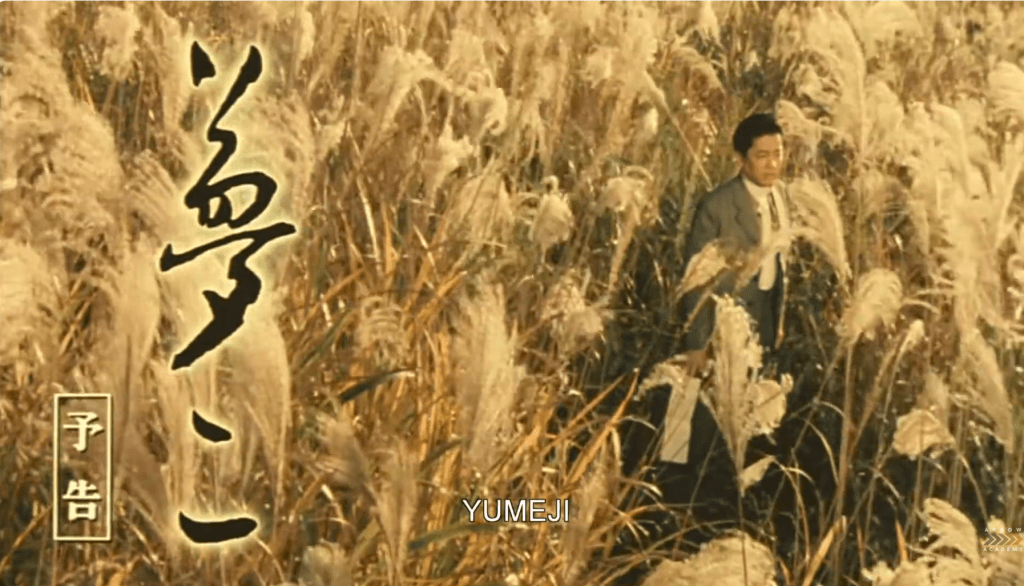
Seijun Suzuki’s Yumeji (1991)
In his discussion of Ashes of Time (1994), Biancorosso notes that it is the only film in Wong’s canon that does not employ pre-existing music and is, “ironically, also the most derivative” (p. 117). He clarifies that this usage is technical rather than pejorative. Originally released in 1994 and later restored as Ashes of Time Redux in 2008, the film occupies a complex critical position, particularly when comparing Western interpretations with those informed by Jin Yong’s martial arts narratives. Despite its narrative opacity (p. 121), Biancorosso describes the original as a “manifestation of the local-global nexus”, later revised “in the shadow of a new, flamboyant, and internationally minded form of pan-Chinese production” (p. 136). The Redux version features altered colour grading and replaces the original’s sonic intensity with “a chamber orchestra enriched by Chinese instruments, most prominently the Chinese zither” (p. 131). Biancorosso interprets this as Wong’s “attempt to adopt a musical aesthetics not his own” (p. 138).
The final chapter examines “Six Days” (2002), a music video directed by Wong and commissioned by DJ Shadow. Starring Chang Chen and Danielle Graham, the video incorporates familiar elements of Wong’s style. Biancorosso traces the song’s layered citational history, noting that “Six Days” remixes the 1971 pacifist track “Six Day War” by Colonel Bagshot (p. 157), itself referencing the Six-Day War (p. 158). In Wong’s reinterpretation, the geopolitical conflict is transformed into a narrative of personal betrayal and internal struggle (p. 159).
Biancorosso concludes by returning to In the Mood for Love, offering a political reading that links back to the obscured origins of “Six Days”. While the music video omits explicit reference to the 1967 conflict, the final act of the film foregrounds economic uncertainty and political unrest. Three years after the failed romance between Mr. Chow and Mrs. Chan, Mrs. Chan returns to her former residence, where Mrs. Suen reveals her intention to leave Hong Kong for the United States due to “the situation in China”, referring to the 1966 to 1967 riots (p. 181).
This political interpretation is valuable, though it arrives rather late in Biancorosso’s study. There are numerous opportunities to connect musical citation, bricolage, and Wong’s cinema as a political project. The circulation and consumption of media in Hong Kong, along with the shifting landscape of its film industry, provide fertile ground for such analysis. Yet a disconnect emerges when politics is detached from historically situated films, which are instead described as “timeless”, a characterisation that risks undermining their political significance. Wong’s politics may be deliberately obscured, echoing Biancorosso’s concern that the origins of “Yumeji’s Theme” are consigned to oblivion, a condition he associates with Wong’s inclination towards forgetting rather than remembering.
However, as suggested by the earlier discussion of Naomi Chiaki’s relatively overlooked “Rouge”, obscurity may not be the central issue. The more pressing question concerns attribution and recognition. Rather than asking who forgets, it may be more productive to ask who does not forget.
Sampling and bricolage ought to carry political significance.
I am reminded of Prince’s remarks on musical sampling. Although not opposed to the practice, he expressed concern that “sampling the sample that was already sampled” might erode the integrity of original music. A similar proposition may be drawn between Prince’s critique and Biancorosso’s concept of bricolage, namely that sampling and bricolage ought to carry political significance.
How to cite: Nguyen, Anna. “Remixing Memory, Forgetting Politics: On Wong Kar-wai and the Limits of Bricolage.” Cha: An Asian Literary Journal, 12 May 2026, chajournal.com/2026/05/12/wong-kar-wai-remixing.



Anna Nguyen left her PhD programme and reworked her dissertation into a work of creative non-fiction while studying for an MFA at Stonecoast, University of Southern Maine. Her work brings together literary analysis, science and technology studies, and social theory to examine institutions, language, expertise, citation practices, and food. She is currently undertaking a second MFA in poetry at New England College, where she also teaches first-year composition. She is the host of the podcast Critical Literary Consumption. [All contributions by Anna Nguyen.]

