
茶 FIRST IMPRESSIONS
茶 REVIEW OF BOOKS & FILMS
[REVIEW] “No Useless Poems: Tsering Woeser’s Greater Tibet” by Angus Stewart
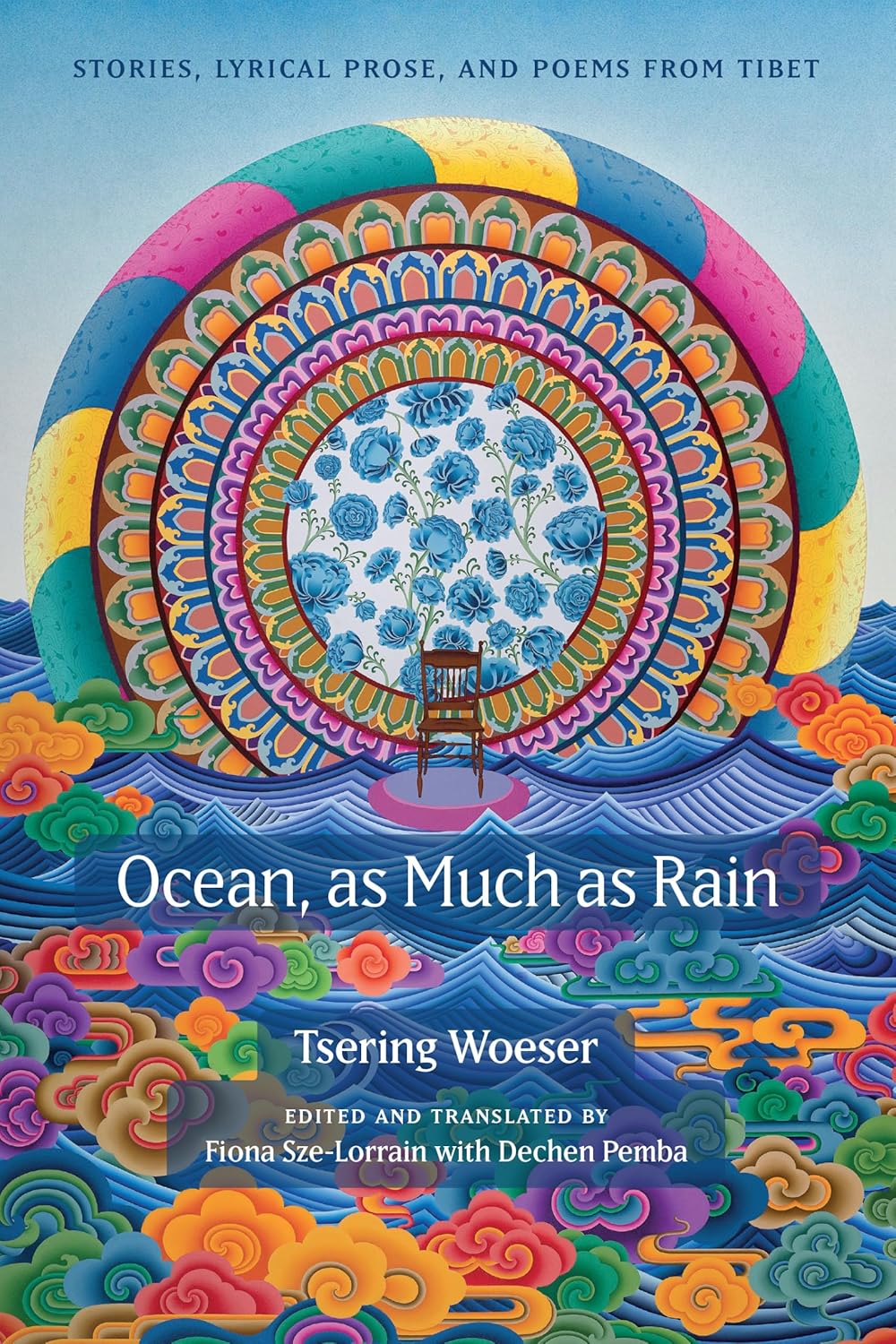
Tsering Woeser (author), edited and translated by Fiona Sze-Lorrain with Dechen Pemba. Ocean, as Much as Rain: Stories, Lyrical Prose, and Poems from Tibet, Duke University Press, 2026. 210 pgs.
This year sees the publication of Ocean, as Much as Rain, a very new sort of work in English translation for Tsering Woeser, usually referred to simply as “Woeser”. She is a dissenting writer of mixed Tibetan-Han heritage who, after an education conducted solely in Mandarin, turned her writing to Tibetan identity, heritage, and politics in the late 1980s. She still lives in China, under heavy scrutiny from the state, and moves, not easily, between Lhasa and Beijing.

Tsering Woeser (Via)
Her translators are Fiona Sze-Lorrain and Dechen Pemba. The former is a writer and literary translator who works across forms, with a particular strength in poetry. She not only co-translated this collection, but also curated its contents. The latter is a UK-born Tibetan with a range of experience in lobbying, campaigning, and running projects and initiatives concerning Tibetan issues and culture. She runs High Peaks Pure Earth, a site covering Tibet on which Woeser has a strong presence.

Fiona Sze-Lorrain and Dechen Pemba
There is also a foreword by Indian essayist and novelist Pankaj Mishra. He provides a concise biography of Woeser and concludes with praise for her “confidence, style, wit, and embodiment of the free life of the mind”.
This is followed by “Ocean Can Be Rain,” an essay by Sze-Lorrain on Woeser’s life and writings. It opens with a more complete biography, offering greater detail on both the censorship and state pressure Woeser contends with, and her corresponding one-woman migration into a “Tibetan cyberspace” of blogs, social media, and radio appearances. And yet Woeser’s literary work remains little known in English translation. Sze-Lorrain hopes to change that. Her essay establishes concepts and concerns useful for readers less familiar with Tibet, beginning with the distinction between the current province of Tibet within modern China and the historical and ethnic “Greater Tibet”, made up of three regions: Ü-Tsang, the heartland and more or less today’s Tibet; Kham, to the east, Woeser’s childhood home; and Amdo, the birthplace of the current Dalai Lama.
Woeser embraces Tibet’s national identity as bound up with its spirituality in leadership, in cultural tradition, and arguably in the landscape.
There is also the issue of orientalism and exoticisation, perhaps more abstract than state oppression, yet nevertheless something Woeser names, discusses, and confronts. She embraces Tibet’s national identity as bound up with its spirituality in leadership, in cultural tradition, and arguably in the landscape. Yet she remains wary of both “pro-Tibetan” Westerners motivated by a Shangri-La conception of Tibet, detached from material reality, and Chinese authorities who would prefer an exotic, pliant, tourist-friendly image of Tibet to the more tangible and uncomfortable questions surrounding political autonomy, expression, and not-yet-distant history.
)
What follows advances like a restless dream.
Sze-Lorrain’s curation of the book intersperses Woeser’s poems among various prose works, some reportage and some essays. The third poem, “Tibet,” surges with stark imagery and accusatory questioning. It opens with a haunting two-sentence statement: “When I saw him he was already gone. Right there.” What follows advances like a restless dream, or a staggering procession along a mountainside where a new sun sears away the snow. There is a sense of a culture close to the land, part living and part lost, situated alongside, in tension with, or superimposed beneath an encroaching Han Chinese modernity. Consider these lines:
The day he was born, petals rained from the sky. Birds landed on branches.
A halo shines in his left palm.
He is now a freshman in a Tibetan high school in Beijing.
Not every poem presents such an intense, fragmentary vision. Most are directly political, or at least more so. “Only This Useless Poem, for Lobsang Tsepak” opens with a short prose paragraph explaining that the titular monk was arrested in 2011, likely for discussing another monk’s self-immolation. As well as confronting the blacklisted topics of protest and repression, Woeser shares her despair and dislocation. “Who can I ask for Brother Tsepak’s whereabouts?” she asks, and in an authoritarian environment the question is rhetorical.
“Rinchen the Sky-Burial Master” is the second prose piece. At the outset, Woeser reflects on the choice of topic. In a Tibetan sky burial, the deceased’s body is placed on a mountaintop to decompose or be consumed by animals, most famously by vultures. Flesh in all its forms provokes strong reactions, and, aware of this, Woeser observes that an author writing on sky burial could be suspected of seeking attention or of exoticising. Her strategy is to focus on an individual encounter rather than to interpret the dual, indeed syncretic, life he leads. This man is Rinchen, and in addition to being a sky-burial master, or tokden, he is also a civil servant and Communist Party member, serving as the head of livestock disease prevention in the local government. He tells Woeser that the role of tokden is also concerned with serving the people, and therefore there is no contradiction between his roles.
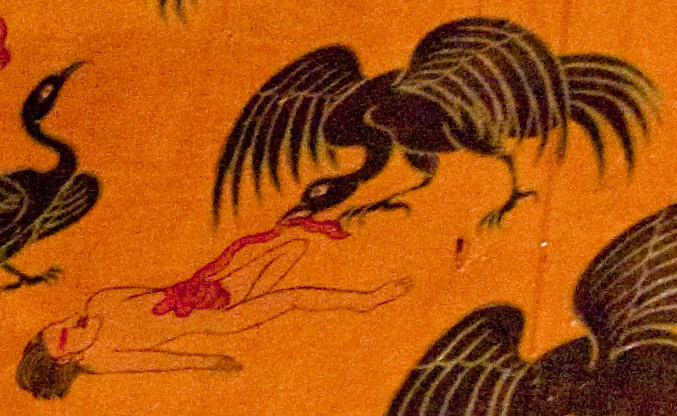
Sky burial art at Litang monastery in Tibet | CC BY-SA 3.0
In recording her journey to meet Rinchen, Woeser recounts her own experiences traversing Greater Tibet, Kham in this instance, before arriving at the living tradition of sky burial. Yet the most compelling aspect is the man himself. In this portrait, Rinchen is weathered and conscientious, engaged in a necessarily bloodied trade. Bolstering Woeser’s account are photographs she took of him. He is captivating, but not a mystic figure. His plain reflections on death and public service foreclose that interpretation. If anything in the piece might be considered “exotic”, it is the brief moment of rustic curiosity in which local government workers are found to have abandoned their posts to gather seasonal mushrooms. Whether this might be called idleness is debatable. Later, Woeser, Rinchen, and their companions eat some of these fresh finds, cooked with tinned pork. Rinchen’s earlier description of chanting to summon vultures for a feast feels part of the same world—because it is.
Although Woeser’s jottings confer a dignified documentary quality upon an array of brave individuals, bittersweet excursions, and tragic ruins, the abject, the earthy, and even the comedic are also present. Besides death, there is excrement. In “Celebrity Street Toilets in Lhasa,” Woeser reveals further aspects of the Tibetan story and reflects critically on the operations of the state. To a large extent, the so-called celebrity toilets are a Chinese story, or at least a story of the Chinese Communist Party, because the facilities in question were erected at strategic points along the motorised routes of visiting dignitaries, whether foreign or domestic, who were to be afforded comfortable passage by the state. Long after these visitors depart, their designated toilet blocks remain permanent fixtures.
She maintains a sardonic tone intended to mock the face-seeking anxieties of government officials.
The piece began as a blog and, through revision and translation, found its way into this collection. In it, Woeser recounts her search for the stories and locations of three roadside toilet facilities constructed for German chancellor Helmut Kohl, King Birendra of Nepal, and Chinese leader Jiang Zemin during their journeys to and from Lhasa. She maintains a sardonic tone intended to mock the face-seeking anxieties of government officials, while weaving together anecdotes both light and serious. She concludes by pondering whether, as some have suggested, these temporary facilities might have been used to collect biological samples and thus private health information of prominent figures. Whether this is jest or a reflection of the paranoia engendered by life under repression remains unclear. The peculiar poetry of the piece lies in the landscape into which these architectural remnants have settled and the cultural residue that has gathered around them. Highways have shifted course, and farmers now guard the structures as modest historical curiosities. For a negotiable fee of one to ten yuan, Woeser gains access.
Woeser gets in, cannot get in, gets out, continues, continues writing.
Woeser gets in, cannot get in, gets out, continues, continues writing; these could all serve as taglines for Ocean, as Much as Rain. She refers more than once to her power of memory, and from a broader perspective one can see that part of her project is to contribute that power to the collective memory of Tibet, and to the memories of it that will endure into the future.
)
The book concludes with an interview in which the two translators pose joint questions and Woeser responds. We are told at the outset that it has been revised and expanded multiple times, originating in 2012 and subsequently extended through exchanges conducted via Skype and email. Perhaps aided by its largely written mode of development, Woeser incorporates quotations from her own poetry and prose, and refers to numerous Western literary influences. Through this, we gain a deeper understanding not only of her literary aims, but also of her ambitions, idiosyncrasies, and passions.
To encompass every perspective Woeser offers in Ocean, as Much as Rain would require an expansive effort. To follow her through every tangential path would overextend the review and diminish the sense of discovery. It is preferable to approach the work directly, reading it at one’s own pace, whether or not a watchful presence happens to be nearby.
How to cite: Stewart, Angus. “No Useless Poems: Tsering Woeser’s Greater Tibet.” 12 May. 2026, chajournal.com/2026/05/12/tsering-woeser.


Angus Stewart writes strange stories and essays that have found home in publications including Necksnap, Big Other, and Typebar. He hails from Dundee, lives in Stockport, and ran the Translated Chinese Fiction Podcast for five years. [All contributions by Angus Stewart.]
 Cha
Cha 