
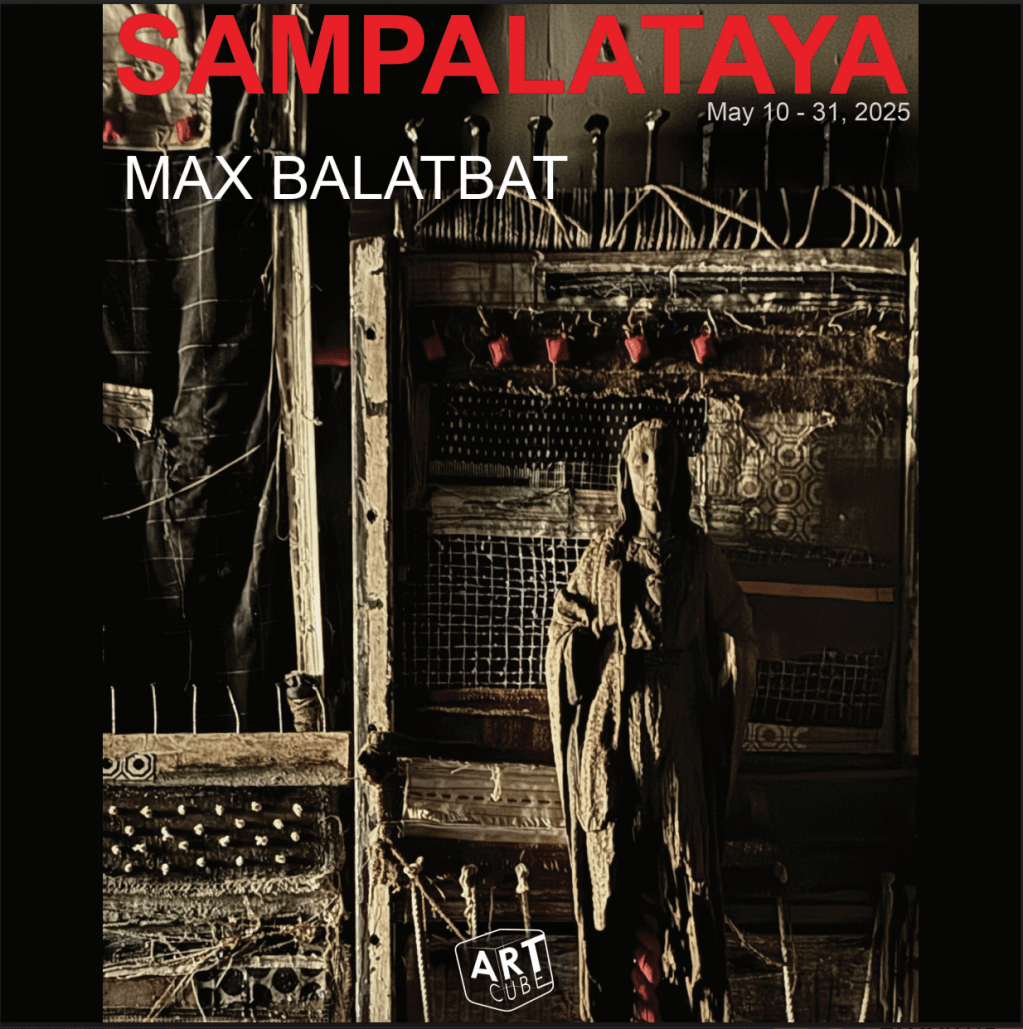
[ESSAY] “Assemblage of/as Faith: Max Balatbat Reimagines the Sacred in ‘Sampalataya’” by Jose P. Mojica
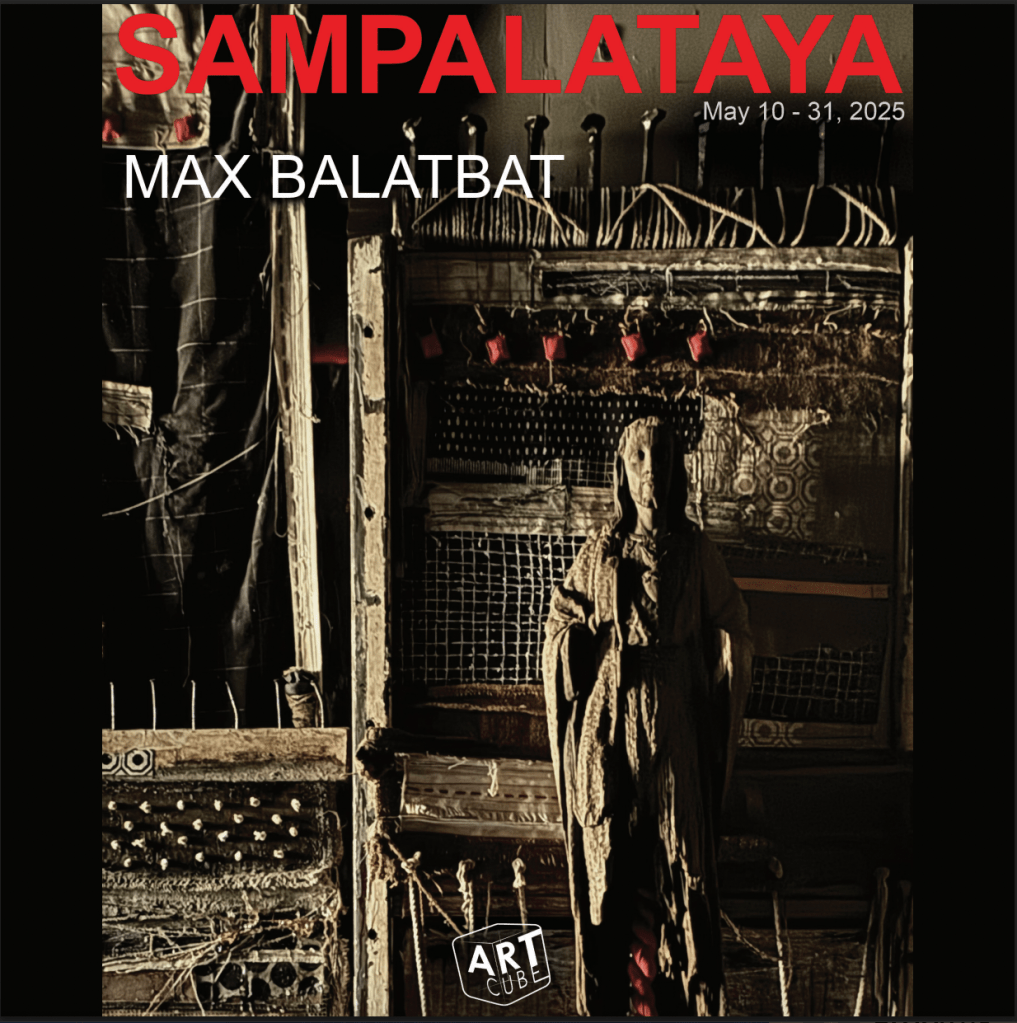
When one imagines the church, certain images come to mind. Mannerist-style paintings of the Stations of the Cross hang on tiled walls. Sunrays brim with colour on the pews as they pass through large stained glass windows. The cross on the altar stands tall. The icon appears almost alive through the intricacy of its sculpted details. Yet the artist who grew up in the bustling streets of Caloocan, Metro Manila, has a different vision. His aesthetic is not that of the sanctified but of the nonconformist, marked by an expressionist sensibility.
Max Balatbat’s solo exhibition “Sampalataya” (Faith), which was on view at Art Cube Gallery, Makati City, from 10 to 31 May 2025, dealt with a subject matter close to him: his formative years in the border city, a neighbourhood that has shaped both him and his view of the world. The textures he has felt and smelled, and the characters he has encountered, neighbours, prostitutes, gun-for-hire figures, drug lords, labourers, and mothers, continue to inhabit his imagination and his works. The exhibition presents his musings on faith and survival.
“Sampalataya” features assemblage works made from various materials, such as textiles, nails, strings, wood, and epoxy. These materials, mostly familiar due to their everyday nature, are not included at random but are grounded in the geography of his subject. Typical of Balatbat’s artistic practice, a visual motif runs through the exhibition, this time the presence of religious iconography. Through assemblage, he elevates these objects to the realm of discourse, as the works articulate social critique. This process of assembling seemingly meaningless objects eventually comes into coherent figures that invite investigation rather than mere adoration.
Balatbat was exposed early to a life of faith. His grandmother built a small chapel on a corner of their street, where he served as an altar boy for some cash. Having spent his formative years in that environment, the Caloocan he knows is “magulo, madumi, madilim, maliwanag (messy, dirty, dark, and bright).” He witnessed how faith was practised as transactional, as people prayed in the belief that a higher being would grant their wishes. For them, there was no proper way. They simply needed something to hold on to for survival. As Balatbat has mentioned, he too had moments of prayer, despite acknowledging his own lack of holiness, both for forgiveness and for wishes.
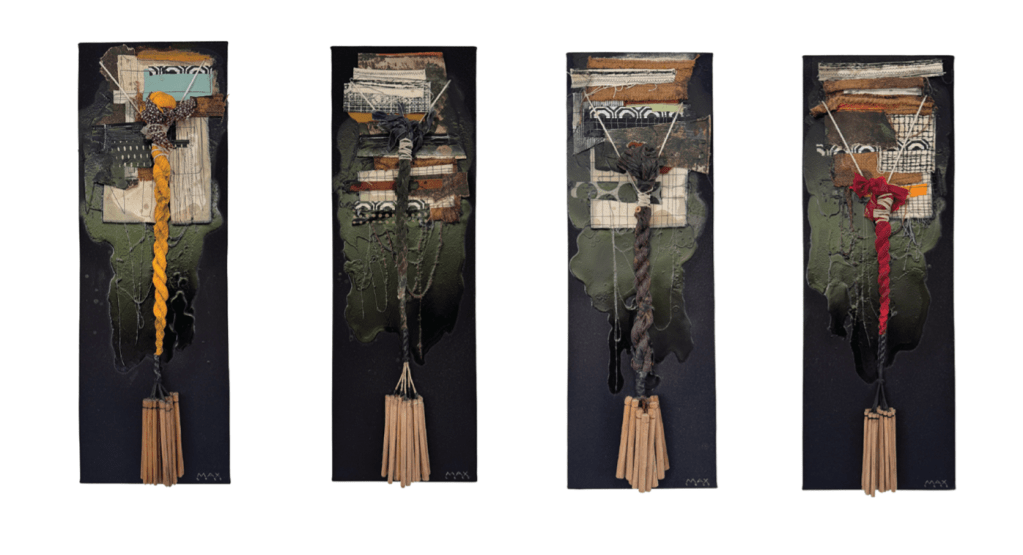
Max Balatbat, Bulyos, 2025. Courtesy of Art Cube Gallery, Makati.
In the Bulyos series, the bulyos, a whip with cylindrical bamboo sticks bundled into a cord and used by devotees as a flagellant during Holy Week, serves as the focal element in each piece. In the background sits a textural composition of layered cloth in varying designs and fabric types, as though mirroring the collage-like houses present in the locality. The hanging bulyos gestures towards the participant’s willing act of ritualised pain as a performance of faith. Later, Balatbat learned that some participants were not asking for forgiveness, but “for prosperity, healing, food, money, wishes always for their family, especially their children.” Known as a symbol of abundance, the green enamel and resin spread across the surface suggest the lurking impulse behind their actions.
Given the complexity of his chosen subject matter for the exhibition, it can be argued that assemblage serves as a fitting form through which to explore ambivalent ideas, as it embodies the inherent paradox in the confluence of materials and ideas. The act of creation becomes Balatbat’s pilgrimage to familiar alleys and avenues, allowing him to piece together his life’s puzzle and arrive at a form of understanding, though the answers remain bleak and unsettled. He moves from an act of reconstruction to one of interrogation.
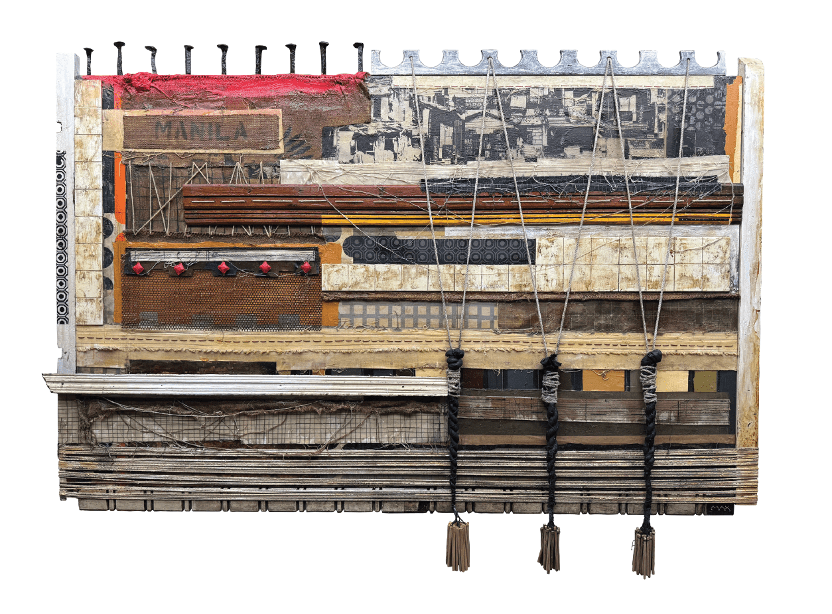
Max Balatbat, Sampalataya, 2025. Courtesy of Art Cube Gallery, Makati.
The titular work Sampalataya can be taken as the artist’s most complete rendering of his concept of the place and its people. At the top of the work, thick, rusted railroad spikes are driven in, evoking the perils associated with the neighbourhood. They may also signify the suffering symbolised by the nails of the cross to which people pray, contrasted with the bulyos hanging below, which signifies the suffering of the faithful. The printed word “Manila” reminds viewers of the subject’s location, while beside it is framed a black-and-white image of shanties. Materials such as thread, burlap, tiles, and wood create impressionistic layers that establish a point of view as though looking at the city from afar. The stacked objects also magnify the experience of density and distance. This may be his attempt not to represent life in pure abstraction, but to recreate it through tactile manifestation.
Visually, there is a nod to the Arte Povera movement, or “poor art,” of the late 1960s, evident in the materials collected by Balatbat over the years. Each object still carries its history and its social connotation. Their mere presence in the work tells a story, as their auratic quality renders them artefacts of their source. As he has mentioned, works must carry their own weight. His act of inclusion is a clear and conscious recontextualisation without erasure, a radical artistic gesture.
It can be argued that, more than advancing an argument about the practice of faith, he leans towards the human element: how people from his community transform the immaterial into the practical, the abstract into the literal, and the divine into the grounded. This interest may have stemmed from his constant encounters with them in a shared space, the chapel, which does not discriminate. As Jesus Christ said when asked why he was dining with Levi, “I have not come to call the righteous, but sinners.”
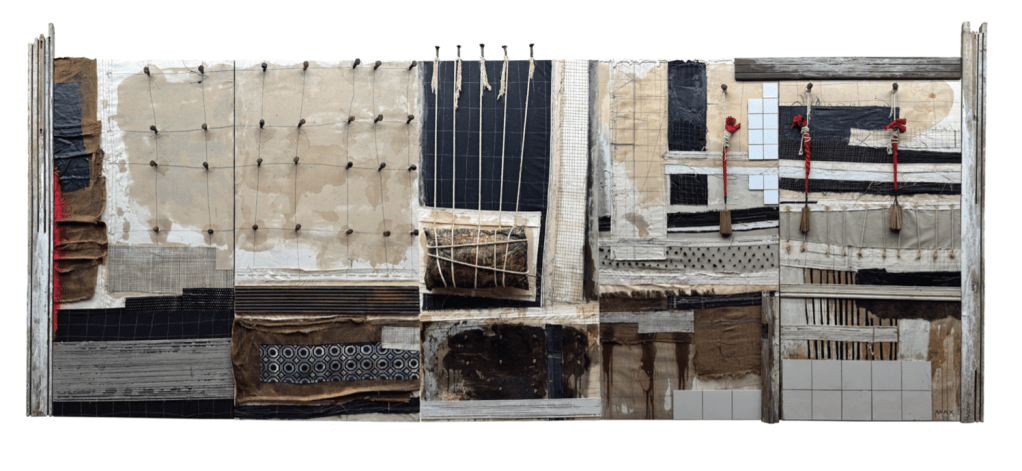
Max Balatbat, Kapilya, 2025. Courtesy of Art Cube Gallery, Makati.
Kapilya, the largest work in the exhibition, measures nine by twenty feet. It shares the same aesthetic as the other works. What distinguishes it, aside from its size, are the looming textiles arranged in various layers, as though enveloping the viewer. These fabrics settle like gauze, ready to be placed over the faithful’s spiritual wound.
In other works, ecclesiastical debris, such as a statue’s head or antique figures, is juxtaposed with other materials to create more affective pieces. At times, these works elicit a sense of abjection, destabilising the viewer’s religious certainties and assumptions. Some may feel that their inclusion in the works constitutes a form of desecration, although it can also be argued that such a reaction reveals more about the viewer than the artist. This is assemblage at work, presenting subjects considered taboo by accepted standards.
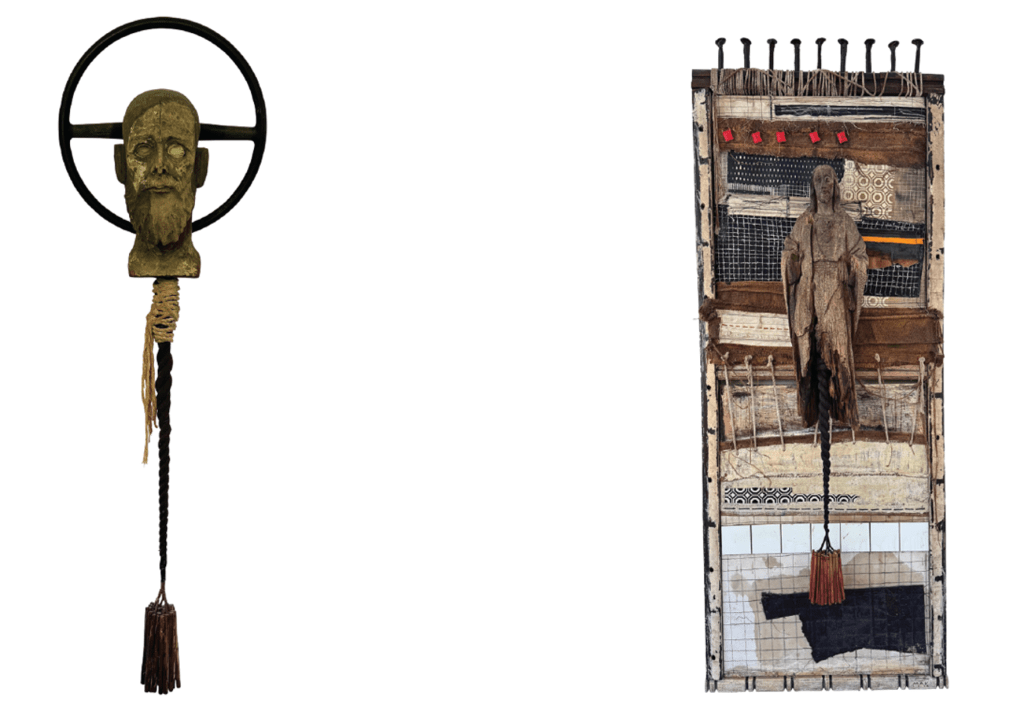
Left: Max Balatbat, Manong Drayber, n.d. Courtesy of Art Cube Gallery, Makati.
Right: Max Balatbat, Tore, 2025. Courtesy of Art Cube Gallery, Makati.
Abstraction is not new to Max Balatbat. In his previous exhibitions, such as Balay (2019), Siyudad (2021), and Anino (2022), there was already a resemblance to assemblage-like aesthetics, even though he was still working in mixed media. Although not yet fully realised through the use of scrap objects, composite images of figures and geometry had already entered the compositions. These works were more fragmented in their figuration, raw in their visuality and visceral in their effect.
Although abstractionist in spirit, the works in this exhibition are grounded in material presence. Yet the expected grunginess and chaos associated with assemblage art are absent from this body of work. It operates within a more conscious aesthetic, presenting cleaner lines and a more ordered arrangement of objects on the surface, despite the deliberate grime and smeared stains. This raises the question of whether Balatbat has yielded to commercial pressures that have led to this shift.
In the early stages of assemblage as an art technique, there was an anti-aesthetic disposition, as practised by Jasper Johns and Robert Rauschenberg. The grit and rawness of their works, as an effect of found objects and unevenly applied paint, express a different level of disruption to a gallery system inclined towards refined works. In Balatbat’s exhibition, despite being assemblage, the works do not appear as random placements on the surface, as in Neo-Dada aesthetics. Instead, there is a clear compositional control, a carefully curated chaos.
As he has pointed out, he participated in Holy Week practices in which devotees walked under the midday heat, lashing themselves as they paraded to the chapel. He has lived the story he once viewed from afar. He became a participant rather than a mere observer, eventually declaring, “I was able to answer some questions, some speculations in my mind became clearer, and I understood more about what they call ‘panata’ (vow).” With this, the assurance embodied in his current work reflects the clarity of his understanding of faith. Although neither antagonistic nor anti-aesthetic, his work retains the provocative power of art in critique.
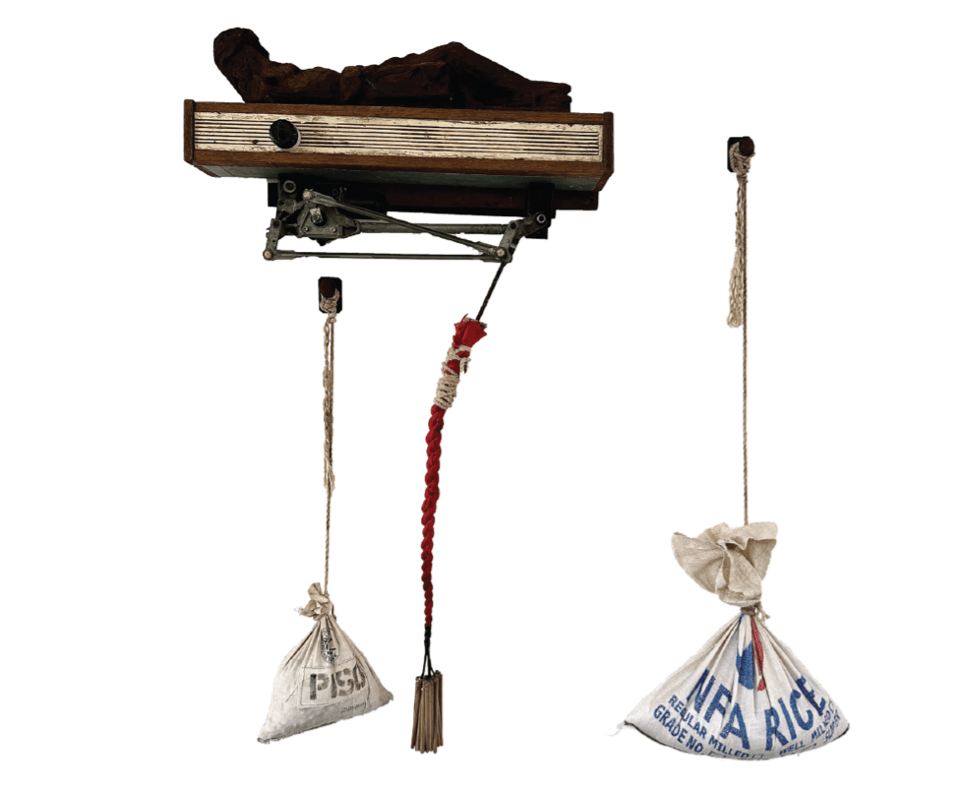
Max Balatbat, Sanapodiyoskosanapodiyoskosanapodiyosko, n.d. Courtesy of Art Cube.
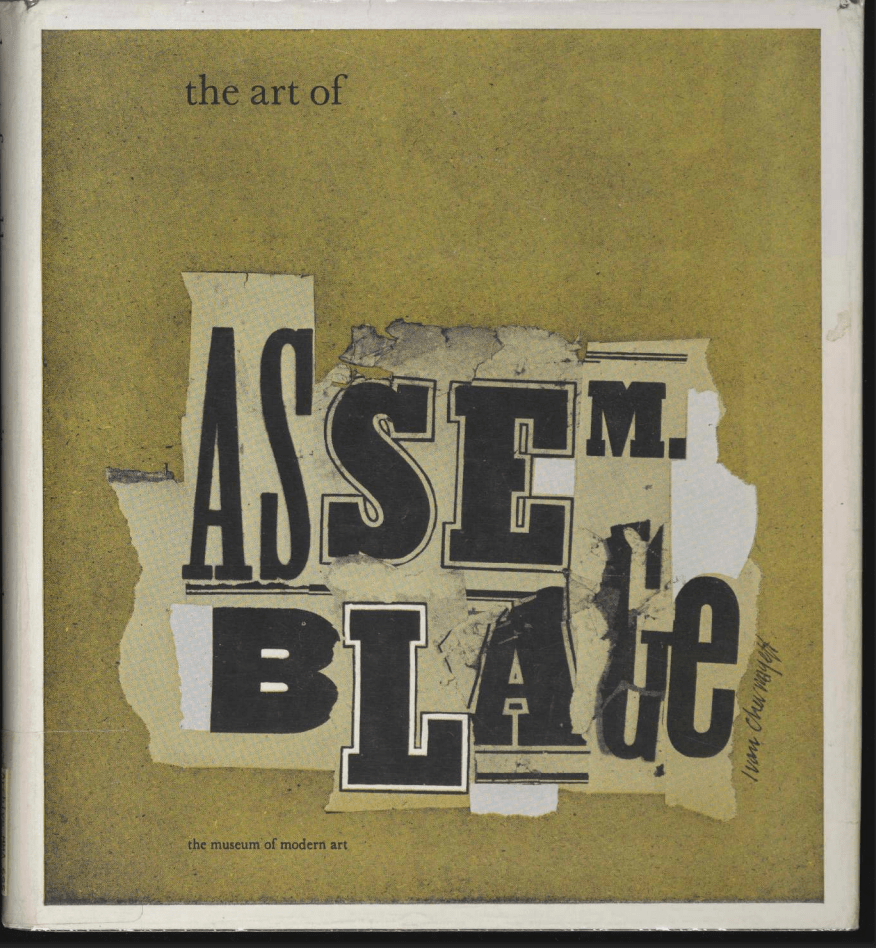
In Sanapodiyoskosanapodiyoskosanapodiyosko, the kinetic work again features the bulyos. Positioned between a sack of rice and a sack of coins, the whip continues to swing, as though caught in a never-ending struggle of choice. The detail in this work suggests that, as an artist, he can be more assertive than questioning, particularly on issues he has witnessed and lived through. This demonstrates Balatbat’s critical capacity to address the viewer more directly. Given this, he could have been more challenging in his works. A clearer proposition might have been more fully articulated to viewers as they stand before each piece. After all, William Seitz, in his 1961 catalogue essay for The Art of Assemblage, described assemblage as “the language for impatient, hypercritical, and anarchistic young artists,” suggesting an inherently interrogative impulse.
Max Balatbat’s exhibition “Sampalataya” shows that the creative act and acts of faith share certain similarities, that both are acts of appropriation. More importantly, they are acts of meaning-making, even if, in the end, people’s concerns remain rooted in survival. “Sampalataya” returns to Caloocan and captures how the city becomes the people’s church, its dark corners their altars.
How to cite: Mojica, Jose P. “Assemblage of/as Faith: Max Balatbat Reimagines the Sacred in ‘Sampalataya’.” Cha: An Asian Literary Journal, 29 Apr. 2026, chajournal.com/2026/04/29/Max-Balatbat.

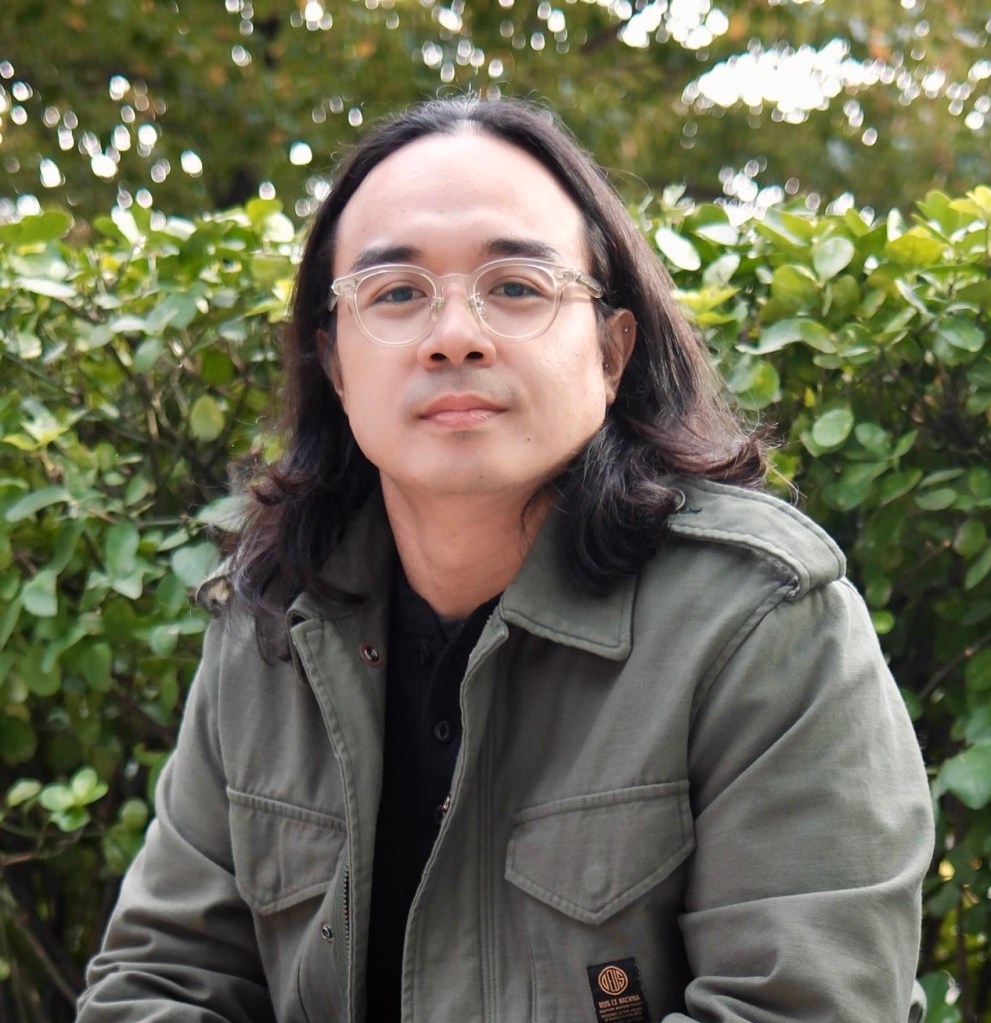
A filmmaker, writer, and scholar, Jose P. Mojica earned his BA in Digital Filmmaking from De La Salle–College of Saint Benilde, and his MA in Creative Writing and PhD in Literature from the University of Santo Tomas. His films have screened at festivals including Gawad CCP at the Cultural Center of the Philippines. His works have appeared in TOMAS Journal, Philippine Daily Inquirer, and PhilSTAR Life. He currently teaches at the University of Santo Tomas in Manila.
 Cha
Cha 