
茶 FIRST IMPRESSIONS
茶 REVIEW OF BOOKS & FILMS
[ESSAY] “The Forgotten Chapter of Indian History: A Study of Abbas Panakkal’s Hindu Amir of Muslims” by Kabir Deb
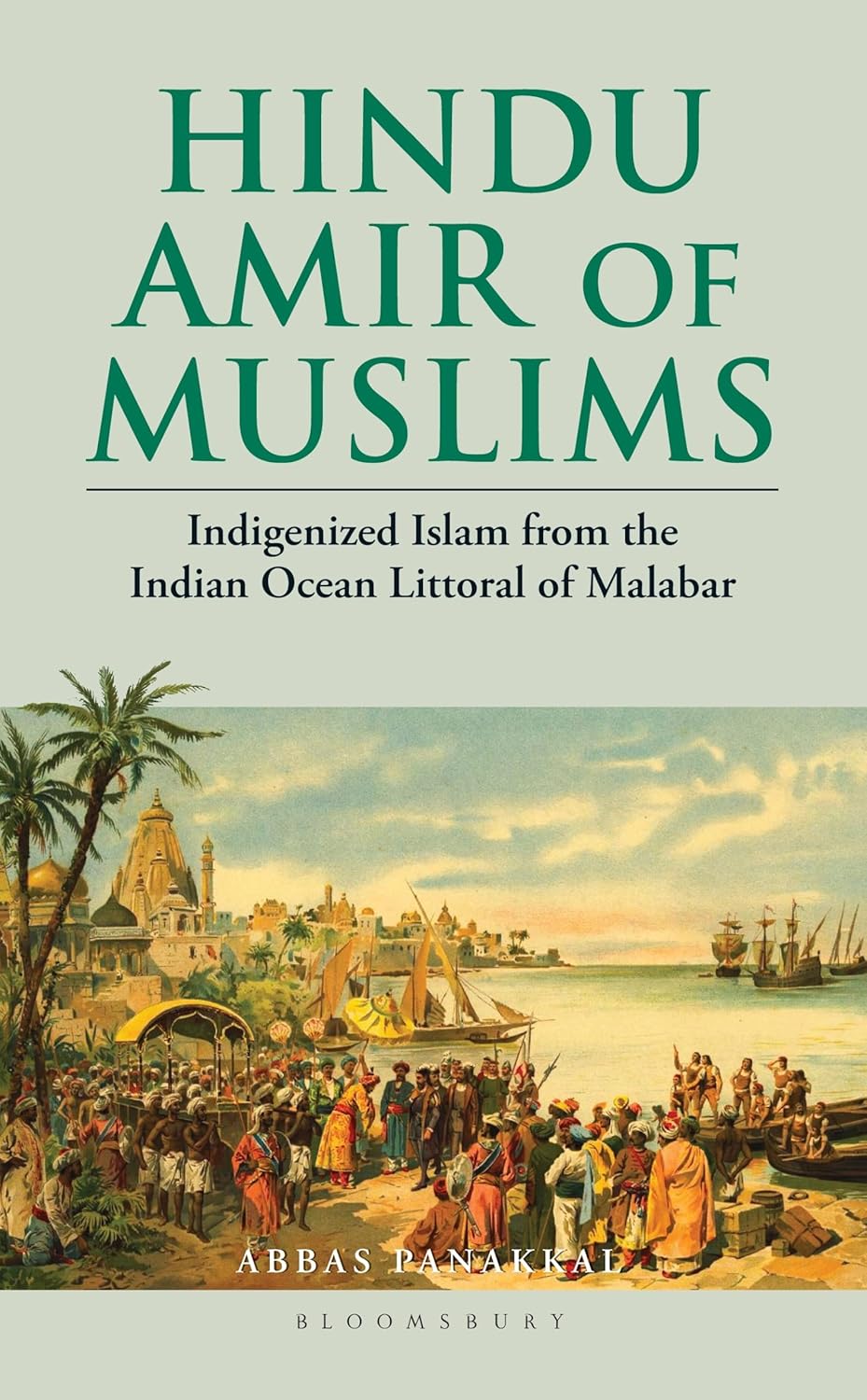
Abbas Panakkal, Hindu Amir of Muslims: Indigenized Islam from the Indian Ocean Littoral of Malabar, Bloomsbury Academic, 2025. 280 pgs.
Contemporary India is marked by deepening polarisation that reduces a complex social fabric to a binary.
In moments of national conflict, a society must return to its past to diagnose the distortions of its present, whether in governance, public discourse, or collective consciousness. Contemporary India is marked by deepening polarisation that reduces a complex social fabric to a binary. Sections of the Hindu majority, despite demographic dominance, perceive themselves as vulnerable, casting the Muslim minority as an unseen adversary. This inversion reflects not empirical reality but the narratives that sustain it. Yet such analyses remain disproportionately focused on northern India, neglecting the South, where long histories of trade, coexistence, and everyday interaction have fostered more accommodative social and political practices, offering a deeper, often overlooked, foundation for secularism and pluralism.
In Hindu Amir of Muslims: Indigenized Islam from the Indian Ocean Littoral of Malabar, Abbas Panakkal illuminates a history of shared life between Hindu and Muslim communities along the Malabar coast. The work demonstrates how cultural exchange, visible in food practices, modes of dress, and everyday lifestyle, emerged organically from sustained contact rather than doctrinal imposition. Even as other parts of India grapple with communal polarisation, Malabar continues to reflect a more resilient ethos of coexistence, rooted in long histories of interaction and inclusivity.
Panakkal traces the arrival and settlement of Islam in the region not as a consequence of invasion or coercion, but through trade, mobility, and gradual assimilation. Both communities retained distinct identities while participating in a shared cultural milieu, suggesting a form of coexistence that did not require formal articulation or ideological framing. The book ultimately presents this mutuality as an unconscious process, one that evolved through lived experience rather than deliberate design, thereby challenging dominant narratives that reduce inter-community relations to conflict or contestation.
Panakkal challenges historiographical distortions that frame the arrival of Islam in India primarily through narratives of invasion, destruction, and religious hostility.
In the introduction, Panakkal challenges historiographical distortions that frame the arrival of Islam in India primarily through narratives of invasion, destruction, and religious hostility. Drawing on Romila Thapar, he underscores that “the activities of destruction and looting were always part of imperial conquest but seldom attributed to religion” (p. 8), thereby repositioning such acts within the broader logic of political expansion rather than theological intent. Against this reductive framing, Panakkal foregrounds Indian Ocean trade networks, particularly commerce in spices and other commodities, as the principal conduit through which Islam and its adherents reached the Malabar coast.
Religion, in this context, did not function as an organising principle of domination but as one among many elements within a fluid social exchange. Irrespective of whether political authority rested with Muslim or non-Muslim rulers, everyday interactions between communities continued to be shaped by shared language, culinary practices, and artistic forms. These exchanges, grounded in lived experience, enabled ordinary people to sustain a cultural common distinct from the strategic interests of elite power structures.
Similarly, Panakkal observes that “Sanskrit sources referred to invaders from the Iranian plateau not by their religion but by their linguistic identity” (p. 9), a detail that unsettles later attempts to retrospectively impose a rigidly religious lens on premodern encounters. This insight complicates contemporary right-wing narratives that cast Muslims as a monolithic, faith-based adversary, revealing instead that earlier modes of classification were more fluid and less ideologically charged. It broadens the possibility of making history an inclusive subject, which under the present government is at a major risk due to its hostility towards minority communities.
While linguistic differentiation is not without its own exclusions, it nonetheless shifts the frame away from an essentialised religious antagonism. In the Malabar context, such differences did not harden into enduring divisions; rather, they were gradually negotiated and bridged through everyday practices. Shared spaces of trade, learning, and social interaction enabled communities to absorb elements of each other’s languages and modes of communication, transforming distance into dialogue. Panakkal’s account thus foregrounds how ordinary people, through sustained contact, diluted the force of imposed distinctions and fostered a lived culture of accommodation.
}
Art stands as a key site of cultural exchange between communities. While power often seeks to regulate or suppress free artistic expression, art simultaneously enables diversity to coexist within shared spaces. In the Malabar context, it became a medium through which difference was expressed without conflict. In his book, Abbas Panakkal highlights this by pointing to narrative traditions that foreground harmony over division. He notes that a distinct account of Islam’s arrival in the region, “rich with stories of harmony, coexistence and pluralism”, was recorded by historians such as Zayn al-Din al-Malaybari and Qadi Muhammad Ibn Abdul Aziz. These narratives position art and storytelling not merely as reflections of shared life, but as active forces shaping a culture of coexistence.
Contrary to historiographies that either isolate Islamic culture or confine it to Urdu and architecture, Panakkal foregrounds a sociological shift shaped by the rise of Muslim folk culture in Malabar. This culture did not emerge as a rigid imposition but as an organic process of blending, gradually harmonising with local practices without generating dogma or antagonism. As he notes, “the cohesive socio-cultural paradigm of Malabar engendered the emergence of a Muslim folk culture, an organic endeavour at harmonising Islam with the indigenous cultural fabric.”
Panakkal reframes the expansion of Islam not as a closed, unilateral movement but as a dynamic process of acculturation.
Panakkal reframes the expansion of Islam not as a closed, unilateral movement but as a dynamic process of acculturation. Rather than confining identities within rigid boundaries, this expansion enabled reciprocal adaptation: local communities engaged with Islamic practices without enforced conversion, while Muslim communities absorbed and rearticulated elements of the surrounding culture. He emphasises this mutuality by observing that Islam, in its spread, has continually interacted with the “cultural or civilisational other,” inheriting, adapting, and evolving through exchange rather than exclusion.
In the chapter “Lunar Splits and Royal Shifts”, Panakkal turns to the figure of the Zamorin of Calicut, whose rule from the 12th century provided a stable framework for commerce, cultural exchange, and social coexistence in the Malabar region. Within this context, Panakkal revisits the account of the Tamuri Raja’s conversion after his journey to Mecca, emphasising that it was not an act of coercion but a voluntary engagement with a new faith. As he notes, “both Arabic manuscripts and vernacular sources recount the king’s voyage to Arabia and his eventual embrace of Islam” (p. 28), underscoring the consensual nature of this transformation. More significantly, Panakkal situates this episode within a broader political and cultural ethos that prioritised coexistence. The interweaving of Islamic and local traditions was not incidental but aligned with the ruler’s intent to sustain cooperation among communities within his domain.
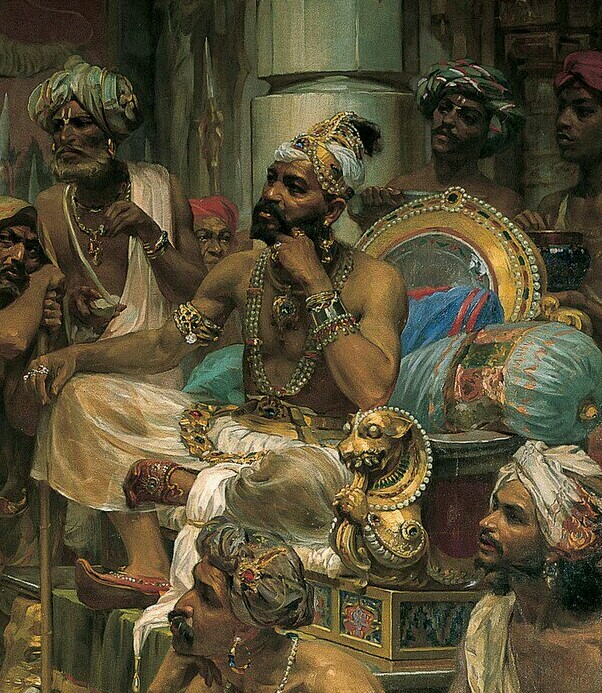
Zamorin of Calicut
Panakkal argues that, even alongside episodes of conquest, Islam’s spread along the Indian Ocean littoral was driven primarily by trade and everyday interaction. Merchants exchanged not only goods but beliefs and practices, situating Islam in Malabar as part of a wider network of cultural contact rather than an instrument of power. He reinforces this through the etymology of Malabar, mala (Sanskrit for “hill”) and bar (an Arabic or Persian suffix), a name that itself signals linguistic and cultural convergence. This confluence was not imposed but normalised through sustained coexistence, reflecting a region where diversity was actively internalised.
Texts such as Qissat and Tuhfat recount traditions of Prophet Muhammad reaching Malabar, situating the region within a shared cultural imagination shaped by Islamic and local Hindu references. These narratives register an exchange where traditions intersect without erasure. This synthesis appears in architecture as well. Mosques such as Cheraman Juma Mosque reflect a fusion of local and Islamic forms, pointing to collaboration rather than imposition. As Panakkal argues, these developments emerged through gradual cultural accommodation, not conquest. Critiquing colonial historiography, Panakkal emphasises that such integrative histories were sidelined despite being documented. He notes that “the mosques of Malabar serve as a prime example of the integration of Muslims into the local social fabric, constructed with the full support of local rulers and skilled artisans” (p. 50), underscoring a coexistence that was materially and institutionally sustained.
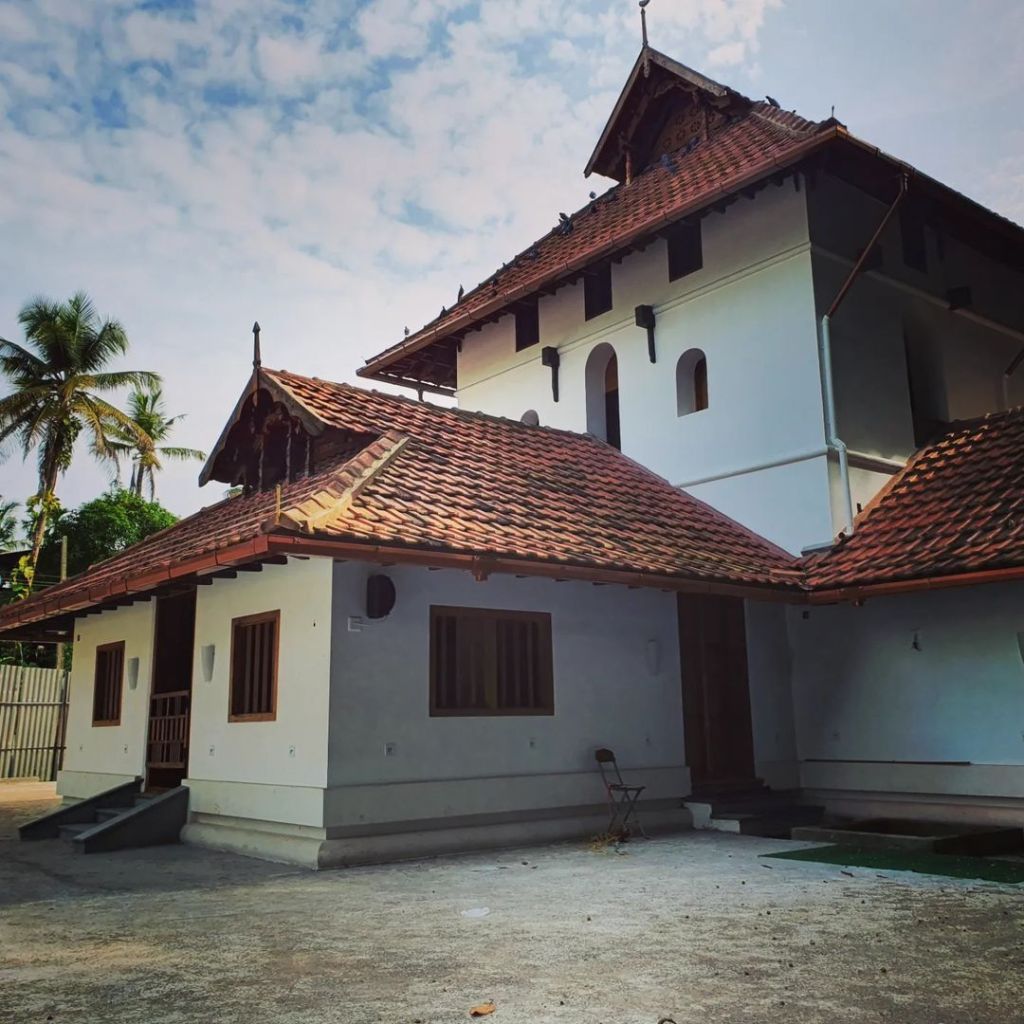
Cheraman Juma Mosque
)
While jihad is often mischaracterised in contemporary discourse by both Muslims and Hindus, Panakkal recovers its distinct articulation in the Malabar context. He notes that “the Arabic word jihad was introduced into the texts as a work of salubrious interfaith harmony and peaceful coexistence, urging Muslims to protect the reign of the non-Muslim king” (p. 122). This framing aligns with the ethical core of the Quran, where jihad signifies a striving towards moral good rather than violence. In Malabar, Panakkal shows, the term evolved into a principle of coexistence, functioning as a tool of “accord and interreligious cohabitation” (p. 123).
This was not merely conceptual. Panakkal notes that Zayn al-Din al-Malaybari invoked jihad in defence of Malabar’s pluralism, opposing Vasco da Gama during the Portuguese assault of 1502. Here, jihad functioned not as expansion but as resistance in protection of a shared social order. Panakkal further complicates dominant narratives by turning to institutions. The construction of Ponnani Valiya Juma Masjid, he writes, “had a lasting impact on the trajectory of Islamic education in Malabar” (p. 126) and “emerged as a cornerstone of intellectual and communal life in early modern Malabar” (p. 127). Significantly, the mosque was built by Ashari Thangal, a non-Muslim artisan, an instance that foregrounds the region’s lived ethos of cooperation and cultural interdependence.
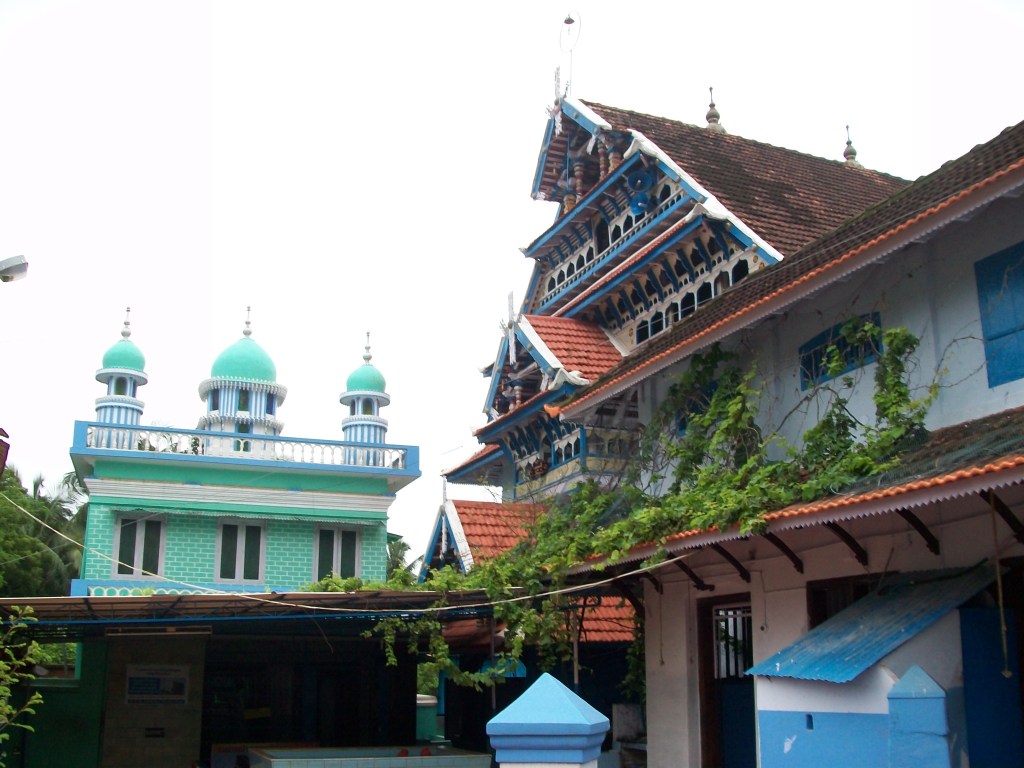
Ponnani Valiya Juma Masjid
The introduction of Islam in Malabar also enabled sections of oppressed lower-caste Hindus to convert voluntarily without forfeiting social value. Many emerged as scholars and contributors to literature, art, and governance, participating actively in the region’s development. Citing Zayn al-Din II, Panakkal notes that “if they converted to Islam, then the individual was considered to share the same status as other Muslims enjoying all the privileges of any member of the Islamic community without discrimination” (p. 164). Against historiographical claims that such converts remained marginal, Panakkal argues that “local Islam encouraged the creative process of mutual consolidation, considering the influential artistic expressions of the land.” Conversion, in this context, did not produce rupture but participation, allowing individuals to move beyond rigid social hierarchies while contributing to a shared cultural and intellectual life.
Hindu Amir of Muslims: Indigenized Islam from the Indian Ocean Littoral of Malabar is an important book that speaks about the India that is slowly sinking with time. It urges us to look back at the harmony the country once had and goes beyond the conventional idea of history to document a place that remains unexplored and its society, which gave room to secularism, inclusivity, and the idea of India.
How to cite: Deb, Kabir. “The Forgotten Chapter of Indian History: A Study of Abbas Panakkal’s Hindu Amir of Muslims.” Cha: An Asian Literary Journal, 29 Apr. 2026, chajournal.com/2026/04/29/hindu-amir-of-muslims.



Kabir Deb is a writer based in Karimganj, Assam. He is the recipient of the Social Journalism Award (2017), the Reuel International Award for Best Upcoming Poet (2019), and the Nissim International Award (2021) for Excellence in Literature for his book Irrfan: His Life, Philosophy and Shades. He reviews books, many of which have appeared in national and international magazines. His most recent book, The Biography of the Bloodless Battles, has been shortlisted for the Sahitya Akademi Yuva Puraskar (2025) and the Muse India Young Writer’s Award (2024). He currently serves as the Interview Editor for the Usawa Literary Review. Instagram: @the_bare_buddha [All contributions by Kabir Deb.]
 Cha
Cha 