
茶 FIRST IMPRESSIONS
茶 REVIEW OF BOOKS & FILMS
[REVIEW] “Food as Violence, Food as Salvation: Ramya Chamalie Jirasinghe’s Father Cabraal’s Recipe for Love Cake” by Rituparna Mukherjee
Ramya Chamalie Jirasinghe. Father Cabraal’s Recipe for Love Cake, Penguin Random House India, 2026. 320 pgs.
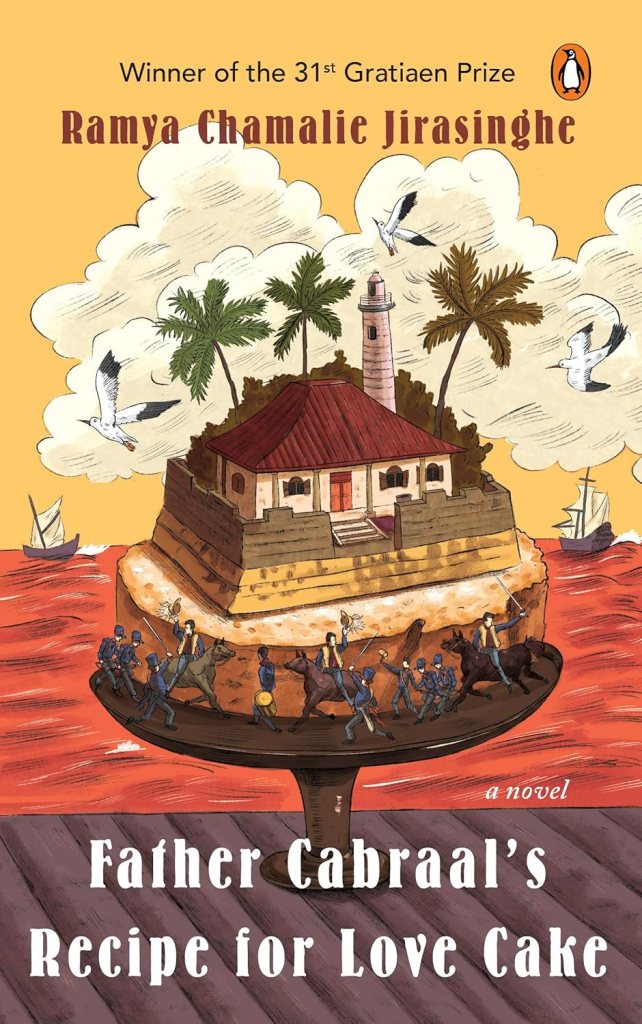
The book explores the violence embedded in colonial food pathways and the indelible residue they have left upon postcoloniality.
We tend to think of globalisation as a modern phenomenon of a jet-setting age, yet it has been built upon colonial modernity and the trading routes that sustained it. The Indian Ocean, in particular, has long been a hub of maritime-trading activity, predating European voyages in search of exotic lands rich in spices and wondrous produce. Ramya Chamalie Jirasinghe’s Father Cabraal’s Recipe for Love Cake, set across two timelines, one in the early-colonial moment of the late-seventeenth century and the other in the contemporary twenty-first century, explores the violence embedded in colonial food pathways and the indelible residue they have left upon postcoloniality.
The fictional island nation of Beira-Mar, one of many small Indian Ocean islands that echo Sri Lanka, is rich in spices and shaped by successive waves of trade and colonisation. Pepper, once prized as black gold by early colonisers, becomes a resource worth killing for. By the late-seventeenth century, islanders trade with Arab and African merchants, many of whom settle, marry local women, and establish families. One such family is Rainha’s. A local Buddhist woman married to an African trader, Negoci, Rainha loses her husband to Company men seeking control over land and resources. Forced to convert and marry the powerful official Santiago De Melo, she becomes Maria De Melo, and her struggle forms the emotional core of the novel.
The narrative demonstrates how the colonial drive for absolute control extended beyond ordinary trade. Through the brutal subjugation of local populations and the elimination of competition, Western colonisers ushered in an anthropocentric age marked by greed and excess. As Amitav Ghosh observes in The Nutmeg’s Curse (2021), the extraction of resources from a specific location could have been conducted in accordance with local laws and customs, “matching ends and means”, yet, driven by excess, colonisers treated colonial “landscapes as factories and Nature… as subdued and cheap” (2021, p. 73).
Jirasinghe’s novel renders this terraforming with striking clarity as colonial greed sweeps across the island in waves of violence. At the centre of this devastation in Beira-Mar stands Simon Cloete, a deputy-governor determined to secure his authority and wealth. He “wants anything that will buy him more shares… things that can be turned into silver and gold” (p. 223). His character offers a sharp study of how class anxiety, cowardice, and power intersect, revealing how “a weak man… raised to a position of power was capable of unimaginable acts of cruelty towards the people below him” (p. 268).
Yet the subjugation of an entire community proves neither simple nor complete. The local people remain resilient, resisting absolute control. In response, the centre dispatches missionaries to the periphery, not merely to “civilise”, but to collaborate with mercenaries and secure a steady flow of resources to their home countries. It is in this context that Father Alessandro Cabraal arrives on the island as a twenty-five-year-old priest and spends sixty years building a church and its community. A realist at heart, he recognises that those compelled to convert will continue to observe their Buddhist customs. Respectful and humane, he shelters African traders during the massacres and protects his own slaves as his life’s work begins to unravel.
Fully aware that denouncing Company men will lead to his capture and eventual execution as a heretic, he nonetheless protests when Simon Cloete, in a bid to curry favour with the Queen on her birthday, cages a local girl, Catherina, alongside elephants, peacocks, and peahens, an act of absolute dehumanisation. This moment exposes the underlying logic of colonisation, namely that the colonised are deemed a lesser species and may be treated with impunity. As Father Cabraal learns during his time with the Company, they “wanted not the souls of the men he saved but what their bodies would buy them. Each time he convinced a villager to pray to his God, it guaranteed the Company a new supplier of spices or gems. Each time he baptised a villager’s child, the Company burrowed itself deeper into the lives of the locals” (p. 185).
In a final act of defiance, Rainha burns her entire pepper harvest. When Father Cabraal learns of an impending attack on the Fort to seize the militia and ships, he hastily teaches Rainha his recipe for Bolo de Amore, a love cake scented with vanilla and nutmeg, gifts from his Far Eastern slaves, hoping she might one day monetise it to survive within the colonial economy. The recipe becomes a link between the two timelines and a source of survival in both.
Further parallels emerge, converging in a satisfying climax. Maria’s descendant, Katharina Silvaria, leaves behind her celebrated life as journalist Bella Fernando in London in search of a new beginning. Yet she inherits not only the house and its love-cake recipe, but also the deeply ingrained prejudices of the neighbourhood. The residents of the Fort, shaped by colonial ancestry, remain profoundly prejudiced, looking down upon mainland inhabitants as well as those sympathetic to the cause of the “Servos”, a term that underscores their enforced servility.
This familiar centre–margin divide reflects the persistence of a colonial mindset within postcolonial urban life.
The island continues to operate within a colonial framework. The Fort functions as a self-sufficient tourist hub, “trapped in a colonial time warp” (p. 283). The mainland, by contrast, is sharply divided. The affluent Oasis is characterised by “gated communities, sprawling mansions and swanky high-rise buildings”, along with “government offices and the Parliament that sit at the centre of the Oasis, on a hillock that sparkles with lights at night” (p. 64). Beyond this lies Slumwood, “a vast landscape of tin sheets and cheap wood buildings, bordered by stagnant drains and sagging wires” (p. 65). This familiar centre–margin divide reflects the persistence of a colonial mindset within postcolonial urban life. The president’s rhetoric against insurgents echoes the ethos of Simon Cloete, revealing the endurance of colonial attitudes within postcolonial governance. In a nation where “after it had lost most of its natural wealth… its local rulers had learnt the fine art of manipulating the masses in the name of democracy just as well as the European rulers before them” (p. 59), the result is a country simmering in “abject poverty, corruption and political instability” (p. 58).
A further parallel emerges in the sudden love between Rajeev Almeida and Kristina Silvaria, which echoes the bond between Santiago De Melo and Rainha. Their relationship develops under exigent circumstances when Kristina shelters the wounded Rajeev during a government crackdown on insurgents. A historian and heir to a vast sapphire fortune, Rajeev secretly funds the insurgent cause through diplomatic channels and must face the consequences of his ideological commitments. Through his interactions with Kristina, his worldview broadens and his prejudices begin to diminish.
In a world where spices have become commonplace, the Anthropocene is defined less by the control of resources than by the exploitation of human labour. As Rajeev tells his son, the privileged lives of the wealthy, shaped by colonial inheritance, continue to depend upon the relentless toil of the servos, economies sustained by cheap, often unpaid labour. In a scathing indictment of power and neo-colonial ideology that underpins contemporary systems of war, insurrection, and so-called revolution, Katharina recalls her traumatic experience of covering the war in Sri Lanka, where rebels used emaciated men, women, and children as human shields against the army. She reflects, with stark clarity, that “there were no heroes. They were all the same. The rebels, the army. All of them” (p. 237).
Through vivid imagery, graceful prose, and compelling storytelling, Jirasinghe demonstrates how contemporary wars often function as instruments for controlling resources. As the present world continues to generate new forms of neo-colonial conflict and enduring tyranny, the novel stands as a timely reminder that kindness, compassion, love, shared food, community, and a sustained reverence for nature, which underlies all human-made worlds, are the forces that truly bind us.
How to cite: Mukherjee, Rituparna “Food as Violence, Food as Salvation: Ramya Chamalie Jirasinghe’s Father Cabraal’s Recipe for Love Cake.” Cha: An Asian Literary Journal, 21 Apr. 2026. chajournal.com/2026/04/21/recipe-for-love.



Rituparna Mukherjee teaches English and Communication Studies at Jogamaya Devi College, Kolkata. She is a research scholar working on gendered mobilities in Nigerian fiction at IIIT Bhubaneswar. Her academic interests include gender studies, food-and-memory studies, precarity, and urban studies. She has published academic work with Routledge and Brill Rodopi. A Pushcart Prize nominee and a multilingual translator, her debut translation, The One-Legged, translated from Sakyajit Bhattacharya’s Ekanore, has been shortlisted for the JCB Prize for Literature 2024 and has won the KALA Literature Awards 2025. She has several creative publications in leading magazines. [Read all contributions by Rituparna Mukherjee.]
 Cha
Cha 