
茶 FIRST IMPRESSIONS
茶 REVIEW OF BOOKS & FILMS
[FIRST IMPRESSIONS] “Terao Tetsuya’s Spent Bullets: Alienation and Intimacy in Silicon Valley’s Taiwanese Diaspora” by Jennifer Eagleton
Terao Tetsuya (author), Kevin Wang (translator). Spent Bullets, HarperCollins, 2025. 208 pgs.
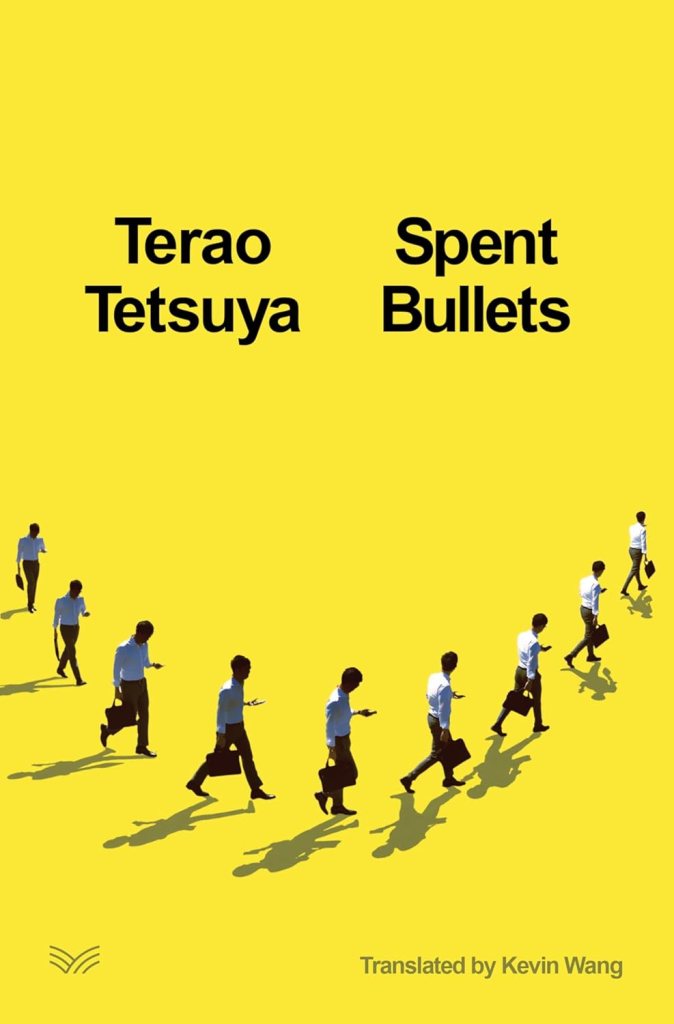
Set in Taiwan and Silicon Valley, this is a series of linked stories following a group of young Taiwanese high-achievers as they transition from their elite university in Taipei to becoming high-earners in Silicon Valley. They discover that, despite their evident professional success, life is far from psychologically straightforward, as reflected in their difficulties with relationships and other aspects of their lives.
The stories shift across time periods and perspectives, shedding light on the post-graduation experiences of Jie-Heng, Wu Yi-Hsiang, Ming-Heng, and their classmates. Jie-Heng serves as the principal linking character, an engineering genius and a loner who is drawn to being dominated, both physically and emotionally, by his classmate Wu Yi-Hsiang. I consider this relationship, introduced in the first story of the collection, “Flatworm A”, to be the anchor piece of the novel, as it demonstrates how human actions and behaviour often resist simple explanation. After questioning why Wu Yi-Hsiang spits into the urinal before using it, Jie-Heng becomes the object of Wu’s persecution, a form of attention that excites him sexually rather than provoking anxiety. The two become “friends”, yet this dynamic of domination, submission, and abuse persists over the years. Wu Yi-Hsiang asserts that someone like Jie-Heng “can’t survive in this world”, arguing that a person who tolerates abuse without inflicting it in return is too submissive to succeed.
The reasons behind these dynamics remain opaque. Jie-Heng does not reflect on his desire for submission, nor do we gain insight into why Wu Yi-Hsiang continues to torment others throughout his life. There are hints of possible childhood trauma, but no definitive explanation is offered. After moving to the United States, Jie-Heng attempts to form friendships, yet finds himself unable to connect, even with other gay Taiwanese men. In “Some Kind of Corporate Retreat”, the unnamed protagonist, likely Wu Yi-Hsiang, enters into a relationship with a female colleague who is also gay. At the outset, she suggests that “maybe [they] needed to find a partner, no matter who they were, to survive this endless blizzard called immigrant life”, a view he accepts. However, when they encounter a former classmate at the airport, who is travelling with his husband-to-be, an alternative model of intimacy becomes visible. Wu Yi-Hsiang appears to derive a form of cultural capital from his relationship, yet later remarks in an alumni talk that “in Silicon Valley, you must first die in order to live.”
The reputations towards which these characters strive appear to lack any clear purpose. Professional achievement does not seem to bring them fulfilment or satisfaction. The narrative provides little detail about their specific occupations, with the partial exception of Ming-Heng in “The Avalanche Joseki”, a story about an almost-professional Go player who nearly realises the ambitions his father abandoned, and whose trajectory is shaped in part by this father-son relationship as he reflects on his own fate.
A nascent sense of community may nonetheless be discerned among these characters across the stories. A subsequent novel might further develop this aspect as the characters gain experience and maturity. However, the emphasis on external action, combined with a relative lack of interiority, creates a distance between the reader and the characters, making emotional engagement difficult. I found myself unable to relate meaningfully to their experiences or to understand them fully. It is possible that a younger generation of readers, particularly gay Asian men, may find greater resonance in this work, and it would be valuable to see responses from that demographic.
How to cite, Eagleton, Jennifer. “Terao Tetsuya’s Spent Bullets: Alienation and Intimacy in Silicon Valley’s Taiwanese Diaspora.” Cha: An Asian Literary Journal, 20 Apr. 2026. chajournal.com/2026/04/20/bullets.



Jennifer Eagleton, a Hong Kong resident since October 1997, is a close observer of Hong Kong society and politics. Jennifer has written for Hong Kong Free Press, Mekong Review, and Education about Asia. She has published two books on Hong Kong political discourse: Discursive Change in Hong Kong(Rowman & Littlefield, 2022) and Hong Kong’s Second Return to China, A Critical Discourse Study of the National Security Law and its Aftermath(Palgrave Macmillan, 2025). Her poetry has appeared in Voice & Verse Poetry Magazine, People, Pandemic & ####### (Verve Poetry Press, 2020), and Making Space: A Collection of Writing and Art (Cart Noodles Press, 2023). [All contributions by Jennifer Eagleton.]
 Cha
Cha 