
[ESSAY] “Maggie Cheung and the Refusal of Cinematic Immortality” by Anna Nguyen
I have many confessions. I am exhausted by the discourse surrounding Wong Kar-wai’s In the Mood for Love (2000). I am exhausted by fandoms that fixate on aesthetic vibes and mere nostalgia. I am exhausted by the constant recirculation of that New York Times piece asking why Maggie Cheung Man-yuk is not a major star in Hollywood.
Yet I genuinely enjoy talking about films, especially In the Mood for Love. I also enjoy talking about Maggie Cheung, an actor whom I, like so many within the Southeast Asian diaspora, grew up watching. A propos of the film’s 25th anniversary in 2025, Maggie Cheung’s deliberate absence is, once again, conjured. Circulating alongside this absence is a romanticised excerpt from a Sight & Sound interview in which Cheung remarks, “I feel very honoured and truly thankful that I was once an actress in this lifetime!”

Our interpretative analyses reflect our values and our views. Where I suspect many read this remark with a sense of wistful yearning, I understand it instead as another gesture towards the actress’s detachment, or simply as a factual statement about acting.

Irma Vep
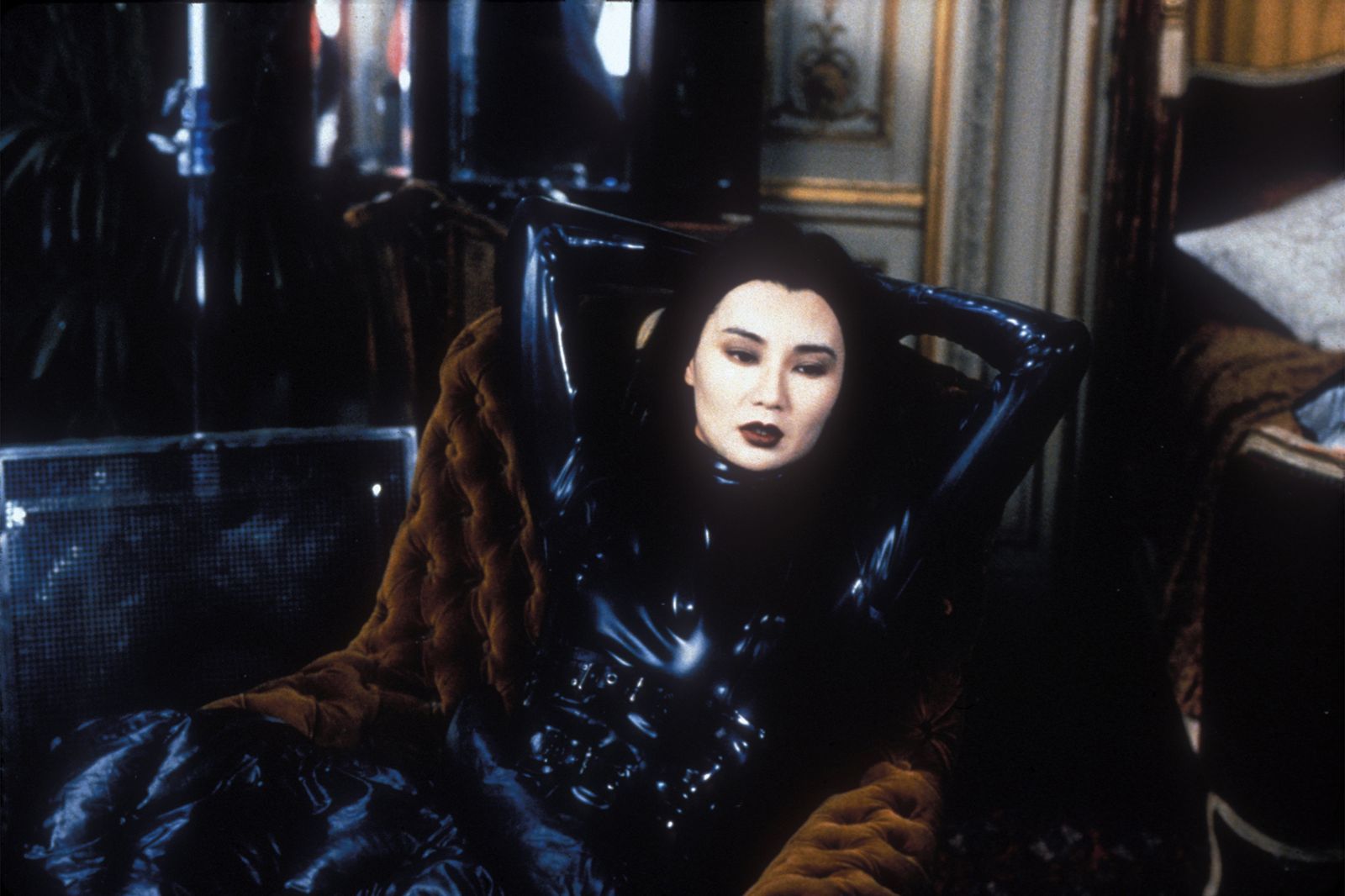
There are two films in which, I think, Maggie Cheung the actor offers the audience clues about her views on longevity and cinema. The more widely recognised, at least in a Western context, is the 1996 French arthouse film Irma Vep (1996), directed by her former husband Olivier Assayas. Cheung plays a fictionalised version of herself, an actress from Hong Kong who has just arrived in Paris to film a remake of Les Vampires (1915), From the outset, the film stages at least two major media and cultural discourses. In France, national cinema is framed as being in crisis, with the anxious director René Vidal attempting to revive it. In Hong Kong, cinema’s reputation, at least as imagined by Vidal and French critics, is narrowly reduced to action films. When Maggie is introduced, the production team has been waiting for her arrival. She was scheduled to be in Paris three days earlier, but a Hong Kong film production overran its schedule by a week. The film makes a point of informing the viewer that she had been shooting an action film about Thai drug dealers.
Although the film stars Cheung, her presence is strikingly passive. She observes as the film crew sexualises her as an object. Vidal believes that Maggie’s participation will rescue his faltering career. The film’s costumer, Zoé, fits her in a tight latex catsuit that is meant to be “incredibly feminine.” At a dinner party, Zoé tells a friend that Maggie looked “like a plastic toy” in the costume.

Irma Vep is discussed in the second chapter of Mila Zuo’s VVulgar Beauty: Acting Chinese in the Global Sensorium (2022). Vulgar Beauty advances the argument that “global identity (racial, gendered, cultural) is imagined precisely through the affective sensorium,” which “draws together material, aesthetic, and racialised conditions and significations” (p. 3). The concept is named after the Chinese term weidao (flavour), which “enables us to examine the nonrepresentational qualities of cinema in conjunction with the ways in which sociocultural tastes are ‘cooked’ into representation, becoming inextricable from, and absorbed into, our experience of on-screen figures” (p. 4). In her discussion of Maggie as a character, Zuo argues that Cheung, alongside Joan Chen’s performance as Josie in Twin Peaks (1990), demonstrates “the postbitter aesthetics of saltiness as a means of negotiating Western infatuation with Chinese femme’s object-surface” (p. 74). In other words, the white Western imaginary depends on recognising racial difference within a supposedly multicultural cinematic identity. However passive Maggie’s character may be, she is ultimately a product of René’s fantasy. The film is less about Maggie herself than about an industry that consumes and exploits her.

Center Stage
Less widely discussed is Stanley Kwan’s 1991 film Center Stage, which closely parallels Irma Vep in its meta, behind-the-scenes perspective. Cheung plays the celebrated actor Ruan Lingyu 院玲玉. Although Center Stage is largely biographical, it includes interspersed commentary from Cheung herself. Early in the film, she observes that both she and Ruan were repeatedly cast in “wallflower” roles, a category that was also applied to Cheung at the beginning of her career.
Even more revealing is the scene that addresses Ruan’s shift towards more serious roles. The camera returns to Cheung, who laughs as she asks, “We share similar fates then?” Someone off-camera asks whether she would like to be remembered half a century later. Cheung does not answer immediately and appears to shrug. This hesitation aligns with her attitude towards her own departure from cinema following the 2004 release of her final film, Clean.
In another meta-cinematic moment, Tony Leung Ka-fai, who plays the director Cai Chusheng, poses a philosophical question: “Should a movie star disappear at the peak of her brilliance?”
The rhetorical force of this line invites us to substitute the name Ruan Lingyu with Maggie Cheung. Yet the actress has already given her answer.
How to cite: Nguyen, Anna. “Maggie Cheung and the Refusal of Cinematic Immortality.” Cha: An Asian Literary Journal, 1 Jan. 2026, chajournal.com/2026/01/01/vulgar-beauty.


Anna Nguyen left her PhD programme and reworked her dissertation into a work of creative non-fiction while studying for an MFA at Stonecoast, University of Southern Maine. Her work brings together literary analysis, science and technology studies, and social theory to examine institutions, language, expertise, citation practices, and food. She is currently undertaking a second MFA in poetry at New England College, where she also teaches first-year composition. She is the host of the podcast Critical Literary Consumption. [All contributions by Anna Nguyen.]