
茶 FIRST IMPRESSIONS
茶 REVIEW OF BOOKS & FILMS
[FIRST IMPRESSIONS] “Shining Through: The Loboc Children’s Choir in King Palisoc’s Song of the Fireflies” by Bryan Elijah Trajano
King Palisoc (director), Song of the Fireflies, 2025. 110 min.
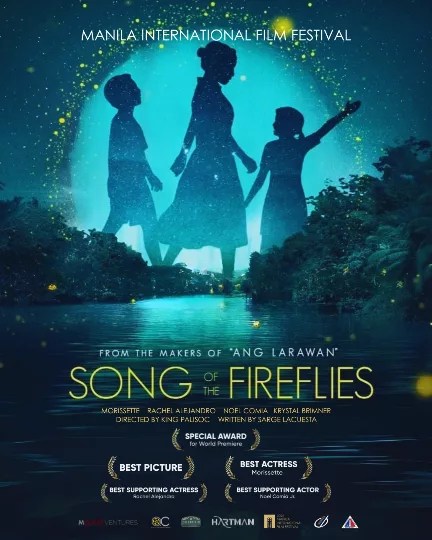
Song of the Fireflies, directed by King Palisoc, opens with a tender portrait of the Loboc Children’s Choir. It traces their humble beginnings in the early 1980s in the quiet riverside town of Loboc, Bohol. The film draws on the real history of the small community choir founded by Alma Fernando Taldo, portrayed by Morissette Amon. It offers a heartfelt exploration of how music, discipline, and shared purpose can transform young voices into a cultural force. This origin story becomes the emotional backbone of the film and creates space to consider how faithfully it captures the choir’s early struggles, grassroots formation, and the social environment that shaped their rise.
The tone is established through an early milestone in the choir’s history, their third place finish in their first attempt at the National Music Competitions for Young Artists (NAMCYA) in 1980. This moment introduces their initial encounter with national recognition, as well as the internal dynamics that influenced their development. In this sequence, Enriqueta “Equet” Butalid, played by Rachel Alejandro and depicted as a cultural advocate and the wife of a provincial governor, steps in to conduct the choir while Alma is temporarily replaced. The scene conveys the pressure faced by a provincial ensemble determined to prove itself on a national stage and highlights the shifting leadership roles that would later shape the choir’s identity.
The film also foregrounds Alma’s journey from public school teacher to founder of the now celebrated choir. One of its strongest elements is Morissette Amon’s portrayal of Alma, marked by sensitivity, dedication, and quiet strength rendered with emotional clarity. Through her performance, viewers witness not only Alma’s achievements but also the sacrifices that underpin them, revealing the difficult balance between doubt and resilience. This layered characterisation humanises Alma beyond her reputation and anchors the emotional core of the film. Rachel Alejandro likewise delivers a memorable performance as Equet, convincingly portraying a passionate cultural advocate with classical training whose social influence underscores her determination to elevate the choir and showcase their talent. Jackie, played by Krystal Brimmer, and Herbert, played by Noel Comia Jr., also stand out. Jackie’s growth as a young singer and Herbert’s emotional struggles, particularly during his trip to Manila where he confronts his father’s situation, add further depth to the ensemble. Together, the cast brings the choir’s early years to life, portraying their beginnings, challenges, and eventual triumphs with sincerity.
The film’s pacing is effective in many scenes, allowing viewers time to absorb emotional and narrative detail. Although some moments unfold slowly while others move more quickly, the overall rhythm supports the storytelling. The use of an opening flashback is especially effective, creating curiosity about the conflict between Alma and Equet during the first NAMCYA competition, a tension that unfolds naturally as the film progresses. As a period piece set in the early 1980s, the film demonstrates careful research through its settings, costumes, language, and cultural textures. Music is smoothly woven into the narrative, with local songs and Boholano used as the primary language. This choice enhances authenticity and roots the film firmly in its cultural environment, despite occasional Tagalog dialogue.
The musical sequences function as essential storytelling devices, illustrating the choir’s growth and the emotions that shaped their journey. Each performance is placed with intention, enabling the audience to feel how music transformed the children’s lives. The film also makes effective use of Loboc’s scenery. Images of riversides, churches, bridges, and everyday community life reflect the culture that sustained the choir, while scenes of rehearsals and town gatherings further enrich the atmosphere. The blend of natural sound, choral harmonies, and gentle scoring strengthens the sense of authenticity, although a few moments might have benefited from smoother audio transitions. Overall, the interplay of visuals and sound brings the story to life in a warm and grounded manner.
Song of the Fireflies has received several international awards, including recognition at the Manila International Film Festival 2025, WorldFest Houston, and the Newport Beach Film Festival. These honours reflect the film’s strong ensemble performances and its effective portrayal of cultural, historical, and social narratives. The Loboc Children’s Choir remains a treasured institution in Bohol and the Philippines, celebrated for its discipline, artistry, and the pride it brings to its community. The film honours this legacy by depicting not only the choir’s achievements but also the humility and collective effort that shaped who they are today.
How to cite: Trajano, Bryan Elijah. “Shining Through: The Loboc Children’s Choir in King Palisoc’s Song of the Fireflies.” Cha: An Asian Literary Journal, 30 Dec. 2025, chajournal.com/2025/12/30/fireflies.



Bryan Elijah Trajano earned his MA in Philippine Studies, Language, Culture, and Media from De La Salle University in 2024, following the completion of his AB in International Studies at Far Eastern University in 2017. By day, he works as a Customer Service Officer in an Australian BPO, and by night and on weekends, he devotes himself to his passions for watching films and reading books. Bryan has presented his research at various academic conferences and has published several critical reviews and scholarly works. Deeply curious about global cultures, he enjoys exploring diverse traditions and narratives through media and literature. He is a member of the Society of Filipino Film Reviewers and the Beach Reads Book Club. [All contributions by Bryan Elijah Trajano.]
 Cha
Cha 