
茶 FIRST IMPRESSIONS
茶 REVIEW OF BOOKS & FILMS
[REVIEW] “Picked Up by Wingtips: Tammy Lai-Ming Ho’s Hula Hooping” by Jonathan Han
Tammy Lai-Ming Ho. Hula Hooping, Chameleon Press, 2015. 108 pgs.
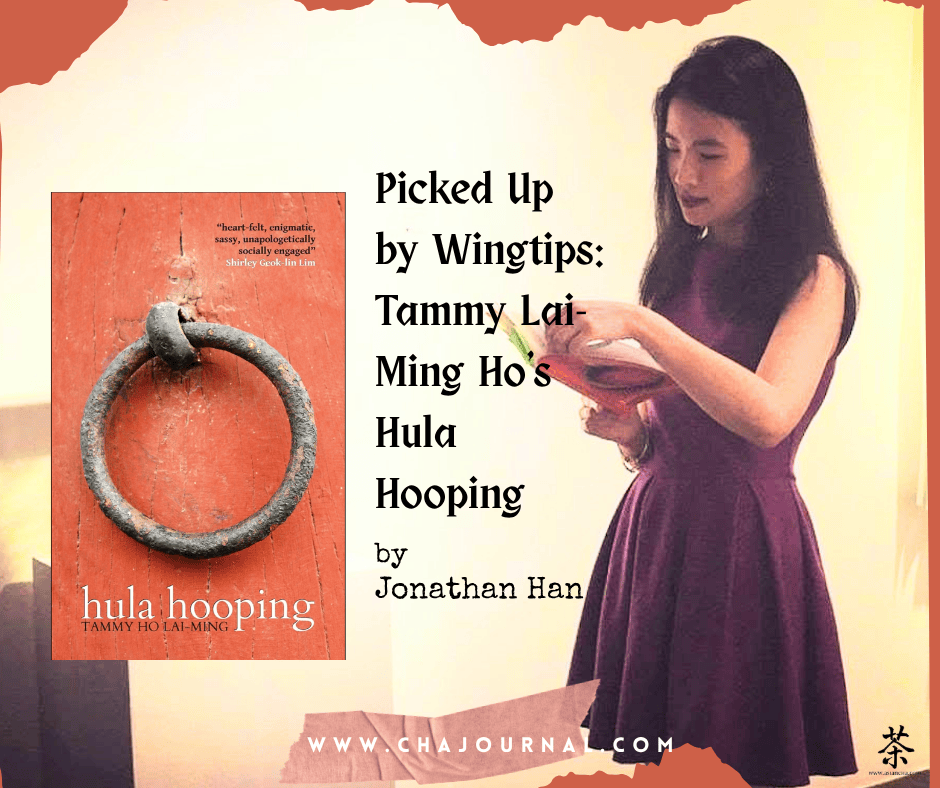
Tammy Lai-Ming Ho at the launch of Hula Hooping, Tuesday 28 April 2015. Hong Kong.

After a long search, I found Tammy Lai-Ming Ho’s Hula Hooping in the most obvious of places: the Hong Kong Central Library. My initial ignorance stemmed from the fact that, over the years, the library has become a less romantic location, less a place of learning and more a place for revision. When I made the visit, it coincided with the weeks leading up to final-year exams. Students occupied the seats where sunlight managed to get through the blinds, some of them buried in their work, others asleep, respecting the physics of pressure by lying flat across the table.
I ignored them, driven by my quest, guided by a uniformed fluorescence that lit my way to the books. There was still plenty of dust, the sweet kind that wouldn’t trigger my allergies, and plenty to read. Most libraries in Hong Kong have a section for rhetoric and literary studies. Often the stacks for poetry overflow into theirs, but I don’t mind. It makes sense that the proof should reside with the argument. Hula Hooping was firmly in the correct section, given that the name Tammy Ho falls near the median of the alphabet. However, her poetry is certainly not, by any measurement, average, and is worth the close study espoused by the books on the next shelf.
◎
A personal favourite of mine is “His t-shirts”, in which the father’s relationship with his daughter is layered with themes of identity and age. I shall present it here in full:
Medium-sized t-shirts on his dark body.
He’s totally Chinese—more so than me.
But in periods when he’s building bridges,
fixing window panes or drilling roads,
I think he’s from Africa.
Yellow skin is black in the sun.
Who said colours are God-given?
Medium-sized t-shirts he has aplenty.
Elated, in countries foreign, we do not forget
at home he’s suppressing his worried lips.
He wants nothing from us, but
we like the idea of giving. And so he’s
wearing t-shirts from London, Thailand,
Auckland, Japan, Finland, India,
Malaysia, Poland, Korea…
“Where are you from, father?” We are
teasers. Names of places bold
in English on his chest. He doesn’t know.
“China,” he answers. We laugh.
We laugh. Bad daughters.
Medium-sized t-shirts on top of Large
-sized ones in his drawers.
He once stood huge
in front of a snack bar,
buying us coca-colas,
and we cheered.
The volta of the poem swings at the hyphen in “Large-sized”, evoking the universal realisation that parents do indeed grow old. The Cantonese phrase for an old person getting smaller, “縮水”, or shrivelling up, is the same as that used to describe a shirt that has shrunk in the wash.
While researching the book, I stumbled upon “His t-shirts” on a Reddit thread from ten years ago, presented here in its pure, original form.
I am really having a hard time understanding this poem by Tammy Ho Lai-Ming, titled “His Tshirts.” It is one of the poems found in her poetry anthology: Hula Hooping.
Can you tell me how you understand this poem by yourself? Maybe I could understand the depth of this poem through other’s perspective. Thank you.
I’ve often found that the exercise of “understanding” a poem through its themes eviscerates its ambiguities and amputates its essence. This is evident in the responses that follow in the Reddit thread:
I think she’s trying to say that national identity is dissapearing as a result of globalism and he’s not really chinese but instead a citizen of the world.
The second answer comes from the Redditor who originally raised the question, with a subdued eureka:
I’ve found the answers now. The closest interpretation we’ve got is this.
He’s really Chinese. That was his home country. But he works abroad and had worked in different nations because he’s an overseas worker. He’s not really the father of those girls, but they call him father in respect (asian culture). Other metaphors hint that he had worked hard in different countries.
This poem talks about globalization and social statuses and a bit about displacement.
The final response comes from a collective:
We investigated this poem during our literature class, and we came up that the t-shirts are given by his daughters from abroad, it means that the daughters are sending the medium sized t-shirts to their father in China…. It tells a story about the daughters who is travelling abroad and is sending t-shirts to their worried father in China.
Even if their interpretations are rather scattered, these students draw on themes that Tammy Ho presents in other poems in the collection: first, the question of identity, and second, the complex relationship between parents and their children. As my own parents grow old, I have also come to realise that the years already spent now outnumber the years we have left together. The careful image of medium-sized clothes lying on top of large-sized ones crystallises this dread, made worse by the worry that, like the daughters, I too haven’t fully understood all that they’ve sacrificed for me. Naturally, students are not yet familiar with this anxiety, and the poem itself, with its teasing voice, only hints at the inevitable.
◎
In my review of Tammy Ho’s If I Do Not Reply, I wrote extensively about love poetry. I feel rather indulgent in once more appreciating the poet’s ability to write for the romantically minded. But how could I disregard a whole section titled “Love Poems”?
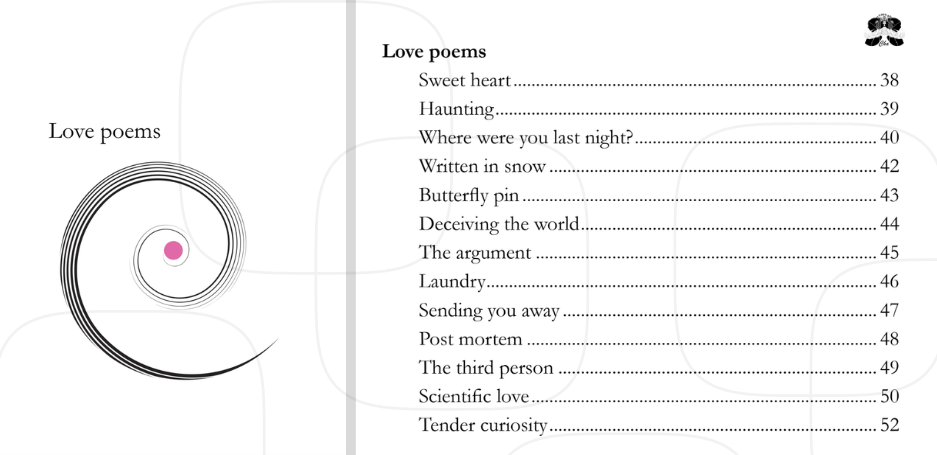
The section begins with the poem “Sweet heart”, which perfectly demonstrates Ho’s capacity for wit.
Place my heart on a large plate
Encircle the red thing with sugar
Number the black holes on it
Inject with honey-soaked water
So my heart is not at all bitter
The precise, almost surgical approach to preparing the heart belongs in a Michelin kitchen. Ho’s ear for poetic musicality is equally precise . The assonance in “[p]lace” and “plate” frames the heart, as a plate would, and the near-rhymes of “sugar”, “water”, and “bitter”, forming a triplet, bring the poem to a natural close. There is mischief, too, at the very beginnings of these lines, rewarding the reader who knows where to look. Perhaps the strangest line in the poem, and therefore the most striking, is the central one. The many “black holes” could indicate a great number of things: arteries, dead tissue, or a reference to the nature of bitterness, which has a tendency to overwhelm and persist, as black holes do.
◎
Major poets often write about major subjects, and many, inevitably, write about the ars poetica: what it means to write and to read poetry. I think of Pope and Horace, Marianne Moore and O’Hara. I’m not qualified to bestow the title of greatness, but “Suggestions for distributing your poems” is certainly a poem that follows the course of this grand tradition. Here’s a stanza:
Write a poem on an umbrella
and go out in the rain.
Watch the lines melt onto the street
and pause briefly at crosswalks and traffic lights,
before continuing on your way.
Most lines will disappear down drains,
first their periods, then predicates, then personal pronouns.
But a few key phrases may be picked up by wingtips,
and stamped as fading footprints, throughout the city.
Tammy Ho’s alliterative skill leaves me blushing. This is combined with her capacity to build a scene delicately laced with metaphor, as well as to articulate the paradox of poetry being dissolved by the same thing that disseminates it. The vividness of the imagery is matched only by the humility and resignation of the suggestion that all poetry will fade, a terrible prediction that has only been proven true.
More than ten years have passed since Hula Hooping was published. A great many things have happened, some good, some bad. One sad thing is that Hula Hooping went out of print. There are beautiful poems in the book, and I must refrain from reviewing and revealing too much, so as to let new and old readers enjoy the poetry for themselves, even though they might require a library card, or infinite patience until the day, should it ever come, when Hula Hooping returns in a second edition. Until then, I shall be wearing wingtips.
How to cite: Han, Jonathan. “Picked Up by Wingtips: Tammy Lai-Ming Ho’s Hula Hooping.” Cha: An Asian Literary Journal, 18 Sept. 2026, chajournal.com/2026/09/18/hula-hooping.


Jonathan Han is a Hong Kong-based writer. His work has appeared in Essays in Criticism, Hong Kong Review of Books, and Asian Review of Books. His chapbook Quinquennial was published by Pen and Anvil Press. Follow his Substack @jhantheman. [All contributions by Jonathan Han.]
 Cha
Cha 