
茶 FIRST IMPRESSIONS
茶 REVIEW OF BOOKS & FILMS
[REVIEW] “We Are Ugly but We Have the Words: Tammy Lai-Ming Ho’s Love Poetry” by Jonathan Han
Click HERE to read all entries in Cha
on If I Do Not Reply.
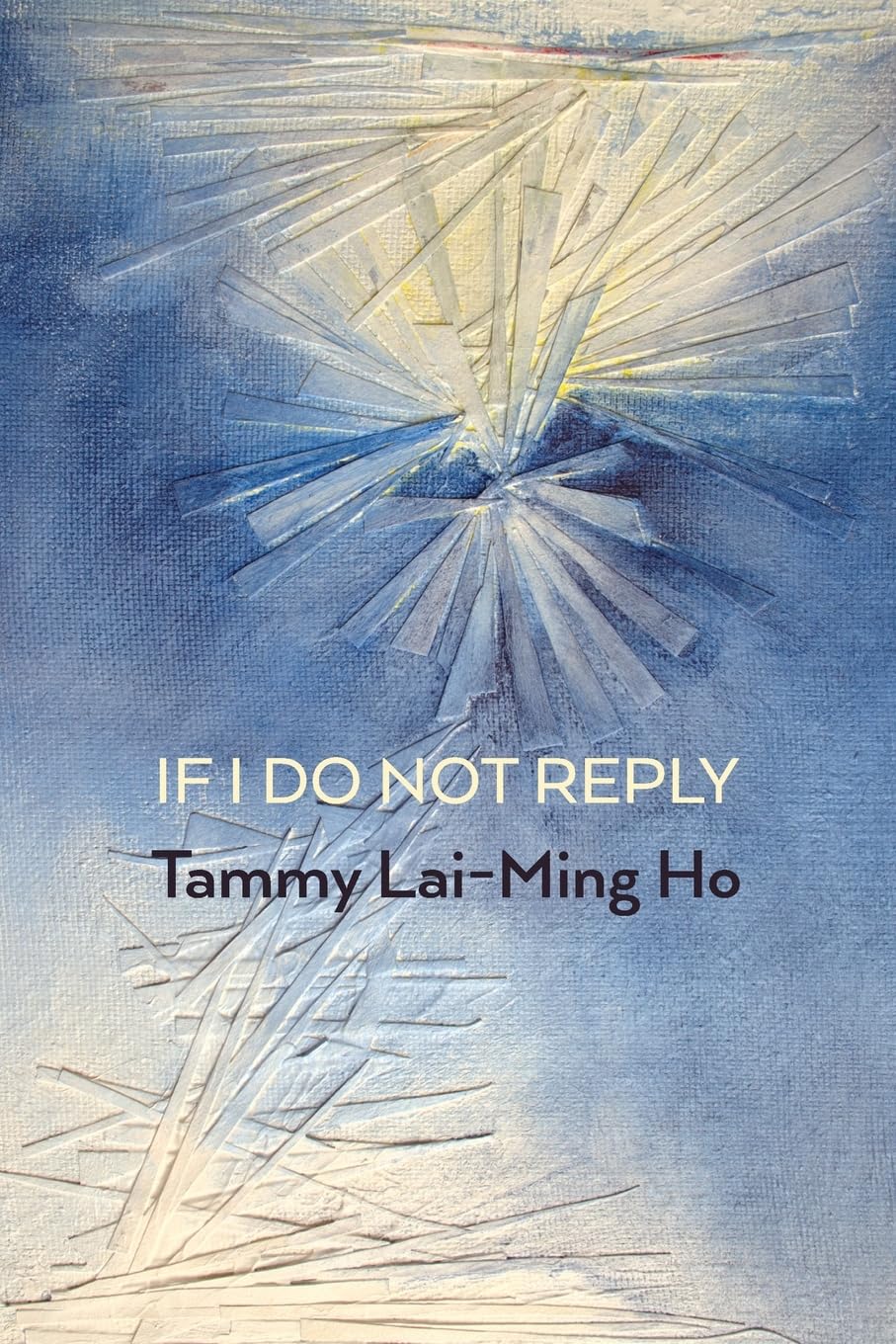
Tammy Lai-Ming Ho, If I Do Not Reply, Shearsman Books, 2024. 110 pgs.

Tammy Ho in Chicago, November 2024
Tammy Lai-Ming Ho’s book, If I Do Not Reply, may be a book of love poetry. Perhaps my romantic side is getting the better of me, but her poems are weighted with love, albeit of the tricky and uncertain kind. Hong Kong, which other reviews have rightly identified as the heart of the collection, receives a great deal of Ho’s affections.
At other times, however, that love is directed elsewhere, often towards a nameless partner, who serves as a starting point, a catalyst, and a personification.
In her poem “Let’s Not Jump into Inconclusions,” the poet begins with a confession:
One November I began to fall deeply in love with a man who just yesterday told me to add tension to my linebreaks, challenge the readers, discomfort the empty spaces on the page.
The poem spirals into rules, into a relationship, and ends, ironically, with a prose poem, a form defined by its lack of linebreaks, capping off the tongue-in-cheek witticisms that balance out the seriousness of her other works. Here the depths of her love are linked to the man’s capacity to care for the same things: “Words are our reliable currency; so is time together.”
“Reliable” is the central adjective here. Words, like currency, can inflate, or grow scarce. Empty space in a poem, or in the dialogue between partners, does add tension. By writing without line breaks, adopting the form, the poem admits to its unwillingness to challenge and discomfort not just the reader, but also the relationship.
It is one of many prose poems in the section “Here’s a Mahjong Table.” The square blocks of poetry evoke the image of a mahjong table. One can imagine, too, given the section’s relative lightness, that Ho is indeed telling us, over a game of mahjong, about her potential last words, books she saved, or this man she met with very particular tastes in poetry.
)
Ho does gamble on the reader’s capacity to play along with her poetry. The book begins with “Love Poem with Typos,” a testament to the poet’s wit. The image of a “sweat note” pairs humorously well with the obvious correction. Other typos might require more imagination: embrace for “embankment”? Sometimes, I wonder if there are any typos at all, as with the lines, “You overemphasised / the poet’s strangeness / and underestimated her…” Perhaps there is something; perhaps not. Either way, as with all guessing games, the fun lies in the ambiguity.
Some of Ho’s poems, including her prose poems, are best read quickly and again, their power drawn from the intensity of the lines as they descend. Others refuse such treatment and encourage a slow, deliberate reading. If I Do Not Reply has ample quantities of both, but I have gained greater pleasure from reading the latter. Take, for example, “This May Be a Love Poem,” with its fifteen mesmerising lines, which I shall leave entirely intact:
We are ugly but we have the words,
even if no one reads them.
We carry no axes, unready to kill.
Or turn on the oven until it warms.
Trains have passed us
since the day we were born
and none have crushed us.
We don’t scheme to
drown in a shallow pond.
Tell me again
how you intend to dig
a grave into our bed.
And how, after all these years,
nothing else but you fills the air.
It’s forever your season: loud & clear.
When first published in Cordite Poetry Review, the poem was segmented into five separate stanzas, with three lines each. Such a structure would compartmentalise the meaning and phrasing of the lines, for example, “Tell me again / how you intend to dig / a grave into our bed.” The same structure also offers timely stanza breaks, such as that between
[…]
Trains have passed us
since the day we were born
And none have crushed us.
[…]
Her decision to collapse the poem into a single stanza slows it down and shifts the emphasis onto the line breaks. The tension then settles on the lines, “We don’t scheme to / drown in a shallow pond.” The cleaved image highlights the push and pull effect that other vivid juxtapositions bring: the “grave” and the “bed,” the lack of arms and the threat of violence, the love suggested by the title and its potential absence. By the end, it is still not certain whether it is a love poem, and the objective of ambiguity is thereby achieved.
Returning to the start, the first line of the poem evokes the Leonard Cohen lyric “We are ugly but we have the music,” from his song “Chelsea Hotel #2.” Of course, I am not encouraging one to read the poem in a deep, melancholic voice, but the comparison does highlight the song-like quality of Ho’s poem. The half-rhymes in “again” and “intend” both fall on the fourth syllable of their respective lines. Or consider “drown” and “how” at the start of their own, before the poem ends with its final half-rhymes, “years,” “air,” and “clear.” Ho’s poetry ought to be enjoyed aloud, even if not sung.
Great poets have often used love as a vehicle for other poetic aspirations. But there are the few whose love poetry is unironic, flawed, and true. Keats comes to mind, as do Sappho and Donne. While the strong thematic undercurrents, so carefully written about already, might suggest that love serves another primary purpose, I remain inclined to believe otherwise. Regardless of whom Ho’s love is dedicated to, whether the city, the language she holds so dearly, or the partner who personifies those values, her latest collection remains a powerful dedication. Perhaps reading it carefully is the greatest affection one can return to a book of love poetry.
How to cite: Han, Jonathan. “We Are Ugly but We Have the Words: Tammy Lai-Ming Ho’s Love Poetry.” Cha: An Asian Literary Journal, 18 Jun. 2026, chajournal.com/2026/06/18/reply-love.


Jonathan Han is a Hong Kong-based writer. His work has appeared in Essays in Criticism, Hong Kong Review of Books, and Asian Review of Books. His chapbook Quinquennial was published by Pen and Anvil Press. Follow his Substack @jhantheman. [All contributions by Jonathan Han.]
 Cha
Cha 