
[ESSAY] “Dead Cat Bounce: The Graphic Novel Boom in Singapore That Wasn’t” by Felix Cheong
I became a graphic novelist by accident. Or perhaps by the necessity of reinvention. Whichever is the more charitable view, it was probably as good a way as any to move into a medium where nobody quite knows what will sell, what will catch on, and what will flop.

In 2018, Ethos Books, one of Singapore’s leading independent presses and the publisher of much of my earlier work, had a change of guard. A new editor, a new ethos, a Roomba sweeping clean. And sometimes the cobweb turns out to be you.
I began putting out feelers. When I initially pitched book ideas to Marshall Cavendish, I was told, in so many words of caution, that poetry by itself would be a difficult proposition. Poetry chaperoned by pictures, however, think William Blake or Edward Gorey, might have legs.

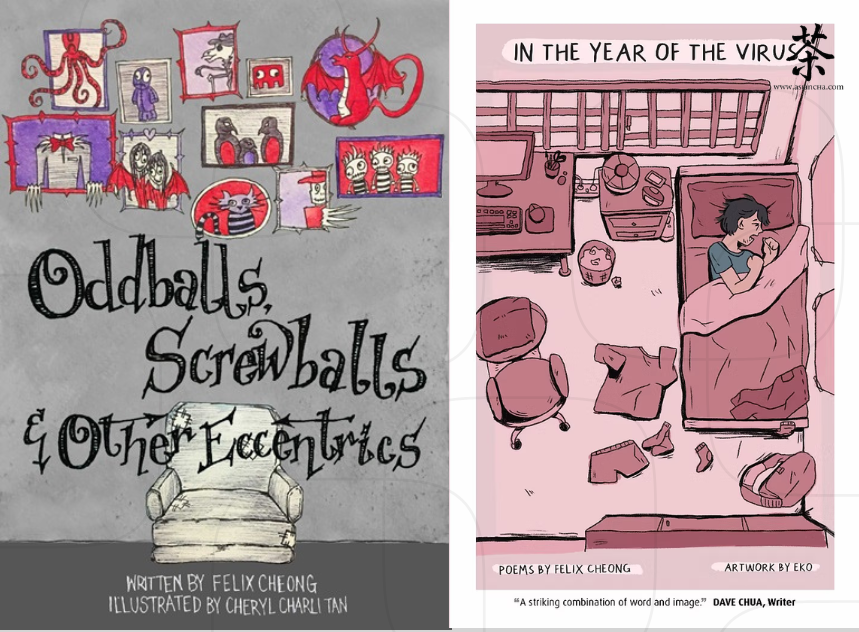
So I proposed Oddballs, Screwballs and Other Eccentrics, a collection of poems inspired by the Tim Burton-esque drawings of a friend, Cheryl Charli Tan. It was accepted. That marked a shift in my writing practice: a sense that poetry holds more sway when it flirts with visuals.
Then Covid arrived, with its long train of lockdowns, masks, and free-floating anxiety, all of which found their way into eight poems I wrote. There were too many darlings to kill but too few to bury in a chapbook. Why not turn them into comics?
The resulting graphic novel, In the Year of the Virus, a collaboration with illustrator Eko, was pitched to and published by Marshall Cavendish in 2020. I had inadvertently stumbled into the medium at what seemed like an opportune moment: the best of times, the times of the best.

Singapore comics had been accumulating cultural capital for years. Epigram Books, the independent publisher founded by Edmund Wee, launched a major comics push in 2012. One of its first releases was cartoonist Andrew Tan’s Monsters, Miracles & Mayonnaise. It featured a story, “Moving Forward”, which was nominated for an Eisner Award for Best Short Story in 2013.
More awards came Epigram’s way. Writer Oh Yong Hwee and artist Koh Hong Teng’s Ten Sticks and One Rice received a Bronze Award at Japan’s seventh International Manga Award in 2014.

)

Then came Sonny Liew.
Liew, a Malaysian-born cartoonist who had already drawn for major American comics publishers, changed the weather, nay, became the weather, with The Art of Charlie Chan Hock Chye. Published by Epigram in 2015, the faux biography of a fictional Singapore cartoonist was the first graphic novel to win the Singapore Literature Prize for English fiction in 2016. The following year, it took home three Eisner Awards and, in no time, landed on the New York Times bestseller list and was translated into nine languages.
The achievement, though, soon became an albatross.
That sounds like sour grapes. But it is not. Liew’s success demonstrated that a graphic novel born and bred in Singapore could travel internationally, our passport is the world’s most powerful, after all, while retaining its political bite.
But Charlie Chan also set expectations so freakishly high that almost everything afterwards looked like last year’s Christmas trimmings.
Perhaps publishers had caught a little of the buoyant festive cheer. If one Singapore graphic novel could find its way to readers around the world, why not another?
)
Welcome to the false dawn of Singapore comics.
The first to see the light was the National Heritage Board (NHB), the state agency charged with preserving and promoting Singapore’s heritage. It funded Comics of Singapore Histories, or COSH Studios, a collective of graphic novelists such as CT Lim, Koh Hong Teng, and Cheah Sinann. Between 2017 and 2018, the project produced seven titles that took local history and ran with it, sometimes into strange neighbourhoods: Bukit Brown ghosts and even chicken rice in a zombie apocalypse.
Comics were sneaking into academia. When Singapore Literature was offered as an elective at the Singapore University of Social Sciences around 2016 to 2017, Gwee Li Sui’s The Myth of the Stone and Ten Sticks and One Rice were among the prescribed texts. For a medium long accustomed to being read under school desks, making it onto an undergraduate reading list must have felt like finally landing on the teachers’ table.
Difference Engine roared into action in 2018 as an independent Singapore publisher devoted specifically to comics from Southeast Asia. Its list ranged across age groups and genres, including the award-winning Work-Life Balance: Malevolent Managers and Folkloric Freelancers (2022).
Other publishers were paying attention. After In the Year of the Virus, Marshall Cavendish green-lit five of my graphic novels. Penguin Random House Southeast Asia, the regional arm of the global publishing conglomerate, also entered the game, publishing three of my graphic novels between 2023 and 2025.
Following NHB’s lead, other institutions joined in. In 2024, the National Library Board awarded its Creative Residency to two graphic novel proposals: my own project, Out of the Night that Covers Me, and Tigers in the Lion City, by architect and historian Lai Chee Kien and comics artist Koh Hong Teng.
The prizes followed. The Singapore Literature Prize, administered by the Singapore Book Council, created a dedicated Comics/Graphic Novel category for 2024, with Kenfoo’s Cockman becoming its inaugural winner. The Singapore Book Awards, run by the national publishers’ association, subsequently created a Best Graphic Novel category in 2025.
And just as suddenly, the weather changed.
)
In 2024, Marshall Cavendish told me it was cutting back on books, graphic novels included. The rights to five of my titles were returned to me. This year, Penguin Random House Southeast Asia told me it was cutting back on graphic novels too. When I recently pitched a graphic novel manuscript to Epigram, I heard much the same caution.
One publisher changing direction is drizzle. Two make a downpour. But three: it is a tropical storm.
The bad news adds up. Earlier this year, the Singapore Book Council announced that its Singapore Literature Prize would not include the Comics/Graphic Novels category while it reviewed its “submission cycle”.
This is not the same as abolishing it, of course. Still, the optics are difficult to resist. The graphic novel finally got its own room, only to find a “temporarily closed” sign on the door two years later.
But the story gets untidy here.
A rough count makes the contradiction clearer. I can identify at least 25 graphic novels and book-length comics published in Singapore between 2015 and 2020, and more than 35 between 2021 and 2026. This is hardly the profile of a medium disappearing. What seems to be shrinking is something more specific: the appetite of general trade publishers to gamble on it.
Epigram has not abandoned the form entirely. It recently published Snakes of Singapore: A Slightly Unhinged Field Guide by Juliette Yu-Ming Lizeray. Difference Engine is still going strong. Its Tiger Girls, written by Felicia Low-Jimenez and illustrated by Claire Low, began as a webcomic before appearing in print in 2025. It won Best Graphic Novel at the Singapore Book Awards in 2026 and has since crossed the Pacific: American comics publisher Maverick, an imprint of Mad Cave Studios, is releasing a North American edition.
Commissioned work appears healthier too. Nutgraf Books, which specialises in accessible nonfiction about the country, produced Not So Little Red Dot: 60 Years of Singapore’s Diplomacy for the Ministry of Foreign Affairs in 2025, combining prose with comics by veteran cartoonist Cheah Sinann. It debuted at number one on The Straits Times bestseller list. Nutgraf is also working with the Singapore Hokkien Huay Kuan on a graphic novel involving the historic Thian Hock Keng temple.

)
And Liew is not finished. He is working on another major graphic novel, reportedly centred on capitalism.
So perhaps the Singapore graphic novel is not dying after all. Perhaps publishers are simply putting their money where the safest sales are.
The projects still finding oxygen tend to come with some form of insurance: an established creator, an institutional commission, an existing web audience, or a plausible route to readers beyond Singapore. Tiger Girls had already built an audience online before leaping into print. Not So Little Red Dot had the Ministry of Foreign Affairs behind it.
Which loops us back to Charlie Chan.
Perhaps its greatest unintended consequence was not that it made publishers believe in the viability of graphic novels, but that it made an exceptional success look repeatable. For a while, at least, it seemed reasonable to imagine that lightning might strike twice, or however many times the printing press rolled its drums.
The Art of Charlie Chan Hock Chye proved what was possible. But possibility is not probability. And probability is not profitability.
Perhaps that was the false dawn: not the rise of Singapore graphic novels themselves, but the brief conviction that one creator’s success would translate into a trend.
In financial lingo, a “dead cat bounce” is a brief recovery that looks like a turnaround until gravity resumes its duties. Perhaps that is what we have been watching: not a bounce in Singapore graphic novels themselves, but in publishers’ expectations of them.
I got into graphic novels because a publisher once said: add pictures and we might publish you.
Seven years later, I wonder whether the advice still holds.
Or whether what I’m holding is a dead cat.
How to cite: Cheong, Felix. “Dead Cat Bounce: The Graphic Novel Boom in Singapore That Wasn’t.” Cha: An Asian Literary Journal, 18 Sept. 2026, chajournal.com/2026/09/18/graphic-novel-boom.


Felix Cheong is the bestselling author of 33 books across different genres, from poetry to fiction. He has also published twelve graphic novels, five of which are bestsellers on Amazon. His first graphic novel, Sprawl, was named by Comics Beat as one of the 75 most anticipated graphic novels of summer 2022. Three of his graphic novels were shortlisted for the Singapore Book Awards. His latest book is A Mild Case of Mass Hysteria. A recipient of the Young Artist Award in 2000, Felix has been invited to writers’ festivals around the world, including those in Edinburgh, Austin, Sydney, Brisbane and Christchurch. He holds a master’s degree in creative writing from the University of Queensland and is currently an adjunct lecturer at a university. Visit his website for more information. [All contributions by Felix Cheong.]