
茶 FIRST IMPRESSIONS
茶 REVIEW OF BOOKS & FILMS
[REVIEW] “The Fugitive: Bei Dao’s Sidetracks” by Jeff Tompkins
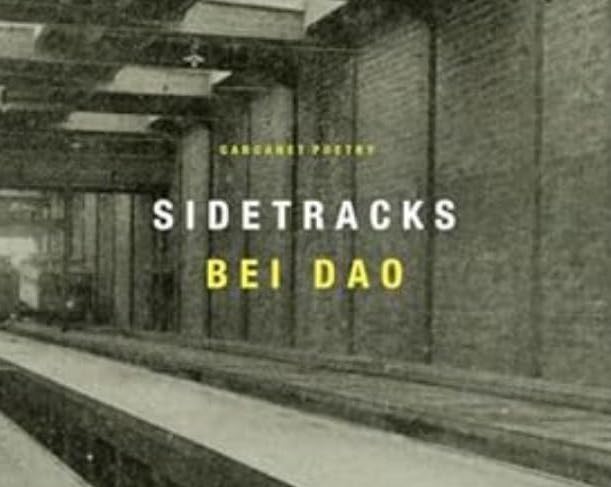
Bei Dao (author), Jeffrey Yang (translator), Sidetracks, New Directions, 2024. 176 pgs.

The “sidetracks” of Bei Dao’s title can first be understood as a structural metaphor—two parallel columns of text, one in the original Chinese and the other in English translation, extending side by side like tyre tracks pointing towards an uncertain horizon. But the term also carries the English connotation of “sidetrack”—a digression or a deviation from an expected course, perhaps an appropriate framework for an autobiographical book of poetry that constantly hopscotches from one place to another, not only across the world but also back and forth in time, with no fixed destination in view.
This itinerant perspective mirrors the lived experience of the poet himself. Bei Dao was delivering readings in Europe in early June of 1989, when the PRC authorities crushed the student demonstrations in Tiananmen Square. Because prominent student protesters had publicly cited (and recited) his writing as an inspiration, he was forbidden to return to China—thereby sending the poet, then approaching his fortieth birthday, on an odyssey of nearly two decades that saw him take up temporary residence in six countries and relocate more than fifteen times before he was allowed to settle and teach in Hong Kong in the late 2000s. Sidetracks is a single book-length poem, divided into a prologue and thirty-four cantos, recounting these experiences with frequent flashbacks to his life before exile. The result is a work that is both urgent and dreamlike—a swift-moving chronicle that also serves as a formidable testament to the poet’s resilience.
In a poem from the early 1990s, “Eastern Traveler,” Bei Dao’s speaker refers to “someone set out on travels beyond their destination.” Sidetracks emerges almost as a realisation of this prophecy. Down every road there’s always one more city: Bei Dao appears in West Berlin, Oslo, Paris, Prague, and Tokyo, with detours to Ramallah, the Sierra Nevada mountains, and the American Deep South. Although practical exigencies—such as the relentless pursuit of teaching stipends—compelled his constant movement, a deeper force seems to be at work. In his memoir City Gate, Open Up (2017), he describes it as “the impulse to keep moving, keep on moving, that burned deep in my innermost being”—a restlessness that had taken root ever since his first journey from Beijing to Shanghai as an eight-year-old child.
Throughout his journey, Bei Dao encounters a constellation of literary luminaries. The book is peppered with vivid vignettes featuring the likes of Tomas Tranströmer and Allen Ginsberg—who, at one point, implores Bei Dao to join him in meditation on a sidewalk in downtown Seoul. A particularly luminous moment unfolds in Canto XXX, where Gary Snyder’s presence is rendered with reverence, elevating him to an almost mythical stature:
woodcutter seaman forester
you are the mind circling in meditation
Taken cumulatively, Bei Dao’s encounters with his fellow poets read as small compensations for the rigours of a life measured out in stints between departure lounges.
Bei Dao craves these moments of fraternity, for throughout these pages, he bears “the baggage of a disquiet heart” wherever he goes. In his 1991 poem “Old Snow,” he offers an indelible portrayal of the exile’s plight:
on this continent
snow shows deep concern
for a foreigner’s small room
When those lines were published, Bei Dao still faced more than a decade and a half of exile before he could return to anything resembling a familiar environment. The recurrent allusions to Chinese characters in Sidetracks—most memorably, “the besieged fortress of Chinese characters”—hint at the profound toll that such prolonged, involuntary separation from his native language must have exacted on a writer. Elsewhere, his melancholia emerges as a persistent, low-frequency resonance, an undertone that never fully dissipates:
Homesickness frequency on a walkie-talkie
That final pairing serves as a testament to Bei Dao’s enduring mastery of the precision image, his gift for striking the bull’s-eye within a single line remaining undiminished. From Canto VI: “stars ignite the gunpowder night.” Canto VIII: “the road tows awake the open sky.” Canto XX: “violence searches for a new riverbed.” Yet it is in Canto XVII that a particularly revealing moment arrives:
the desk is the real border
and work comes and goes
That may be the poet’s most candid acknowledgment of the psychic fortitude he had to cultivate in order to keep writing under such unsettled conditions.
The book-length format allows Bei Dao to expand his cinematic sensibilities. In City Gate, Open Up, he relates how, in his youth, he was drawn to Sergei Eisenstein’s theory of montage—an influence that can be traced throughout his poetry. The critic Michael Palmer once described his work as characterised by “sudden juxtapositions and fractures,” which make his verse alternately bewildering and electrifying, often within the space of a few lines. In Sidetracks, Bei Dao deploys the technique to full effect, not only within individual stanzas but also between sections, as in the striking jump cut between the end of Canto VI, which recounts a fateful resolution at Oslo Airport on New Year’s Day, 1990, and the opening of Canto VII, which jerks us back to early 1970s Beijing.
Then there is this remarkable feat of ventriloquism in Canto XXI, a passage that may well redefine Keats’s concept of negative capability for the twenty-first century:
I am patient zero
A spirit released from a tiny bottle
Donning a paper crown I reign over the world
All the powers that be kneel before me
A page later, the virus even has the audacity to plead, “I am innocent—whatever exists grows like crazy.” Translator Jeffrey Yang deserves particular credit here—the demotic “like crazy” infuses the line with an unsettling levity.
The final canto of Sidetracks finds the poet relocated to Hong Kong, yet any expectation of respite or stability is swiftly dispelled. The Fragrant Harbour proves anything but a safe haven. In 2012, Bei Dao suffers a debilitating stroke, requiring years of recovery—making the very existence of this book all the more extraordinary. Then the pandemic arrives, followed by the encroachment of another, more insidious force—evoked obliquely in the phrases “like water” and “words hunted and killed”—the latter hardly even a metaphor in the 2020s. Bei Dao’s whirlwind recounting of a life in perpetual motion breaks off at yet another moment of uncertainty:
I am you a stranger on the sidetracks
waiting for the season to harvest blades of light
sending letters though tomorrow has no address
This sudden identification of writer with reader, and the acknowledgment of the unknowable future they share, stands as the most profoundly moving moment I have encountered in Bei Dao’s poetry.
A New Yorker review of Sidetracks observed an “autobiographical immediacy” not previously characteristic of Bei Dao’s verse. This is one reason why the new book makes an ideally accessible entry point into his work for late arrivals. Come for the human interest, stay for the fierce, challenging, and ultimately mind-expanding sensibility that bristles from one page after another. “Bei Dao uses words as if he were fighting for his life with them,” wrote the China scholar Jonathan Spence, in an often-quoted review from thirty-five years ago. In a more recent appreciation, Michael Hoffman made the case this way:
They are difficult poems, neither collages nor surreal, but enforcing unusual or personal connections. They think in images, across categories, making a new, often violent reality that we may think of as dissident or expressionist.
For newcomers, Hoffman’s invocation of the term “expressionist” offers a valuable analogy. Approach a collection of Bei Dao’s poetry as you would an exhibition in a gallery. Be patient—if the composition before you does not immediately arrest your attention, the next one just might. Do not become preoccupied with extracting meaning; such an effort risks tumbling into what the poet himself once termed “the abyss of explication.” Likewise, resist the temptation to impose politics onto the work—the reductive impulse to see everything as a commentary on the state. As Joseph Brodsky—no stranger to censorship, persecution, and exile—once wrote, in “The Child of Civilization” (1977):
A poet gets into trouble because of his linguistic, and, by implication, psychological superiority, rather than because of his politics. A song is a form of linguistic disobedience, and its sound casts a doubt on a lot more than a concrete political system: it questions the entire existential order. And the number of its adversaries grows proportionally.
I appreciate Brodsky’s formulation—but Bei Dao surpasses even that in “Midnight Singer,” a poem from the 1990s. In it, he describes a song as “a steam locomotive / bursting into the church”.

How to cite: Tompkins, Jeff. “The Fugitive: Bei Dao’s Sidetracks.” Cha: An Asian Literary Journal, 2 Feb. 2025, chajournal.com/2025/02/02/bei-dao.


Jeff Tompkins is a writer and zine artist in New York City. His essays and reviews have appeared in the Brooklyn Rail, IMPULSE, and Words Without Borders, among other outlets. In previous incarnations he was a Senior Producer for Asia Society New York and the Online Content and Community Manager for Library of America, the non-profit publisher. [All contributions by Jeff Tompkins.]