
茶 FIRST IMPRESSIONS
茶 REVIEW OF BOOKS & FILMS
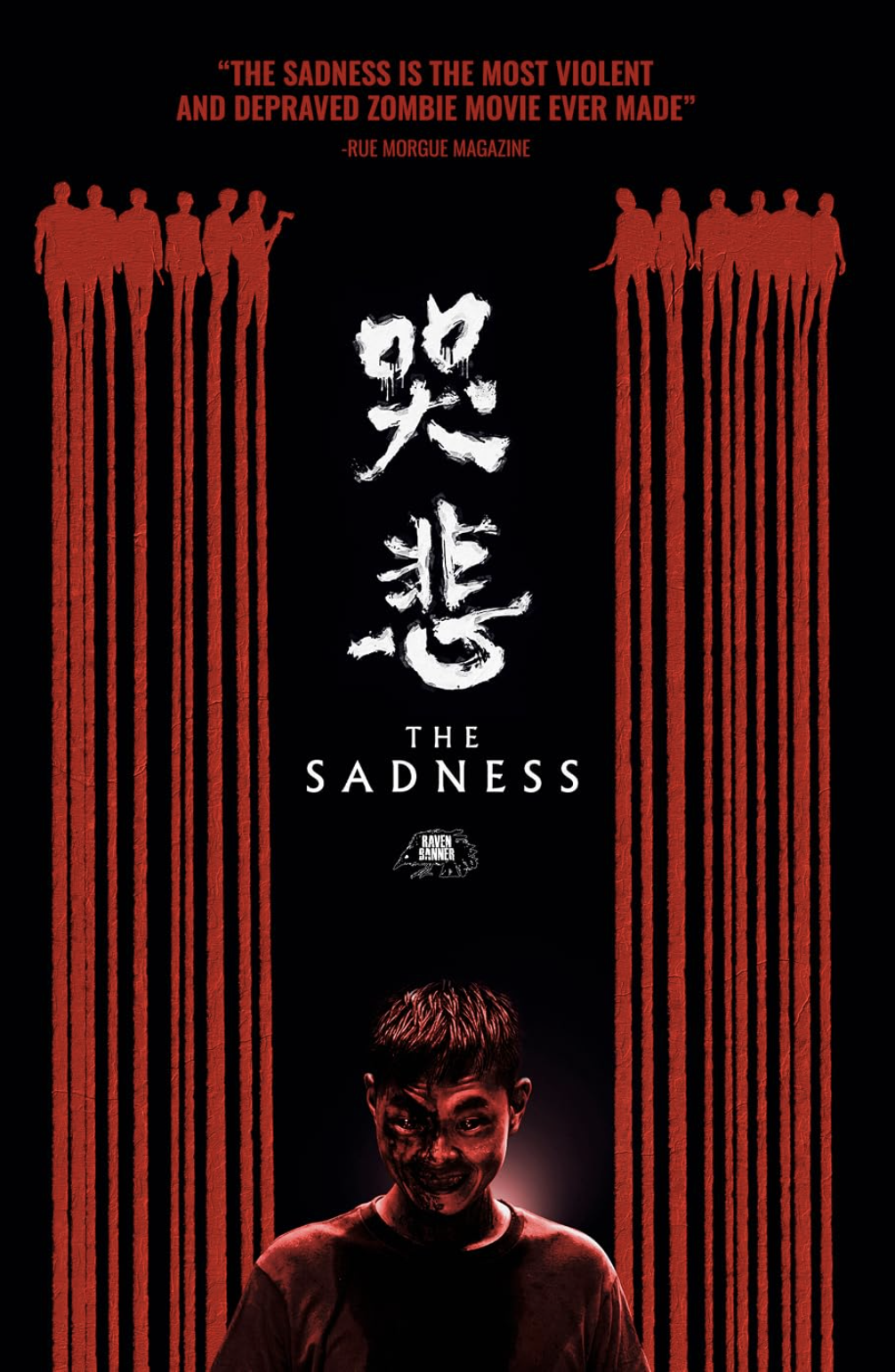
[ESSAY] “Rob Jabbaz’s The Sadness: Taiwan’s Version of Covidsploitation and Category III-like Cinema” by Cyril Camus
Rob Jabbaz (director). The Sadness 哭悲, 2021. 99 min.


In June 2022, Nanarland, a well-known French website devoted to “nanars” (i.e. comically bad films), posted a graphic list of covidsploitation films on its Facebook account.
Now, The Sadness, a Taiwanese production despite its Canadian director-writer-editor, is the very antithesis of a comically bad film: it is exceptionally well made, as well as being a cheerless, unrelentingly cruel and traumatising bloodfest. Yet it unquestionably deserves a place on Nanarland’s list, not as a “nanar”, but as quintessential covidsploitation.
This is perhaps to be expected, given the timing of the film’s release and its subject matter. Indeed, The Sadness is essentially an “infected” film, belonging to that peculiar subgenre of zombie cinema in which the “zombies” are not the living dead but people infected by a virus that renders them zombie-like.
The lineage of this premise runs from George Romero’s The Crazies (1973) through Danny Boyle’s 28 Days Later (2002) to Yeon Sang-ho’s Colony (2026). Even so, I was taken aback by the degree to which The Sadness leans into the Covid theme, and by how explicitly it does so.
Although the virus depicted in the film goes by a different name (“the Alvin virus”), it is essentially a deadly serious version of the way Charles Band’s silly horror comedy Corona Zombies (2020) portrays Covid-19 (i.e. with exactly the same symptoms and impact as the real thing at first, before it begins turning people into zombies). The crucial difference, of course, is that the director, together with the Taiwanese production team and cast of The Sadness, genuinely put in the work to craft a proper film, whereas Charles Band and his Full Moon production company merely shot a handful of transitional scenes and spoof news bulletins, which they spliced together with a great deal of recycled footage from their own production Zombies vs. Strippers (directed by Alex Nicolaou in 2012) and from Bruno Mattei’s Hell of the Living Dead (1980), a classic of the Italian “nanar”. The result was essentially a mixture of shameless opportunism and one big, goofy joke.
The Sadness, by contrast, takes itself so seriously that I am fairly certain I heard exasperated sighs from fellow cinemagoers when, towards the end, a monologue revisits the same criticisms of “covidiots” that had made up the bulk of the dialogue at the very beginning of the film. Granted, the film does have some markedly didactic aspects that may come across as tedious, even to viewers who are not themselves proud covidiots liable to take offence. However, given the intense irritation I felt towards covidiots throughout the pandemic, I can certainly sympathise with the director-writer’s frustration, and with his urge to take jabs at such people through long stretches of expository dialogue.
As for the violence, clearly one of the film’s chief selling points, the gore (all those pustules, fluids, viscera, and grotesque faces) initially felt, despite the serious tone, more like a cartoonish spectacle in the vein of Peter Jackson’s Dead Alive (1992) than one of those extreme, disturbing “Category III” Hong Kong films to which The Sadness has been compared. Later, however, the carnage takes on such explicitly sexual connotations that it shifts into something else altogether; in this respect, the film seems to owe as much to Drew Bolduc’s The Taint (2010) as it does to Corona Zombies. While the infected do not target women exclusively in their sadistic, rapacious rampages, women remain, as is so often the case in such stories, a primary target. The protagonist, for instance, is a woman directly threatened by this particular facet of the film’s pandemic. Furthermore, one of the infected, elevated to the status of a “superior” villain capable of strategising and of leading the rest of the horde (much like Stripe in Gremlins), serves as a particularly clear (and, again, almost didactic) embodiment of the film’s commentary on toxic masculinity.
Ultimately, the film is extremely hard-hitting, venturing into a realm of depravity reminiscent of certain Category III films, such as Ebola Syndrome (1996). Nevertheless, it remains very much an entertainment-focused film, stopping well short of the unspeakable ethical trauma found in other Category III works such as Red to Kill (1994), or of the semi-respectable, and thus all the more wince-inducing, sensationalism of something like Men Behind the Sun (1988). Still, the brand of entertainment that The Sadness offers perhaps pushes things a little too far for it to be regarded as a “normal” film. Indeed, at one point I found myself thinking that the Taiwanese film’s blood-splattering did not quite compare to the approach taken in Irreversible (2002), the renowned, harrowing French experimental rape-and-revenge film from which one truly struggles to recover; but then, only a moment later, The Sadness offers its own take on Irreversible’s “smashing someone’s face in with a fire extinguisher” trope, so… go figure.
How to cite: Camus, Cyril. “Rob Jabbaz’s The Sadness: Taiwan’s Version of Covidsploitation and Category III-like Cinema.” Cha: An Asian Literary Journal, 15 Nov. 2026, chajournal.com/2026/11/15/the-sadness.


Cyril Camus teaches English to post-secondary students at Lycée Ozenne in Toulouse and is an associate member of the Centre for Anglophone Studies at Toulouse University. He is the author of Myth and Fabulation in the Fantasy Fiction of Neil Gaiman, originally published in French in 2018, with an English-language edition published by McFarland in August 2026. He also wrote the historical horror novel Grand Guignol, published in October 2026, which had previously appeared with another publisher, in a slightly different version, under the title Sang de bœuf between 2019 and 2025. His academic publications address Neil Gaiman, Alan Moore, comics, music, and postmodern fantasy. He also co-edited a 2021 journal issue on societal and environmental collapse in fantasy and science fiction. Further information is available on his website. [All contributions by Cyril Camus.]