
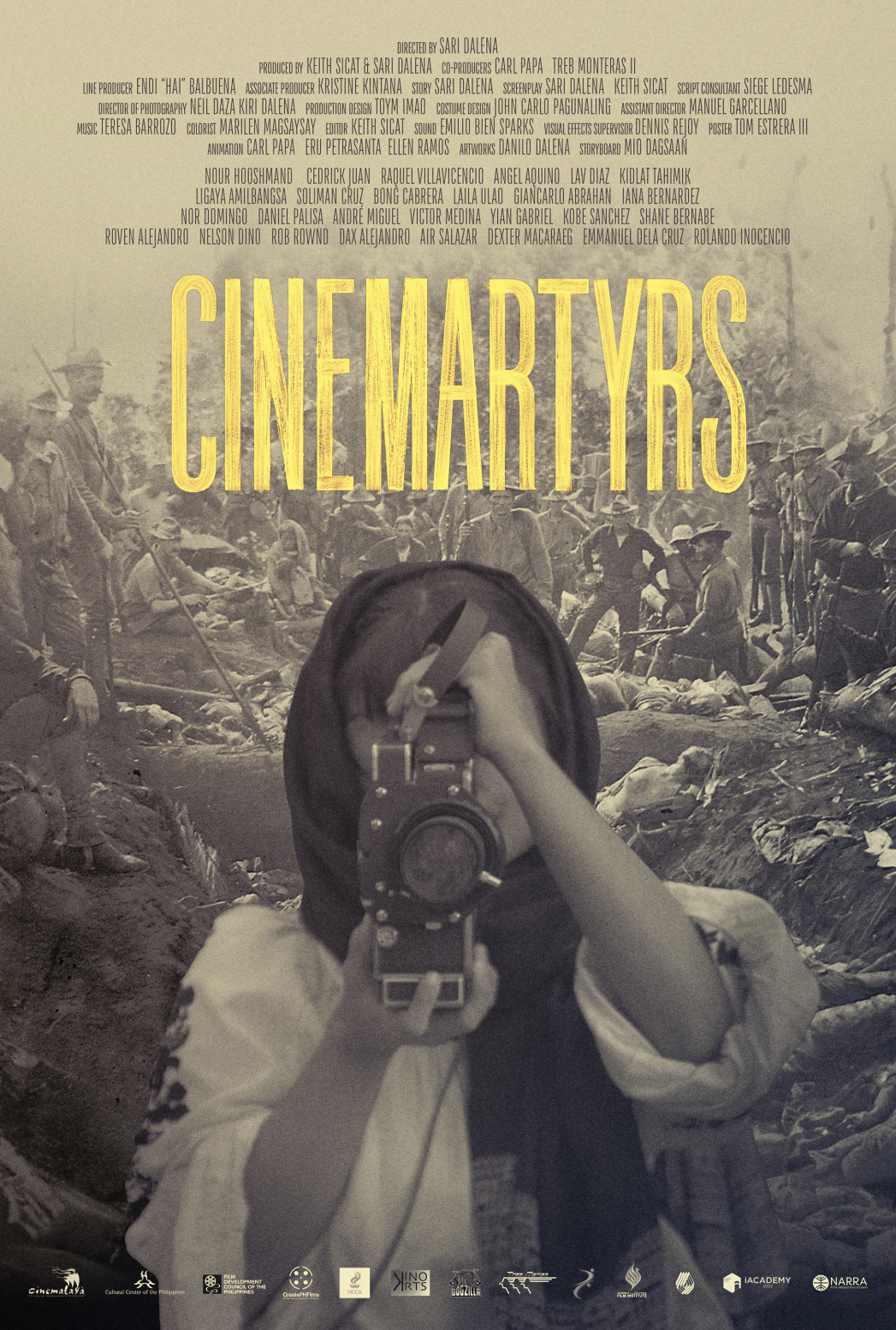
[FIRST IMPRESSIONS] “Cinemartyrs: When the Camera Sails into the Sea of Forgotten Memories” by Nelson Dino
Sari Dalena (director). Cinemartyrs, 2025. 104 min.


The sea has long borne witness to Sulu’s history. Its waters have connected communities, welcomed traders, endured colonial encounters, and preserved memories across generations. In Sari Dalena’s Cinemartyrs, this maritime landscape becomes a cinematic passage into the historical and spiritual consciousness of the Sulu Archipelago. As one of the film’s actors, I gained an intimate perspective on how cinema can carry ancestral memory into contemporary storytelling.
Directed by Sari Dalena and co-written with Keith Sicat, Cinemartyrs draws inspiration from Dalena’s documentary Memories of a Forgotten War (2001), which explored the atrocities of the Philippine-American War in the southern Philippines, known locally in Sulu as the Sulu-American War. Her journey to Jolo, Sulu, and her encounters during the documentary’s production helped shape the film’s creative foundations. More than two decades later, I found myself participating in a story connected to those earlier encounters, lending the experience personal significance and deepening my sense of the film’s ties to history and memory.

In Sulu, history lives on through genealogies, oral traditions, place names, songs, and stories passed from one generation to the next. The sea becomes an archive of journeys, the land preserves the traces of human experience, and the people remain the interpreters of their ancestral inheritance. Cinemartyrs draws on these dimensions to place Sulu’s historical identity at its centre, opening a broader conversation about maritime histories, colonial encounters, Islamic traditions, and cultural exchange across the Sulu Archipelago and the Malay world.
My role in the film was that of an Imam from Jolo. Within the Muslim community, an Imam serves as prayer leader, religious guide, teacher, and figure of moral authority. Portraying him demanded careful attention to his composure, gestures, expressions, and spiritual disposition. The experience deepened my appreciation of Islamic scholarship and religious leadership in Sulu society, where Imams and ulama have helped to transmit religious knowledge, nurture moral values, and sustain communal traditions. Every moment spent inhabiting the character became an exercise in understanding the relationship between faith, identity, and collective representation.
Among the film’s most compelling aspects is its exploration of the relationship between the living and the departed. Ancestral memory abides in familiar places, inherited responsibilities, oral narratives, and spiritual awareness. This theme recalls the experiences surrounding Dalena’s earlier documentary and strengthens the connection the film forges between historical remembrance and the unseen dimensions of human experience. The camera becomes a vessel of memory, preserving faces, landscapes, gestures, and moments for generations of viewers.
The film’s acknowledgement of pioneering Filipina filmmakers such as Carmen Concha, Susana de Guzman, and Consuelo Osorio further anchors its narrative within the broader history of Philippine cinema. Their contributions illuminate generations of women whose artistic vision helped to shape the nation’s cinematic imagination.
This engagement with history also situates Cinemartyrs within the wider discourse of Asian cinema. Across the region, filmmakers are exploring colonial histories, indigenous experiences, spirituality, cultural identities, and collective memory. Through Sulu’s historical landscape and its maritime ties to Sabah and the wider Malay world, the film offers a regional perspective shaped by centuries of movement, exchange, and encounter.
For me, taking part in the film offered an opportunity to witness filmmaking as a form of collective artistic expression. The director’s vision, the actors’ interpretations, the cinematography, and the production coordination all converge in the making of every scene. Each rehearsal and take becomes part of a shared endeavour, allowing individual performances to contribute to a larger cinematic whole.
What stays with me most profoundly is the film’s engagement with Jolo as a place of historical and cultural significance. Its shores, maritime routes, Islamic heritage, and generations of community life around the Sulu Sea embody a distinctive historical consciousness. I hope that younger audiences, especially the people of Sulu, will recognise their own landscapes and inherited memories in the film and begin conversations with their elders about the histories that have shaped their communities.
At its heart, Cinemartyrs is an encounter between cinema and collective memory. Its images invite audiences to look towards Sulu as a living wellspring of history, spirituality, and cultural imagination. Having portrayed an Imam from Jolo, I feel privileged to have been part of this cinematic journey. The film leaves me with a lasting impression of the sea as witness, the land as archive, and the people as storytellers of their own histories, and it grants the Sulu Archipelago a meaningful place in the ongoing story of Philippine and Asian cinema.
How to cite: Dino, Nelson. “Cinemartyrs: When the Camera Sails into the Sea of Forgotten Memories.” Cha: An Asian Literary Journal, 15 Nov. 2026. chajournal.com/2026/11/15/cinemartyrs.


Nelson Dino is a literary writer, cultural researcher, academic, and assistant professor at MSU TCTO in Tawi-Tawi, in the Sulu Archipelago. His interests centre on Sululogy, Sulu literature, indigenous narratives, maritime and archipelagic studies, cultural heritage, and Southeast Asian literary and cultural criticism. He concludes his writing by inviting readers to sail together, closing with the tagline “Layag Sug”.