
茶 FIRST IMPRESSIONS
茶 REVIEW OF BOOKS & FILMS
[REVIEW] “Age of Vice: The Crime Thriller That Makes Vice Intoxicating” by Abhinav Tulachan
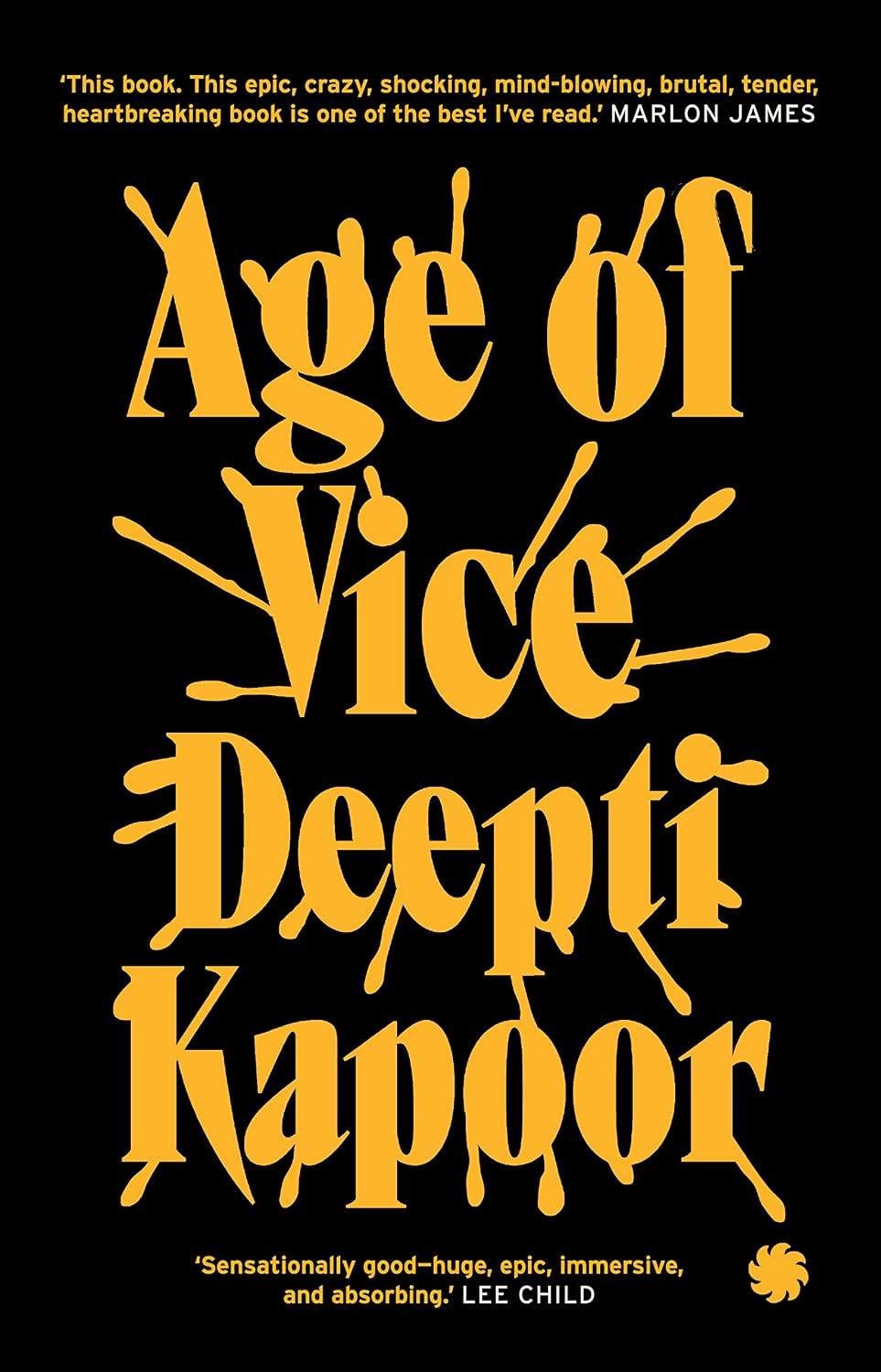
Deepti Kapoor. Age of Vice, Fleet, 2023. 560 pgs.


Now here’s a story worth talking about.
I’ll begin by admitting that I often struggle to sustain my interest when reading, and even writing, long-form narratives. Investing oneself in any text that stretches beyond 300 pages can be arduous.
Words are drowned out by one’s own thoughts as the text becomes background noise. It’s difficult to absorb the world being depicted, to immerse oneself in it, or indeed in anything, when almost everything nowadays seems designed to satisfy a craving for instant gratification through quick dopamine hits.
The same could certainly be said of this ongoing tangent. Readers mainly want a straightforward summary and are likely skimming the reviewer’s personal reflections to reach the main point, decide whether the book is worth reading and draw their own conclusions. The brain seems to have been trained to move on rather than linger.
You. Need. To. Keep. Moving.
Why does any of this matter, one might ask? “Just get to the point,” others may say, and so I shall. But this is relevant, rest assured. Deepti Kapoor’s Age of Vice is a brick of a book, running to well over 500 pages, depending on the edition. Despite its length, it is one of the few long-form works I’ve read that held my attention throughout.
Perhaps that is simply because of how much it contains. It has depth, yet never feels suffocating, however long you remain submerged in it. Instead, its immersive quality draws you deeper.
The premise itself is fresh and arresting: a crime thriller set in the heart of India during the early 2000s, examining corruption through the crime families that exploit it for their own benefit.
We are immediately thrown into this world with a Mercedes crash. Five people, including a pregnant woman, are dead, and the man behind the wheel is arrested.
Except that he is not a man, not really, not in the sense that the word “man” implies agency, adulthood and a life one has consented to inhabit. He is Ajay, a driver, which is to say a body positioned by others at a steering wheel. The arresting officers know this, the crowd knows this, and the reader, some 500 pages later, will understand it most painfully of all.
This is Kapoor’s opening gambit, and a wonderfully efficient beginning it is. The story returns to it repeatedly. It is also, I believe, why I remained engrossed in its pages while lugging my hefty paperback through Hong Kong’s MTR.
❧
Three characters dominate the novel’s three main sections. Each is connected to the crime family in one way or another, offering a different perspective on how deeply corruption has taken root and how far its influence extends. Their lives intertwine through loyalty and circumstance, each revealing a different aspect of that corruption.
We have already briefly encountered Ajay, so I’ll begin with him. He is by far the most interesting character, partly because his story comes first and has time to develop, but also because he introduces us to the criminal underworld through untainted eyes, both his and the reader’s. A boy sold into what is essentially slavery, he escapes his fate and begins to build a life through his own efforts. When those efforts intersect with chance, he meets a young criminal heir, Sunny Wadia, and is brought into the organisation as his guard.
Naturally, these events establish the familiar archetype of the loyal retainer. What is interesting is how that loyalty develops. Most traditional narratives would portray it as a bond born of indebtedness, which is certainly part of Ajay’s attachment. But having experienced the Indian hierarchy from almost its lowest rung, and having always placed survival above all else, he comes to regard himself as a weapon to be wielded. His obedience initially serves his survival, and usefulness to powerful people offers protection. His loyalty to Sunny therefore also has a transactional dimension. That tension gives Ajay far more complexity than the familiar “poor man enters a rich man’s world” narrative might suggest.
Then there is Ajay’s boss, Sunny, the heir to the organisation. His section comes last, but I wanted to discuss him earlier because he is almost Ajay’s complete inverse. The Wadia heir offers a glimpse of life at the top.
Readers witness the sheer extravagance of that position, with money, influence and property in such abundance that their possessor can control other people’s lives for personal gain. Sunny is certainly a spoilt heir, but what makes him interesting is how little his privileged upbringing has left him wanting. When there is nothing to crave, what is there to gain?
I particularly enjoyed the way these tensions recur throughout the novel. This is perhaps one of its greatest strengths and, depending on the reader, one of its more interesting weaknesses: Kapoor depicts corruption so beautifully. Lavish interiors, expensive cars, parties, hotels, private rooms, drugs and grand ambitions abound. All convey the sense that money can bend the physical world around those who possess enough of it. This excess stirs the reader’s envy. It is a life only a privileged few ever experience, yet we want to learn more because reading offers a way into it. The novel condemns this hierarchy while making it intoxicating to read about, and that is precisely why it works.
If vice were ugly all the time, it would be easy to reject, wouldn’t it?
This makes Sunny particularly interesting. If he has all of this, what can he crave? It soon becomes evident that he longs for his father’s approval: to be seen and embraced as a son rather than treated as the bearer of the organisation’s legacy. The lengths to which he might go to satisfy that hunger make him a fascinating character in retrospect.
The third character, Neda, enters here because her role is tied to that craving. She stands between Ajay and Sunny, occupying the most unstable position of the three. As a journalist, she is an observer whose profession demands a critical examination of the world around her. It is easy to condemn Sunny and his privilege from beyond the fence, but considerably harder when that privilege opens its gate and invites her inside.
Where Ajay represents those on the lower rungs forced into servitude, and Sunny embodies the enviable life at the top, Neda is the one seduced by the system. Through her, Kapoor examines how something you scorn from the outside can become something you defend once you have tasted its pleasures or fallen under its spell.
Neda’s section was the one I enjoyed least because of its extensive political analysis. That is a personal reservation, as I am not particularly well versed in the subject. Readers with a stronger interest in politics may find her the most compelling character.
What I enjoyed most, returning to my initial point, was the story’s pacing. For such a lengthy book, Age of Vice moves with an almost perverse sense of urgency. Kapoor’s command of rhythm is fascinating and addictive. The prose becomes increasingly cinematic during frantic sequences: sentences are as abrupt as the actions they describe, dialogue propels the scene forward, and everything reads like an action film. Despite the book’s length, the pages fly by. You begin anticipating rather than merely reading. Your heart beats faster. You feel a rush of adrenaline as your eyes race across the text. You know something is about to happen, though you don’t yet know exactly what, and by the time it does, you have already been dragged halfway towards it.
❧
It’s almost like watching an action film.
None of this diminishes the depth of the surrounding world; there is still ample time to understand how it works. Neda’s section provides a crucial midpoint, but once you settle into the rhythm, you cease to notice it. Age of Vice would not be nearly as compelling if speed were its only virtue, because beneath that urgency lies a question about power.
Who gets to make choices? Who gets blamed when those choices go wrong? Who gets to call exploitation “development”? Who gets to move through a city without seeing the people whose lives are being displaced by that movement?
The opening accident contains almost everything you need to know about the novel: a man placed behind the wheel to face the consequences. This is more than a story about good and bad people. It examines why people embrace corruption, but also a system in which power becomes so ordinary that almost everyone, whether they possess it, serve it, investigate it or desire it, is eventually implicated.
Perhaps that is why, even after finishing the book, what I remember first is the feeling of being unable to put it down. A book this long should, by any conventional measure, have given me every opportunity to lose interest. But the more I read, the more I wanted to know. The characters became more entangled and the world widened, until I looked up from the page and discovered that night had become day.
There are worse vices than that.
How to cite: Tulachan, Abhinav. “Age of Vice: The Crime Thriller That Makes Vice Intoxicating.” Cha: An Asian Literary Journal, 14 Nov. 2026, chajournal.com/2026/11/14/age-of-vice.


Abhinav Tulachan is an undergraduate student in the Department of English Language and Literature at Hong Kong Baptist University. He loves reading, writing, and sharing the knowledge he has gained through his academic journey. [All contributions by Abhinav Tulachan.]