
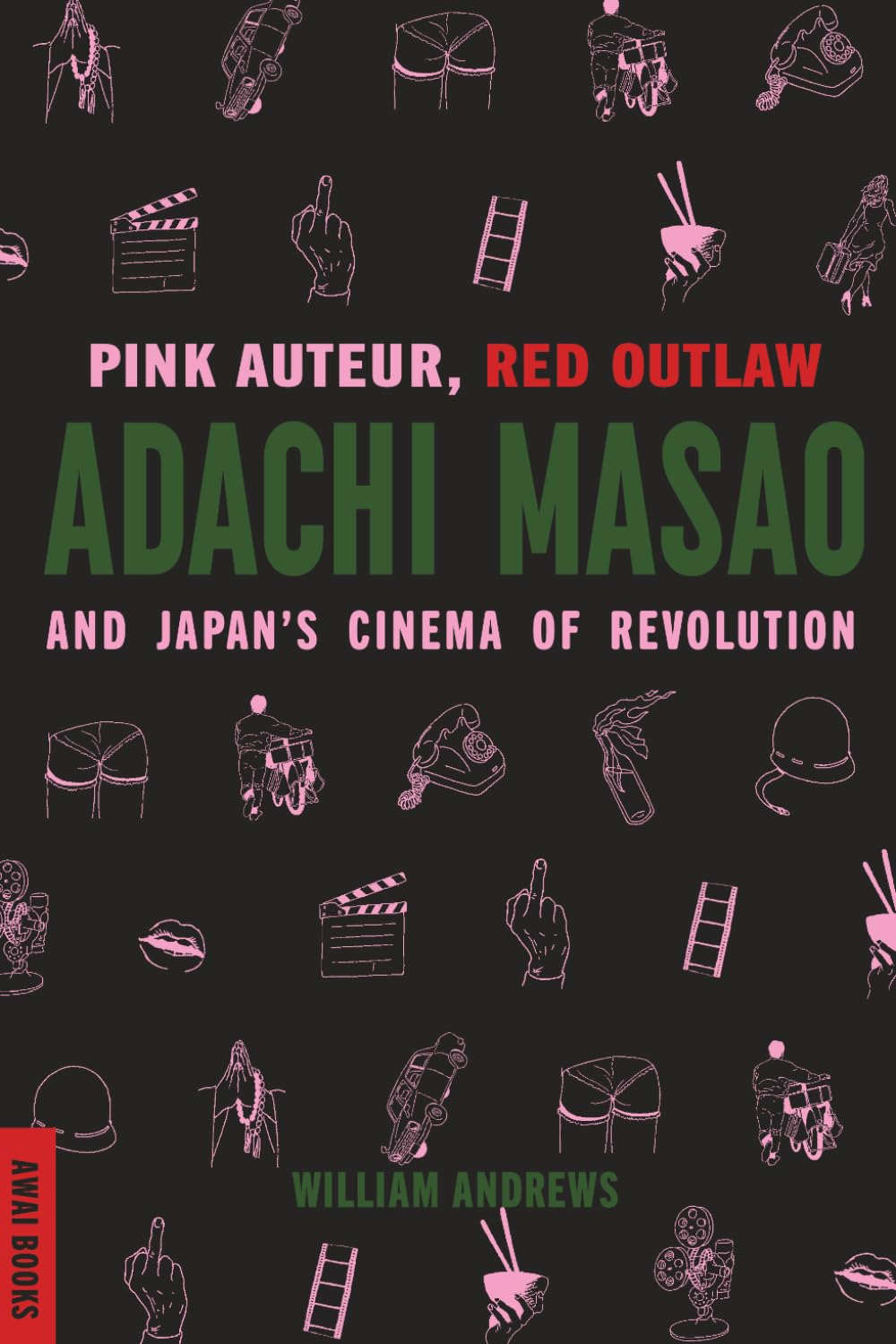
[ESSAY] “Pink Auteur, Red Outlaw: Adachi Masao and Japan’s Cinema of Revolution” by William Andrews
William Andrews. Pink Auteur, Red Outlaw: Adachi Masao and Japan’s Cinema of Revolution, Awai Books, 2026. 370 pgs.


It is often remarked that revivals of interest in cultural figures are cyclical, and that everyone’s turn comes around eventually. In truth, there are few hard and fast rules; such reappraisals seem rather to follow the vagaries of an invisible algorithm of public and critical serendipity.
When I began writing a biography of the film director Adachi Masao in 2016, he was in his late seventies and commanded a cult following. A one-time member of the 1960s New Wave, he had become notorious for his political activism as a member of the Japanese Red Army from the 1970s onwards, before resuming underground filmmaking after his return (in handcuffs) to Japan at the turn of the century. The new works that resulted were relegated to the margins of Japanese film culture, though interest overseas was growing, thanks both to screenings and events that framed Adachi as the very epitome of the political artist and to scholarly attention to landscape theory, a set of practices with which he was associated.
❧
First conceived by the critic Matsuda Masao, landscape theory (fukeiron) posits that traces of invisible state power can be discerned in the quotidian landscape. The idea is particularly pertinent to post-war Japan and its period of high economic growth (roughly 1955 to 1973), when the country was rapidly transformed into a superpower with vast new rail and road infrastructure, even as society failed to come to terms with the legacy of its colonial past and the trauma of war.
Though born of contexts highly specific to Japan in the 1960s and 1970s, landscape theory has since gained international currency as a way of seeing the world, inspiring recent work by the filmmakers Éric Baudelaire and Heidrun Holzfeind. Scholars have also adopted it as a framework for fresh interpretations of figures such as Chantal Akerman, Jean-Marie Straub and Danièle Huillet, Marguerite Duras, and James Benning.

All this was made possible by researchers’ rediscovery of landscape theory in the 2000s, prompted by Adachi’s return to Japan. It had been an obscure movement, its most famous iteration being the experimental documentary A.K.A. Serial Killer, made by Adachi, Matsuda, and others in 1969 but not shown publicly until 1975, and for some years thereafter difficult for international audiences to see. This began to change with screenings and events, first in Japan and then in North America, and with major interventions by the researcher Hirasawa Go in Japanese and the media scholar Yuriko Furuhata in English.

❧
This dovetailed with a growing fascination among scholars and film enthusiasts with Japanese sexploitation cinema (known as pink film), a genre to which Adachi contributed several significant works in the 1960s and 1970s. Jasper Sharp published the lavishly illustrated Behind the Pink Curtain in 2008, and Markus Nornes followed with an edited volume of scholarly essays on pink cinema in 2014. Smut and titillation had become subjects for serious consideration by academics and cineastes, particularly in the case of the films of Adachi and his frequent collaborator Wakamatsu Koji, which were framed as politicised sexploitation engaging directly with the oppositional politics of the Long Sixties.


❧
Two further currents fed into this stream. The first was renewed attention on Japanese underground cinema, including its relationship to its American counterpart. Having languished for years in private collections and archives, these films now began to find new audiences through exhibitions, screenings, and streaming releases, among them Adachi’s early films (which I personally consider among his most rewarding works). The second was a revival of interest in Japan’s Long Sixties, manifest in a veritable explosion of memoirs and books, exhibitions, documentaries, and fiction films (including Wakamatsu’s acclaimed 2008 docudrama about the United Red Army purge). In the case of Adachi and other members of the Japanese Red Army, trial testimony and various publications at last allowed the public to learn more about their activities from the mid-1970s onwards, which had long been shrouded in mystery. The Irish filmmaker Shane O’Sullivan made a well-received documentary, Children of Revolution (2011), about the daughters of two female radicals of the Long Sixties: Ulrike Meinhof of the German Red Army Faction and Shigenobu Fusako of the Japanese Red Army.

❧
This constellation of interests seemed to crystallise around Adachi, yielding a 500-page semi-autobiography (edited from interviews with Hirasawa) in 2003, a French translation of a selection of his key writings in 2012, and, around the same time, documentaries by the French filmmakers Éric Baudelaire and Philippe Grandrieux. He became a favoured talking head in documentaries, always ready to wax lyrical on camera about sexploitation and the counterculture. Screenings of his work at international festivals and exhibitions were by now fairly common, and in 2015 he was commissioned by a South Korean cultural institution to make a new film, his second since returning to Japan.
❧
Things then went quiet again while I beavered away at my biography, the world contended with the pandemic, and Adachi kept himself busy with occasional acting roles, articles, and public events. In 2022 he found himself embroiled in controversy over allegations of antisemitism in the Tokyo Reels Film Festival screening programme at documenta fifteen in Kassel, Germany. For all the renewed international curiosity about his work, his close involvement with the Palestinian cause still rendered him a problematic figure (and an alleged terrorist) in some countries, Japan among them.
Ten years after I began, my biography finally saw the light of day as Pink Auteur, Red Outlaw: Adachi Masao and Japan’s Cinema of Revolution, published by Awai Books in September. By then, the situation for Adachi, now eighty-seven, had changed markedly.
A new short film, Masao Adachi Takes a Passport Photo, is precisely what its title suggests: Adachi ambles to a small neighbourhood studio in Tokyo, where the ageing proprietor (blissfully unaware of his notoriety) photographs him for his latest passport application, which the authorities are likely to reject yet again (nominally on account of his past connections to the Japanese Red Army). Directed by Kamal Aljafari, the film has screened widely at festivals this autumn, in cities such as New York, London, Toronto, Bilbao, and Amsterdam. Its success is somewhat bittersweet for me: it was completed after my book had gone to print, and I would dearly have loved to mention it.

❧
Adachi’s own recent work as a director has stimulated interest both at home and abroad. Revolution+1 (2022) is a docudrama about the man who killed the former prime minister Abe Shinzo. It provoked a storm of public attention in Japan on account of its subject matter, the speed of its production (it was shot in a matter of days, just weeks after the assassination), and the timing of its initial release (a short version was screened to coincide with Abe’s state funeral), as well as the notion of a putative former terrorist making a film glorifying a man who had killed a nationalist prime minister (in fact, the film does not treat the assassin as a hero). Revolution+1 received high-profile screenings abroad at Berlin Critics’ Week in 2023 and at the prestigious e-flux Screening Room in New York. Writing for Mubi, Z. W. Lewis observed that, far from offering a sensational portrayal, Adachi’s film “demands that a moment of bloodshed be followed by serious political reflection”.
His next film, The Escape (2025), likewise concerns a notorious criminal and was made shortly after the fugitive militant’s death. Its release in Japan was somewhat muted, but it enjoyed considerable acclaim abroad, screening at the Jeonju International Film Festival, Nippon Connection in Frankfurt, Jajuscreen in Seoul, and the New York Film Festival, and then at the ICA in London in early 2026 as part of a mini-retrospective of Adachi’s work that was extended by popular demand. In the Guardian, Peter Bradshaw awarded the film four stars out of five, calling it an “intriguing chamber piece [. . .] an intensely, sometimes even passionately acted piece of work”. For the International Cinephile Society, John Lynn wrote: “It’s a remarkable late-career work that feels like both a culmination and a renewal of one of Japan’s most radical cinematic voices.”

❧
As I note in my biography, Adachi began to emerge as an artist of genuine global stature in the 2010s, a claim that has only grown truer since the pandemic, with recent developments cementing his rise. This welcome if overdue flowering in the twilight of his life is set to be crowned by a new English-language book in 2027, a collection of translated interviews and archival texts. Of perhaps greater importance than critical appreciation, however, is accessibility: Adachi’s work is within reach of general audiences as never before, with many of his films now available to stream (not always legally, it must be said, though watching a pirated upload rather than a screening at an institution such as an art museum feels closer to the spirit of the underground cinema from which Adachi first emerged).
Politically, too, much has changed. The outbreak of the Gaza conflict in 2023 provoked widespread outrage among the Japanese public, prompting protests by many with no previous connection to the issue. The Palestinian struggle had long been a distant concern, a cause championed only by dedicated veterans such as Adachi, but now younger people have taken to the streets. The bombing of Gaza has awakened a whole new generation to the plight of the Palestinians and brought them into contact with the past activism of figures like Adachi, who has joined them in protest. A crucial difference, however, is that these new protesters have no intention of adopting militant tactics of the kind employed by the Japanese Red Army in the 1970s.
The world of political violence and direct action that Adachi represents is discredited and long gone, and his mode of political cinema has likewise fallen out of fashion, at least in Japan. Nonetheless, far from being a roguish has-been, Adachi remains relevant: provocative and problematic, certainly, but also a figure whose work commands serious attention, beyond the merely sensational treatment of the past.
How to cite: Andrews, William. “Pink Auteur, Red Outlaw: Adachi Masao and Japan’s Cinema of Revolution.” Cha: An Asian Literary Journal, 14 Nov. 2026. chajournal.com/2026/11/14/pink-auteur.


William Andrews is a British writer and translator based in Tokyo. His books include Pink Auteur, Red Outlaw: Adachi Masao and Japan’s Cinema of Revolution (2026) and Dissenting Japan: A History of Japanese Radicalism and Counterculture, from 1945 to Fukushima (2016). His writing has appeared in Mubi, Jacobin, ArtAsiaPacific, Baku and CounterPunch, among other publications. Visit his website for more information. [All contributions by William Andrews.]