
茶 FIRST IMPRESSIONS
茶 REVIEW OF BOOKS & FILMS
[ESSAY] “The Collective Unconscious: The Subtle Voices of Trauma in So Long-Yan’s Watching Fire” by Darius Tang
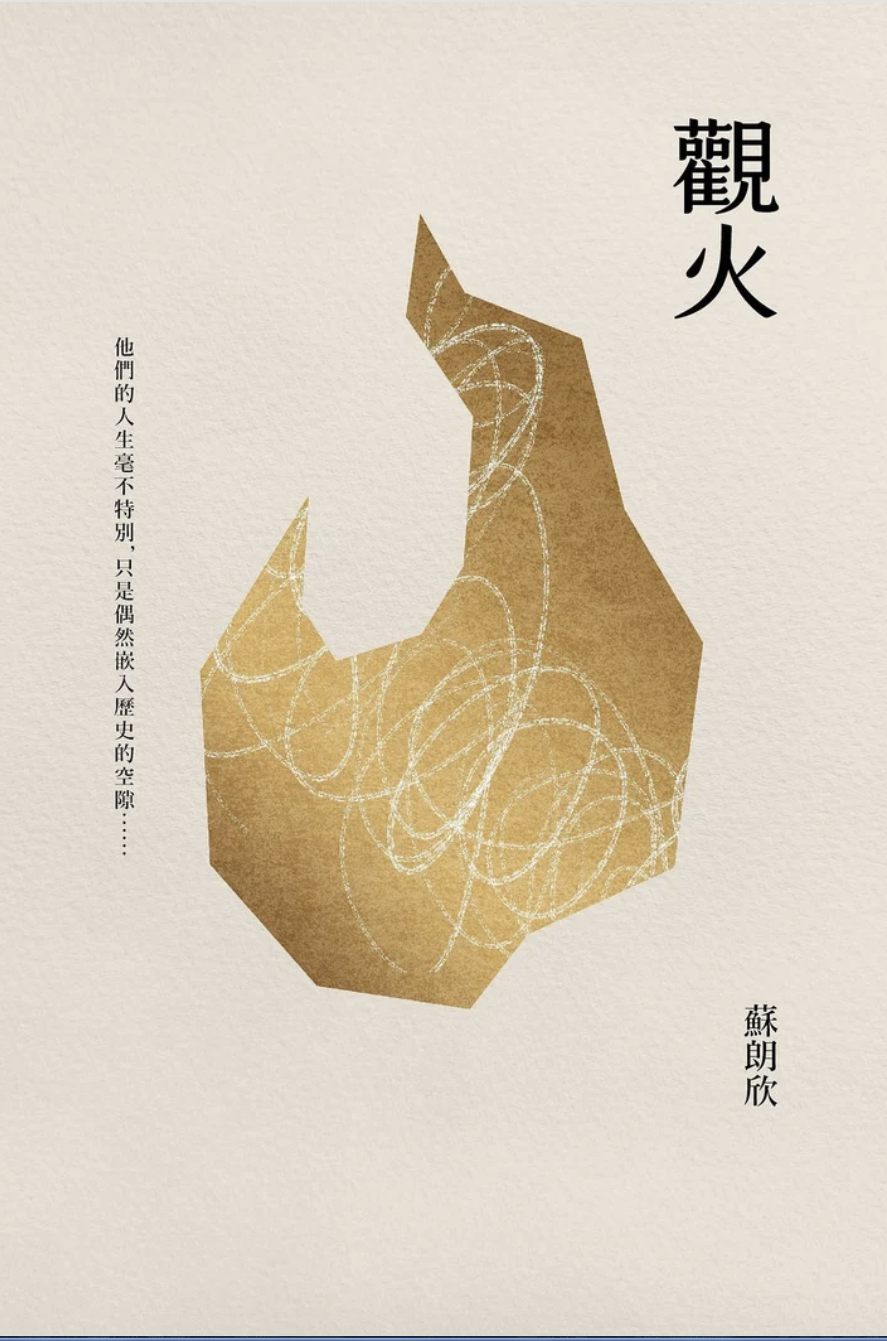
So Long-Yan 蘇朗欣. Watching Fire 觀火, Ecus Publishing House 木馬文化 (an imprint of Book Republic), 2024. 272 pgs. Published in Chinese; not yet translated into English. The title is rendered in this essay s Watching Fire.


On 5 November 2026, the young man who fought for my city’s freedom received a further ten-year prison sentence, having already spent almost six years behind bars. News of Joshua Wong’s sentence spread rapidly across social media, and I even saw friends who describe themselves as apolitical liking and reposting it.
Seven years after the protests against the extradition bill, public discussion of that political upheaval seems to have dwindled. But silence does not mean acceptance. Sometimes I wonder whether the apparent indifference of those dismissed as “Kong-pigs” (“港豬”) is the shrewdest disguise for surviving the worst of times, and whether the people living in this city have ever truly forgotten that burning summer.
This is not because I believe everyone who witnessed the movement supported democracy, or that the protests meant the same thing to everyone. Rather, I suspect that, as Hongkongers, we cannot entirely escape the collective, often unconscious trauma of historical violence, regardless of our political positions.
❧
In a similarly reflective, almost merciful register, So Long-Yan published her second work of fiction, Watching Fire (觀火), two years ago. Acknowledging the “outsider” positions her characters occupy, she remains faithful to the suffering she experienced as an observer of the movement. “Because I don’t think what happened in 2019 has really passed,” she explains. “The shadow is still there, the scar is still inside me” (Hon, K. T., 2024).1
The Chinese title, gun-fo (觀火), literally means “watching fire” and is rendered in this essay as Watching Fire. It evokes the expression gaak-ngon-gun-fo (隔岸觀火), literally “watching a fire from the opposite bank”, which describes observing others’ troubles from a safe distance without becoming involved. The title suggests both a position of safety and the distance So experienced while studying in Taiwan. The collection challenges the distinction between “insiders” and “outsiders” in collective trauma, tracing the obscure suffering of seemingly peripheral people and suggesting that nobody remains entirely untouched by catastrophe. If trauma is the enduring pain of an unexpected loss inflicted by an external force, whether overwhelming or barely perceptible, it cannot belong exclusively to those who participated in the protests. In So’s stories, it can also pass, often unconsciously, from one person to another.
The Impossibility
of Bearing Witness
Unlike her contemporary Gigi Leung Lee-Chi, whose characters in Everyday Movement directly participate in and suffer through the movement, So focuses on people who remain at a distance from the unrest while maintaining emotional or social ties to those involved.
In “Lighting Fire” (打火), Hiu Ching is a young woman whose studies in Taiwan leave her observing events from afar. In a narrative that echoes the author’s experience, she meets Chi Yeung, a taciturn young man who struggles to adjust to university life in Hualien. One day, while they share cigarettes on the shore, he tells her that he is from Hong Kong and used to smoke with his fellow protesters. Hiu Ching comes to suspect that he is wanted by the Hong Kong police and that the others were arrested during the siege of the Hong Kong Polytechnic University, one of the most intense episodes of the movement. She feels guilty for neither feeling nor acting as he did at a critical moment in the city’s history. She identifies as a Hongkonger and a supporter of the protests, yet feels she has made no “contribution”.
The story raises the familiar question, “Who has the right to mourn?”, but also asks something more fundamental than the binary distinction between supporter and opponent: can anyone remain outside a catastrophe? Hiu Ching’s guilt over failing to live up to her sense of identity suggests that something within her has indeed been lost, dividing her between two conflicting selves. On the one hand, she embraces her peaceful university life in Hualien; on the other, she regards Chi Yeung’s loss as more profound and feels frustrated by her inability to share it, as though excluded from the memories of the 2019 protests. The impossibility of witnessing the catastrophe’s “truth” haunts her, forcing her to question her right to acknowledge her own, seemingly more “banal”, loss.

In Remnants of Auschwitz: The Witness and the Archive (1999), Giorgio Agamben examines Primo Levi’s reflections on Holocaust testimony. Central to this discussion is the figure of the Muselmann, a term used in the camps for prisoners reduced by extreme deprivation to a condition close to death. Levi recognises the impossibility of fully speaking for those who died or could no longer testify, yet feels compelled to tell the world what happened. His work confronts the limits of language and reason in the face of catastrophe, a problem also crystallised in Theodor Adorno’s assertion that writing poetry after Auschwitz is barbaric. Yet Levi continued to write. Precisely because catastrophe exceeds rational understanding, testimony becomes a moral and ethical imperative: memories must be passed between generations to resist the repetition of history. No survivor can fully bear witness to the suffering of the dead or those rendered silent, but this impossibility makes testimony necessary. The question is not simply who is authorised to speak for the silent, but how anyone can testify to what happened while acknowledging the limits of their witness.
Compared with the experiences of those still in prison, or those who have suffered severe physical and psychological trauma, the losses So depicts may seem negligible, banal or even mawkish. Yet we must recognise both the difficulty of recovering a “truth” obscured by violence and the fact that not every loss is momentous. There are also quiet murmurs of pain, small losses and moments of vulnerability. These feelings deserve recognition alongside more visibly tragic, transformative suffering. Conversely, it can be unethical to compel those still serving sentences, or those who have suffered profound loss, to testify. They should not be required to turn personal memories and traumatic experiences into political agency, particularly when testimony itself strains the limits of language and imagination.
Fire Beneath
the Surface

In her preface, Dorothy Tse Hiu-Hung writes that So’s fiction summons the “memories that intrude on our daily lives” (干擾日常的記憶). Compared with the impressionistic depictions of pain and violence in So’s earlier novella, Water Burial (水葬, 2020), the suffering in this collection is more inward and nuanced, yet no less profound. Her stories capture the contradictions of everyday life that resist articulation under authoritarian rule. The disquieting feeling that something is wrong reminds us that society is less harmonious than it appears, while her speculative narratives encourage readers to look beneath the surface.
Ah Kwuen’s story in “Farewell” (離場) offers a compelling example of this uncanniness. Uninterested in politics or public affairs, she resembles the stereotypical Asian housewife: a si-naai (師奶) concerned only with her family and the bargains at the local market. By her own understanding, her life is apolitical. Yet the crackdown on Apple Daily unsettles her deeply. Her best friend, Lam Jeh, decides to leave Hong Kong because of its shrinking autonomy, while her daughter and husband repeatedly quarrel over politics. The raid on Apple Daily marks a rupture in both the city’s stability and Ah Kwuen’s ordinary life. Despite her efforts to avoid involvement in the protests, her life is already entangled with the political upheaval. So does not directly depict the police raid, yet readers can sense its tension in the moments when something feels wrong, as politics intrudes into everyday life under the shadow of repression.
In this respect, So extends the tradition of magical realism in Hong Kong literature. “Farewell” produces an enigmatic effect reminiscent of works by predecessors such as Hon Lai-Chu and Dorothy Tse. Consider Tse’s Owlish (2023): although Ah Kwuen and Professor Q inhabit different narratives, both are alienated figures caught in the Kafkaesque maze of modern social systems. So’s distinctive contribution lies in the plain, realistic tone with which she depicts mysterious disappearances from her characters’ lives, and in her attention to the small, traumatic losses we so often overlook. She writes honestly about her feelings as a Hong Kong writer and, more fundamentally, as a person vulnerable to abrupt changes in life. This quality gives her work a resonance beyond its immediate time and place. However reluctant we may be to acknowledge it, living in Hong Kong has become increasingly uncanny amid the changes that followed the protests. As the gulf between everyday routines and lived reality widens under diminishing freedoms, Watching Fire becomes an ominous allegory of the city’s fate.
Modern lies, Dehumanised Individuals

In Literature in the Ashes of History, Cathy Caruth examines Hannah Arendt’s thinking on political violence and collective trauma. Modern lies, in this account, do more than conceal history. They seek to remake it, exceeding even their creators’ intentions. Through the destruction of factual truth and the substitution of an “image of omnipotence”, political action becomes image-making that “empties this process of any power except that of the image itself” (Caruth, 2013, p. 47). Lies no longer merely distort our understanding of past atrocities. They acquire a momentum of their own, enabling authorities to undertake further actions that erase historical facts and reinforce the original image. Bearing witness to such lies, and to the violence they conceal, becomes especially difficult: survivors must testify to an “invisible truth”. In the context of this review, this means writing about experiences whose existence is denied and whose expression is suppressed. Such denial can inflict further trauma, leaving survivors feeling forgotten or betrayed by a community that shares the haunting legacy of violence.
“Soul Messaging” (靈魂通信) probes the secondary trauma that such image-mediated lies can inflict across generations. The story draws on the case of Leung Kin-Fai, who died by suicide after stabbing a police officer in Causeway Bay on 1 July 2021, a date traditionally associated with public demonstrations in Hong Kong. Following the attack, Secretary for Security Chris Tang described it as an act of domestic terrorism by a lone attacker, and expressions of sympathy subsequently came under scrutiny.
So imagines a near future in which the daughter of a suicide bomber, whose attack on police quarters killed several people, is treated as a “problem child” and labelled “antisocial” because her father was a “rioter”. At the suggestion of her disciplinary teacher, Mr Lo, she begins writing letters to her late father. She recounts the discrimination she has endured, her hatred of him and her questions about his attack, including his portrayal as a terrorist in a national security education pamphlet.
The narrative explores how political violence operates through lies, traumatising the next generation within a community shaped by falsified history. Because of her father’s public image, the daughter has suffered profound loneliness since birth. Bullied by classmates and teachers alike, she cannot give an account of herself when her father’s history has been erased or rewritten in the name of teaching the “correct knowledge of national security”. Under the banner of nationalism, the complexity of what happened is replaced by the claim that her father was a “psychopath”. To sustain this account and preserve social stability, policymakers subordinate themselves to the image they have created, reducing him to a radical enemy of society, a nameless gravestone in Sandy Ridge or a cautionary example in policy documents.
Once this manufactured history becomes all-encompassing, the protagonist, whose experience contradicts the public image of her “terrorist” father, occupies an almost untenable position within a society that has forgotten its traumatic past. The most horrifying feature of this machinery, understood through Caruth’s account of modern lies, is that nobody is held responsible for the systematic violence inflicted on an innocent daughter by both the authorities and the community.
The Possibility
of Bearing witness:
We Are All Human
Nevertheless, “Soul Messaging” ends on a relatively hopeful note. Mr Lo becomes the first person, though perhaps not the only one, to encourage the protagonist to come to terms with her own and her father’s traumatic past. So’s nuanced portrayal suggests that he may have witnessed the tragedy and chosen to remain in Hong Kong rather than emigrate. Refusing to accept the prevailing account uncritically, he tells the angry daughter that, however dangerous or deranged her father may appear in the media, “whatever else, he is first and foremost a human being” (不管怎樣,他首先是一個人) (So, 2024, p. 238). The story reaches the heart of its humanistic inquiry here. It reminds us how readily individuals can be stripped of their humanity by modern media and reduced to hollow images on screens and paper. It also reveals the difficulty of remembering and testifying to historical violence: the struggle is not only between people and authorities, but between memory and forgetting.
The power of individual recognition remains uncertain. It does not necessarily generate a new discourse capable of changing history. Yet, as Hon Lai-Chu (2024) writes of life in the changed city, “there are countless gradations between resistance and submission, more subtle and complex than either term suggests” (在反抗和馴化之間有著更幽微和複雜的無數刻度). In a world shaped by lies, even bearing witness can endanger survivors. Does this mean, however, that we can no longer distinguish the buried past from a fabricated history? So Long-Yan offers another possibility: to remain human and compassionate. Safeguarding the humanity of victims need not begin as an assertion of political righteousness. It can begin with the fundamental refusal to be dehumanised by lies.
I remember reading Joshua Wong’s mitigation statement, in which he recalled an encounter with a national security officer who described them as enemies. Wong did not argue. He calmly replied, “You are not my enemy. We are all Hongkongers; there is no antagonism between us.” In the past, I might have interpreted this as a concession to the authorities. Now, who can say? At least he remains human.
Note
- My English translation. The original Chinese reads: “因為我覺得19年是沒有結束的…那個陰影還在那裏,傷口還在我這裏。” ↩︎
Bibliography
▚ Agamben, Giorgio. Remnants of Auschwitz: The Witness and the Archive. Zone Books, 1999.
▚ Caruth, Cathy. Literature in the Ashes of History. Johns Hopkins University Press, 2013.
▚ Hon, K. T. (韓祺疇). “繼續書寫,2019年未結束的故事:專訪在台香港作家蘇朗欣” [“Continuing to Write the Unfinished Stories of 2019: An Interview with Hong Kong Writer So Long-Yan in Taiwan”]. Inmedia, 2024.
▚ Hon Lai-Chu (韓麗珠). “舊香港人” [“An Old Hongkonger”]. P-articles, 2024.
▚ So, Long-Yan (蘇朗欣). 觀火 [Watching Fire]. 木馬文化, 2024.
▚ Tse, Dorothy (謝曉虹). “人心即火:序蘇朗欣《觀火》” [“The Human Heart Is Fire: A Preface to So Long-Yan’s Watching Fire”]. In 觀火. 木馬文化, 2024, pp. 13–20.
▚ Wong, Brian, and Mandy Cheng. “Joshua Wong Jailed for 10 Years over Bid to Instigate Sanctions on Beijing, Hong Kong”. South China Morning Post, 5 November 2026, updated 6 November 2026.
How to cite: Tang, Darius Ho Tin. “The Collective Unconscious: The Subtle Voices of Trauma in So Long-Yan’s Watching Fire.” Cha: An Asian Literary Journal, 13 Nov. 2026. chajournal.com/2026/11/13/watching-fire.


Darius Tang is an MPhil student in Humanities and Creative Writing at Hong Kong Baptist University. Drawn to literature and film, he is particularly interested in Hong Kong cinema, literature and the city’s wider cultural life. Alongside essays and reviews, he writes fiction and prose in Chinese. His work has appeared in Artmap (藝術地圖), Ming Pao Columns (明報時代版), O-Square (方圓) and P-articles (虛詞).