
茶 FIRST IMPRESSIONS
茶 REVIEW OF BOOKS & FILMS
[ESSAY] “zi: Kogonada’s Hong Kong Homecoming” by Bea Phi
Click HERE to read all entries
in Cha on zi.
Kogonada (director), zi, 2025. 199 min.


zi feels like Kogonada’s love letter not only to Hong Kong but to cinema itself.
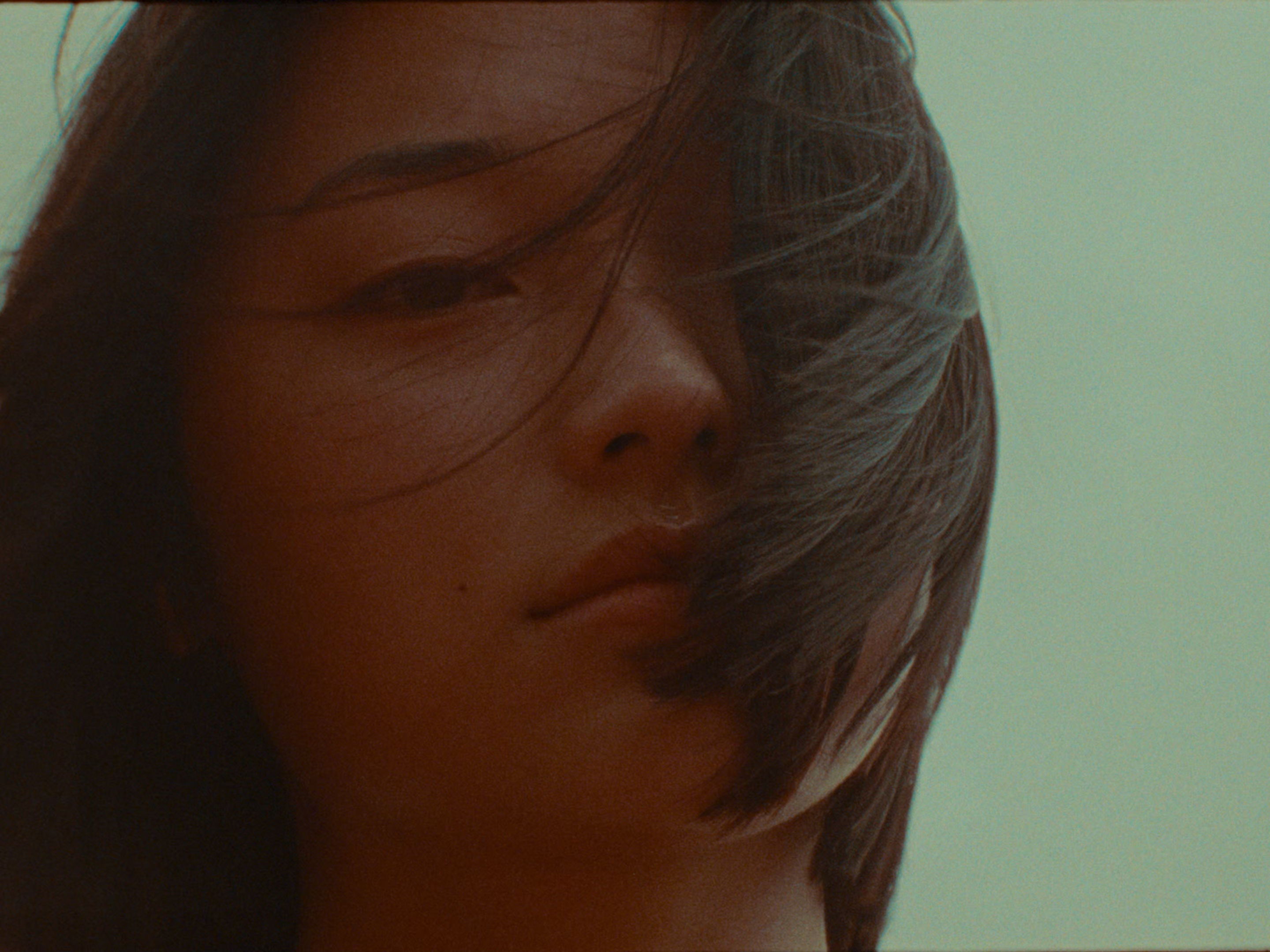
In Kogonada’s fourth feature, a concert violinist in Hong Kong named Zi (Michelle Mao) leaves a neurology centre one morning devastated by the possibility that she has a brain tumour. As in Agnès Varda’s Cléo from 5 to 7 (1962), she has roughly twenty-four hours to pass in her city before returning the next morning for a definitive diagnosis. We then follow closely behind her as she struggles to endure the uncertainty of the wait.
Just as Cléo from 5 to 7 is as much about Paris as it is about Cléo, zi is a love letter to present-day Hong Kong, frequently using distant cityscapes and close-up shots to capture its streets and skyscrapers as Zi wanders anxiously among them alone. Cinematographer Benjamin Loeb and Mao, herself a Hong Kong native, chose many of the filming locations on the spur of the moment, creating scenes that feel natural and lived-in rather than touristy and picture-perfect. Early on, Zi visits her parents’ headstones in an unusual cemetery, its rolling hills crowded with graves and hemmed in by high-rises. With its density of both architecture and mourning, the sight feels quintessentially Hong Kong.

As we soon learn, however, Zi’s distress lies beyond grief or even the possibility of a brain tumour. Rather, she frequently experiences hallucinations that appear to be visions of the future. Leaving a cha chaan teng after lunch, for instance, she sees herself standing across the street with a blonde woman, after which jump cuts, flashes of light and colour, and scenes that blur the line between hallucination and reality convincingly convey her unease. Soon, her visions seem to be confirmed when she happens to meet an American, Elle (Haley Lu Richardson), whom she immediately recognises as the blonde woman.
By now, Zi is in crisis, reduced to tears and on the verge of panic attacks, but Elle’s jovial demeanour grounds her as they walk through the city together. On a skywalk, we learn that Elle was born and raised in Arizona but wanted to become a dancer in New York City. When those dreams were dashed, she came to Hong Kong to start again. Here, she sometimes takes out a recorder simply for the pleasure of capturing the city’s sounds: spirited conversations and Cantonese karaoke, countless cars and their horns, every noise merging into a single restless hum. Occasionally, Kogonada interweaves this soundscape with classical yet futuristic, synth-driven compositions by the late Ryuichi Sakamoto, a musical legend and collaborator on Kogonada’s After Yang (2021), to whom zi is partly dedicated.
As Zi and Elle continue passing the time and taking in the sounds of Hong Kong, a supposed stranger (Jin Ha) follows them, watching from a distance. That night, when Elle takes Zi to her “friend” for help, we discover that he is the stranger in question: Min, a Korean man who works at the local neurology centre and was once engaged to Elle. While resting in his bed, Zi overhears them speculating about her condition on the balcony. After a few minutes, they land on temporal relativism, in which Zi’s experience of the present gradually lags behind the actual present, leaving her feeling literally out of time. As time passes, Min suggests, Zi will feel increasingly farther behind.
From then onwards, the trio remind me of Stanley Kwan’s 1987 classic Rouge, in which a Hong Kong newspaperman, Yuen, and his girlfriend, Chor, encounter the ghost of a courtesan named Fleur, played by Cantopop diva Anita Mui. Just as Yuen and Chor try to reunite Fleur in the afterlife with her lover Chen-pang, a playboy played by none other than Leslie Cheung, Elle and Min accompany Zi through Hong Kong’s frenetic, fantastical night until morning, taking her to night markets, karaoke and Victoria Harbour. Both films tell of women in Hong Kong who feel unsettled within themselves and literally out of step with time, yet find salvation through befriending troubled couples whose relationships are re-examined and strengthened by these unusual circumstances.

At its most visually stunning in its night scenes, zi recalls not only Kwan but Hong Kong New Wave cinema as a whole, suffusing the modern-day city with the breathtaking imagery of an earlier era as seen in films such as Fruit Chan’s Made in Hong Kong (1997). In particular, it abounds with references to Wong Kar-wai’s 1994 hit Chungking Express: a woman’s struggle to make it through a single night in Hong Kong, Elle’s blonde wig in homage to Brigitte Lin’s, blue fluorescent lights in apartment blocks and snack bars, step-printed shots akin to cinematographer Christopher Doyle’s, and, above all, the question surrounding the 1997 Handover: “Where are we going?”
It is this existential question that brings zi closest to Hong Kong, a city that has repeatedly asked it throughout the twenty-first century. In their raw, desolate depictions of its neon-lit nightlife, Kogonada and Loeb capture the city’s distinctive, estranging urban loneliness, which characterises not only Chungking Express but many Hong Kong films made during and after the disaffected, isolating years of the 1990s. Similarly, Zi, Elle and Min each have losses to mourn, regrets to ponder and wishes for lives other than their own. Their melancholy feels close to the sentiments of many Hongkongers reflecting on what their city once was.

For all their foreboding, the characters still remain as grounded as they can in the present, as though nothing matters beyond the togetherness afforded to them for this one night. Here, zi feels most alive, even as it shies away from a concrete plot and ultimately offers little clarity or resolution, much like the best of Wong’s films. Instead, Kogonada gives us remarkable characters in Zi, Elle and Min, and in modern-day Hong Kong itself, which mirrors their thoughts and feelings, accommodating both their sadness about what has passed and their hope for what might still be. Life simply happens here, and every day and night holds the possibility of an encounter that can change you. For these three characters, it does.
❧
Kogonada’s debt to Chungking Express, however, isn’t just due to zi’s references. It also lies in the tiny budgets, small crews and guerrilla-style filmmaking with which both films were made. Needing a break from editing his wuxia epic Ashes of Time in 1994, Wong hastily sketched a script whose material would eventually become Chungking Express and, later, Fallen Angels (1995). He then began filming in Chungking Mansions and around Lan Kwai Fong without permits or much preparation. Instead, Wong largely improvised scenes for his actors on the spot, Doyle shot handheld with little or no set-up, and the team relied on Hong Kong’s spontaneous, lively energy to propel the film forwards.
Likewise, zi marks Kogonada’s return to a smaller, though by no means insignificant, scale, scale after last year’s Hollywood production A Big Bold Beautiful Journey. That film had a forty-five-million-dollar budget and major names attached: Margot Robbie and Colin Farrell in the leading roles, Studio Ghibli’s Joe Hisaishi as composer, and Columbia Pictures producing. With zi, Kogonada made a complete 180-degree turn. Arriving in Hong Kong with only a microbudget and a handful of cast and crew, he specifically asked his team to watch Chungking Express to better understand the city as captured through Wong’s spare yet artful direction.

zi thus feels like Kogonada’s love letter not only to Hong Kong but to cinema itself, a long-awaited acknowledgement of the minimalist, auteur-driven filmmaking that made Columbus (2017) and After Yang so special. His pseudonym is itself a reference to Kōgo Noda, Yasujirō Ozu’s screenwriter responsible for some of cinema’s greatest films, including Tokyo Story (1953) and Late Spring (1949). Watching Kogonada’s films, one indeed senses Ozu’s influence in the “pillow shots”, frames within frames and attention paid to the preciousness of time. The stripped-back zi, in particular, allows Kogonada’s many inspirations, including Varda, Wong and Ozu, to come to life in a film that is far more than the sum of its parts.
Kogonada has always worked best by putting himself in conversation with history’s greatest directors in this way, even before making his first features. During the early 2010s, he produced video essays, some commissioned by the Criterion Collection and the British Film Institute, that explored their distinctive qualities: Ozu’s cinematography, the moral concerns of Robert Bresson and Ingmar Bergman, Stanley Kubrick’s compositions and Jean-Luc Godard’s counter-cinematic techniques, among others. It therefore never quite made sense that Kogonada was chosen to make a Hollywood blockbuster, given how little the industry has cherished or understood the verve and nuances of the directors he admires.
Reflecting on zi, Kogonada said that it helped him finally see film “not as a product or some vehicle for storytelling, but as a way to experience time and being”. It thus feels like the closest he has yet come to embodying the spirit of his namesake, and all the more fitting that he would bring his renewed vision of filmmaking to Hong Kong, one of cinema’s most beloved cities and home to many great directors before him, including Kwan and Wong. Just as zi follows a woman from Hong Kong trying to reckon with who she is and where she comes from, it can also be read as this cinephile director’s way of reminding himself why he loves cinema in the first place. In both respects, zi is a brilliant, heartfelt homecoming.

How to cite: Phi, Bea. “zi: Kogonada’s Hong Kong Homecoming“ Cha: An Asian Literary Journal, 13 Nov. 2026, chajournal.com/2026/11/13/Kogonada-zi.


Bea Phi is a Vietnamese-American editor and film critic based in Brooklyn. [All contributions by Bea Phi.]