
茶 FIRST IMPRESSIONS
茶 REVIEW OF BOOKS & FILMS
[REVIEW] “Crime and No Punishment: Filipino Noir in F.H. Batacan’s Accidents Happen and Other Stories” by William Carlo Antonio Sanchez
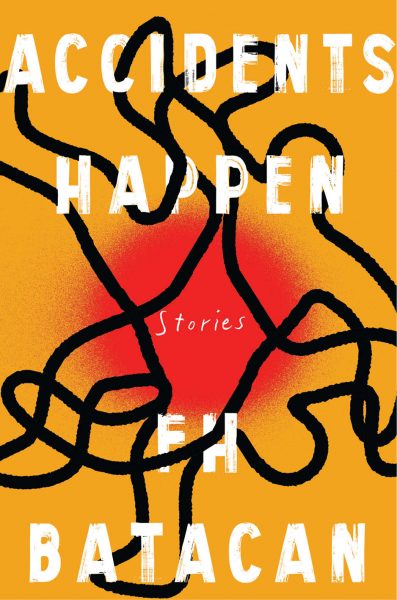
F.H. Batacan. Accidents Happen and Other Stories, Soho Crime, 2025. 272 pgs.


At the close of Accidents Happen and Other Stories, F.H. Batacan thanks the Philippine publications in which her pieces first appeared. It came as a genuine shock to learn that most of the collection was written in the 1990s and 2000s, for these narratives explore the crime, violence, and institutional incompetence that continue to plague the Philippines to this day. In other words, the moral and environmental decay that inspired Batacan’s stories remains as troubling as ever, which reveals everything one needs to know about Filipino society.

Accidents Happen comprises eleven short stories that illustrate how violence in the nation can be at once spontaneous and calculated. Crimes such as murder, assault, trafficking, kidnapping, and domestic abuse are brutal enough in themselves, and are made all the worse by sloppy forensics, lax due process, and brazen cover-ups by the politically powerful. Given the weight of the subject matter, it is entirely understandable if readers cannot finish the collection in a single sitting. That said, each story is a fast-paced page-turner, thanks to Batacan’s strong prose, made stronger still by a subtle, dry humour that offers much-needed levity from time to time.
It cannot be emphasised enough how deftly Batacan’s writing captures the frantic, grimy nature of Filipino crime. The reader is led from room to room, detail to detail, and suspect to suspect, without a single paragraph ever feeling like a chore or a slog. More importantly, the mysteries are genuinely fair. Every work of crime fiction has its eureka moment, when all the evidence falls into place and the investigators finally establish the identity of the person or persons behind the crime.

This pivotal moment is never merely the detective spouting exposition; it is an opportunity for readers to realise for themselves that seemingly mundane details from earlier sections held the answers all along. For this to happen, revelations must be built up through clues carefully planted in the text itself. A recurring problem in detective fiction is the plot twist for its own sake, in which the author seeks to provoke a reaction without laying the necessary foundations, resulting in a weak twist and an even weaker narrative. Thankfully, this is never a concern in Accidents Happen, so much so that even the stories that do not directly revolve around investigations play fair.
In “Door 59”, a lonely professor grows protective of her middle-aged British neighbour, Angus, who is paralysed from the waist down and neglected by his wife, Lila. Their strained marriage stems from the death of young Maggie, Lila’s biological daughter and Angus’s stepdaughter, in a car crash that Angus himself caused. The narrator learns that Maggie had been sickly in the period leading up to the tragedy, and throughout, Angus treats the narrator sensually, as though she were “a good kid”. He even gazes “hungrily” at a group of university students, yet both the narrator and the reader are led to believe that he is simply reminiscing about his life before the accident.
And so, when Angus is revealed to have trafficked his own stepdaughter and possibly other children (hence Maggie’s failing health and Lila’s subsequent coldness), his intimate moments with the narrator take on a sinister cast in retrospect. The twist is shocking, indeed outright horrifying, yet it does not come out of nowhere. The devil is quite literally in the details. “Door 59” begins almost as a love story and, through well-crafted prose and clues, becomes a reflection on the continued violence against women and children by both local and foreign powers in the country, as well as on the covert yet often charming presence of evil everywhere.
❧

Throughout Accidents Happen, there runs a potent fear of the kind of world we will be left with. Batacan’s “Keeping Time”, which concerns an enzyme that will soon bring about human extinction, is the only story to portray these fears explicitly, yet a sense of dread permeates each and every piece in the collection. Batacan’s distinctive technique of shifting between point-of-view characters lends itself well to heightening this dread; by the end of each story, everyone is exhausted by the futility of it all, and so is the reader. After all, a process or system such as Philippine forensics is best summarised in Batacan’s “Comforter of the Afflicted”:
Lab tests, requests for information, paperwork, everything moves slowly, as it always does in Manila… The DNA, the hair, the fingerprints don’t match anything on record, but given the state of recordkeeping in the country, it was always going to be a long shot.
Thus, the true tragedy of Filipino noir lies not in the sudden loss of life or liberty, but in the Philippines’ enduring status as a setting conducive to crime and obstructive to justice. The noir genre would not be noir without its bleak settings and hard-boiled characters, yet there was always a light to look forward to: the crime would be solved and the perpetrator put behind bars. Those days are gone, for Filipino justice has long since assumed the defining quality of even the most grounded stories: it is fictional.

F.H. Batacan, the “master of Filipino crime fiction”, is best known for her award-winning and critically acclaimed novel Smaller and Smaller Circles, which was adapted into a film in 2017, directed by Raya Martin. Her accomplished prose, pacing, and foreshadowing make for engaging stories that are authentic to Filipino society while remaining universally resonant. This marks her work as essential reading for anyone who genuinely wants an unfiltered, unbiased picture of all that one must be wary of in the Philippines. In time, Accidents Happen and Other Stories may well stand as another timeless fixture of the Filipino crime fiction canon.

How to cite: Sanchez, William Carlo Antonio. “Crime and No Punishment: Filipino Noir in F.H. Batacan’s Accidents Happen and Other Stories.” Cha: An Asian Literary Journal, 12 Nov. 2026. chajournal.com/2026/11/12/accidents-happen.


William Carlo Antonio Sanchez is an aspiring novelist and lifelong horror fan from Butuan City, Philippines. His surrealist poetry and prose have appeared locally and internationally, notably in The Archipelago Press (California), Voice & Verse Poetry Magazine (Hong Kong), CultureCult Magazine & Press (India), TAKÓS: An Anthology of Gendered, Queered, Literary Genres, and Heritage Youth in his home country. He graduated magna cum laude with a BA in Communication from the University of the Philippines Cebu in 2024 and currently works full-time as a layout artist and production staff member at Father Saturnino Urios University. [All contributions by William Carlo Antonio Sanchez.]