
茶 FIRST IMPRESSIONS
茶 REVIEW OF BOOKS & FILMS
[REVIEW] “Diasporic Condition in Pik-Shuen Fung’s Ghost Forest” by Katherine Leung
Click HERE to read all entries in Cha
on Ghost Forest.
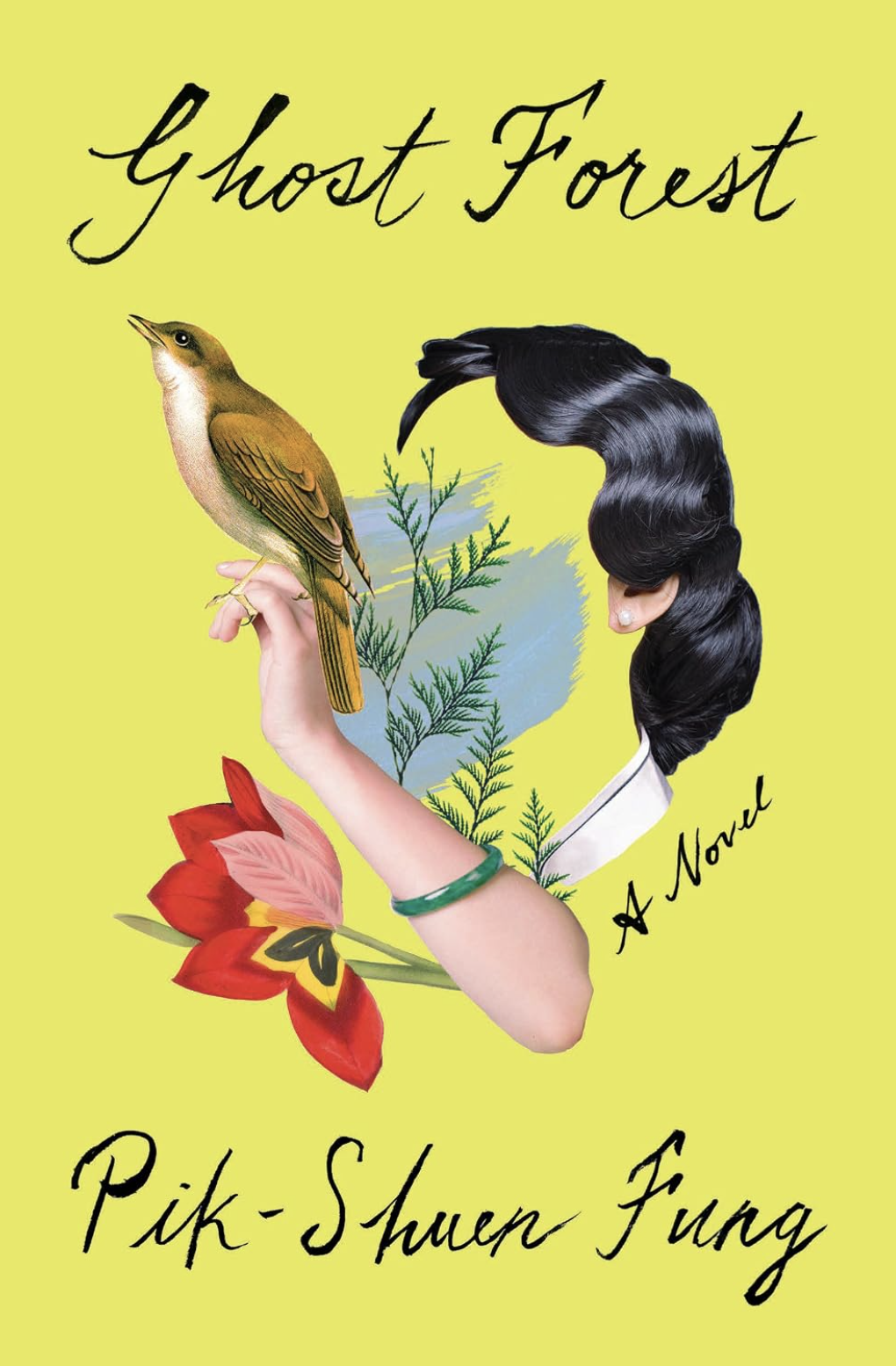
Pik-Shuen Fung. Ghost Forest, One World, 2021. 272 pgs.


Pik-Shuen Fung’s Ghost Forest is a portrait of familial longing within the Hong Kong diaspora. Much goes unsaid, yet the novel’s brevity conveys profound communal grief. Its chapters are short and poetic, attentive to fleeting emotions in the present tense. Readers across the diaspora will recognise these feelings. The tone is frank and concise, echoing the speech of people with ties to both Hong Kong and the West. Fung’s tender autobiographical novel speaks both for the diaspora and to those within it.
The novel centres on vignettes of Fung and her father, tracing their relationship from her childhood to adulthood. Her family exemplifies a familiar phenomenon: the “astronaut family”. Before the 1997 handover, three-year-old Fung, her mother and her grandparents emigrated to Canada, while her father stayed behind to keep his job in manufacturing. As in many transnational households, he remained in Hong Kong throughout her life. From adolescence onwards, Fung’s relationship with her father is strained.
Fung and her sister trust their mother and share a deep love for the grandparents who live with them. Fung freely asks them questions, and they, in turn, share colourful accounts of their lives. She documents these histories with awe and respect throughout the book. By contrast, she has no comparable access to her father’s inner life. He visits Canada only during school breaks. Irritable from jet lag, he sleeps through much of his brief stays. As a child, she feels that the family cannot breathe freely until he leaves. This form of patriarchy is common across the diaspora. Because he is the selfless breadwinner who stayed behind, she never talks back, even as a child. He feels like a stranger to her; she is uncomfortable around him and has no instinctive response to him. In their few interactions over the years, he criticises her, exposing the growing rift between his expectations of an ideal daughter and her upbringing in the West. He remarks on her manners and interests, and even makes all-too-familiar jabs about her body. One perfect day at the beach is ruined by his comments about her weight.
Her visits to Hong Kong during school breaks are unsentimental. Fung and her sister spend their days shopping, chatting online and enjoying street food, just like other adolescent girls. Fung and her father seldom connect emotionally. During her university years, his blunt remarks still hurt her feelings. Her childlike deference gives way to an awkward relationship between two adults. She gradually shares her interests with him, including art, and it becomes clear that he fundamentally does not understand her. This is the most painful realisation of all, and the scene in which it emerges gives the novel its title.
Fung begins studying art at university. One summer, she is invited to study abroad at the China Academy of Art in Hangzhou, China. The experience is transformative. Suddenly, her lifelong Western art education comes together with Chinese techniques. The teachers and course content make a profound impression on her. On the academy’s hundredth anniversary, she invites her father to visit. He has never visited her anywhere, and they have not spent time alone together since two summers earlier. She studies tourist guides and plans an enjoyable itinerary. During his visit, she finally shows him her painting Ghost Forest, which has been selected for an exhibition. After seeing it, he responds, “I think there is something wrong with you that you’re making art like this.” Later, he adds, “You’re not very ambitious, are you?” As a parent, I can hardly believe someone would say this aloud; as a Cantonese diasporic artist, however, I have heard similar sentiments from my own parents.
The novel’s tone shifts when her father is hospitalised and his health deteriorates. She leaves a job in London to see him. The entire family reunites in a hospital room. Fung pushes herself to tell him she loves him, although doing so runs counter to her family’s cultural norms. In time, he tells her that he loves her too. During his illness, Fung’s mother performs many selfless acts, such as rubbing his feet. Beloved dishes and nostalgic meals recur throughout the story as expressions of care.
In many tender moments, her father recognises how callous he was in his younger years and tries to make amends to Fung’s mother. He also begins to open up to Fung about his childhood and his life before having children, revealing parts of himself that remained inaccessible throughout the first half of the novel. Both Fung and her father have out-of-body experiences and surreal visions, each involving the other in some way.
Ghost Forest reflects the Hong Kong diasporic experience in several ways. The first is the family’s socioeconomic position. A working father makes the family’s financial mobility possible. The children in the story can access medical care, attend university, live in Western countries, study art and undertake internships. Their privilege is inseparable from Hong Kong’s prosperity in the 2000s, when the city’s status as a global financial hub allowed families like Fung’s to straddle two worlds.
A second is the ease with which the characters draw on both Eastern and Western traditions throughout the novel. Upon arriving in Canada, Fung’s mother sees a Chinese herbalist. When the children are born, their parents consult a fortune teller. When someone falls ill, the family can seek second and even third opinions from practitioners of other forms of medicine. Acupuncture and Eastern remedies are held in equal esteem with Western treatments. The family prays to Buddhist deities. Dreams play an active role in decision-making. This freedom is made possible not only by Hong Kong’s wealth but also by its distinctive cultural position. Hong Kong sits comfortably between East and West, treating neither as foreign. The characters navigate the world in much the same way.
Fung’s story is diasporic, marked by physical and emotional dislocation. She code-switches into Cantonese throughout the novel, making the audiobook especially gratifying. Key scenes unfold in Hong Kong, Canada, London and Hangzhou; there is no single home. Fung also feels an urgency to preserve her elders’ memories. Her parents’ and grandparents’ generational scars, as well as their good fortune, wit and brilliance, live on within her.
As a diasporic person, I share many of these communal memories. There are numerous uncanny parallels between Fung’s life and mine. I lost my father in 2012 to a similar illness and relate to the physical and emotional aspects of Fung’s journey. I travelled back and forth between cities as my father’s illness worsened. My parents had a modern form of arranged marriage in their twenties and, like Fung’s parents, fell in love again. I have the diary my father kept in his iPhone notes until his final days. The death scene in Ghost Forest eerily echoes my father’s last moments, almost word for word.
In one of the final chapters, Fung rereads an email her father wrote many years earlier, this time with greater maturity and forgiveness:
“Why did I remember only his disappointment in me?”
“Did I ever get to know who he was becoming? Did I try?”
This is the diasporic condition: a family scattered across oceans, unfamiliar to one another. By recognising her father as complex and evolving, Fung realises that they were never as far apart as the generational and cultural rift between them suggested.
How to cite: Leung, Katherine. “Diasporic Condition in Pik-Shuen Fung’s Ghost Forest.” Cha: An Asian Literary Journal, 12 Nov. 2026, chajournal.com/2026/11/12/forest-ghost.


Katherine Leung is an artist, organiser, and creator of Canto Cutie, a zine about the Cantonese diaspora. Learn more at cantocutie.com.