
[ESSAY] “Pen: A Vietnamese American in Tokyo” by BP Pham


Having grown up in Saigon as a US-born Vietnamese American, I had been drawn to Tokyo by its apparent impartiality.
I’ve been signing documents with a stolen pen. It’s in my hand right now, and I’ve just realised the fact, because the damn thing nearly flew out my fingers when I gave it a flip. A thin, jet-black BIC, with a gold button and a silver clip at the top. I turn it over: the label taped across its barrel reads “Property of the ___ Ward Civil Office”.
Japanese kanji has no upper or lower case, but the large, unmissable print, no doubt intended for the failing eyes of the over-sixty crowd, conveys its intention well enough: “DON’T TAKE ME!” I must have pocketed it on my way out of the pension office.
❧
I don’t make a habit of loitering in government buildings, but that year, around my study-abroad university’s autumn break, a problem had arisen with my visa. About a month after I returned to Tokyo from my home in Saigon, large A4 dossiers began to appear in my letterbox, the kind fastened with a string and button. Every day I would return to my dorm to find a fresh batch drooping from the slot like overripe fruit. Gathering up two or three, I would carry them into my room and, in the interval between kicking off my shoes and shrugging off my bag, toss them under my dresser with the rest. Occasionally, when I had a moment to spare, I would turn one over, my eyes glossing over the words; showing them to my roommate, I swore that each letter came in a slightly different shade of red.
My student exchange programme told me to ignore them. You’ve done everything right, they said; this is simply how it is. Retroactive action, they explained, is the way of “Japanese Bureaucracy”. Your initial exemption papers take a few months to process, and until then they will keep sending you post, pleading with you to pay, threatening you, trying to trick you, until the paperwork goes through in full, at which point the accumulated debt and all its attendant consequences will simply vanish, and the letters will stop.
What could I say? As an international student with scarcely any grasp of conversational Japanese, let alone the jargon-laden language of government documentation, I could only accept this as truth. My fellow exchange students, mostly white, confirmed it with a snigger: “You’re, like, a little boy. Why the hell would you have a pension?” Among them, the prevailing attitude was simply: “So what?” “So what if you go over the deadline? They’ll take forever to deport you anyway. You’ll figure it out, dumbass.” “Just fly out to Seoul for an hour and come back to refresh your ninety.” (A baseline of 90 days is allowed to U.S. citizens visiting Japan without a visa.)
I tried to laugh it off, my face reddening. The caucasity of the suggestion left me dumbfounded: it was impossible to explain that such an attitude was the very antithesis of my reason for studying abroad in Japan.
Having grown up in Saigon as a US-born Vietnamese American, I had been drawn to Tokyo by its apparent impartiality. For most of my life, my identity had been defined by my documents, and every conversation seemed to become an exercise in identity politics, a weighing of my authenticity as I balanced my American accent and citizenship, symbols of a place I had no memory of, against my lived experiences as an ethnic Vietnamese in the homeland. As a teenager trying to discern the rules of this game, I grew increasingly disillusioned. At the intersection of class, race, gender and nationality, where these categories constantly overwrote and contradicted one another, I found there was no way to be enough in the eyes of the other.
When I arrived in the US for university, I found that my identity was, by contrast, defined entirely by my appearance: no longer Vietnamese, but Asian. I mean, How stupid is that? Before America, I had never been Asian. I was nothing but Asian. It seemed that, wherever I went, the way I was treated was governed by social and cultural contracts to which I had never been made privy.
In truth, I was jealous: jealous of the ease with which some could embody the other; of the privilege of ignorance, the privilege of an embedded colonial history; of always having somewhere to go should you be rejected or deemed incompetent; of a worldwide culture that would protect you; of the comfort that something, be it material or spiritual, would gather you back into the fold, wherever you were…
Here, in futuristic, cosmopolitan, iPad-menu Tokyo, far from that wearisome either/or existence, I needn’t speak or stand out at all. Wearing a blank expression, I could disappear into the crowd, drifting with the commuters changing trains at Iidabashi or Korakuen, sidestepping the anti-immigration protesters at every station: not a passport or a racial demographic, but easily (I thought) made anonymous. More than anything, I refused to squander a day at the pension office with a number pinned to my chest, only to be told that I had been worrying over nothing, that, had I only read that little bit there…
I watched as the letters grew ever more intimidating. Brighter shades of crimson, harsher typefaces, smaller and smaller envelopes plastered with jagged, reflective tape. Returning home, battered from my run, I would pull them from my letterbox to find torn scraps of paper clipped to the front, bearing hand-scrawled notes that warned of an approaching deadline. That gave me a moment’s pause (what kind of automated mailing system writes notes by hand?), but not enough. I shoved them under my dresser and went about my day.
It was only when a letter arrived with wide, bloodshot eyes drawn on the front that I finally bit and read it in full, only to discover that I was a mere three days from deportation. Shaking, I re-read the document once, and then once again. My presence at the pension office was required at the earliest opportunity. I checked my calendar: as it was the weekend, I had a single day, Monday, before I became an honest-to-god criminal.
On Monday, having not slept a wink since opening that letter, I was the first through the great glass doors of the city ward office, letter in hand. Inside, the place was somehow already crawling with elderly pensioners, swarming around the floor plans like ants. I scoured the walls for a directory, but found nothing legible to my eyes. Mantras and quotations engraved into the marble walls clamoured for my attention, and portraits of mayors and directors, hung at tasteful, sunlight-catching intervals, followed my every step.
The evening before, I had dragged the pile out from under my dresser and tried to piece together the problem. What I could glean was this: because I had left Japan in June to visit family, my first student exemption from the pension, signed in March shortly after my arrival in Tokyo, had been voided prematurely, my departure from the country taking precedence over the stated end date of my visa. Even so, the month I spent away from Japan qualified as an active pension period in its own right. Two periods, then, were unaccounted for: the month I was away and the month after. Yet it still made no sense. The figures cited were inconsistent, the dates out of order, lurching between the Reiwa and Gregorian calendars. If I was to pay a monthly fee, why were the bills for March, February and August missing? How could I still be a Japanese national, somehow made eligible for the pension while out of the country, when my initial exemption had been cancelled for that very reason? As I read those curt lines over and over, a familiar frustration and inadequacy crept over me: what was I failing to see?
The scowling woman at the reception desk raised an eyebrow the instant I opened my mouth. Though she stood no taller than five foot two, she gave the distinct impression of looking down on me. I tried to explain my original exemption slip, but she held up her hands and shook her head. Despite my having given her nothing to review, she insisted that the mistake was mine. No doubt I had signed this or that slightly askew, or perhaps my name had strayed a little outside its box, and I would need to pay a fee of 200,000 yen (about 1,275 dollars) if I wished to correct “my error” before the ward office closed for the day. I gagged. A thousand dollars? I felt like a child running to his parents after breaking a family urn: ashamed, longing for forgiveness. Suddenly, it felt as if every eye in the hall was on me, passing judgement.
Had I really messed up that badly? I felt like a child running to his parents after breaking a family urn: ashamed, longing for forgiveness.
Instinctively, I reached for my wallet, then stopped short. I heard, suddenly, the snigger of my compatriots again: and I, as if by instinct, took on their gall. What kind of schmuck pays a thousand dollars after being taken advantage of? Browbeaten by some indifferent bureaucrat, wrapped like kebab meat in that black gyro of a business suit, listlessly eyeing her phone beneath the desk? I began to stammer, growing heated, and the customary pleasantries of Japanese, all those “thank yous” and “I’m sorrys”, slipped clean out of my mind. Eight in the morning on a Monday, and behaving like this: who the hell do you think you are? Already, I felt as if I’d just about had enough.
Standing my ground, I argued that I had followed the proper procedures and, after a quick scroll through the city hall’s billing website on my phone, showed her that no such fee was associated with the pension service. She shrugged, but I pressed on. I had completed my slip with a licensed study-abroad proctor, using information taken directly from my resident card. The error was not mine, but that of the city’s processing system. In fact, I said, pressing my finger on the desk, as a foreign student I should never have been billed at all. After all, how could a study-abroad student on a two-year visa ever be eligible to draw a pension?
And so on, and so forth. Our voices underlaid the soundse of the vast, bustling hall. It was the kind of unbudging argument that was futile for both parties. After twenty minutes of back-and-forth, with a queue of disgruntled people growing restless behind me, she relented and waved me off to the exemptions office far above, on the eleventh floor. Thank you! I hurried towards the lifts, my eyes on the clock.
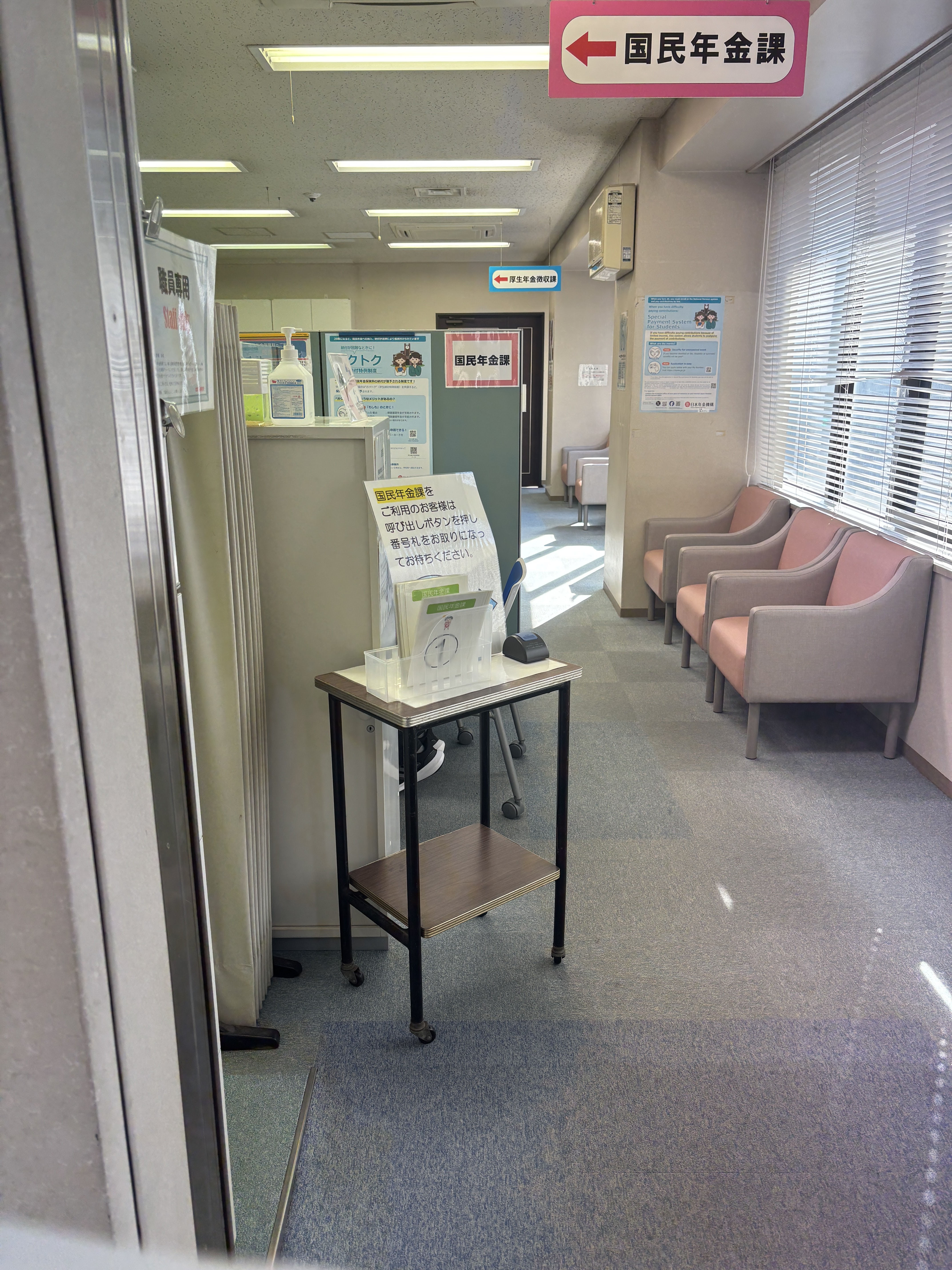
The exemptions office was a cramped, rectangular box, comprising a waiting area and a staff area. Dividing the two was a long wall of booths, numbered 1 to 38, each with a worker seated behind a grimy plastic window, like a police line at a riot.
I was directed to an empty chair between two dozing grandpas. I kept my hands to myself, my jacket zipped to the top. The air conditioning was running too cold, and a gritty, dandruff-like dust hung in the air. There were more communal touchpoints than in a nightclub toilet, every handle and surface rubbed slick with grease. A straggling row of elderly people shifted to and fro in their seats ahead of me, muttering to themselves. With no one left to direct my anger at, my momentary tantrum subsided, giving way to a spiralling, helpless anxiety. What if nothing could be done? It was the middle of the semester: where would I go? What about my classes, my belongings?
From the booths, each occupied by an entreating pensioner, came the hushed hum of listless, fragmented debate. I followed arguments that ran in circles, folding in on themselves and veering off into personal anecdote. Every so often, papers and binders were rammed up against the glass like desperate evidence in a murder trial—but never did they pass the barrier. I cringed a little at their want of decorum as they resisted, shaking their heads at every polite, underhanded attempt to usher them out of the building. “No, I’m certain… You’ve clearly made a mistake… My son filled in this form for me…” On the other side, the civil servants crinkled their eyes, thumbing at their comb-overs and crouching beneath their desks, pretending to reach around for something: “Please give me one moment…”
When did it begin for us? With every year you spend on this planet, you accumulate documentation. It starts with your birth certificate: with your name, sex, date of birth, the hospital where you were born and your social security number, you come into being in the eyes of your nation. You’re still sit down for your first official photograph, hair neatly combed to show off the quintessential you, and it is printed on all manner of ID cards and documents: for the government, for school, for the family photo album. And not only physical documents, but spiritual ones too. My father used to say that when I was born, I had signed a contract in blood, pledging my filial piety to him and to the family name, the new steward of the clan. Before consciousness, before I knew enough to consent, hundreds of documents had signed me into existence, a graph of data points tracing the outline of my soul. From there, every seed of information sprouts into a flower of derivative data: municipal identifiers, changes of occupation and marriage status… Things get shuffled around, paper gives way to digital; how can anyone reasonably keep track? The methods change, as do the conventions and values, and, just like that, what was once a cornerstone of one’s life can cease to exist with a single sheet of paper. If a young person like me could be so confounded by a filing system, how much harder must it be for the elderly, sweating helplessly over some overlooked line in a contract or newsletter?
And yet they persisted. After round upon round of excruciating argument, something strange began to happen. Once ten, twenty, thirty minutes had passed, the smallest of chinks would appear in that row of expressionless faces. I began to tap my foot as I waited my turn. Another ten minutes: one or two of them began to rub the bridges of their noses, closing their eyes, raising their hands, calling their managers over. Another ten, another twenty documents dismissed from the outset were grudgingly drawn through the glass for review. Attuned to them, I began to realise that their voices carried a certain weight: a story, an indefinable earnestness, was worming open a door that had long been shut.
There came a groan, then a shrug. A marker was uncapped for the first time. Forms were taken and not immediately handed back. The scales began to shift, and, empty-handed, suddenly those old men and women rose, empty-handed, and hobbled wordlessly to the lifts, victors. Not once did they shout or make a scene; they merely sat there, persevering, insisting. And, somehow, it was working.
I had been completely wrong. Having cut their teeth on decades of bureaucracy, they were by far the better equipped to navigate this world of red tape and fine print.
What were they saying? What were they doing? My impatience vanished in an instant. I strained to listen, but every word, steeped in archaic colloquialisms and unlearnt vocabulary, was lost on my ears. I hadn’t had enough time: when I was finally called to a booth myself, my blood ran cold.
An older lady in a pearl necklace across the divider as I sat down. I introduced myself, stumbling over my words, and slid my documents through a gap in the window, trying not to meet her eyes.
She prised open my file with her fingers. She put on her glasses. Then, locating the problem in a second, she tapped a single box and shook her head. When she spoke, I stared, wide-eyed.
“You speak English?”
“You’re lucky,” she chuckled. “I’m a homestay parent for British international students.”
Patiently, she listened to my slow, broken Japanese without a hint of judgement or rudeness, allowing me to practise. She had a friendly, good-humoured bearing, as though perpetually on the verge of laughter, and a neat, auburn-dyed bob. She had, it transpired, been to Vietnam, and we spoke briefly about her time touring Saigon by double-decker bus. After a few minutes, we slipped naturally into English, and our conversation eased into the matter at hand. Tracing an invisible diagram on the desk with her finger, she showed me the three periods that required three separate exemption forms. Step by step, she walked me through the wording, and, slowly, it all began to make perfect sense.
Kanji I had never seen before surfaced on the very pages I had spent hours poring over. And yet, strangely enough, it felt good to be made a fool of. Under the guidance of her hand, a clear path emerged towards a solution that had been there all along, merely hidden from my inexpert eye. Doy!
Twenty minutes later, she set down our pen and smiled. Leaning back, I unzipped my jacket and basked in the now pleasantly cool air. As she filed my paperwork into a binder, my study visa breathed a sigh of relief. Safe! Seeing me to the door, she reminded me, for the third time, that the documents would take about three months to process.
“The post will keep coming, trying to scare you. The payment office won’t know for a while that you’re exempt, so just throw away whatever letters they send you, okay?” She picked up my documents.
“Unfortunately, I can’t just take these to them myself. Silly, isn’t it…? They’re only downstairs, but for paperwork, that distance might as well be Shenzhen.”
I must still have looked confused, because she suddenly looked me right in the eye. A smile blossomed across her face from cheek to cheek, as though I were simply darling.
“Oh, I hope that makes sense,” she said.
I looked away to hide my blush.
“It does. I’m sorry for the trouble.”
“Whatever you do, do not read those letters, okay? I can’t tell you how many foreigners, intimidated by the colour and the deadline, come running to the office to pay the full fee, then leave the country none the wiser.”
“Ma’am, could I have got a refund if I had paid it?” I asked.
She squinted at the ceiling, rifling through her mental filing cabinets. “In theory.”
“And would I really have been deported if I hadn’t come in, ma’am?”
“Again, in theory…”
I looked her in the eye, trying to discern her meaning.
“So I didn’t need to do anything at all, ma’am?”
“No.” She smiled. “Not at all.”
As I stood up to leave, something suddenly came back to me. I had, in fact, filled in an exemption form at the very beginning of the year. What had become of it? Why did I now have to fill in three forms instead of two? Wasn’t that first period covered? I was sure I had done it correctly. But what did that mean? As demurely as I could, I encroached the question. The lady shrugged.
“I suppose,” she smiled, “you shouldn’t worry about it.”
I stepped out onto the street happy, yet still in the dark as to why any of this had happened in the first place. And, to be honest, it nagged at me. It really nagged at me. Now well versed in this particular form, I knew that I had filled it in perfectly the first time. In a single exchange, the beautiful, invisible edifice that was Japan began to crumble in my hands. For no good reason, my exemption form had been swallowed by the black box of that post slot and lost in a realm of letters, phrases and paperwork. In its absence, the threat of a criminal charge or deportation order had been set in motion. For three days, the comfort of my life had vanished, leaving me utterly exposed, my identity as a person forgotten, reduced to a face on a card and a number in a spreadsheet. And for what? It had been an empty threat: words in a letter I was never meant to read.
Who had penned this fiction? Whom did it serve? I didn’t know; but it became unbearably clear that, to grasp the depths of these questions, I would first have to admit something that no amount of study or knowledge could blunt.
I thought back to my first day at the immigration bureau, and the people I had seen there who looked just like me, sweating through their best clothes, trying to get their set phrases right, pens trembling in their hands. They had been born with the wrong passports, born with the wrong accents, born with the wrong skin, trying to keep their new jobs in a new country, victims of wholly unforeseen problems. How hard had they worked to get here? To afford the flight? How hard had they studied to forge their own path through the world, all alone, ever aware of their vulnerability to a system that could change at any moment? And there, in the corner of that scene, was I: exempt, wandering the halls in my propeller hat, simply glad to be in “magical” Tokyo, la la la laaa…
Despite there being two kinds of stories for the immigrant in Japan, was it not so that I had made a choice, without so much as a second thought, as to which one I deserved?
Picking up my pace, trying to clear my head, I made for the nearest café for a few slices of pie. After all this, I thought, a weekend in Korea did sound rather nice.
❧
Rummaging through my backpack for something to sign the lease on my new apartment in Tokyo, I found that nice lady’s pen in my hand. It was oddly comforting, still warm with the shared exertion of countless people like me, caught out and, through careful, precise instruction, brought back into society. I clicked my tongue. Wasn’t that silly? Really, I’d throw it in the bin if it weren’t such a nice pen.
I still receive those threatening letters in the post, but I’ve been told, as before, to ignore them.
How to cite: Pham, BP. “Pen: A Vietnamese American in Tokyo.” Cha: An Asian Literary Journal, 11 Nov. 2026, chajournal.com/2026/11/06/bp-pham.


BP Pham is a Vietnamese American writer, born in Bethesda, Maryland, and raised in Saigon. He currently writes essays and travelogues for the Alan Cheuse International Writers Center.