
茶 FIRST IMPRESSIONS
茶 REVIEW OF BOOKS & FILMS
[REVIEW] “The Ghost Within the Ghost: Race, Sex and Ornament in Anne Anlin Cheng’s Ornamentalism” by Debra Liu
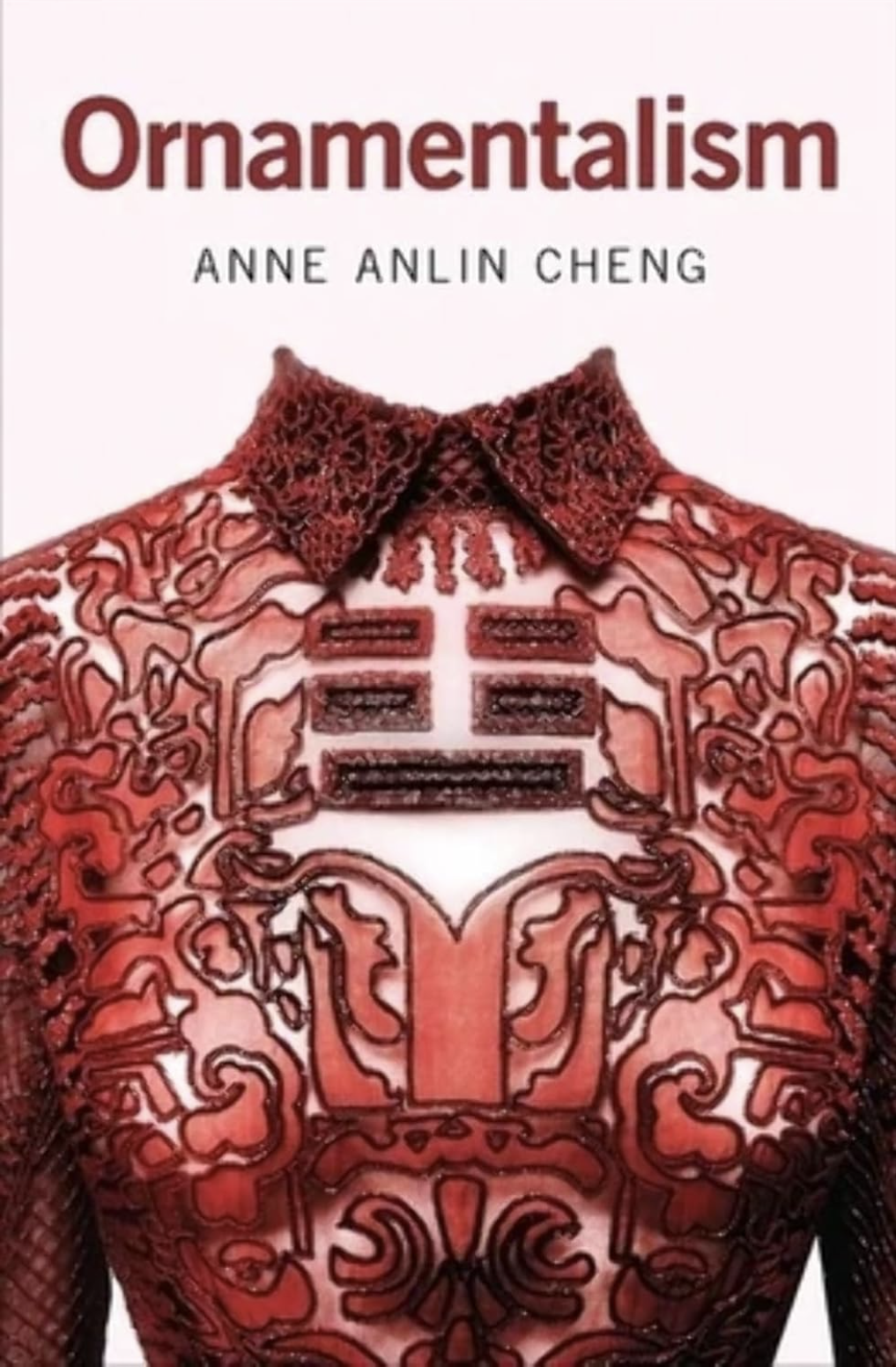
Anne Anlin Cheng. Ornamentalism, Oxford University Press, 2019. 224 pgs.


In July 2026, following widespread public outrage, an elite fitness chain apologised for a disturbing advertisement featuring an Asian woman’s face mounted on a metal rod. The disembodied face was an act of objectification, akin to the often violent images of Asian women in pornography.1
The advertisement could well serve as a contemporary coda to Anne Anlin Cheng’s 2019 book Ornamentalism. In her introduction, Cheng states that her aim is to “theorize a condition of denigration so profound and expansive that it could go unsaid or unnoted even as it lives, produces a great deal of beauty, and enacts violence”.2
The book has attracted renewed attention in 2026, owing to Cheng’s public speaking engagements and the continuing reviews of her latest book, Ordinary Disasters: How I Stopped Being a Model Minority (2024).3

❧
In Ornamentalism, Cheng unflinchingly employs the term “yellow woman” to “name the processes of racialization”. Her theory calls for “a theorization of persons and things that considers a human ontology inextricable from synthetic extensions, art, and commodity”.4
She proceeds to assemble, in forensic detail, a multidisciplinary body of evidence spanning art and visual culture, porcelain and ceramics, film, fashion design and legal history. Cheng builds her case from a nineteenth-century lawsuit in California. A group of women arrived by steamer in San Francisco, in possession of the legal documentation required for entry, yet were nevertheless arrested and subjected to sexual slurs. Although the women appeared in court wearing “loose-fitting black clothes”, the arguments against them rested, paradoxically, on extravagant and detailed accounts of elaborate hairstyles and flowery silk clothing (down to the width of their sleeves!) This fictitious attire was intended to imply their supposed licentiousness, an account wholly at odds with what the women were actually wearing.5
The women’s imagined material ornamentation was thus marshalled as evidence. Although the Supreme Court dismissed the case, Cheng argues that the very act of deploying imagined clothing and decorative goods (“ornamentation”) as evidence reduced these women to something less than human: objectified “person-things”.6
The book is rich in photographic evidence, opening with black-and-white period images before turning to vivid, multicoloured plates as Cheng moves into her analysis of fashion. By juxtaposing images with detailed analysis, she establishes a structural framework that propels the text forward and lends her arguments visual clarity. This is especially evident in her comparative study of photographs of male and female Chinese immigrants in the nascent San Francisco Chinatown of the late nineteenth century, in which the women’s elaborate headdresses and Qing-style clothing stand in stark contrast to the men’s dark suits and their grim surroundings.
❧
The title of this first chapter, “Borders and Embroidery”, pairs two seemingly incongruous words. Indeed, the vocabulary Cheng chooses for her chapter headings serves both to distil her arguments and to connect subjects that might otherwise appear disparate. The technique functions not merely as juxtaposition but as a means of drawing often overlooked details of women’s lives into the politico-legal architecture that regulates female agency.
Cheng extends her case through an examination of cinematic stereotypes, most notably those surrounding the actress Anna May Wong. In a chapter entitled “Gleaming Things”, she focuses on “shine” and “bling” as cinematic metaphors for the female body. She argues that film, by virtue of its capacity to manipulate light, draws ornamentation into the realm of fetishism, and suggests that the exploitation of women’s bodies was racially coded: black women’s bodies through nakedness, yellow women’s bodies through ornamentation.7 By focusing on the “ornaments” that cover a woman’s body, she contends, film can intensify the visualisation of the racial embodiment of “objecthood”.

The next chapter, Blue Willow, turns to modern fashion and haute couture, examining an exhibition at New York’s Metropolitan Museum of Art. A black-and-white photograph of a silk dress serves as the chapter’s opening image. Echoing the familiar “willow pattern”, a chinoiserie design introduced to Britain on tableware in the eighteenth century, the dress draws on original Ming motifs of dragons and scrolling lotuses. The symbolism is further complicated by the word “willow” in the chapter title, which refers both to the colloquial name for the exhibition space (the “Blue Willow room”) and to the familiar chinoiserie ceramic pattern.8 Even so, the monochrome photograph marginalises the familiar, making it appear less remarkable than a full-colour image would.

The reader is thus led directly into her argument that the fashion collection reinforces the positioning of Asian women as “ornaments”. The very design of the museum space underscores this notion. Cheng describes how the intricate spatial architecture of the Chinese garden is appropriated within the Met’s galleries: in place of the seasonal interplay of water, stone and light found in traditional gardens stands a forest of plastic bamboo. Describing the display as a “beautiful graveyard”, she writes: “No natural light disturbed this dreamlike, highly man-made environment. The lacquer pond glimmered but did not flow.”9 In Cheng’s meta-analysis, the ornamentation of the surrounding display serves only to accentuate the “person-thing” quality of the fashion objects.
When a full-colour photograph of the evening dress appears a few pages later, in all its cobalt-blue patterned glory, the striking image punctuates the paragraph from within, interrupting a passage that sets out Cheng’s overarching theory: “Where Orientalism is about turning persons into things that can be possessed and dominated, ornamentalism is about a fantasy of turning things into persons through the conduit of racial meaning in order, paradoxically, to allow the human to escape his or her own humanness.”10 The visual clarity of Ming blue-and-white serves to illuminate her thesis, while echoing the appropriation of Chinese porcelain in the chinoiserie of willow-pattern ceramics.

Cheng moves seamlessly from ceramics to sushi, weaving together English idioms, the aesthetics of food culture, the culinary semantics of a short story, reflections on Thoreau, the racial politics of food tourism and the “erotics of consumption”. She then develops her concept of “the sushi principle” (a term she first formulated in an earlier article)11 as a meditation on the relationship between raw food and the sense of self. In this chapter, she suggests that Western culture thrives on managed, anaesthetised commodities. Once again, Cheng deftly deploys mismatched terms in her chapter title: the category confusion of “Edible Pets” serves both to confront and to provoke.

In a section of the final chapter, Cheng examines the complex intersectional politics of the 2017 film Ghost in the Shell. Following a searching analysis of Asian femaleness and the Western “racial imagination” (a discussion interspersed with vibrant, full-colour film stills), she determines that “the ghost within the ghost” is indeed the “yellow woman”,12 and concludes that Asian women are themselves dismissed as “ornamentation” by the Western patriarchal imagination.
❧
This conclusion eerily prefigures the disembodied Asian female face in the fitness chain’s advertisement, which would appear seven years after the book’s publication.
Ornamentalism is a book to linger over. The text is dense with historical detail, literary criticism and a singular analysis of cinematic ontology, alongside a controversial reading of food culture and the politics of haute couture. It gathers momentum as it moves through diverse domains of human endeavour, placing racial and sexual politics at the very heart of the reading experience.
The book’s influence extends well beyond cultural theory. From the study of memoir to a trauma-informed approach to therapy, Cheng’s work has entered public discourse in divergent arenas. Yushang Ni’s study of three Asian American women’s memoirs concludes that “Cheng’s ornamentalism remains a necessary point of departure” for conceptualising the experiences of the women whose memoirs Ni analyses. As Dr Sien Rivera has explained, the principles expounded in Ornamentalism have been developed into techniques used by psychiatrists and psychoanalysts to support patients working through intergenerational colonial trauma.
The fitness chain’s 2026 advertisement, with its disembodied Asian female face on a metal rod, hints at how the advent of AI technologies may render the objectification of women (what Cheng, in relation to Asian women, terms “ornamentalism”) ever more widespread. Ornamentalism therefore remains essential reading: the persistent and insidious underbelly it exposes at the intersection of race and sex is structural, and still visible today.
Notes
- Communications expert Eila Park Robertson has stated on her Instagram page that this advertisement has endangered Asian women by portraying them as “sexbots”. Esther Lian, writing in Inc., states: “Regardless of the brand’s intent to critique the unreality of AI, placing an Asian woman’s head on a metal rod with a hand pressing a thumb to her lips inherently dehumanizes her.” Lian then quotes Jocelyn David, CEO of a marketing agency, who asserts: “It strips the subject of agency and reinforces a historical fetishization that Asian American communities have fought against for decades.” Eila Park Robertson, Instagram post, 28 July 2026, https://www.instagram.com/p/DbTsQFhPa-K; Esther Lian, “Equinox Thought It Was Critiquing AI. Critics Say It Ended Up Reinforcing a Harmful Stereotype”, Inc., 30 July 2026, https://www.inc.com/esther-lian/equinox-thought-it-was-critiquing-ai-critics-say-it-ended-up-reinforcing-a-harmful-stereotype/91381671 ↩︎
- Anne Anlin Cheng, Ornamentalism (New York: Oxford University Press, 2019), p. 14. ↩︎
- The Asian American Center for Psychoanalysis organised these speaking events in September 2026. https://taacp.org/events-1 ↩︎
- Cheng, Ornamentalism, pp. 20 to 21. ↩︎
- Cheng refers to this case in Chapter 1 of Ornamentalism. ↩︎
- Cheng first gives her definition of “person-things” here: Cheng, 2019, p. 14. ↩︎
- Cheng draws on her previous study of Josephine Baker to make these comparisons. ↩︎
- Gallery 213, where the dress is found, was officially named The Blue-and-White Porcelain Gallery. ↩︎
- Cheng, Ornamentalism, pp. 88 -89. ↩︎
- Cheng, Ornamentalism, pp. 96-98. ↩︎
- Anne Anlin Cheng, “Sushi, Otters, Mermaids: Race at the Intersection of Food and Animal; or, David Wong Louie’s Sushi Principle,” Resilience: A Journal of the Environmental Humanities 2, no. 1 (2014): 66 to 95, https://doi.org/10.5250/resilience.2.1.006. ↩︎
- Cheng, Ornamentalism, p. 137. ↩︎
Bibliography
▚ Cheng, Anne Anlin. Ordinary Disasters: How I Stopped Being a Model Minority. Legacy Lit, 2024.
▚ Cheng, Anne Anlin. Ornamentalism. Oxford University Press, 2019.
▚ Cheng, Anne Anlin. “Sushi, Otters, Mermaids: Race at the Intersection of Food and Animal; or, David Wong Louie’s Sushi Principle.” Resilience: A Journal of the Environmental Humanities, vol. 2, no. 1, Winter 2014, pp. 66-95.
▚ Ni, Yushang. “The Ornamental Myth: Narrative Form, Temporal Asymmetry, and the Undoing of the ‘Successful Immigrant’ Arc in Contemporary Asian American Women’s Memoir.” Literature, vol. 6, no. 3, September 2026, article 26.
▚ Rivera, Sien. “Transfigurations: Ornamentalism and a Decolonial Theory of Magic.” Journal of the American Psychoanalytic Association, vol. 73, no. 6, December 2025, pp. 825-46.
How to cite: Liu, Debra. “The Ghost Within the Ghost: Race, Sex and Ornament in Anne Anlin Cheng’s Ornamentalism.” Cha: An Asian Literary Journal, 11 Nov. 2026, chajournal.com/2026/11/11/ornamentalism.


Debra Liu is the author of Into the Mountains: Exploring China’s Sacred Daoist Peaks. Her Substack, Bamboo and Jade, is where she writes about dragons, Dao, art and history.