
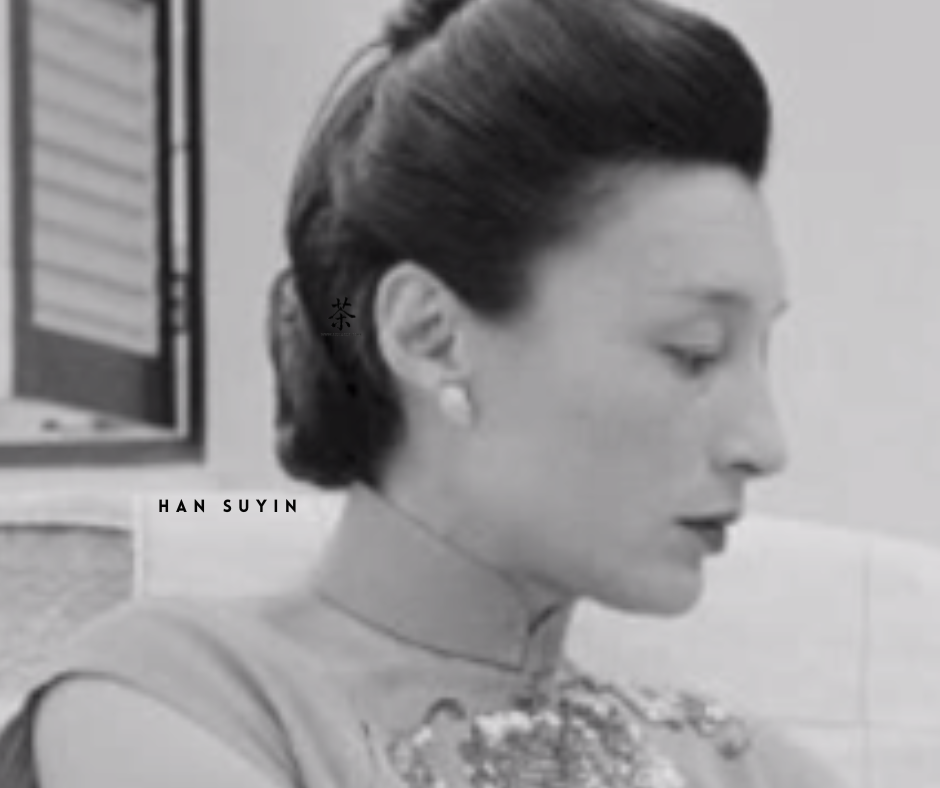
[EXCERPT] “Self-Made Effigies: The Life of Han Suyin” by Susie Gordon
Click HERE to read Susie Gordon’s essay “On Biographsing Han Suyin”.


… to be whole, I must fragment myself; like a tree multiplying its skyward gestures, I proliferate personae, and search my self-made effigies in quest of coherence.
—Han Suyin
Don’t imagine that there could never be another Han Suyin. Ambitious apologists for authoritarianism will certainly vie to take up her mantle. And who could blame them? Her works might appear odious to us now, but she had a very successful run.
—Hugo Restall, Wall Street Journal, 6 November 2012

1.
All dissidents have always been right in the end
28 January 1985, Canada: Jack Webster interviews Han Suyin on BCTV
Jack Webster (JW): I think I can safely say that Dr Han Suyin is a legend in her own time. Not that she’s that old, but she is a woman of incredible charm and beauty. She is a woman who is a living expert on China.
Han Suyin (HS): Not an expert…
JW: She has been involved in every aspect of China. She has written some wonderful books, the most famous of which was A Many-Splendoured Thing. Is that correct?
HS: Thank you, Jack, for having it right. Usually people say Love is a Many-Splendored Thing. That was the film.
JW: That was the name of the movie?
HS: Yes.
JW: A Many-Splendoured Thing. And she’s here, of all things, because she’s written another book, called The Enchantress—a breathtaking new novel. But I want to talk to you about some other things as well.
HS: Yes.

JW: When you look at China today, Han Suyin, do you see a country which is so fantastically different from the Mao Zedong era which you knew and learned about?
HS: Fantastically different from the old China I knew, Jack. You see, everybody now, because they have short memories, compares with Mao Zedong. For me, Mao Zedong brought China from the 10th century into the 20th. He couldn’t go further. He also made some mistakes, but the great things that he did for China will remain eternally with us. He really… Without him there would not have been the possibility to do what is being done today. And so, even though in his old age he did commit mistakes and he went… well, even senile, we must not forget that without him we would probably be satellites of Russia, or we would be back with the warlords. We would be worse than Latin America. Oh, no. It’s not with the Mao Zedong period we must compare; it’s with Old China—the Old China where one million to three million people died every year of hunger, but nobody cared. Nobody even… People took it for granted. That’s the China I came from. The Old China. My family has been serving China for eight hundred years, as mandarins. We have a tradition, and our tradition is that we serve China. We don’t serve “-isms”; we serve China, because China is China. And it doesn’t matter if you have to be Communist to serve China properly and to do something. So therefore you see, Jack… That’s our background.
JW: But you were also married to, in fact, an officer of that—can I say?—dreadful man, Chiang Kai-shek.
HS: But only because Chiang Kai-shek suddenly (because he had been kidnapped by the Communists) turned around and agreed to make a united front with them. Do you know what happened in December 1936 when the Japanese had already been invading China, Jack? Chiang Kai-shek was giving in, giving in, giving in to them. And it was Mao Zedong and Zhou Enlai who captured Chiang Kai-shek, and instead of putting him to death said, “Now, look. The country comes first. You killed a million of us. You have been hounding us all over the place. The Long March was due to this hounding. But let’s make a deal. Let’s get together to fight for the country, because China comes first.” And because they did that, Jack, I never saw—and many people like myself never saw the Communists as “-ists”; we saw them as nationalists. And this is why I married a man who afterwards—after I married him—became an officer in Chiang Kai-shek’s army. And for some years I believed that yes, they were fighting for China, until I realised with my own eyes. I saw them preparing for the next civil war and not fighting the Japanese. The only people who fought the Japanese were the Communists. So, of course, all of us non-Communist intellectuals, we sympathised with the Communists, quite frankly. My whole university did.
JW: How bad, how serious, how wrong were the Americans when they recognised and dealt with Chiang Kai-shek against dealing with Zhou Enlai and Mao Zedong? That must have been the world’s greatest diplomatic mistake.
HS: Well, it’s very difficult for me, being Chinese and having what I call “Chinese discretion”. If you will notice, I never criticise any other country. Non-interference is my motto. Not through fear, but because I’m afraid of making mistakes. Yes, it was a mistake, because Mao Zedong had, in 1947, already told the Dixie Mission—it was a mission of American experts and military people who had gone to Yan’an to see Mao Zedong, he told them “only America can help China modernise”. You see, this idea of today—modernisation and opening—was already there in 1947. And he said that to them, and unfortunately after that came McCarthy, came the idea that Russia and China were all the same, and so on and so forth, when it was very clear that Mao Zedong always detested Stalin, and Stalin detested Mao.
JW: But there’s something else worries me about the new China: what little we know about it. We read little bits in the Globe and Mail, little bits in the New York Times. It would seem that China is on the road to becoming—I overstate this—a carbon copy of the United States, with Coca-Cola, and Diet Pepsi, and free enterprise, and franchises, and multi-millionaires, and social injustices, which they were trying to wipe out.
HS: Jack, you are very perceptive, and you are saying things which are also being said in China. Now, my feeling is this one, because as you will see when you read The Enchantress: I’m something of a historian. You cannot have five thousand years of history without knowing that China has been invaded and conquered by many foreigners. And, lo and behold, within five to ten years they’ve been sinicised. What China has done, even during these thirty years under Mao, has been to sinicise Marxism. To turn it to adapt to Chinese conditions—not very successfully, not very well, but then when you make an experiment you’re always making mistakes at first. And what I think they are doing is make what the Chinese genius has always done. The Chinese genius is not analytic. It’s synthetic. A synthesis. They’ve always put things together. I think the Chinese will be the first people in the world to put capitalism and socialism together and to work out what they call Chinese Socialism. Now, I never quarrel with ‘–isms’, because I don’t know what they mean. I’m stupid, you see.
JW: Heh.
HS: I’m quite stupid about it. But I know that when Hong Kong was accepted as being two systems… One country, two systems… I said, “There you are.” China’s going to do the same thing all over China.
JW: I suppose that is the highest shining example of Chinese pragmatism.
HS: And of British wisdom. I was very happy. I love the British. I’m sorry—perhaps this isn’t right, in British Columbia, to say it?
JW: No, no—it’s quite allowed, I think! Providing you say it in French.
HS: All right, I’ll say it in French: j’aime beaucoup les Anglais. Yes—my French friends do not forgive me for preferring as my boyfriends English people… But let’s leave that now.
JW: You love the British, and you—
HS: I do. I do. I love the British and I get on well with them. I’ve got a British sense of humour—deadpan, which doesn’t work well on French television, but it works well on Chinese television. And I must say, what I felt there was that my dearest wish had come right, which was that the British—who have played a great part in world history, never mind imperialism and all that. I’m not… As I say, no “-isms”…
JW: Never mind the slave trade. Never mind the Opium War—
HS: Never mind. Never mind. Never mind. Let us forgive and forget. But let us start on a new deal, okay? And let us accept that China has her own originality, her own creativity, her own way of looking at things. And the British have done it. And so they’ve made a very good deal for themselves with Hong Kong.
JW: You are a beautiful woman, but you are not wholly Chinese. In fact, you are what was called then—
HS: Eurasian.
JW: Belgian…
HS: No, we were called—ah… Mixed blood. Mongrels. Half-castes. Dirty yellow-bellies. We were kicked around. Our fate—the fate of a Eurasian girl was to be a prostitute. Ha.
JW: And you escaped it, obviously. But how did you escape?
HS: I didn’t escape. I fought it. That’s different.
JW: You fought it? Because your attitude towards the development of your life has been something you fight from within, not from outside, is that right?
HS: I fight from within, yes. I don’t join groups or movements. I just say, “Well, I don’t think so”, and I go ahead.
JW: What about Dao Zh… What’s his name? Dau… My favourite Chinese statesman, Dau…
HS: Deng Xiaoping?
JW: Deng Xiaoping.
HS: Deng Xiaoping? Oh, he’s not a Eurasian. He’s from my province of Sichuan. You see, I do identify emotionally with the Chinese, and the reason probably was that it was so highly unfashionable. When I was twelve, thirteen years old, we all had to pass. You know what the word ‘pass’ means? It means becoming white.
JW: Oh, yes…
HS: God. Well, I went the other way, or tried to. So, there you are.
JW: You were passing Chinese instead of passing white?
HS: I was trying to pass Chinese, yes.
JW: That must have been difficult then.
HS: It was difficult. And therefore during the war I went back to China. I was for two years in Belgium to study medicine, and I gave up my scholarship and went back to China, and started as a midwife in my province—the province of Sichuan. Now Deng Xiaoping comes from Sichuan. Zhu De comes from Sichuan. Many of the great generals of China and the great poets came from my province. My province only has one hundred million people. We are one tenth of China. Only one hundred million. We’re a small province.
JW: Four times the population of Canada!
HS: Maybe. And what was very interesting was that I identified so much, probably because I was during the war instead of serving tea in teacups, you know, to nice ladies and all that sort of thing, I went and became a midwife in the countryside, and so—
JW: And when you became a doctor you became a free enterprise, because they tried to run you out of town, did they not?
HS: Well, that was later. Yes, a lot of people do try to get rid of me one way or another, but somehow I stick. But to come back to Deng Xiaoping… He is a typical Sichuan man. And he’s immensely pragmatic. I’m told that when he was a young man, a young student who went to France, he was the only guy who, at the port, had everybody’s luggage placed and identified with their names, and everybody standing by their luggage—the other students, I mean. Whereas, you see, everything else was in confusion. And he also operated a small printing press, which of course at that time was illegal. But, you know, you’ve got to be illegal in order to become legal one day, may I say? All dissidents have always been right in the end. And he did that. And he’s always been the kind of person who fought in a way with both feet on the ground.
JW: Is that an old Chinese proverb? I’m going to use it. “All dissidents have always been right in the end.”
HS: It wasn’t very accomplished to do that because of Confucius. You know, I blame—I think the Chinese Communist Party sometimes made mistakes not because it was communist but because it was so Confucian. Not ‘confusion’…
JW: No—Confucian.
HS: Yes. It always had to stick by so many rules, and half the rules are defined again in Confucius. And I do not like—
JW: Except for one.
HS: Which one?
JW: Power comes from the barrel of a gun!
HS: Well… Confucius would have said the same thing if—
JW: He would have said the same thing?
HS: If he’d had a gun. I’m sure!
JW: Now, you got away from me on today’s China changing, when I said criticisms about the Diet Pepsi-Cola, society…
HS: No. I do not criticise. I do not like everything that’s said. For instance, my granddaughter, who seems to have inherited some of my dissident genes—she’s just been to China all by herself, pack on the back, for three weeks with the family, and she also disliked terribly the kind of, you know, Walt Disneyland that they are making of the Ming Tombs and so on.
JW: Who would want to see that?
HS: Yeah, but I’m afraid that it’s very difficult. They are trying to make money, the Chinese. They need foreign exchange. If we don’t have foreign exchange we can’t buy your machines. In order to buy your machines we must make foreign exchange; in order to make foreign exchange we must please a lot of people, who aren’t as noble as you are…
JW: Me? You’re still giving us terrible problems in logs, in lumber. We think, you see… innocent, naïve Westerners—if we can only tap the market of China we can sell every piece of lumber we can produce.
HS: Oh, no.
JW: The Chinese say, “We don’t want your little sticks. We want the whole tree, and we will use 99 per cent of that tree where you will throw away 50 per cent of it in Canada.”
HS: It is quite true that, as I said before, I think the Chinese will evolve their own economy by adapting from capitalism whatever they think works. But, meantime? Yeah, maybe they’re going to make mistakes. Maybe people are going to drink Coca-Cola. But so what? Some people are horrified by the Coca-Cola, especially Americans. They said, “What? Are you becoming American?” I said, “Look. Hong Kong has been getting water from Red China throughout all the time when the Americans said that even if you had a duck that came from China you couldn’t eat it in Hong Kong because it was a Red China duck. And yet they haven’t become communist.” I don’t think that Coca-Cola is going to turn anybody into a capitalist. It’s just going to rot some teeth, perhaps, because they are drinking too much of it, and not brushing their teeth afterwards. That’s all.
JW: Political question. Surely the day must come when—I shall not say Formosa— Taiwan becomes part of China. When will that come? Who will lead them into that?
HS: Aha! Aha. Now, do I reveal or do I not reveal official secrets?
JW: You reveal. You reveal! You reveal!
HS: Well, to begin with, in America and even in this country you have a lot of Taiwan students and Chinese students, and they are co-existing in universities, and they are the best of friends. That’s the next generation. And we are all Chinese together, as I have kept on repeating for thirty years, for forty years. We are Chinese first and everything else afterwards. I think we must let the Chinese work that out. And they’re doing it very successfully. For instance, there are writers’ seminars, at which writers from Taiwan come, and nobody does anything to them except if they go back to Taiwan, so they live in Hong Kong.
JW: You know, we always think of the Chinese as the most… in their own way quietly sophisticated, civilised people with a history going back—what? Ten thousand years?
HS: Ah… Let’s say five thousand.
JW: Five thousand years.
HS: Let’s be modest!
JW: How do you treat your minorities?
HS: Ah, that’s a…
JW: Do you treat them well?
HS: That’s a very good question because, to be quite honest, I have been studying that problem for quite a number of years. I must say that in Old China… When I mean Old China I don’t mean Mao Zedong China; I mean way back before—
JW: Old, old China.
HS: Before 1949 they were very badly treated.
JW: You’re talking about the Boxer Rebellion China?
HS: Ah, yeah. That kind of thing. I’m talking… Don’t call it rebellion! How can it be rebellious for a people to rise up against their oppressors?
JW: I saw Charlton Heston and David Niven—
HS: Oh, that’s it.
JW: And they called it Boxer Rebellion, when brave white men marched through hundreds of thousands of million Chinese peasants.
HS: Yeah… Shooting them all the way. Okay. But that doesn’t matter.
JW: No. Look—The Enchantress! We haven’t talked about The Enchantress. Will you stay and take some phone calls? One segment of telephone calls?
HS: Yeah. Sure.
JW: What an opportunity. Han Suyin. Doctor Han Suyin.
2.
A particularly egregious avoider of the truth
It’s a cold day in Lausanne. Early November and the trees are black and naked. The sky is dense and the chapel bells are lost in it. The right sort of day for a funeral. The guests make their way up the damp path through the graveyard in thick coats and hats. There aren’t so many of them, certainly not as many as you’d expect for a woman who lived for almost a hundred years, married three times, and wrote over forty books. Asia’s most famous writer. At least she was, in 1966. Half a century later she is dead, and not one of those books is still in print.
In other parts of the world journalists and critics are sharpening their pens, keen to fire a parting shot at the woman who’d once called Chairman Mao a “genius”. In the Wall Street Journal, Hugo Restall doesn’t hold back. Cringe-worthy, he writes. Odious. A particularly egregious avoider of the truth. But only a handful of his readers will recognise the name he is denouncing. Scanning the obituary, their eyes will finally find something familiar. … achieved fame when her 1952 romance novel A Many-Splendoured Thing was made into a charming movie starring William Holden. Memories jogged, they may recall her autobiography—five volumes in all—with her photograph on the cover: staunch, uncompromising, the collar of a patterned cheongsam fastened at her throat.
Han Suyin.
She wasn’t always Han Suyin. To her Belgian mother she was Rosalie Mathilde Claire Genevieve. To her Chinese father she was Chou Kuanghu. To her second husband she was Dr Elizabeth Comber. To Yungmei Tang she was mom.
Yungmei is part of the ragged line that’s filing into the chapel. By her side is her daughter, Karen Shepard. Karen hasn’t seen her grandmother for thirteen years. She only agreed to come to Switzerland at Yungmei’s request.
It’s difficult. Karen has always been ambivalent about her once-famous grandmother. Now, she has no choice but to think about her. The memories spread like ink stains: a trip to China in 1972, the child-sized Red Guard uniform Suyin had made in the hope of irritating Karen’s Jewish American father Sidney Glazier. She remembers the old woman eating chilli peppers straight from the plant, wearing winter coats made exclusively of fur, teaching her how to fold silk blouses so they didn’t crease. Karen can still picture her grandmother silencing a room with a harsh word, berating anyone whose opinion didn’t tally with her own. Dragon Lady, Sidney used to call her, and sometimes—less generously—asshole. Yet Karen feels a reluctant kinship. After all, she shares her grandmother’s Eurasian heritage. As a writer, she shares her vocation as well. Suyin wrote in one of her memoirs, “Karen is so very much like me in some ways that it is almost unbelievable.”
There are five eulogies that day. Karen watches as her mother steps up to the rostrum. She listens as Yungmei speaks in admirably neutral terms about the woman she despised. The only mother she’d known, but not the only one she’d had. Karen thinks back to their trip to Sichuan province in 1972—her mother asking, begging Suyin to help her locate her birth family. “She probably doesn’t even want to see you,” Suyin had said. “She did give you up.” Karen had seen her mother smoking a cigarette that day—the first and only time.
The sky is still dense with rain when the chapel doors open to let the funeral-goers out. Karen is happy for it all to be over. She’s done her duty. Yungmei, an old woman now herself, is keen to leave as well. The chapter is finished. Han Suyin is dead, tucked safely between the pages of books that are out of print.
3.
About my father and my mother …
The Hakka are the nomads of China. Known as the Guest People, they headed south from the Yellow River heartlands of Shanxi, Henan, and Hubei in a series of migrations that began in the third century. Their walled tulou villages sprang up in the areas where they settled, and their language developed as the fast staccato Hak-kâ-va. Their women didn’t bind their feet like other clans. Wanderers at heart, the Hakka now number eighty million worldwide, and have gifted history with political luminaries such as Sun Yat-sen and Zhu De, and the maniac-maverick Hong Xiuquan, leader of the brutal Taiping Rebellion.
The Zhou family were Hakka from Meixian in Guangdong Province. They could trace their ancestors back to the late Song Dynasty, but the date of their southward journey had long been forgotten. In the fourth wave of Hakka migration between 1682 and 1710, a young pedlar from the Zhou clan left Meixian for Sichuan Province on a salt gondola, rowing through the sweating shallows via Jie’an in Jiangxi, and then to the city of Chengdu. The vast territory of Sichuan—land of the four Yangtze headwaters – was a fertile field of opportunity, with mountains touching Tibet in the west and plains stretching down to the Yunnan tropics in the south.
The young Zhou pedlar stopped and settled in the small town of Pixian near Chengdu, and soon set his sights on the region’s top crop: tobacco. The Dutch had brought it from the Philippines and found that it grew exceptionally well in Sichuan’s soil. Within a decade or so, Zhou’s Guangxing cigarette brand had a monopoly; there were few men in Pixian who weren’t hooked on his wares. In a clever feat of diversification Zhou created a line of accessories including paper spills that worked as matches. A consummate salesman, he purposefully set up his stall outside the public toilets, exploiting a captive audience returning from their ablutions.
As the generations drew on, Zhou’s progeny rose up through the gentry class into feudal society, and then into the officialdom—the highest Chinese caste. In the early years of the Qing Dynasty the imperial examinations were still in full swing, populating the nation’s administrative offices with scholars versed in classical texts and Confucian ideals. Several generations of Zhou men passed the notoriously difficult tests and were sent to outposts as far afield as Gansu Province in the arid west.
But by the turn of the 20th century the examination system was flagging. An increasingly bloated bureaucracy led to a series of rebellions that paralysed the Qing court. However, attempts by the Emperor Guangxu to streamline the administration were thwarted by the indomitable Dowager Cixi. It wasn’t until 1905, after the Boxers had risen up against imperial forces, that the system was finally abolished. Young Zhou Yantong had sat the exams in 1898, but the disbanding of officialdom left him with no long-term prospects. There would be no job for life as there had been for his father, grandfather, and great-grandfather before him.
In 1902 the Zhou elders gathered to discuss the fate of Yantong and his two brothers. It was customary to send young men abroad in those days, and the eldest brother was earmarked for Japan. Yantong would go to Europe to study science, while the youngest would attend Chengdu’s Military Academy for the New Army. Their fates were sealed.
China was embroiled in a push for modernity, bolstered by a fresh determination to banish the imperial powers that had carved the eastern seaboard into treaty ports with their gunboats and missionaries. For inland Sichuan modernity called for the creation of an infrastructure to complement its rich reserves of minerals, coal, and iron. This would come in the form of a railway. The “iron road” was just what China needed to finally shake off the shackles of its colonisers. The Russians had built the Trans-Siberian. The French and the British had laid their own lines along the coast. Now it was time to bring the railway home.
The Chinese transport authorities looked to Belgium for inspiration. The Belgians had tried their hands at railways in China as well, but their incursions were viewed more positively than other European efforts. Unaware of King Leopold’s tyranny elsewhere, China viewed Belgium as a paragon of railway construction.
Sichuan’s Provincial Government selected four promising young men to study railway engineering in Brussels as part of the New Learning movement. Zhou Yantong was among them. In the summer of 1903 they set off from Chengdu in a junk from the Nine-Eyed Bridge, surrounded by silk bales, opium chests, casks of tobacco, and camphor trunks filled with furs. After throwing offerings to the river gods, Yantong and his friends settled below deck to play mah-jong.
For long hazy nights and muggy days the boat passed up the Mian River to the Yangtze and through to Chongqing. It steered the narrows of the Three Gorges, stopping at Hankou and then at Shanghai where the railway boys alighted, bound for the Language School where they were to spend six months learning French.
A photograph of Zhou Yantong from 1903 shows a slender-faced young man, hair braided in a long queue, wearing silk boots, trousers, and a jacket with Manchu cuffs. On arriving in Shanghai he was impressed at first. The city was vastly and almost blindingly cosmopolitan—a hive of international trade that felt very different from the provinces. The more Yantong saw of it the more he was overwhelmed by the poverty and injustice. The foreigners were the top dogs followed by the Chinese merchant classes. Below was a seething mass of beggars, coolies, and ne’er-do-wells. It looked wrong to him. He was an educated man, but his version of the world was the one he’d seen between the pages of Confucian textbooks – a precise world of justice and natural hierarchies. Shanghai was nothing like that. It made him fear what lay even further afield.
At first the four friends roomed on the campus of the Language School in the foreign settlement, but soon grew sick of the food and decided to lodge instead with a Sichuan merchant in the Chinese quarter. Their days were spent memorising the curious, lyrical grammar of French in mosaic-tiled classrooms, their evenings playing cards and dozing while the Old City chattered below the windows of their cramped quarters.
In the winter of 1903 they boarded the French mail ship Porthos bound for Marseille. Yantong packed as much food as he could carry: five whole fish in baskets, and five wicker hampers stuffed with bean curd, cakes, and preserves. While the ship was stopped in Singapore he went to a barber and had his queue cut off. Later, the removal of Chinese men’s braids would become a symbol of the Revolution; for Yantong it represented a different sort of freedom. He kept the long rat-tail of hair in a sandalwood box. Many years later his Belgian wife would find it and curse him for his backwardness.
Before he met Marguerite Denis, Yantong found European women strange and slightly unsettling. Hushed rumours circled among his friends that foreign ladies had tails concealed under their wide skirts. In the Brussels suburbs where the four young men settled in early 1904, there were similar prejudices from the other side. The family Yantong lodged with—the Beckmans of Ixelles—were immediately disgusted by the smell of his wicker hampers. His classmates at the engineering school were entranced by him, caught up in wild Orientalist visions.
“Are you a prince in China?”
“Is it true you eat mice?”
“Is it true you cut off the feet of little girls?”
“How many pipes of opium do you smoke a day?”
Yantong was the object of sexual fascination as well. His friend’s landlady tried to tempt him into bed.
“I like Chinamen,” she said, sliding her thumb into his collar. “Your skins are so wonderful. Like a baby’s. You have no hair on your face.”
He refused her advances. He also declined all attempts to convert him to Christianity.
One day in May 1905 he was walking through the cheese market in Ixelles when a girl caught his eye. Her pale oval face was crowned with red curls, and her eyes were a strange amber. She was dressed in muslin and wore a cameo pendant at her throat. There was an air of weary mischief about her, which stopped Yantong in his tracks. Amid the clamour of Flemish voices and the sharp stink of cheese he watched the girl as she idly examined a wheel of Gruyère. He was so captivated that he decided to play truant from his afternoon classes and follow her home. On a street of tall townhouses he ducked behind a wall and held his breath as the girl walked up the steps to a cream façade with ornamental ironwork. He went back the next day and the next. On the third day the girl’s mother spotted him through the window.
“A Chinaman,” she sniffed.
Marguerite put her eye to the gap in the curtain. She smiled.
“Who is he?” her mother asked.
Marguerite didn’t reply. She turned on her heel and walked out of the house.
Yantong was so surprised that he forgot to take off his hat when the girl walked over to him. He didn’t know it, but she’d noticed him at the cheese market before he had laid eyes on her. Through the steam of a cart-horse’s breath she had glimpsed him and mistaken him for an Asiatic prince.
Marguerite Denis was given to flights of fancy. At twenty years old she was reckless and mulish. She’d taken herself off to Ireland two years earlier to work as a governess, and would have stayed if she hadn’t caught typhoid. Her family despaired of her wilfulness. Her mother was Matilda Rosalie Leenders, a Dutch Protestant from Antwerp. Marguerite was her only child. To prevent any further pregnancies Matilda fashioned contraceptives out of vinegar and cotton wool. Her husband, George Denis, didn’t object; such things were a sin, but only for Catholics.
The Denis family had once been the Flemish Dennys – high-ranking military stock from Mechelen, a hub of the railway industry that would later function as a transit camp for Auschwitz-Birkenau. The same spirit that lay below Marguerite’s defiance led many of her relatives to fame and prominence. Her uncle Henri led Belgium’s Ministry of Defence between 1936 and 1940 as a technical expert. Her cousin Armand became a renowned documentary filmmaker for the BBC.
But the Denis were traditionalists at heart, and Marguerite’s fledgling romance with Zhou Yantong did not go down well. This was partly why she pursued it. After months of wistful strolls in the Bois de la Cambre the pair ran away together for an extended tryst, putting Yantong’s place at the railway school in jeopardy. When they returned, Marguerite was threated with the convent but it was too late. She was pregnant.
A bishop agreed to marry them in spring 1908 despite Yantong’s refusal to convert to Christianity. This was the only way his father in Chengdu would give his blessing to the union. In October that year, George Zichun (Son of Spring) was born in Ixelles. The young family set up home in Wouwe St. Lambert, a good district of Brussels. Yantong completed his studies and worked his apprenticeship on the railways for eighteen months.
Zichun was a well-loved child. The Zhou elders in Sichuan were delighted to hear of his birth. As the first male born of his generation he went straight to the top of the list of descendants for ancestor worship. Marguerite took happily to motherhood, dressing the baby in outfits she fashioned from bolts of brightly-coloured brocade sent from Chengdu. She began to learn Chinese and gave up her Belgian nationality in the vague hope of one day relocating to her husband’s homeland.
This happened sooner than she expected. Yantong completed his apprenticeship at the end of 1912 and was required to take up a position in Chengdu as quickly as possible. They arrived in January 1913. It was a very different country to the one Yantong had left ten years earlier. The Xinhai Revolution had unseated the Qing court and stripped the child emperor Aisin Gioro Puyi of his throne. With the new republic in its infancy the railway project was all the more vital. Yantong’s skills would be in high demand.
Marguerite was sorely disappointed in China. She’d dreamed of pagodas and gardens, misty mountains and lakes. What she found instead, alighting in Shanghai, was the same mess of beggars and clash of cultures that Yantong had witnessed in 1903. She was dismayed to discover that her husband was not revered in his homeland, as she had expected him to be. The Revolution may have come but old prejudices lingered. On the river steamer to Hankou Yantong could only buy a Second Class ticket. As Europeans Marguerite and Zichun were allowed to travel in First. To salve his humiliation Yantong paid for a private junk to take them from Hankou to Chongqing.
The journey lasted nine weeks. Marguerite hated every minute of it. She was appalled by the poverty in Chongqing, and wondered why the foreign missionaries had been unable to improve the situation. After ten days in a sedan chair to Chengdu, the young family was greeted warmly by the Zhou elders. Their hospitality was no balm to Marguerite. It was horribly hot and humid. Mosquitoes buzzed and bothered her pale skin.
Things began to look up when Yantong was installed as Chief Engineer of Sichuan Province, but the rocky political situation under warlord emperor Yuan Shikai put the railway project on hold. Marguerite grew more and more unhappy, annoyed by the constant presence of the Zhou women in her quarters. Eventually Yantong decided it was time to leave Chengdu. At the Belgian Consulate in Hankou he met a diplomat named Joseph Hers, who secured a job for him on the Lunghai Railway in northern China. Monsieur Hers sensed that Marguerite was unhappy and offered to help her repatriate. In a fit of pique she vowed to remain with Yantong, but agreed to send Zichun back to Belgium for schooling.
Yantong’s tenure in Henan Province would last eight years. They settled in for the duration, taking a small house beside the railway construction site in Xinyang. There was a small population of foreigners there among the Chinese workers – Belgian engineers, French missionaries and a doctor. Marguerite expected to make friends among them but they were reluctant. Mixed marriages were frowned upon, not least when the husband was Chinese. Sensing their disapproval, Marguerite vowed not to bring a child into the hostile atmosphere. Yantong had other ideas. Their second son, Gabriel ‘Sea Orchid’, was born within a year of their arrival in Xinyang.
Despite the censure of the other expatriates Marguerite found solace in her motherly duties, the way she had with Zichun in Chengdu. Sea Orchid was happy and docile, and strangely beautiful. He had his mother’s pale skin and his father’s curious eyes. With Zichun far away in Belgium he filled Marguerite’s arms and gave her a dash of hope that all of her rash decisions had not been in vain.
One night when Yantong was working at a station further down the line, Sea Orchid fell sick with convulsions. Frantic, Marguerite took him to the house of the local French doctor after hours. The doctor’s wife opened the door, took one look at the baby, and closed it again.
“Filthy half-caste brat.”
Sobbing, Marguerite begged and banged at the door.
“Please!” she cried. “Please!”
It was no use. The doctor refused to see her.
Sea Orchid died in the night.
Inconsolable, Marguerite turned to brandy and Chinese wine. Listless and despairing, she spent her days drinking and her nights weeping. Yantong’s sympathy was limited. There was work to be done and life to be lived. He was not a sentimental man. By 1916 Marguerite was pregnant again, and had no choice but to see it through. On September 12th her first daughter was born.
In the hope of masking her disappointment Marguerite gave the girl a clumsy clutch of names plucked from her family tree. Mathilde Rosalie Claire Elizabeth Genevieve. For tradition’s sake Yantong added Guanghu, meaning ‘bright coral’.
The child was long and thin and sallow. Marguerite could hardly bring herself to look at her. She wasn’t sure if the hue of the girl’s skin was jaundice or her natural tone. The yellowish object, she thought with disgust every time she had to touch her. Only after her husband beat her did she agree to feed the child. The very act revolted her. She wanted Sea Orchid instead. She wanted Zichun. She wanted to go home.
“Take that half-caste brat away,” she hissed. “It is not my child.”
How to cite: Gordon, Susie. “Self-Made Effigies: The Life of Han Suyin.” Cha: An Asian Literary Journal, 10 Nov. 2026, chajournal.com/2026/11/10/life-of-han-suyin.


Susie Gordon is a British writer, translator, and editor. She is the author of two poetry collections, Peckham Blue (2006, Penned in the Margins) and Harbouring (2015, Math Paper Press). Her work has appeared in collections and literary journals, including Sinister Wisdom, Eunoia Review, Junoesq, Jewish Fiction, and the 10th Anniversary edition of the May Anthologies. She participated in the Royal Court Theatre’s Young Writers Programme in 2007–2008 and was a finalist in British Vogue’s young writers’ competition in 2004. She holds a PhD in Comparative Literature from the University of Liverpool and a BA in English from the University of Oxford. She is the founder of the independent press and journal OfTheBook and co-founded Literary Shanghai in 2014. Her debut novel, A Monster in the Ash, was published by Claret Press in 2026.