
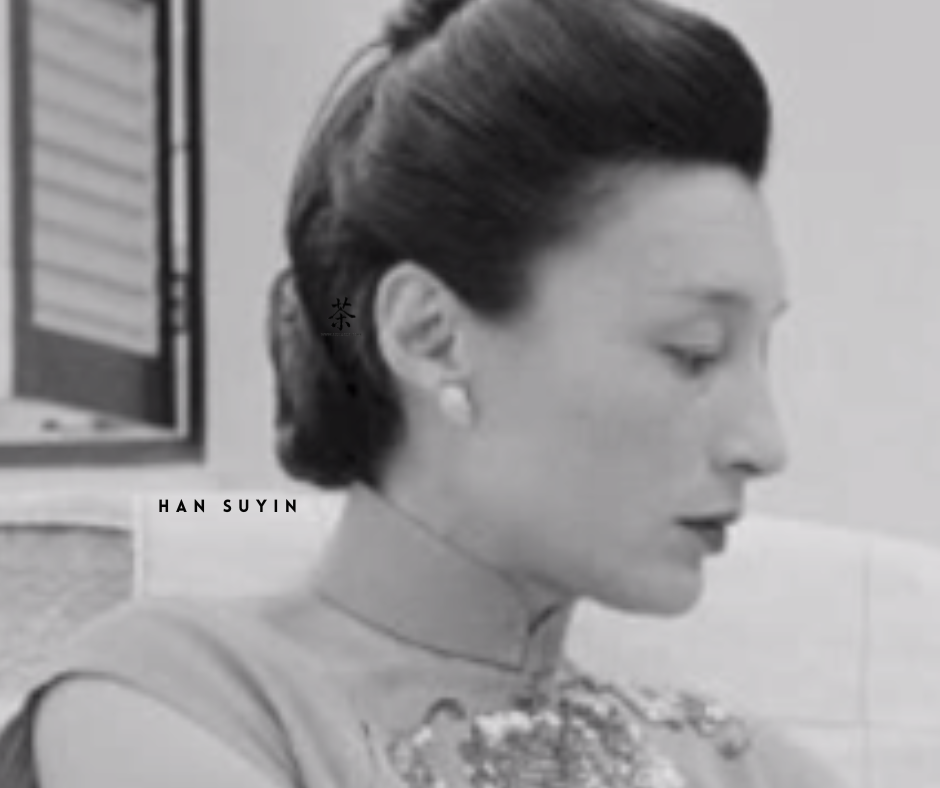
[ESSAY] “Self-Made Effigies: On Biographising Han Suyin” by Susie Gordon
Click HERE to read an excerpt from Self-Made Effigies.


To the biographer, choosing a memoirist as a subject is both a gift and a curse: a gift, in that her life has already been written in her own hand; a curse, for precisely the same reason.
I first encountered Han Suyin through a former partner, at the tail end of my decade in Shanghai. The relationship ended, and not long afterwards, so did my life in China. Perhaps for this reason, Han acquired a faint air of tragedy for me. Her books became bound up with departure, with the dismantling of one life and the uncertain prospect of another.
I was preparing to return to England and needed a subject for a Master of Research in Chinese Studies. I hit upon the idea of investigating Han Suyin, and more particularly the relationship between her work and biography as a literary form, viewed through the lens of Michel Foucault’s concept of heterotopia: the “other” space in which otherwise incompatible sites can exist alongside one another. Biography struck me as an inherently heterotopic form. A life is lived only once, yet it can occupy several textual spaces simultaneously: memory, fiction, memoir, archive, biography. Han, who had spent decades writing and rewriting herself, proved an unusually fertile subject.
Han Suyin wrote well; so well, in fact, that even as he set about discrediting her in 1980, Simon Leys spoke of “the roaring tide of the author’s powerful imagination” and confessed his admiration for “the positively cosmic quality of her overall vision. It is a fertile chaos, a polyphonic coexistence of opposites, a lyrical alternance, a grand dialogue between Yin and Yang.” In those piquant phrases, offered by way of introduction to a five-page hatchet job of her work, Leys encapsulates the many contradictions that first made Han Suyin’s name and later blackened it.

Best known for her five-volume memoir and for the novel A Many-Splendoured Thing, which was adapted into a blockbuster film in 1955, Han left a legacy that spans fiction, non-fiction, social commentary and politics. Yet in some circles it is a legacy that leaves a sour aftertaste. In the West, her outspoken support for Chairman Mao and his successors proved troubling, as the rash of critics who stepped forward to denounce her attests. She confounds sensibilities that still fester with Orientalism: a Eurasian who chose to honour her Chinese heritage over her European roots, and to curry favour with the Communist Party rather than with the scions of the capitalist West. It seems unthinkable. Unforgivable.
And she is difficult to grasp; difficult even to name. Elizabeth Comber. Rosalie Matilda Chou. Zhou Guanghu. Han Suyin. She defies succinct definition: a physician, a writer, a historian, a memoirist, a Eurasian, a communist sympathiser, a Mao apologist. Her writing compounds the difficulty. In her memoirs she vacillates, holding forth only to retract. Her fiction, drawn largely from her own life, muddies the waters further still. Her biographies of Mao Zedong and Zhou Enlai are less measured accounts than myopic hagiographies. And yet she is irresistible.
In the course of my master’s degree, the academic project began to evolve into something else. At roughly the same time, a novel I had written died on submission. It was a dispiriting moment. I had thought of myself principally as a novelist, but while my fiction seemed to have reached an impasse, Han was expanding. The deeper I delved into her life, the more dissatisfied I grew with the existing biographical record. There had been one previous full-length attempt to chronicle her life, but it was not, to my mind, equal either to the scale of its subject or to the contradictions I was uncovering. And so the dissertation became the genesis of a biography.
The decision was perhaps more audacious than it appeared at the time. Han had already written her own life, and repeatedly so. Five volumes of memoir ought to be a biographer’s dream; instead, they multiply the problem. The Han of the memoirs exists alongside the Han of the novels, the Han of the political works, the Han of interviews and public appearances, and the Han remembered by those who knew her. One version does not necessarily corroborate another. At times they scarcely seem to recognise each other.
It was Han herself who supplied the metaphor that would eventually give the book its title: “…to be whole, I must fragment myself; like a tree multiplying its skyward gestures, I proliferate personae, and search my self-made effigies in quest of coherence.” The biographer who enters that gallery of effigies does so at her peril.
At a time when the concepts of passing and cultural appropriation have entered popular discourse, Han cuts a particularly compelling figure. Her struggle for identity calls, plangently yet boldly, to a world unable to bury the bones of Western imperialism and lodged upon the horns of new power structures that mirror the old. It is a world in which Gayatri Spivak’s subaltern still struggles to speak and be heard, in which Homi Bhabha’s hybrid remains otherised, in which Mary Louise Pratt’s cultural contact zone is a battlefield, and in which Edward Said’s Orient endures as the fearsome yet toothless dragon of the Western imagination.
What began as an academic investigation has become an attempt to present a fuller portrait of Han Suyin than any yet achieved, treating her and her work as inseparable from the eras through which she lived. She herself believed that “we are all products of our time, vulnerable to history”. The effects of her work on the modern reader and China-watcher must also, of course, be considered.
The aim is to discover who she was, why she was, and why she wrote. Did she accomplish a dizzying feat of literary yellowface? Why was she so doggedly, even contrarily, loyal to China at the expense of her Western roots? Did she harm or help Sino-Western relations at a critical juncture in their development? Who loved her, and whom did she love? Han once wrote that “we should never condemn what we do not understand”. The excerpt that follows, taken from my work in progress, Self-Made Effigies: The Life of Han Suyin, forms part of that attempt to understand.
How to cite: Gordon, Susie. “Self-Made Effigies: On Biographising Han Suyin.” Cha: An Asian Literary Journal, 10 Nov. 2026, chajournal.com/2026/11/10/biographising-han-suyin.


Susie Gordon is a British writer, translator, and editor. She is the author of two poetry collections, Peckham Blue (2006, Penned in the Margins) and Harbouring (2015, Math Paper Press). Her work has appeared in collections and literary journals, including Sinister Wisdom, Eunoia Review, Junoesq, Jewish Fiction, and the 10th Anniversary edition of the May Anthologies. She participated in the Royal Court Theatre’s Young Writers Programme in 2007–2008 and was a finalist in British Vogue’s young writers’ competition in 2004. She holds a PhD in Comparative Literature from the University of Liverpool and a BA in English from the University of Oxford. She is the founder of the independent press and journal OfTheBook and co-founded Literary Shanghai in 2014. Her debut novel, A Monster in the Ash, was published by Claret Press in 2026.