
茶 FIRST IMPRESSIONS
茶 REVIEW OF BOOKS & FILMS
[ESSAY] “Seeing Our Parents Otherwise: Hong Kong, Diaspora, and Family in Pik-Shuen Fung’s Ghost Forest” by Jeyan Chung
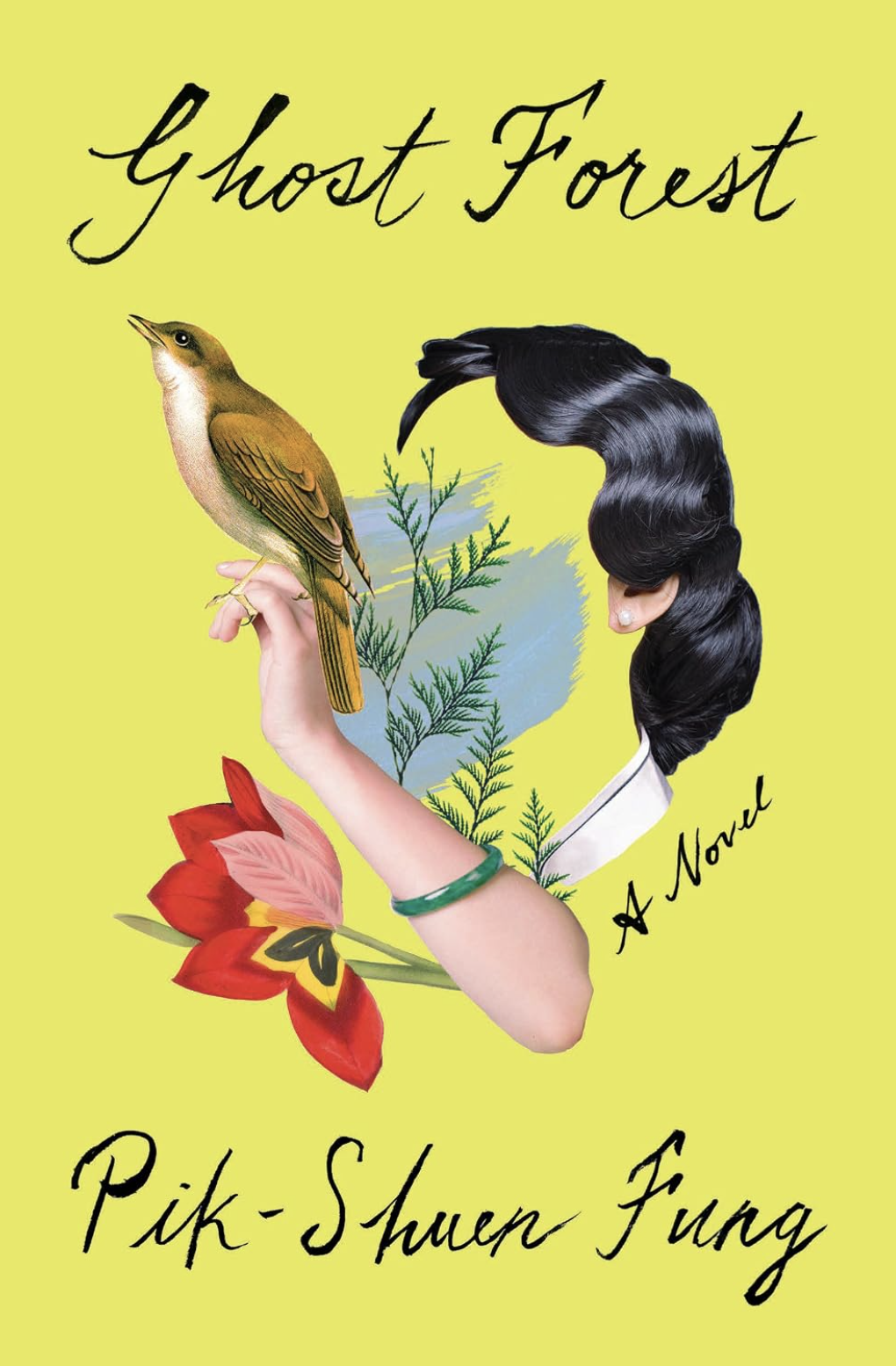
Pik-Shuen Fung. Ghost Forest, One World, 2021. 272 pgs.


For a long time, I have been waiting for a satisfying and truly representative book about the Chinese diaspora. Perhaps this is because I am part of it myself: I was born in Hong Kong, joined the great wave of emigration around 1997, and settled in Canada as a first-generation immigrant. I knew that somewhere there had to be a reasonably representative work by those who shared my story.
Diaspora media, sometimes dubbed “mango poetry” among other labels, often fails to strike a balance between the Western way of life we are compelled to lead and the Eastern culture from which we are estranged. It subtly reflects the inner complexities of diasporic writers by sublimating Eastern philosophies into forms that a Western audience can grasp. We mould ourselves, and our representation, to fit a box defined and structured by Western standards, shying away from describing religious and cultural beliefs that resist categorisation in favour of physical experience. Despite our efforts at self-expression, we in the diaspora fall into the same trap of exoticising our heritage through the very experiences we choose to share and the language in which we couch them. The result is a cycle of repetitive retellings: sliced fruit offered in lieu of an apology, the insurmountable expectations of hardworking parents, translating English for family members, and the yearning for native fluency.
Yet Pik-Shuen Fung’s debut novel, Ghost Forest, refreshingly inverts the genre’s familiar refrain. Instead of turning the Western gaze upon distinctly Hong Kong experiences, she depicts life in Vancouver with a cautious, restrained curiosity. Canada becomes a blank canvas, a new city the protagonist approaches free of preconceived biases. It is neither better nor worse than Hong Kong; it is simply different, and Fung subtly emphasises that the protagonist is no foreigner to be ostracised. The migrant family stands at the centre, while the wider world of Vancouver becomes the foreign other, as Fung applies East Asian standards and norms to the Canadian landscape.
❧

Inspired by its epigraph from The House on Mango Street, Ghost Forest reads as a work of autofiction that joins the literary subgenre of the vignette-style memoir, alongside Édouard Levé’s Suicide or much of Annie Ernaux’s œuvre. Some vignettes are short, others long, and none is meant to be read in chronological order. Rather than forming a single coherent stream, as in the conventional structure of a Western narrative with its protagonist, antagonist, climax and conclusion, the chapters resemble shards of glass. Only when these fragmented chapters and memories are read together can we appreciate the stained-glass window of the protagonist’s reflections on her family. The protagonist, along with her mother and younger sister, migrates to Canada while her father remains in Hong Kong for work. The mother is supported in her household and childcare duties by the grandparents, who have moved to Canada with them.
The protagonist’s memories of Canada are explored only sparingly. Instead, Fung focuses on how the family sustains its bonds of kinship across time and space, with the father’s distance playing a central role in generating tension within their multigenerational astronaut family. Even the protagonist’s family is a subtle inversion of the sociological term “astronaut family” (太空人), coined by Aihwa Ong to describe a phenomenon among Hong Kong and Taiwanese families in the early 1980s, in which the “astronauts” were usually sent abroad to work and to provide for the family who remained in the home country. In Ghost Forest, however, the family is sent abroad to Canada while the working father stays in Hong Kong.
When the father visits Vancouver for Lunar New Year, the household is magically tidier than usual, and the family performs. The two daughters are reminded to be gwaai (乖), obedient and well-behaved, until their father returns to Hong Kong and the house feels like their own once more. Much of the protagonist’s childhood and early adolescence centres on how she and her family perform social roles and simulate the image of a functional family unit. Rather than moving the family back to Hong Kong, the mother remains in Canada because she wants to be a good mother to her daughters. The protagonist strives academically because she believes this is what she must do to earn her father’s approval. Likewise, she views her father’s interactions with her through the lens of a daughter who is never enough.
“You’re not very ambitious, are you?”
“You’d look better if your face was thinner, and if you were two inches taller.”
“I think there’s something wrong with you that you’re making art like this.”
❧
These expectations and social roles fall apart when the 61-year-old father develops terminal liver disease. The whole family flies back to Hong Kong, and then to Hangzhou, in search of a hospital that can treat him properly. His deteriorating health and impending death force the daughter to confront her father for the first time. She spends days and nights at his bedside. They talk. She learns his favourite colour, film, place, music and hobbies. She listens to his stories about his family, among them his absent father and his older sister, who was both deaf and mute. Together, in halting Chinese, they read a Buddhist book, The Pocket Thich Nhat Hanh. Death is the natural reckoning that dismantles the emotional distance separating the family. It gives the protagonist both the realisation and the opportunity to see her family members as people, rather than as actors playing familial roles in her life.
Death allows the protagonist to witness the quiet gestures of affection between her parents. Every night, her mother massages her father’s feet for three hours until he falls asleep. Her father daydreams about taking his wife on holiday, perhaps to Greece or on a cruise, and about trying pizza for the first time. Her mother rests her cheek on his chest. Gazing at the oxygen tube beneath her father’s nose, the protagonist realises that, as a child, she never had the chance to say goodbye to her grandfather; it was a missed opportunity to share an intimate moment. In his final days, she begins to tell her father “I love you”.
The father’s death unfolds across many emotional chapters and, true to Chinese spiritual tradition, the novel portrays beliefs about the afterlife and the practices surrounding a funeral. The mother, daughters, and extended family call out reassurances as he passes away. At the funeral, the family burns colourful joss paper alongside paper effigies of worldly amusements, to keep the father entertained in the afterlife. The protagonist carries out the funeral rites, performing a final act of intimacy for her late father. In traditional Chinese funeral rites, it is the eldest son who gently washes the face and visible parts of the body of the departed, gestures that express respect and care for the dead.
The effects of the father’s death linger for years after his passing, an irony given the immense emotional suppression that had afflicted this awkward family for decades. The most profound revelation comes when the protagonist clears out her old email inbox. Evidently, she had corresponded with her father many years earlier, yet she has no memory of the message before her. Her father’s words on the screen brim with praise and encouragement for his daughter, but they fail to register, for the protagonist has internalised the image of a perpetually disapproving father. Any words to the contrary risk cognitive dissonance, as well as regret at never having built a relationship with him while he was alive. It seems that the protagonist can only partially come to terms with this regret and realisation after her father’s death, along with the forgiveness for his strict parenting that she never granted him when, from his hospital bed, he asked both daughters for it.
“Why did I remember only his disappointment in me? Did I ever get to know who he was becoming? Did I try?”
❧
One of the novel’s final vignettes is a touching tribute to a Chinese tradition, the hair-combing ceremony for the bride, which binds together the matrilineal generations of the family. Inspired by old footage of her mother’s own wedding in Hong Kong, the protagonist asks her younger sister to film their mother performing the ceremony for the protagonist’s wedding. She passes through a cultural ritual shared by her mother, her grandmother, and her great-grandmother, and is reminded of how old each of them was when they underwent it. All of them were younger than she is now. They shared the same giddy excitement. Recognising that she and her foremothers are bound by a common experience seen from different vantage points, the protagonist arrives at a sense of sonder towards them. They are no longer merely foremothers but women appreciated for their own complex inner lives.
Nor is the father forgotten at this personal milestone. His passing, together with the themes of death and the passage of time, pervades the ceremony. The protagonist clearly feels his absence as she imagines him taking part in the joyous occasion; only in her imagination does the ceremony feel complete. At the same time, however, she is reminded of how little time she may have left with the rest of her family. Looking at her grandmother’s body, small and ever fragile, she holds back tears. Will her grandmother live to welcome her great-grandchildren into the world? Or to celebrate her younger sister’s wedding? Who in the family will still be alive to witness these pivotal moments in their lives? These concerns matter because the protagonist has been asking about their lives and histories, and has come to see her loved ones beyond the social roles ascribed to them. Otherwise, she would risk overlooking the significance of their presence, repeating the mistake she made in underappreciating her father.
“People ask me why I’ve been recording my mother’s and grandmother’s stories. I asked them questions only after my dad died.”
What the novel leaves behind is a deeply poignant reminder of many an old chestnut: spend more time with your loved ones, for you never know how much time you have left with them. Fung reminds us that family roles are simply another set of socially constructed parts in which we find ourselves cast, and although they usefully guide our behaviour, they can create friction between what we wish to express and what we are comfortable showing. Compounded by a Chinese culture of reticence about affection, these roles confine us precisely when we experience moments of intense vulnerability and most desire meaningful connection. Yet it is vital that we unshackle ourselves. In the face of time and death, words cannot be left unsaid and actions must not falter, or else we lose the privilege of deciding at all.
How to cite: Chung, Jeyan. “Seeing Our Parents Otherwise: Hong Kong, Diaspora, and Family in Pik-Shuen Fung’s Ghost Forest.” Cha: An Asian Literary Journal, 10 Nov. 2026, chajournal.com/2026/11/10/ghost-forest.


Jeyan Chung is a recent graduate of University College London, where she completed a master’s degee in Legal and Political Theory. She also holds a bachelor’s degree in Politics and International Relations. Born in Hong Kong and raised in Canada and Malaysia, she currently resides in England and seeks to bring Southeast Asian issues out of the periphery. Her interests include philosophy, critical theories, authoritarianism and alternative political organising. Chung also founded Narratives of Resistance, an international collective that organises charity film screenings and art events worldwide in support of victims of genocide (norfilms.substack.com or @nor.films on Instagram).