
茶 FIRST IMPRESSIONS
茶 REVIEW OF BOOKS & FILMS
[FIRST IMPRESSIONS] “Love Yourself: Repetition and Return in Hong Sang-soo’s The Day She Returns” by Oliver Farry
Hong Sang-soo (director). The Day She Returns, 2026. 84 min.


The cinema of Hong Sang-soo calls to mind the late John Peel’s words about his favourite Mancunian art-rockers, The Fall: “always different, always the same”. Hong’s work continues to mine the same rich seam of a life lived in between the making of those very films, which arrive with dizzying frequency; by now, there is one every six months.
There are occasional detours, be they geographical (to Paris for Night and Day [2008], or to Germany for On the Beach at Night Alone [2017]), collaborative (three films with Isabelle Huppert) or, more recently, formal (the blurred-out In Water [2023]), yet a common thread runs even through these. As with those of Éric Rohmer, the director to whom he is most often compared, Hong’s films are rarely the standout release of the year; rather, each is another entry in a wider body of work whose consistency few other filmmakers can match.

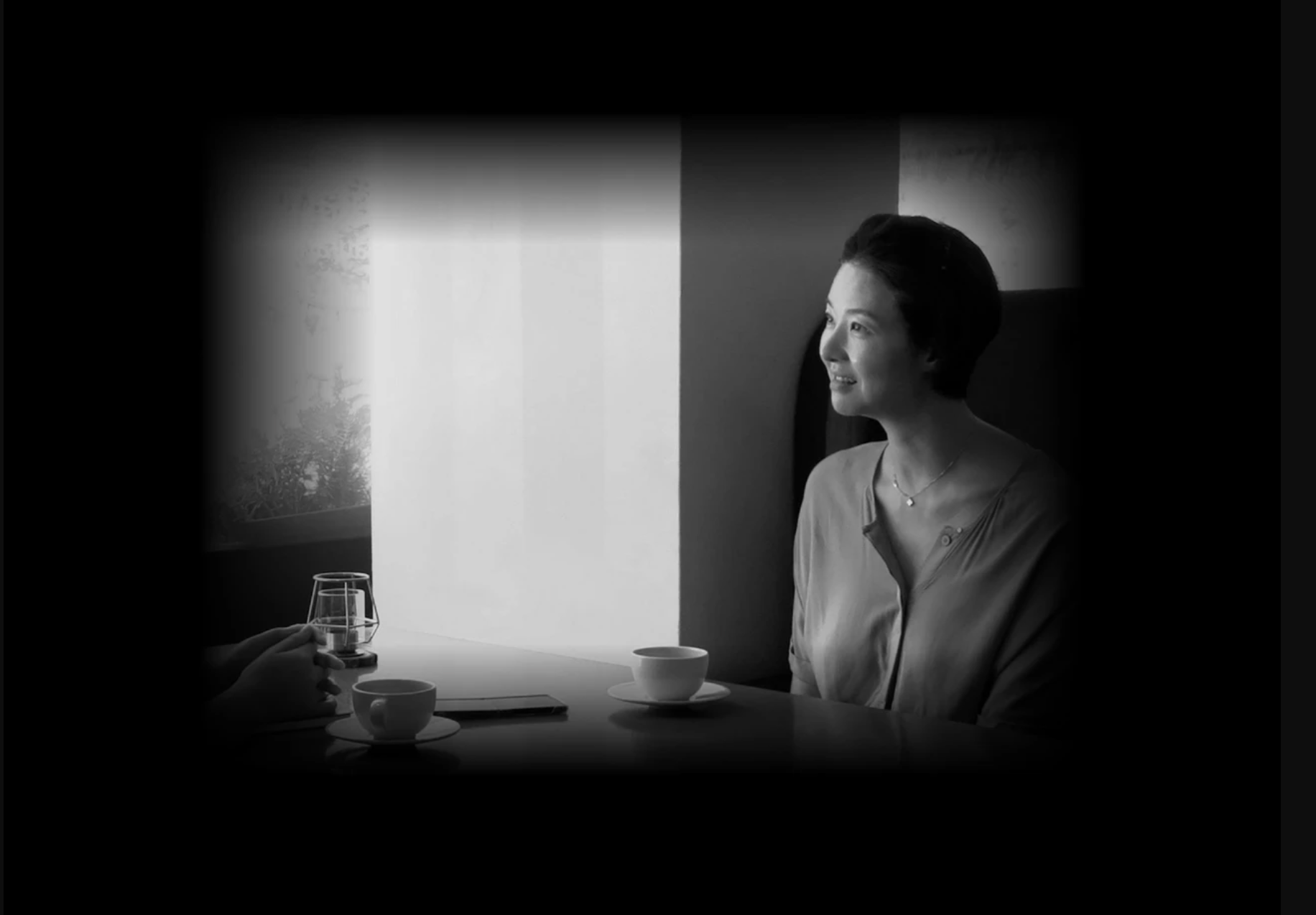
The Day She Returns might be categorised as one of the formal detours, being a plotless, lo-fi exercise in repetition, disclosure and forgetting, no doubt inspired by the promotional merry-go-round that accompanies those incessant new releases. Bae Jeongsu (Song Seon-mi) is a middle-aged former actress who gave up the profession upon her marriage 14 years earlier. Now freshly divorced, she has returned to acting, opting for an independent production quite unlike the mainstream films with which she made her name. One afternoon, she receives three journalists for press interviews, all of them young women who happen to be fans. Each interview is shot in a single static take from the same angle.
Though the film she is promoting is, like Hong’s own, a low-to-no-budget affair, the junket has been arranged for Jeongsu’s comfort, at a German bar she frequents in the Seoul neighbourhood where she lives. Each interview varies slightly, though not by much: always different, always the same, one might say. Jeongsu unwittingly finds herself using them as a sounding board, or even as an opportunity for much-needed sociability, coaxing two of the interviewers into having a beer with her and even suggesting they have something to eat. She perhaps opens up a little too much (as she admits to her press officer between interviews), leaving herself vulnerable in a way she might not have been had the journalists been older, or male.
Jeongsu is clearly marked by her divorce, yet remains unforthcoming about its causes, since, as she says, “it wouldn’t be fair” on her ex-husband. She is equally determined, however, to make the most of her new-found single life, even with a pre-adolescent child to care for. Returning to the promotional circuit after many years away, Jeongsu slips effortlessly back into the codes and conventions of that world, rounding off each of the three half-hour interviews with the same message for budding actresses: “love yourself”. Though we can see the mechanism behind the curtain, the artifice reveals itself to be sincere rather than cynical. Jeongsu resembles a benevolent Norma Desmond, fragile yet generous with her time and attention, while the monochrome setting, combined with her old-fashioned hairstyle, bestows upon her a vintage studio look.
Once the interviews are over, Jeongsu heads to an acting workshop in which she takes part alongside student actors, and decides to use the interviews as source material for the dialogue being workshopped. At first this seems lazy, but the rehearsal also plays out as a therapy session of sorts, heightened by Jeongsu’s lacunae and aporiae regarding what she had said earlier.
❧
Although Hong’s films clearly belong to the realm of fiction, their thematic proximity to his own milieu (they nearly always feature people working in film or other creative fields) means that reality often bleeds into the diegesis. The tragic personal history of Song Seon-mi, one of a number of actors on whom Hong regularly calls, casts a shadow over the film. In 2017, her husband was stabbed to death in what was later revealed to be a contract killing commissioned by his cousin in a dispute over a family estate. Jeongsu’s own disquiet, though minor by comparison, carries an echo of this undeniable sadness. While Song did not take 14 years out of acting as a result, there is a sense that The Day She Returns bookends a certain period in her career, and in Hong’s, not least because its title responds to that of his earlier film The Day He Arrives (2011), in which Song also starred.
How to cite: Farry, Oliver. “Love Yourself: Repetition and Return in Hong Sang-soo’s The Day She Returns.” Cha: An Asian Literary Journal, 4 Nov. 2026, chajournal.com/2026/11/04/she-returns.


Oliver Farry is from Sligo, Ireland. He works as a writer, journalist, translator and photographer. His writing has appeared in The Guardian, The New Statesman, The New Republic, The Irish Times, Winter Papers, The Dublin Review, The Stinging Fly and gorse, among other publications. Visit his website for more information. [All texts by Oliver Farry.] [Oliver Farry and chajournal.blog.]