
[INCIDENTAL] “Crafting the Hong Kong Signs Series” by Alex Przybyla
Editor’s note: Click HERE to read/view Alex Przybyla’s “Hong Kong Signs Series”.

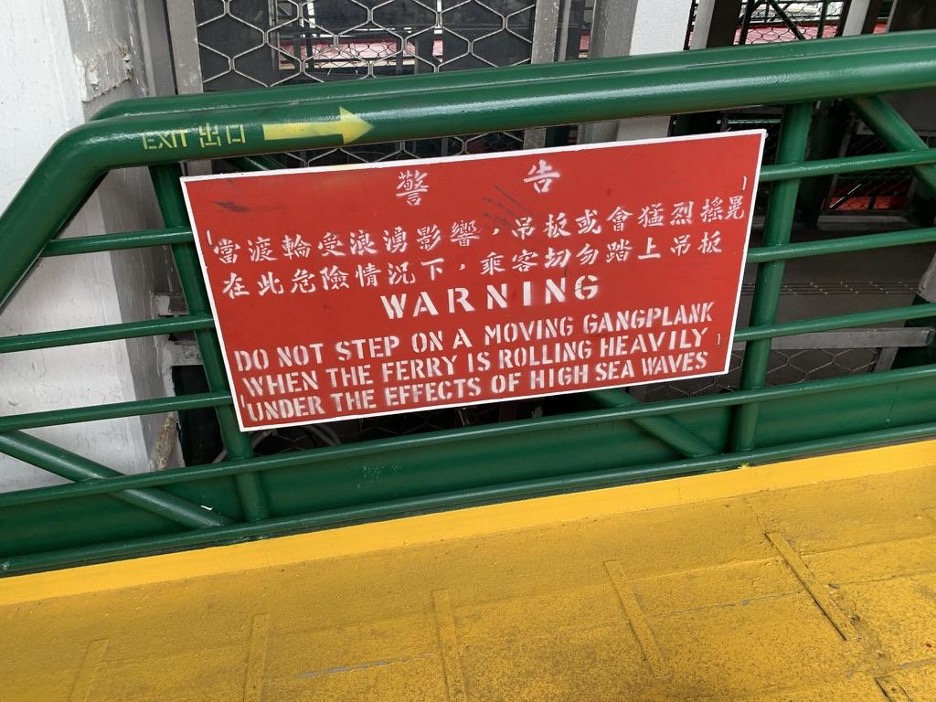
To walk through Hong Kong is to walk through a world of signs. Directions, advertisements, warnings, reminders: Hong Kong is like a fretting, frenetic brain who, in an attempt to tamp down the chaos churning on all sides, without and within, has pressed a latticework of orderly messages upon herself. Chaos contained: look left; look right; tram lane; Do not stray from the trail; Beware the effects of high seas waves; Immigration Tower >; mind the gap.
Now she rattles between chaos and order, with chaos never quite galloping free, order never quite able to block out the wild, neither ever gaining the upper hand. Hong Kong’s signs are symbols. They are the battlefields where chaos and order grapple, and they are everywhere.
Signs as
Distant Affection

All cities have signs, but back in the early 2010s, I’d never been to a city as narrated as Hong Kong. (I still haven’t.) Soon after I arrived, I began to notice signs everywhere. All that instruction felt like a great kindness, as though the city were present, always looking out for me.
Wherever I walked, I felt as though signs were guiding me towards my next destination: the library, an administrative building, a museum. As I wandered, ever distracted, I would find myself standing at a zebra crossing, looking up from a book in my hands, then glancing down at a helpful LOOK LEFT! “Thanks, Mama and Papa Hong Kong,” I’d think to myself, giddy at the silliness of it all but grateful nonetheless.
Guided, warned, made aware: I experienced these signs as distant affection. They meant that someone, somewhere, had made a decision about this spot, this crossing, this ding ding stop, this ferry gangplank, and the person who would, someday, be standing there. I was known, anticipated, welcomed. Signs felt intimate: someone, somewhere, wanted to look after me, me and all of us walking these streets together. Somebody, in that distant somewhere, extended care and empathy all the way to where we stood, in the form of a sign. Like little, innocuous gifts that both reveal and conceal profound affection, these signs hid love behind the most ordinary façades.
Signs as propaganda
at its most intimate

After I spent the late 2010s on the mainland and then moved back to Hong Kong just before the pandemic, signs took on a new, heavier meaning.
What were signs but power, filtered down to the smallest level? The hand of the northern emperor was everywhere, it seemed. In some distant place, distant decisions were made. They filtered from puppet to puppet to puppet until finally they arrived at some nameless person’s desk. This person transformed those distant decisions, now thin and watery after being filtered so many times, into signs for the street. Not just for a street, but for this street: Tonnochy Road, the Cheung Chau ferry terminal, the walkways along the harbour. Those distant decisions made by the powerful eventually became directives tailored to this street corner, controlling this intersection, pinned to the trees in this neighbourhood. Controlling me, here, in this moment. Signs were propaganda at its most intimate. Behind even the most banal sign, a line stretched and looped and wandered all the way from the provinces to the pulsing heart of power.
Writers, like Alice, are always tumbling into rabbit holes. As I was researching Hong Kong’s islands for another project, I learned about Mo To Chau, the Brothers. Two islands that were razed for the airport. After their obliteration, they were apparently declared marine park conservation zones. I never made it to those islands, so I don’t know what their signs said, but I couldn’t think of a more apt description of what I was seeing in Hong Kong as booksellers, children’s book authors and people whose only weapons were empty notes were persecuted in the name of unity. Raze us until no rebellion, no difference, no protest is possible, and then call us a park. In a simple wooden sign, the power to make and unmake.
Imagining the Words
Behind the Signs

In those wandering years, I felt stuck in the vast space between affection and power. Were signs there to look after us, to guide us, to care for us? Or were they symbols of power, forever insecure, keeping us sheep from straying even slightly, because who can tell where a sheep might go when it sees that straying is possible? To find, in wandering, wonder?
Chaos and order wrestled within me. I couldn’t find an answer. Unlike Hong Kong, I couldn’t press a latticework of order down into myself, but I could walk through hers. And as I meandered amid all the messages, chaos bristling beneath smooth metal and paint, I began to imagine the words behind the signs. A heliport notice muzzled the numinous into the obedient ordinary. A conservation zone became an epitaph. A battered lifebuoy hid the face of God. Ferry warnings became power at its most evasive and accusatory, and a message of love so profound it could bring all the islands and the seas to tears.
In one of the fascinating accidents of English, a wild language pretending, unsuccessfully, to be organised, “sign” can mean both a visual display of information and a portentous omen, an ominous symbol. A lovely inheritance the word has. Because signs are all these things at once. Propaganda, power unsheathed. Affection and care for the lonely and the stranger. Pointing towards a destination, towards undesirable futures, towards safety, towards home.
I hope you find joy in the signs and poems paired in this series. Even more than that, I hope that, the next time you wander through your orderly, wild streets, you’ll see the words behind the words.
How to cite: Przybyla, Alex. “Crafting the Hong Kong Signs Series.” Cha: An Asian Literary Journal, 4 Nov. 2026, chajournal.com/2026/11/04/crafting-hong-kong-signs.


Alex Przybyla is a poet, writer, and translator currently based in Los Angeles. He spent ten years in the furniture industry in Shanghai and Hong Kong, where he called first Wan Chai and then Luk Tei Tong home. The poems in “The Hong Kong Signs Series”, published in Cha on 4 November 2026, were written mostly on ferries or ding-dings. Przybyla‘s writing has appeared in Reactor Magazine, The Bangalore Review, California Quarterly, Eunoia Review, and The Ekphrastic Review. He recently completed a master’s degree in creative writing at Harvard Extension School. [All contributions by Alex Przybyla.]