
[INCIDENTAL] “Resolute Voices Across Time: Virginia Woolf, Eileen Chang, and Chow Hang-tung” by Patrick Poon


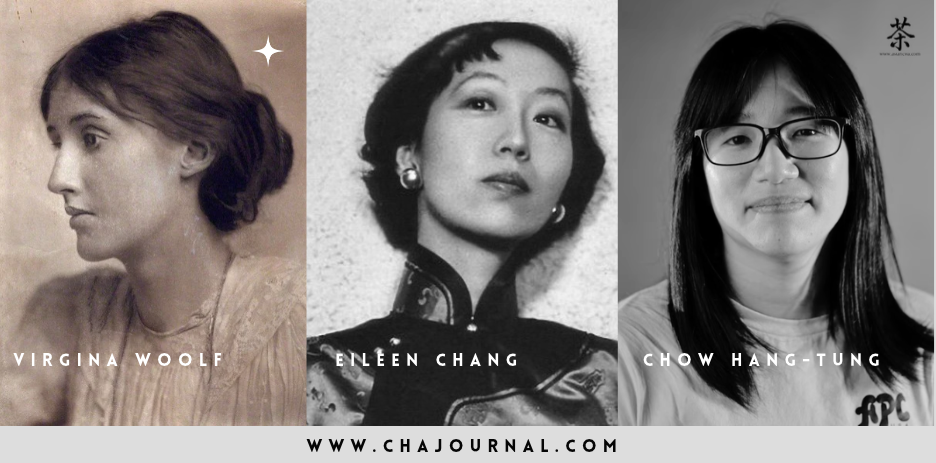
Few would think to place the British writer Virginia Woolf, the Chinese writer Eileen Chang, and Chow Hang-tung, the Hong Kong barrister and Vice-Chairperson of the Hong Kong Alliance in Support of Patriotic Democratic Movements of China, side by side. Yet I believe the values each of them pursued throughout her life are ones they hold in common.
Virginia Woolf voiced her concern for women’s rights through her letters and other literary works. Eileen Chang projected her imaginings of love onto her fiction. Chow Hang-tung communicates with the public from afar through her prison letters, shared via a Facebook page and a Patreon account managed by her friends, in which she articulates her pursuit of democracy and human rights.
❧
Woolf’s seminal work Mrs Dalloway, published in 1925, caused a considerable stir in the literary world with its stream-of-consciousness technique. Through its party-loving protagonist, the novel portrays the roles society assigned to women, as well as their subtle forms of resistance. It reflects how, in the aftermath of the First World War, the gender stereotypes and expectations of the old order remained unchanged, and how the trauma of war prompted an exploration of mental illness and depression.
Eileen Chang’s own life was no less remarkable. Her relationship with Hu Lancheng, marked by bold passion in both love and resentment, became the stuff of legend against the backdrop of a turbulent age of war, surging nationalist sentiment, resistance to foreign aggressors and chaotic contests over culture. Many literary critics believe that the classic characters in her writing were in fact self-portraits, steeped in the sorrow and helplessness of meetings and partings. Although she came from a distinguished family, she possessed a strong personality and an independent mind. Rooted in Hong Kong and Shanghai, two metropolises where Chinese and Western cultures mingled, her works vividly reflected the turmoil wrought by the Imperial Japanese Army’s invasion of China and other countries during the Second World War, while remaining rich in the flavour of their time. Some critics regard her as having expressed anti-communist views, while others maintain that her political stance was less clear-cut.
Chow Hang-tung has lived through the seemingly peaceful late twentieth and early twenty-first centuries, in a Chinese society free of war, yet in a momentous era in which the Chinese Communist Party’s authoritarian rule wears an outward appearance of prosperity. A top graduate of Cambridge University, she made choices that baffled those who judge solely by practical gain: she abandoned her doctoral studies in geophysics, returned to Hong Kong to work for a labour NGO, studied law while employed, became a barrister handling human rights cases, and later became actively involved in the Hong Kong Alliance. She confronted the realities of post-colonial Hong Kong, a city that had once enjoyed freedom of speech. As a highly educated woman, she has proved more independent than the women of Woolf’s or Chang’s eras, and less constrained by society’s prevailing expectations and views of women.
❧
Woolf lived through the late Victorian and Edwardian periods, spanning the end of the nineteenth century and the beginning of the twentieth, when Britain, the United States and the European powers held colonies across the globe even as some of those colonies were gradually gaining independence, and when society was pervaded by inequality and unjust distribution. It was in this context that Woolf expressed her concern for women’s rights through her works and other writings. Chang’s era was one in which Chinese society had only just come under the influence of Western culture. Chow, by contrast, lives in an age in which one might reasonably expect ideas and political systems to have advanced considerably, and women’s voices and rights to have been transformed since the Britain of over a century ago or the Chinese society of several decades past. Yet although all three studied at or graduated from prestigious universities, at a time when women could attain a high level of education, and although Woolf and Chang became renowned writers, their literary standing failed to win their ideas due respect in a cultural sphere still dominated by men. Chow rose to prominence as Vice-Chairperson of the Hong Kong Alliance, yet for exercising her freedoms of speech and assembly she was prosecuted under the so-called “National Security Law”, a draconian piece of legislation. Judging from the court’s attitude towards her, neither her eloquent statements in court nor the articles she wrote online for the public were taken seriously.
❧
All three were products of their times. Each held fast to her own ideals and convictions, yet the times in which they lived overlooked what they sought.
How to cite: Poon, Patrick. “Resolute Voices Across Time: Virginia Woolf, Eileen Chang, and Chow Hang-tung.” Cha: An Asian Literary Journal, 26 Oct. 2026. chajournal.com/2026/10/26/three-women-writers.


Patrick Poon was a court reporter for the South China Morning Post in Hong Kong (2000 to 2003) and a China researcher at Amnesty International (2013 to 2020). He served as executive secretary and board member of the Independent Chinese PEN Center (2009 to 2013). He was a visiting scholar at the University of St Andrews and a visiting researcher at Meiji University and the University of Tokyo. He is a board member of the Tokyo-based Asian Lawyers Network and East Asia Lead at the New Zealand-based Human Rights Measurement Initiative. He holds a BA in Literature in English and Comparative Literature from the University of Hong Kong, an MSSc in Law and Public Affairs from the Chinese University of Hong Kong, and a Postgraduate Diploma in Journalism Studies from the University of Sheffield.