
[ESSAY] “Spongeboy” by Kin Pan

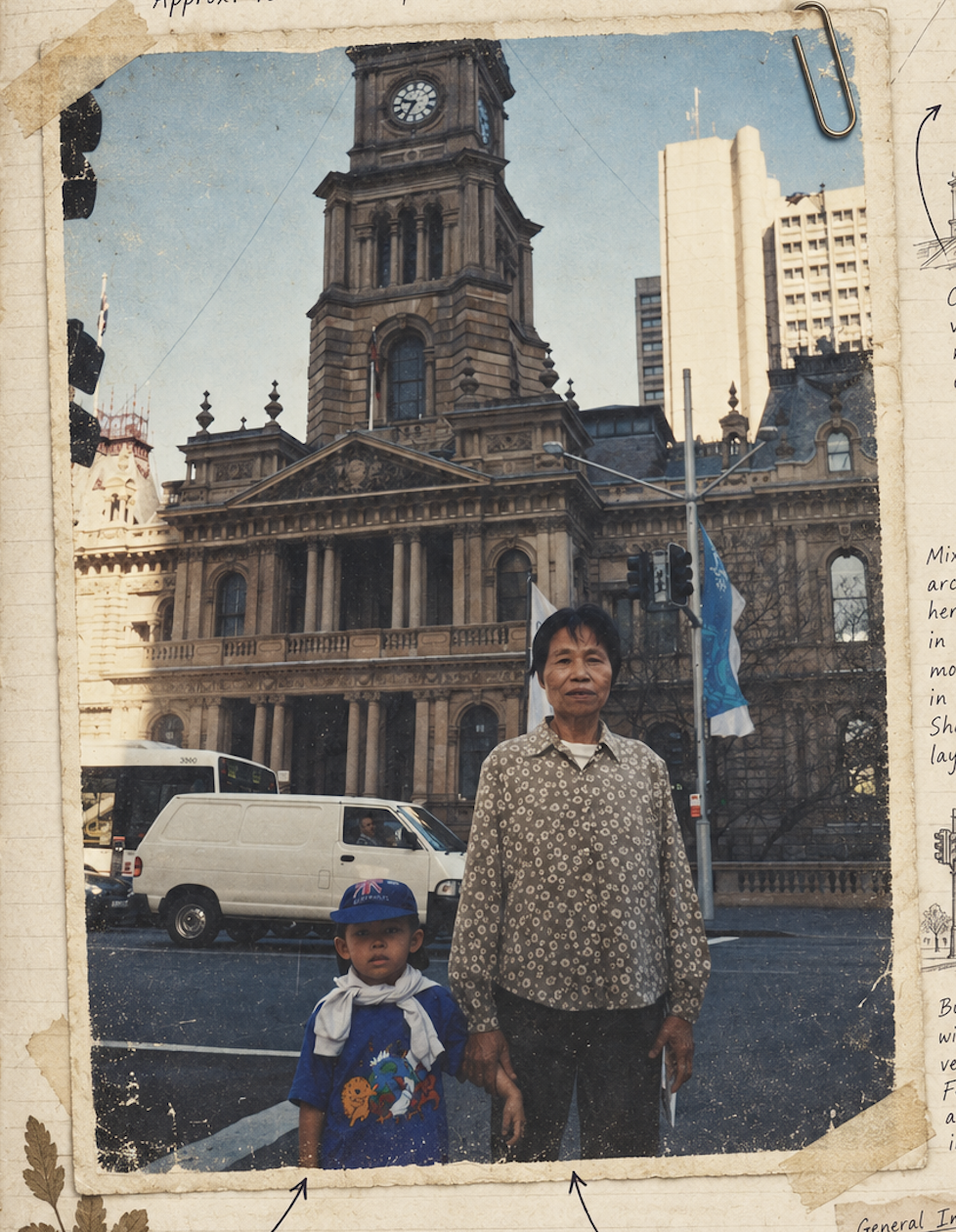
The author with his grandmother outside Sydney Town Hall in the Olympic year, 2000.

Her Cantonese isn’t the melodic speech of a Hong Kong film.
In my first Mandarin class, the teacher asks why each of us is here.
I like Chinese food.
I want to go to China.
My partner is Chinese.
When it’s my turn, I consider repeating each of these reasons. But I don’t want to draw attention to myself. So instead, I simply say that I am Chinese.
The teacher seems surprised by my answer. Your dad and mum are Chinese?
I nod, wondering if I’m in the wrong room.
❧
Two years later, I’m late for my weekly class. I’m always late, scrambling to finish my homework before heading into university.
When I walk into the classroom, there’s a woman sitting in my usual spot. The teacher explains that she isn’t a new classmate but a Chinese student from Oxford, observing us for her research into translanguaging. I nod and move to the opposite side of the room.
So we finally have another Chinese student in our class. I glance across at her, wondering if she’s noticed. But the researcher doesn’t look back. She’s fiddling with her audio recorder. I lower my eyes to my phone and, under the shadow of my desk, search for “translanguaging”.
When the class ends, the researcher hands each of us a sheet of paper. It’s blank except for the outline of a person holding up their right hand, as if waving.
Complete this language portrait by mapping the languages you know onto the body. You can use whatever colours or methods you like. There is no right or wrong way, but you must do it by yourself.
Even more homework for this week.
❧
After primary school, Grandma picks me up. My parents are always working.
I hand her my backpack and then charge ahead. I don’t want to walk with her. On those journeys home from school, twenty minutes in the Sydney sun, my skin browns.
At home, I make my younger sisters play cricket with me in the backyard. I terrorise them with fast balls, but use a spongy orange ball so they don’t bruise. I don’t stay in my room because I share it with Grandma. She’s always napping there, muttering to herself. I cover my ears, even though I don’t know what she’s saying.
Grandma barges across the pitch as I’m bowling. You can eat now, she yells. Her Cantonese isn’t the melodic speech of a Hong Kong film. It’s the coarse Cantonese of a Guangzhou dockworker. I follow her back into the kitchen. Fried rice again.
I don’t want to eat it. It’s always too oily.
Eat it, eat it!
I don’t want to eat it.
You’re hurting me. Why did I come to Australia? Eat it, eat it!
I don’t know what you’re saying. I can’t understand Cantonese.
But eventually I eat it, not because I want to, but because I’m hungry. Then I rush out of the kitchen and Grandma returns to her garden.
❧
In Sydney, Grandma grows 丝瓜, silk melon, in the backyard. When a silk melon is ripe, she uses kitchen scissors to cut through its bright green vine. Then she lays the melon in a flimsy plastic tray, leaving it outside. The sun is unrelenting in the western suburbs of Sydney. We are far from the coast. When the mercury hits 40°C, some of our plants will die. We cannot stop it.
The weather is perfect for Grandma’s silk melons. She’s growing them not to eat, but to harvest. When a melon’s green, veiny skin has browned, she brings it over to her red IKEA stool. There she hooks her fingers, tanned, wrinkled and thick, under the brown skin, peeling back the flakes to reveal a pale yellow membrane inside.
The membrane is a sponge, but not dense like a sea sponge or the supermarket variety. It’s a coarse lattice of fibres, shaped into a loose weave by the discarded shell. It’s the kind of sponge you might use for a gentle bath. But we don’t have a bathtub. In this house, this membrane is plunged not into a salted bath, but into the grime of a kitchen basin.
❧
At weekends, I don’t eat Grandma’s cooking. Mum is home, frying steak and seasoning it with herbs from a jar. Grandma won’t eat steak. It’s too tough. She cooks her own meal: some mushy vegetables from the garden, boiled down into a pulp and layered over rice, soaking it into a kind of congee.
When Mum is finished, she calls for us. My sisters and I charge into the dining room. Grandma is already there, eating her congee and muttering to herself again. 西餐, 西餐, 西餐就出来了. Western food, Western food, for Western food you’ll come out.
I can’t argue with her. My Cantonese isn’t good enough. So I furrow my brow and start cutting up my steak. When I lift the fork to my mouth, I notice that Grandma’s watching me, laughing through her chopsticks.
After dinner, I take my plate to the basin to wash up. Grandma’s already there. I don’t like waiting, so I offer to wash her dishes too, but she won’t let me. She counters by insisting on washing my plate as well. When I refuse, she pleads that I should be doing homework, not cleaning. Let me help you wash, let me work out my fingers, let me 劳动. I say no again. My hands can do their own scrubbing.
Grandma turns back to the basin and mutters to herself. I should go back to China. Why did your dad bring me to Australia? She roughly rubs this yellow membrane, this sponge I’ve never seen in any other home. It swallows the oils and scraps from the dishes in the basin. Then Grandma wrings the soapy water out of the sponge and hangs it up to dry.
Grandma doesn’t know how to work the dishwasher. In this house, her fingers scrub, scrub, scrub. And I stand behind her, watching and waiting.
❧
I’m looking at my skin. If I press it, it turns faintly yellow. It reminds me of that smoky sunlight in Guangzhou, where I was born. I don’t remember those early moments, but Mum has shown me the grainy film photographs that prove I was there. I reach for a yellow pencil and fill in the body on the page. A pale yellow for Cantonese, the language of that city.
Next is English, the language of my second home, Sydney. I soak the yellow figure in an ocean of water. It’s everywhere, seeping into the body. Was the figure’s raised right hand deceiving me? He’s not waving any more. He’s swimming. No, he’s drowning.
When I look closer, I see that he’s made not of skin and flesh, but of sponge. He was born of dirt and sun in that overworked, cramped garden. He belongs to that garden, not this kitchen basin. He’s saturated. He can’t keep the water out.
I try to help by drawing a swirl of yellow in the corner of the page for Mandarin. It’s a deeper yellow than Cantonese. Not the smoky sun of Mum’s grainy film photographs, but the harsh afternoon sun that cuts across my classroom, casting a glare across the whiteboard. Then I draw a green vine, weaving it through the waves towards the yellow body.
Hold on, hold on.
❧
My arm trembles as I grip the green vine with my right hand.
As the sun shines through the window, water starts to drip from my body. With each drop, I feel lighter. My arm shakes a little less. I look down at my body, twisting it so I drip faster. But when I look down, I notice that the basin is plugged and the drops aren’t draining away. They’re pooling together. Now they’re an ocean, watching and waiting.
I don’t want to go back. Grandma, can you unplug the drain? I can’t reach from here.
She’s heard me. She’s coming over. But why is she holding scissors?
Please don’t cut the vine. I’m not ready, I’m not ready.
But in Grandma’s kitchen, there is always more scrubbing.
❧
The following week, the researcher interviews me about my language portrait. When I hold up my drawing, she leans closer. This looks interesting. Can you please explain it?
I look at myself. I’m drowning, but I cannot drown.
But, of course, I don’t tell her that.
How to cite: Pan, Kin. “Spongeboy.” Cha: An Asian Literary Journal, 26 Oct. 2026, chajournal.com/2026/10/26/spongeboy.


Kin Pan is a London-based writer and lawyer. Born in Guangzhou and raised in Sydney, he explores in his writing how questions of place, memory and identity surface in ordinary moments. His work has appeared in DADDY Magazine, and more of his writing can be found at kinpan.substack.com.