
茶 FIRST IMPRESSIONS
茶 REVIEW OF BOOKS & FILMS
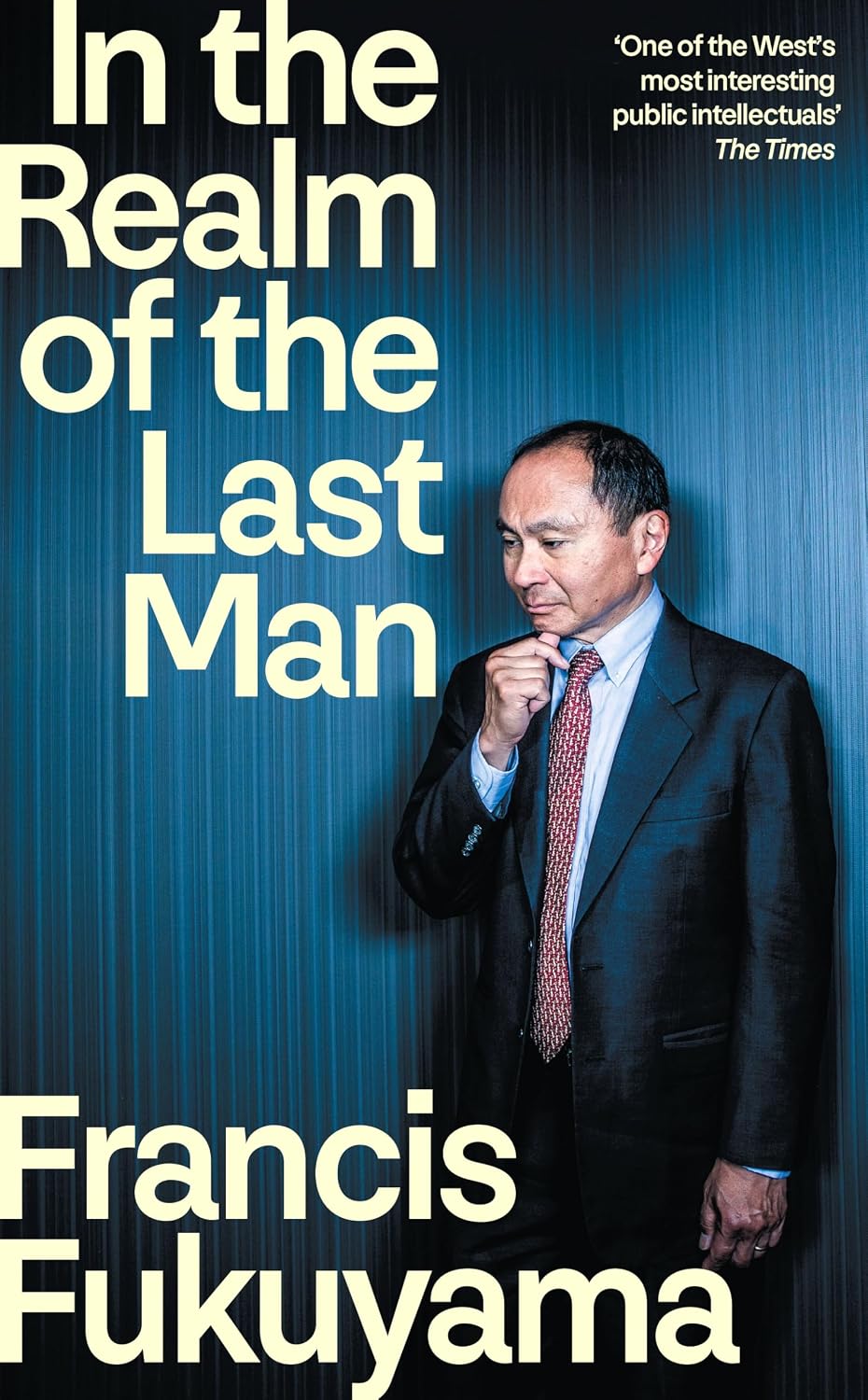
[REVIEW] “Between Hegel and Home: Reading Fukuyama’s In the Realm of the Last Man” by Raymond Pun
Francis Fukuyama. In the Realm of the Last Man: A Memoir, Farrar, Straus and Giroux, 2026. 304 pgs.


In 1989, Francis Fukuyama’s thought-provoking essay “The End of History?”, published in The National Interest, garnered international attention for its controversial claim that the triumph of liberal democracy marked humanity’s ideological zenith as the Soviet Union fell, thereby “ending” the Cold War. Fukuyama argued that the “end of history”, a term borrowed from philosophers such as G. W. F. Hegel and Alexandre Kojève, signified not the end of events but rather the emergence of liberal democracy and market capitalism as the final, unrivalled form of human government. According to Google Scholar’s citation metrics, the essay has, as of 2026, been cited in more than 45,000 publications, a testament to its influence on the evolution of political thought, political systems, and international relations since 1989.
Fukuyama, the Olivier Nomellini Senior Fellow in International Studies at the Freeman Spogli Institute for International Studies and Professor, by courtesy, of Political Science at Stanford University, as well as the author of numerous articles and books on political theory and international relations, revisits this essay, along with other major works, in his latest book, In the Realm of the Last Man: A Memoir (2026), published by Farrar, Straus and Giroux. The memoir offers an intimate account of Fukuyama’s thoughts and intellectual reflections, tracing his academic formation and influences, his career, his ideological evolution, and his hobbies, which include building computers, woodworking, and photography.

Those familiar with his earlier works, such as The End of History and the Last Man (1992) and Political Order and Political Decay (2014), will appreciate this behind-the-scenes view of how his ideas were shaped and reshaped by a multitude of thinkers and debates. In each chapter, Fukuyama offers candid opinions on a wide array of subjects, from economics and French social theory and its theorists to Latin America, artificial intelligence, Donald J. Trump, China, and the philosophers of ancient Greece: far too many to cover in a brief review.
On economics, Fukuyama takes issue with the discipline’s practitioners on two counts:
… the first is that in their search for methodological rigour, they fail to address some of the most important questions, and fail to appreciate the importance of other approaches to knowledge. And the second is that their underlying model of human behaviour is woefully limited.
Nor does he hold back on comparative literature, the field in which he first pursued a doctorate at Yale University. He eventually withdrew from the programme, and from the field altogether, having grown disillusioned with the postmodernism expounded in the seminars and lectures of Roland Barthes and Jacques Derrida. Fukuyama reflects:
These French intellectuals were playing with dangerous ideas at a moment when the Cold War struggle between liberal democracy and Communism was deepening. My father dismissed the kind of hyperintellectualized realm I had entered as “intellectual masturbation,” and I began to see his point. (p. 72)
He subsequently transferred to Harvard University’s Government Department, despite never having taken a political science course, and never looked back.
❧
Among the memoir’s most fascinating passages are those devoted to Fukuyama’s family: their experience as Japanese Americans, his strained relationship with his father, his appreciation of his uncle, and his ties to other relatives. His father’s family, like so many Japanese and Japanese American families at the time, was sent to incarceration camps in the 1940s under Executive Order 9066. His father, Yoshio Fukuyama, and his aunt Kiku avoided the camps by securing academic scholarships to Doane College in Nebraska. Fukuyama reflects:
I will eternally be grateful to these small liberal arts colleges that reached out to help Japanese internees in this period and would make similar gestures to Arab Americans after September 11. (p. 11)
Of his uncle, he reveals:
I felt sorry for Uncle Hiroo over the years: though he and my father were fraternal twins, my father was always treated as the eldest son by their parents, a traditional role in Japanese families. My father was taller, did better in school, and went on to get a PhD and become a successful academic. My uncle Hiroo, by contrast, worked as a buyer for the army after leaving service, then started a travel business and went into other, not terribly successful ventures. (p. 55)
Fukuyama also writes about his uncle’s letters to Soong Ching-ling (Madame Sun Yat-sen, honorary president of the People’s Republic of China), hinting at a possible romantic relationship between them, and portrays his uncle as an active participant in geopolitical struggles of which no one was aware. His father, an American theologian, academic, pacifist, and “die-hard liberal”, could not understand why his son, influenced by the philosophers Allan Bloom and Leo Strauss, turned conservative after graduating from Cornell University; indeed, Yoshio believed his son had been brainwashed. Fukuyama acknowledges this tense relationship, reflecting:
My views have, in any event, ended up much more aligned with his as I’ve gotten older. I nonetheless regret the fact that he never gave me credit for being able to think for myself. (p. 24)
❧
Fukuyama’s political shift came in 2003 with the invasion of Iraq, which he calls “a huge waste of human lives and incubator of human suffering” (p. 139). He broke with the neoconservatives in a critique of the war written for The New York Times and in his subsequent book, America at the Crossroads: Democracy, Power, and the Neoconservative Legacy (2006). He describes feeling liberated to think critically about other areas of policy, though the episode also taught him a painful lesson:
What you think and believe is so much more the contingent product of your individual psychology (your social circle, your friends, and the environment you happen to be embedded in) than rational thought process digesting empirical information. Social rationality may appear in the long run, but we can go through prolonged periods when it is entirely missing. (p. 150)
His reflections on higher education and the academic curriculum in chapter six, “The Best Way to Live”, reveal his ire towards today’s liberal arts education, which, he contends, has been shaped by progressive identity politics and has marginalised “Western values”. As he cites no sources, however, it is unclear which institutions he has in mind. Fukuyama states:
To dismiss Plato and Aristotle as “white males” and replace them on the required reading list with the Guatemalan indigenous activist Rigoberta Menchu is to deprive students of what might be a transformative moment in their education. (p. 40)
Beyond the absence of sources, Fukuyama misses an opportunity to reflect on the relationship between his own positionality and his access to education: the advantages he enjoyed over many students in owning and critically reading texts and in having college-educated family members, and how these experiences shaped both his upbringing and his approach to political discourse. There is, moreover, merit in understanding overlooked figures such as Menchú and their role in shaping justice in Guatemala; her influence may not equal that of Plato or Aristotle, but much can be gained from understanding Indigenous activism, knowledge, and engagement in a world dominated by Western values and traditions.
❧
Spanning 304 pages, In the Realm of the Last Man: A Memoir is generous in its references to figures from the worlds of politics and academia, reflecting Fukuyama’s deep gratitude to those who influenced and shaped his life in various ways. Readers wishing to explore a particular theme will be delighted by the index, as well as by Fukuyama’s own annotated bibliography of selected texts; the index is an especially welcome inclusion at a time when publishers increasingly omit indices to reduce costs. Anyone interested in a political theorist’s journey will find this memoir engaging and thought-provoking, as Fukuyama confronts his own political misgivings and offers searching critiques of the illiberal democracy and populism that have taken hold around the world.
How to cite: Pun, Raymond. “Between Hegel and Home: Reading Fukuyama’s In the Realm of the Last Man.” Cha: An Asian Literary Journal, 25 Oct. 2026, chajournal.com/2026/10/25/last-man.


Raymond Pun is an education librarian based in the United States. His writing and reviews have appeared in The Huffington Post, The Immigration and Ethnic History Society’s Blog, The Library Journal, and Booklist. Pun holds an Ed.D. from Fresno State, a Master of Library Science from CUNY Queens College, and an MA in East Asian Studies and a BA in History from St. John’s University. [All contributions by Raymond Pun.]