
茶 FIRST IMPRESSIONS
茶 REVIEW OF BOOKS & FILMS
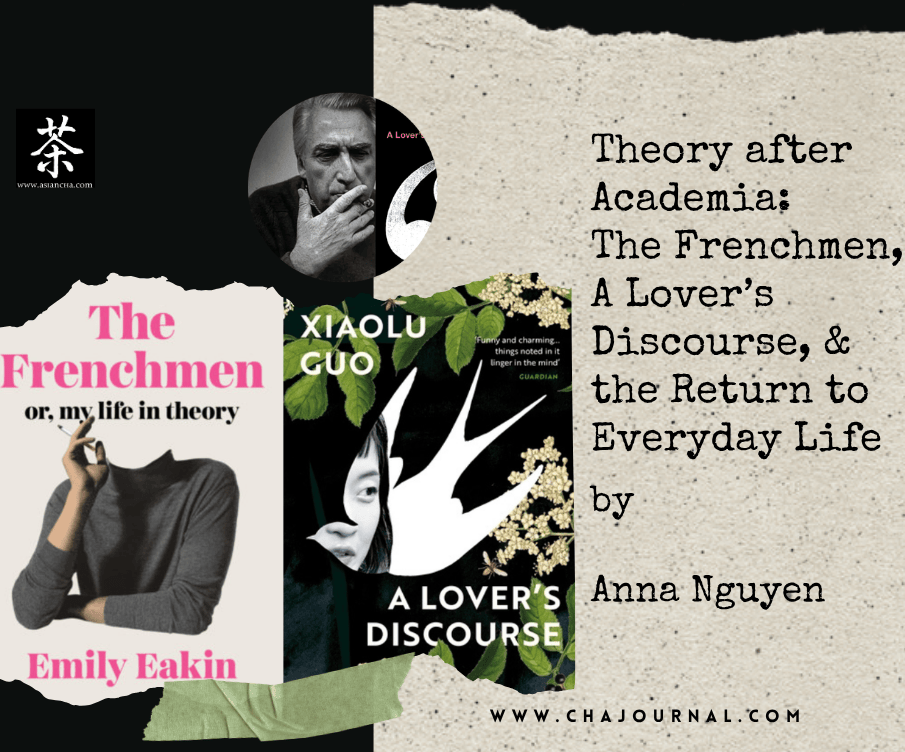
[REVIEW] “Theory after Academia: The Frenchmen, A Lover’s Discourse, and the Return to Everyday Life” by Anna Nguyen
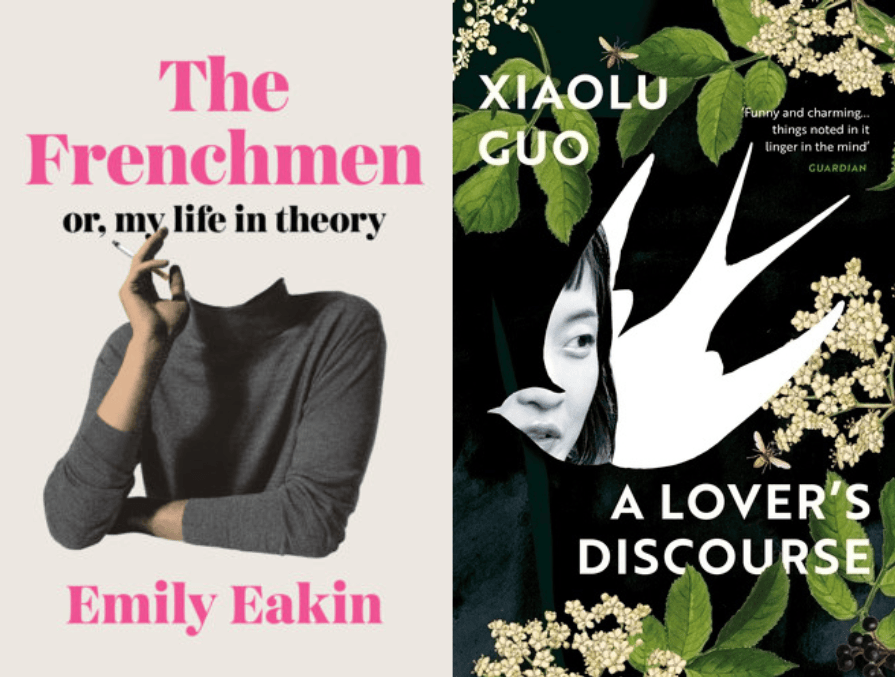
❀ Emily Eakin. The Frenchmen: Or, My Life in Theory. Penguin, 2026. 496 pgs.
❀ Xiaolu Guo. A Lover’s Discourse. Vintage, 2020. 288 pgs.
There is something familiar in Emily Eakin’s personal stories and her attachment to theory, both of which she documents in The Frenchmen: Or, My Life in Theory. She portrays herself as an impressionable student at Harvard in the 1980s, seduced by French theory “at the height of America’s theory craze” (p. 3). Eakin’s Bildungsroman unfolds in small waves, its pages filled with intellectual history and gossip about canonical French theorists. Yet the more revealing passages emerge from her description of herself as a recovering theorist.
Towards the end of the book, after documenting Derrida’s death and the Times tribute-obituary, Eakin reveals that she had dropped out of her PhD programme in English at Columbia. She “had come across a study detailing how few essays in humanities journals were ever cited by another scholar, or by anyone at all”.
“In sum, the vast majority of scholarly writings in my field went unread; they were effectively dead” (p. 377), she writes. She also worried about the scarcity of jobs available to the many soon-to-be PhD holders.
More than this, she was suffering from theory fatigue. She repeatedly received comments on her term papers suggesting that, although she could cite theory and universalise its generalities, she did not bring enough of her own voice into her formal writing. Recalling another conversation with a peer, Eakin asked which authors and literary period she was studying. Her peer laughed and replied, “I don’t read books. I just do theory” (p. 381). These two simple sentences convinced Eakin that “theory had become a dangerous substance to me, too abstract, too all-consuming, too removed from everyday life, too removed from lived experience” (p. 381).
)
Theory can both narrow and universalise, depending on those who cite it.
In the ever-resonant essay “Notes of a Barnard Dropout”, June Jordan expressed the hope that the college would help her forge “the connection between the apparently unrelated worlds of white and Black, or that this college would enable me to make the connection for myself” (p. 98). She remembers that a year of sociology proved useful, giving her a language through which to see the world. Yet “nothing at Barnard, and no one at Barnard, ever, once, formulated, and expressed, the necessity, the political necessity, if you will, for the knowledge they required you to absorb” (p. 100).
I am reminded of Jordan’s essay and her political praxis while reading The Frenchmen. Jordan understands that theory is yet another language, albeit a specialised and dense one, that can help us perceive a particular version of the world. Theory is not fact. It is a descriptive and interpretative language. Yet, as with all problems of language, theory can both narrow and universalise, depending on those who cite it.
)
Theory is not confined to the university, nor has it ever been. There are certainly gatekeepers, but they are the ones committed to preserving the binary between the personal and the political, and between the personal and the academic. Nor is it uncommon for a novel to employ theory, an admission Eakin makes in her epilogue. Xiaolu Guo’s A Lover’s Discourse takes obvious inspiration from Roland Barthes’s A Lover’s Discourse: Fragments. Guo’s homage takes the form of fiction, perhaps autofiction, although she eschews conventional narrative and plot in favour of fragments and vignettes.

These fragments reveal the unnamed narrator’s move from Beijing to London. After receiving her MA in sociology and filmmaking, she decides that she does not want to work in an office or remain in China. She “read a biography of the American anthropologist Margaret Mead, and decided to study visual anthropology in the West” (p. 7). Already, there is a certain cheekiness in the novel’s indebtedness to Barthes. Like Barthes, she is preoccupied with the image-repertoire. Like Barthes, she attempts to understand the banality of language. And, like Barthes, she examines love in all its anxieties, gestures, and inarticulacies.
A meta-discussion of Barthes’s own work also humorously reveals the narrator’s epistemic limitations. Her long-term partner, an Australian-German living in England, tells her that Barthes was a queer man, a fact that baffles the narrator, who had read A Lover’s Discourse: Fragments as an account of a heterosexual relationship. She realises that she knows nothing about his emotional and personal life, another reference to the Barthesian concept of the death of the author.
Most poignant, however, is the political perspective of Guo’s work. A Lover’s Discourse begins with the narrator’s arrival in Britain in December 2015, six months before the referendum. She admits that she is unfamiliar with the term “referendum” because “in China we never had such an experience. I had never voted, because we were never asked to vote”. Yet, politics aside, the narrator says that she has brought too many unanswered questions with her. What unfolds is her interpretation of Western frameworks and legal terminology as a Chinese resident, someone who can read the language but may not understand it within its sociohistorical and cultural contexts.
Like so many hopeful PhD students, the narrator originally believed that “doing a PhD was a way of finding a place in the real world, with a set of ‘specialist’ vocabularies and methods” (p. 57). Yet she finds herself disengaged from her seminars and uninterested in speaking to her supervisor. She realises that “perhaps I didn’t find anything real in that environment. For me, the conflicts and discussions worth being part of were coming from the everyday world, not from academia” (p. 57). Lectures disconnect her from the everyday, echoing Eakin’s own realisation.
)
She laments that, although she speaks Chinese and English, she is unable to possess either.
Like Guo’s narrator, Eakin cites A Lover’s Discourse: Fragments as a text to which she retains a sentimental attachment (p. 230). But an attachment to theory, as campus novels and despairing academic essays repeatedly reveal, is not enough. The narrators of these stories, fictional or otherwise, invariably leave academia, with or without a degree.
“What we cannot hope to do is have the last word” is Eakin’s final sentence. The line encapsulates her book particularly well because it captures the discursive character of the theorists she examines. The stories are filled with one Frenchman responding to another through letters, academic essays, and frequently cited monographs. Perhaps the question of what we want from theory is less interesting than the question of what accountability we demand from it. Academia requires theory as a form of discursive power that professors can hold over students. If theory remains confined within the university, perhaps this is because those within it have helped to maintain the barrier separating it from the world outside.
Similarly, Guo’s narrator is shaped by her migration between languages. She laments that, although she speaks Chinese and English, she is unable to possess either. “Language had existed before me and would continue after me” (p. 167), she observes. But must we aim to possess language? And in thinking about the great Frenchmen Eakin cites, one wonders whose voices continue to be cited and overcited, and whose remain in the shadows as the other.
Bibliography
▚ Jordan, June. “Notes of a Barnard Dropout”. Civil Wars: Observations from the Front Lines of America. Touchstone, 1995, pp. 96-102.
How to cite: Nguyen, Anna. “Theory after Academia: The Frenchmen, A Lover’s Discourse, and the Return to Everyday Life.” Cha: An Asian Literary Journal, 4 Sept. 2026, chajournal.com/2026/09/04/theory.

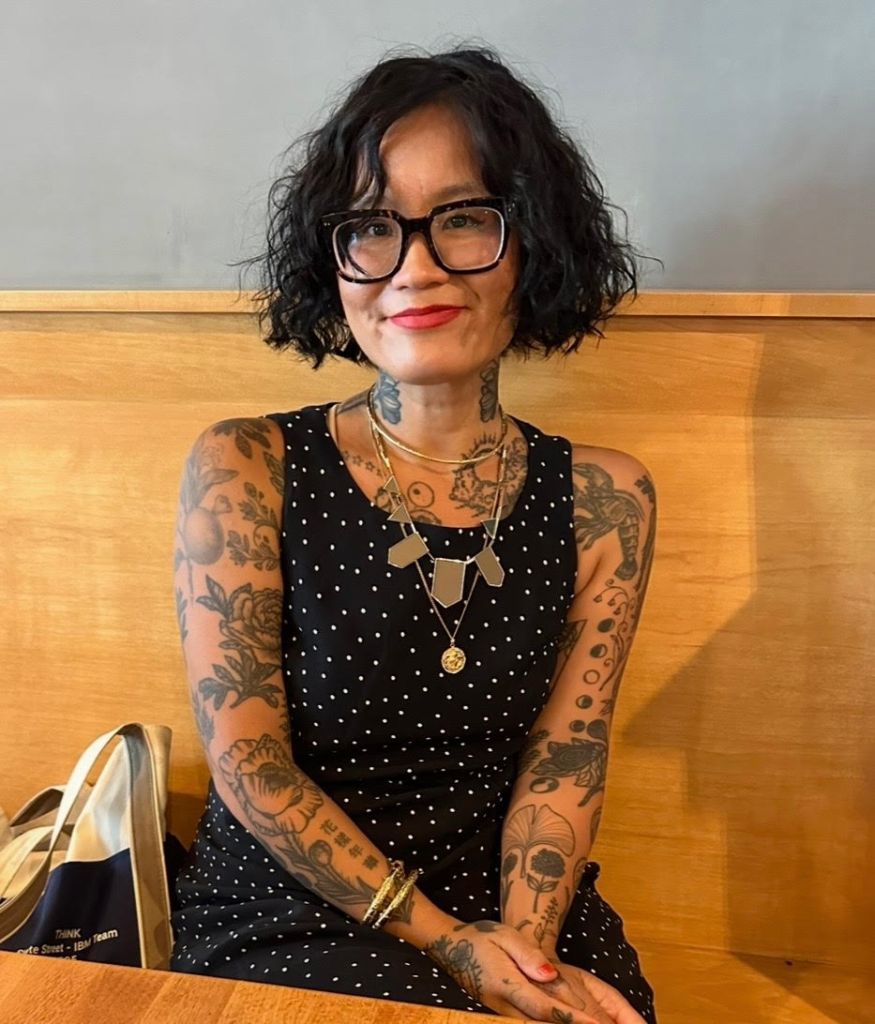
Anna Nguyen left her PhD programme and reworked her dissertation into a work of creative non-fiction while studying for an MFA at Stonecoast, University of Southern Maine. Her work brings together literary analysis, science and technology studies, and social theory to examine institutions, language, expertise, citation practices, and food. She is currently undertaking a second MFA in poetry at New England College, where she also teaches first-year composition. She is the host of the podcast Critical Literary Consumption. [All contributions by Anna Nguyen.]
 Cha
Cha 