
茶 FIRST IMPRESSIONS
茶 REVIEW OF BOOKS & FILMS
[FIRST IMPRESSIONS] “Body Part 520: Crime and Tragic Romance in Herman Yau’s We’re Nothing at All” by Jennifer Eagleton
Click HERE to read all entries in Cha
on We’re Nothing at All.
Herman Yau (director). We’re Nothing at All, 2026. 128 min.


On St Valentine’s Day, a double-decker bus is making its way down a street in Hong Kong. Suddenly, it explodes. Is this a tragic accident or an act of terrorism? Lung, a forensic investigator, is called out of retirement to answer the question of why.
From inspecting the victims’ charred bodies (trigger warning: there is a great deal of blood and gore throughout the film) to retracing CCTV footage, Investigator Lung (played by Patrick Tam) gathers clues and notices that Body Part 520, an arm, bears an expensive watch; this becomes the segue into the story of the person who wore it. I thought this a clever way to open the film. The narrative then moves back and forth between a crime scene investigation and a tragic (gay) romance.

Patrick Tam as Investigator Lung
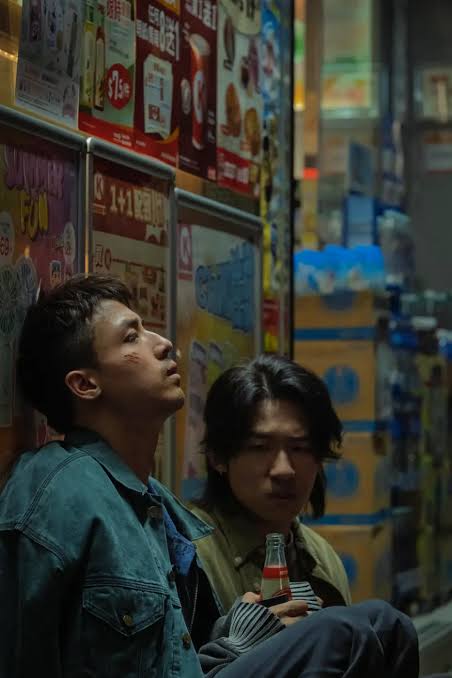
Among the dead are the lovers Fai and Ike (played by the pop stars Anson Kong and Ansonbean), two gay men who have suffered economic hardship and family rejection. Fai is a construction worker whose employer is late in paying him; the police tell him, under threat of arrest, to take the matter up with the Labour Department. He returns to his dilapidated subdivided flat, where he tries to recover money he is owed, only to be gaslighted into believing he is a nuisance for asking for it back. Ike, meanwhile, is trying to make a go of it as a street portrait artist, dreaming of drawing in Paris and selling sex on the side to make ends meet. He, too, needs money, because after he begins seeing Fai, his father throws him out of the family home on discovering that he is gay. The only good thing in Fai and Ike’s lives is that they have each other.
Clearly, the filmmaker wished to address contemporary social issues in Hong Kong, not merely the problems of a single gay relationship or homophobia in general: the very real problems of subcontractors failing to pay their workers, the lack of affordable housing and the authorities’ failure to address the difficulties of society’s grassroots. The cinematography offers a grey, gritty palette that vividly captures the dinginess and claustrophobia of the spaces the characters inhabit.
The gay characters, however, are rather archetypal: noble sex workers, traumatised victims, suicidal youths. Fai and Ike seem to be blank slates onto which various social ills are projected. I found it somewhat implausible that Ike, knowing how his father would probably react to his sexual identity, would baldly write “I like boys” on a piece of paper, thrust it under the family’s front door and expect acceptance. His father reacts as expected, and Ike storms out and moves in with Fai. I also found it odd that Ike and Fai hold hands and kiss while out and about, rather than within the safe confines of a gay club. It seems inevitable that they will be set upon by a group of men who see them doing so.
Fai also has family troubles: his father is abusive towards his mother, a drug addict. Fai reacts in a way that only compounds the couple’s problems and makes a happy ending seem ever more unlikely. After this violent act, Fai and Ike treat themselves to a lavish meal at a luxury restaurant with Ike’s remaining cash as they plan their next move. Investigator Lung appears at the restaurant, which, by coincidence, is managed by his wife. He addresses the couple, acknowledging their gay relationship, and blurts out that he is “pansexual”. Earlier in the film, Lung, whose sexuality is known to his superiors, is caught in a compromising position with a male escort, yet he remains on the case because of his exceptional skills as a crime scene investigator. I am unsure what point is being made here. Perhaps it is that exceptional talent can override what might be considered a traditional social taboo, and perhaps also that elites can get away with unconventional behaviour because of their social status.
Since nothing goes right for Fai and Ike, and there appears to be no hope, a tragic end feels inevitable. I am not giving anything away, as they obviously die in the bus explosion. I was somewhat surprised by the cause of the explosion and the reasons behind it, but needless to say, it is probably a statement that Hong Kong society needs transformation in many respects. The film foregrounds Fai and Ike’s particular story, but I also wonder what stories the other passengers on the bus might have told.
How to cite: Eagleton, Jennifer. “Body Part 520: Crime and Tragic Romance in Herman Yau’s We’re Nothing at All.” Cha: An Asian Literary Journal, 24 Oct. 2026. chajournal.com/2026/10/24/we-are-nothing.


Jennifer Eagleton, a Hong Kong resident since October 1997, is a close observer of Hong Kong society and politics. Jennifer has written for Hong Kong Free Press, Mekong Review, and Education about Asia. She has published two books on Hong Kong political discourse: Discursive Change in Hong Kong(Rowman & Littlefield, 2022) and Hong Kong’s Second Return to China, A Critical Discourse Study of the National Security Law and its Aftermath(Palgrave Macmillan, 2025). Her poetry has appeared in Voice & Verse Poetry Magazine, People, Pandemic & ####### (Verve Poetry Press, 2020), and Making Space: A Collection of Writing and Art (Cart Noodles Press, 2023). [All contributions by Jennifer Eagleton.]