
茶 FIRST IMPRESSIONS
茶 REVIEW OF BOOKS & FILMS
[ESSAY] “The Politics of Smallness and the Power of Cute in Hui Faye Xiao’s Youth Economy, Crisis, and Reinvention in Twenty-First Century China” by Géraldine Fiss
Hui Faye Xiao. Youth Economy, Crisis, and Reinvention in Twenty-First Century China: Morning Sun in the Tiny Times, Routledge, 2020. 222 pgs.


Young people in China today confront formidable challenges and contradictions. Known as the “Me Generation” because they were born under the One-Child Policy and have no siblings, they face intense pressures in uncertain, anxiety-ridden times. Yet, as this book demonstrates, youth culture in twenty-first-century China is an explosive and powerful force, rapidly bringing about cultural innovation, social change, and collective efforts by and for frequently marginalised groups.
In this important and insightful study, Hui Faye Xiao illuminates not only the difficult circumstances that this young generation of trailblazers must navigate, but also the new genres they call into being. Focusing on voices from the margins of Chinese society, including those of high-school dropouts, industrial workers, migrant labourers, and “leftover women”, as well as bestselling writers and filmmakers, cultural entrepreneurs, queer idols, and feminist activists, she shows how China’s youth culture mobilises small, transmedial genres to create “a network of small, atomized individuals” who are forging a youthful coalition of the silenced, the belittled, and the socially excluded.
The Ant Tribe and Rootless Sojourners Living in a City of Others
In her introduction, Xiao analyses youth culture in three keys: youth economy, youth crisis, and youth reinvention. These core themes chart the book’s trajectory from economic and cultural change, through the contradictions and crises experienced by young people, towards the possibility of solidarity and social renewal. Evoking the transformative power of youth (qingnian or qingchun) throughout modern Chinese history, she recalls Mao Zedong’s famous comparison of youth to the “brightness of the morning sun”, reminding us that during the Cultural Revolution it was young people who were “entrusted with the great task of building China’s future with their explosive energy and refreshing vitality of new life” (p. 2).

Young Red Guards reading Mao Zedong’s Little Red Book during the Cultural Revolution (1966-1976).
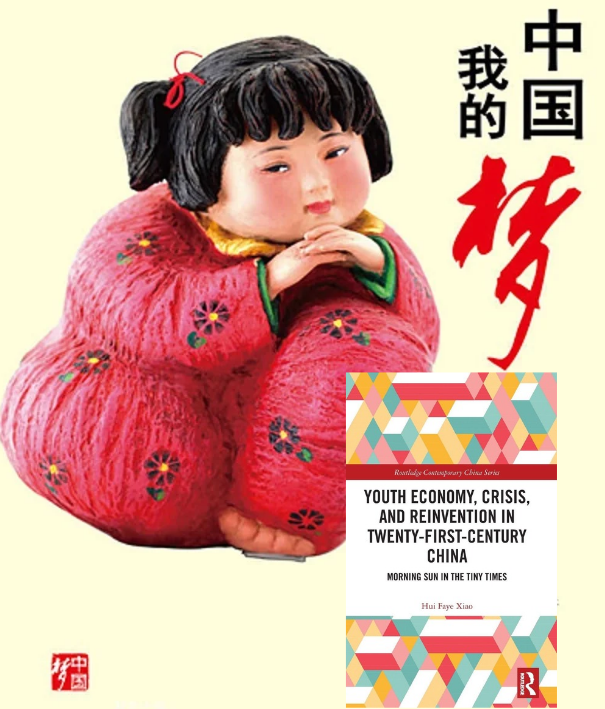
Like Mao, President Xi Jinping frequently addresses young people directly, regarding them as the driving force behind the development of the national economy and the China Dream (Zhongguo meng) initiative.

A 2023 poster entitled “The Chinese Dream, my dream”.
As this book reveals, however, the grand ideal of qingnian (youth) has become a hollow concept in today’s postsocialist China, and the day-to-day reality of countless young people is marked by broken dreams, disillusionment, social fragmentation, and alienation. Many no longer believe in the Party-prescribed ideal of national rejuvenation or in the future-oriented bildungsroman narrative of the grand China Dream discourse. Instead, millions of highly educated, degree-holding “small-town youth” from rural or lower-income backgrounds have joined the “ant tribe” (yizu) in the big cities, striving in vain for economic security amid constant anxiety, polarisation, and disorientation. In the chapter entitled “Against the proletarian modernity: retrotopic journey and precariat subject in alternative youth literature”, Xiao cites Lian Si, who coined the term in his book Ant Tribe:
“They share every similarity with ants. They live in colonies in cramped areas. They are intelligent and hardworking, yet anonymous and underpaid. [. . .] They slave at low-paying jobs or dubious unpaid internships on the conviction that things will turn around and someone will finally recognize their talent” (p. 76).

“Ant tribe” graduates in Beijing fight their way up.
Meanwhile, young migrant workers (nongmin gong), who are likewise flooding into the cities, have become a rootless precariat1 subsisting in an existential state of liminality as part of the low-income floating population. The worker-poet Zheng Xiaoqiong, widely regarded as a key voice of this disenfranchised group, describes these young people as “rootless sojourners living in a city of others”, who feel like “outsiders in their own country” (p. 16). They are at once the creators and the consumers of a youth-oriented internet culture characterised by a retrogressive vision and an escapist mood, often called the “dead end of Enlightenment” (qimeng de juejing).

China’s migrant workers are the new “precariat class”.
The China Dream versus the Defiant Energy of Small Genres
In each chapter, Xiao engages critically with the genres, forms, media, and phenomena of youth culture that emerge from this context. Her analysis affords a clearer understanding of the tensions at the heart of young people’s experiences, and of the novels, television shows, music, films, and graphic art that they both consume and create. As Xiao observes, what we witness in China today is a creative, highly networked youth economy that celebrates a new, postmodernist aesthetics of “difference, ephemerality, spectacle, fashion, and the commodification of cultural forms” (p. 11). The transmedial and multi-locale practices of this youth culture encompass light novels that are often adapted into blockbuster summer films, short videos consumed on small screens, shojo manga (girls’ comics), and other youth-oriented subcultural forms. By focusing on these “small genres”, Xiao celebrates their creativity, agency, and iconoclastic potential, which enable young people to imagine new identities, relationships, and futures.
In the chapter “Youth economy in the “China Dream”: rise of the Me-generation creative class”, she spotlights the writer-filmmaker-entrepreneurs Han Han and Guo Jingming, whose creative and entrepreneurial practice spans a wide range of “small” forms and media. One of the most revealing cultural figures of post-reform China, Han Han is a bestselling novelist who went on to become a prominent blogger, social critic, racing driver, and filmmaker. The popularity of his many works of fiction and blockbuster films complicates the assumption that commercially successful youth literature must be either political or socially superficial. The 2014 film The Continent, for instance, which Han Han wrote and directed, paints a dystopian picture of contemporary Chinese society and its lost generation of aimlessly wandering young people.

Poster for The Continent (2014), written and directed by Han Han.
Guo Jingming’s Tiny Times is a bestselling trilogy of novels, later adapted for the screen, about young people navigating friendship, romance, careers, ambition, and social competition in contemporary Shanghai. Its world is one of luxury apartments, designer clothing, fashionable workplaces, glamorous parties, and intense personal relationships. In her analysis of this text, Xiao argues that Guo presents an “affective map of Shanghai” that renders a fragmented and dystopian picture of China’s neoliberal globalisation (p. 46). As Xiao writes:
“The youthful dreamscape in Tiny Times is not future bound as the China Dream. Rather, it is painted as a nightmarish picture of youth noir. The quick forward-moving urban development does not guarantee the fulfillment of youthful aspirations but turns the soul into a “ticking bomb” that will be blown up into pieces with the passing of time” (p. 48).

Guo Jingming’s Tiny Times trilogy was also adapted into a comic series.
The Anti-Bildungsroman: Retrograde Journeys in an Age of Precarity
Xiao further elucidates the trope of the “retrograde journey”, the very antithesis of the bildungsroman telos, in her discussion of several novellas, including Fang Fang’s The Individual Sadness of Tu Ziqiang, in which a young worker named Tu Ziqiang loses all hope for the future and acknowledges the futility of all his hard work. A typical member of the ant tribe, Tu Ziqiang declares at the beginning of the novella: “I live for the future.” A firm believer in the urban telos that posits the city as the ultimate site of self-realisation through free-market competition, he pushes his body and soul to the limit to generate economic output and attain the urban lifestyle of which he dreams. At one point in the story, he gazes at the splendour of the city’s neon lights and thinks:
“My ideal is like this. It is the dazzling light in the dark. I work hard to make money so that I can afford to go live in the midst of this brilliant light” (p. 76).
Yet even though he “keeps his body functioning as a fast-running machine” (p. 77), he sinks ever deeper into a series of setbacks and misfortunes that intensify his sense of defeat, self-doubt, and isolation. Eventually, he simply vanishes, and his disappearance goes entirely unnoticed. As Fang Fang writes:
“After that, no one has ever seen Tu Ziqiang. His disappearance has not even been noticed by anyone. How lonely is such a person! This world that he has lived in is never aware of his presence or absence. In other words, he is so trivial that no one cares to remember him” (p. 80).
In her analysis, Xiao observes that this closing passage reads like an epitaph “dedicated to the trivial and transient ant-like existence of Tu Ziqiang” (p. 80), as every trace of him is erased from a bustling world that carries on unchanged. Xiao’s reading further underscores that this generation of youth is no longer the spirited vanguard of social change driven by collective effort, but has instead become the individualised bearer of systematic risk and collective anxiety. As Xiao writes:
“Instead of an embodiment of futuristic hope, or a piece of private asset to be managed and invested for a utopian tomorrow, the young body is transformed into a corporeal testimony to a dystopian China of failures, deprivations, systematic violence, and individual wounds” (p. 79).

Cover of Fang Fang’s 2013 novella The Individual Sadness of Tu Ziqiang.
“Unpindownability” and the Power of Cute
To illustrate the ways in which today’s young writers, artists, and activists are fighting back to reclaim cultural and political agency, Xiao focuses in particular on young queer idols in reality television shows and on shojo manga. Tracing the networked, cross-cultural, and transmedial nature of contemporary Chinese youth culture, she presents the winners of the popular shows Super Girl and Produce 101, together with shojo manga, as embodying new strategies of gendered resistance, while illustrating “the defiant energy of the small genre” (p. 165).

Wang Ju, China’s latest unlikely gay icon.
One of the most illuminating insights emerges in her discussion of the “aesthetics of cuteness”, and in particular her observation that young women in the public sphere are “reinventing the cult of cuteness as gendered resistance” (p. 189). Xiao demonstrates, for instance, how the iconic shojo manga figure of Sailor Moon has been reinvented through the creative labour of young women activists to critique gender hierarchy and unequal power relations within gay communities.

Cover of the first tankōbon volume of Sailor Moon, featuring the titular character.
In her perceptive analysis of an anti-sexual-harassment campaign led by the young feminist activist Zhang Leilei in Beijing, she further illustrates how young women’s agency, creativity, solidarity, and collective action draw on the “unpindownability of cuteness” to convey incisive political messages. “Cuteness”, she writes, “can be deceitful because it often appears in the form of being small, charming, soft, vulnerable, and harmless.” However, cuteness can also be a controversial and subversive, flamboyant, shocking, and even disturbing visual icon . . . something you cannot miss or ignore, like it or not (p. 199).

Zhang Leilei, who describes herself as a pink-haired “weirdo” and dresses in pink, travels around the city with an anti-sexual-harassment poster of her own design.
Footnote
- The term “precariat” refers to a social class whose lives and employment are characterised by chronic insecurity, instability and a lack of predictable income. The word combines “precarious” (uncertain or unstable) and “proletariat” (the traditional industrial working class). It was popularised by the British economist Guy Standing in his 2011 book The Precariat: The New Dangerous Class. ↩︎
How to cite: Fiss, Géraldine. “The Politics of Smallness and the Power of Cute in Hui Faye Xiao’s Youth Economy, Crisis, and Reinvention in Twenty-First Century China.” Cha: An Asian Literary Journal, 24 Oct. 2026. chajournal.com/2026/10/24/youth-economy.


Géraldine Fiss 許潔琳 is Associate Teaching Professor in Inter-Asia and Transpacific Studies: China Focus at the UC San Diego Department of Literature, where she teaches modern Chinese literature, film, intellectual history, and aesthetics, as well as comparative literature and East Asian ethical thought. Her research focuses on Chinese literary and cinematic modernisms; memory and trauma in Chinese literature and film; Chinese women’s literature and cinema; Chinese science fiction; and East Asian ecocritical discourses. Her work examining transcultural influences in modern and contemporary Chinese literature has appeared in Frontiers of Literary Studies in China, Chinese Poetic Modernisms, The Rocky Mountain Review, and A New Literary History of Modern China.