
[ESSAY] “Intimacy and Distance: Reflections on Learning to Be Bicultural in Malaysia, 1966 to 1969” by Daniel Regan
Fitting In

I’m no smuggler. And yet I smuggled. It wasn’t much, just some cloth and foodstuffs tucked beneath clothing and in a suitcase. But still.
Ustadz Razak and I stumbled from the slow-moving train before it halted for a customs check. We moved as quickly as we could down the track and boarded again before the train resumed its slow progress. As it inched towards the border crossing and the station beyond, our spouses remained on board. Finally, the train crossed the border between Malaysia and southern Thailand, where Salmah’s kampung was located.
That was our destination for a visit during the school holidays. Salmah’s husband, Razak, was the religion teacher at the Malay-medium secondary school outside Kuala Terengganu where I taught English and civics. He was not particularly well liked by our fellow teachers, especially the younger, more fashionable ones. It wasn’t entirely clear why. It might have been because he taught religion or because he spoke no English and was “Arabic”-educated. My wife and I couldn’t be choosy, however, and frankly, we were bemused that this Islamic religion teacher and his young wife had befriended two Jewish twenty-somethings from the Bronx.
He and I also bypassed the immigration authorities. I don’t think Razak had any papers. Nevertheless, I had accepted his assurance that bypassing both customs and immigration was routine when travelling from Malaysia to southern Thailand. When in Rome (or Terengganu), do as the locals do. I had begun to inhabit another social world.
Becoming
Part of the Village

Pak Hitam
A couple of years later, having moved to an inland village to conduct a health survey, I found myself bathing in the shallow river a couple of yards from incurious kerbau. The dry season had been harsh, causing a severe drought and forcing villagers to abandon their wells for the river. Later that afternoon, a scrawny cow staggered out of the woods to the foot of the steps leading up to our house on stilts. The consensus was that the desperately thirsty animal had sipped latex from half coconut shells affixed to the trunks of newly tapped trees. Whatever the exact cause, the consequences were devastating. Quickly, before the suffering animal expired (and the owner’s investment was completely lost), nearby villagers ran to summon Pak Hitam, a local bomoh, or traditional practitioner, who was also a carpenter and a butcher. Recognising the urgency of the situation, he uttered the Islamic invocation and swiftly slaughtered the cow.
Inevitably, its blood covered our steps as Pak Hitam, working quickly against the afternoon sun and heat, butchered the animal into portions for consumption. A succession of villagers lined up to purchase the meat, a kati here, two kati there. Pak Hitam distributed the portions while I collected the proceeds, playing my part in the unfolding social drama. Later, I passed the remaining money to the owner to help defray his considerable loss, after Hitam had received his fee.
When Fitting In
Is Not Enough

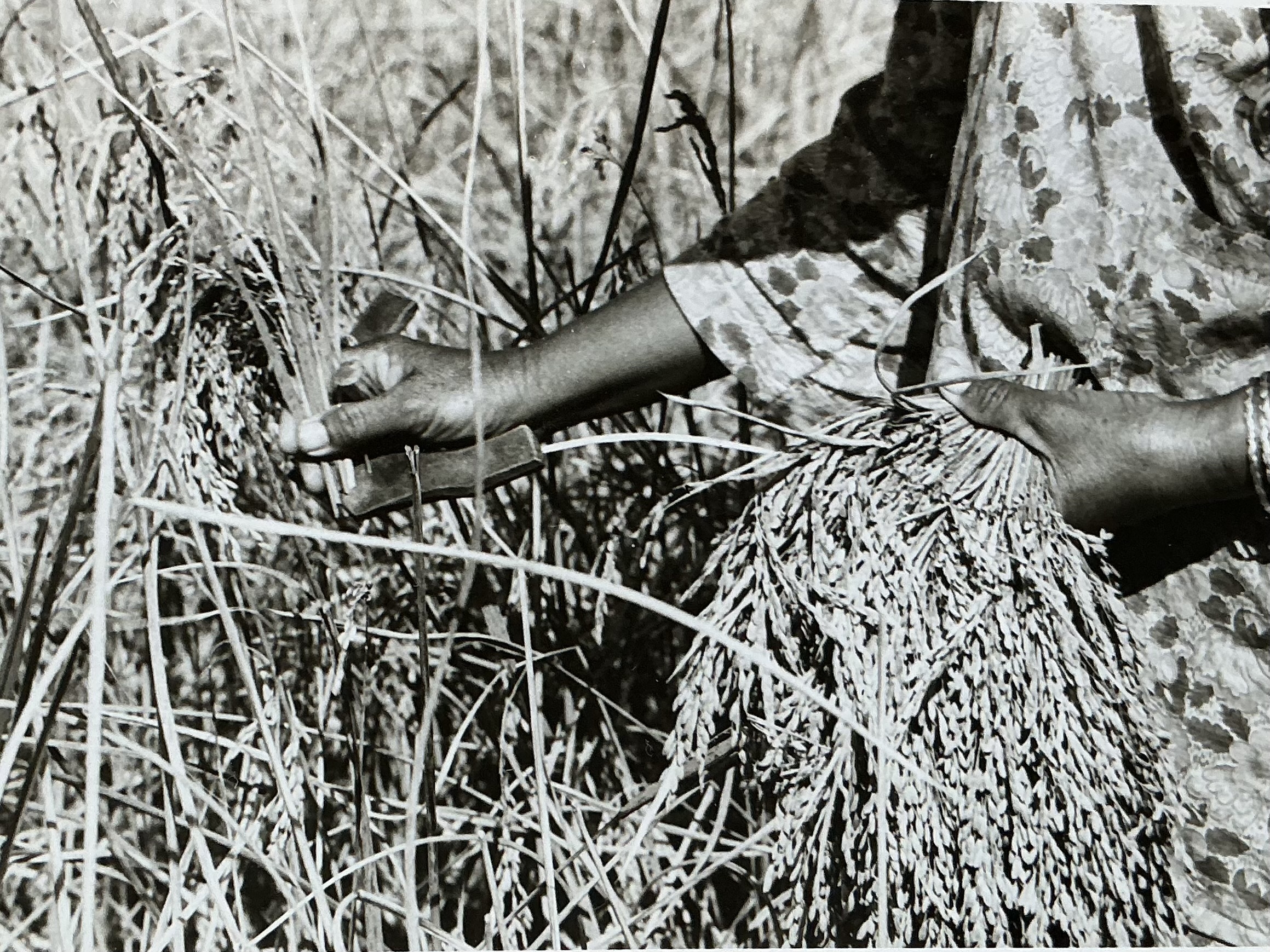
Cutting padi
Not long afterwards, I experienced a less benign consequence of my attempts at biculturalism. As is well known and extensively documented in government reports (Majlis Gerakan Negara, 1969), personal accounts (Tunku Abdul Rahman, 1969), and more searching scholarly analyses (e.g., Kua Kia Soong, 2007; Goh Cheng Teik, 1971), Malaysia experienced the most serious short-term communal violence in its history in May 1969, a sequence of events between 13 and 17 May that proved shattering for the new nation. The violence followed an election that seemed to signal a decline in Chinese (and Indian) deference to the Malay-dominated Alliance.
News from Kuala Lumpur, the epicentre of the violence, quickly reached my Terengganu kampung, stoking fears and latent ethnic animosity among its Malay-Muslim inhabitants. In communicating those fateful events, battery-powered radios had easily overcome the village’s lack of electricity and its distance from the capital. As I returned home one evening during the crisis, I noticed a group of young men gathered on the village’s only road. Their angry sentiments and wild gestures were directed at a community of Chinese villagers who lived a mile or so up the road. Loudly, one after another, they declared what they would do if any of their Chinese neighbours ventured into their vicinity. They looked and sounded nothing like the same easy-going young men with whom I had recently launched a jamban (latrine) business.
I was horrified by their threats but slipped somewhat guiltily past the group, away from the road where they had gathered and up the path to my house. At the time, I comforted myself with the thought that, as the Malay saying goes, “lafaz tinggal lafaz saja”, that words would remain merely words and not translate into actions. Indeed, no encounters occurred. But later, my silence haunted me. Why had I not at least attempted to challenge those hateful sentiments? After all, this was a long-established rural Chinese community whose members interacted daily with Malay-Muslims. They spoke Terengganu Malay, wore sarung, tapped rubber, and planted padi, and in almost every respect (except for dietary preferences and religion) were indistinguishable from their Malay neighbours.
It’s complicated, I know. Even afterwards, I could have absolved myself and dismissed what I had witnessed as mere histrionics. And yet, under the circumstances of that evening in Terengganu, I could not help but conclude that the potential for serious violence had been high. At the time, Malaysians overwhelmingly viewed their society in communal rather than class terms. A frame of reference other than a communal one was rare, especially among poorer Malaysians and those educated outside the English-medium system. Everyday expressions of communalism were often benign, but under certain circumstances, such as those triggered by the events of 13 May, their consequences could be catastrophic.
This episode made me realise that my unthinking biculturalism, whatever its virtues, also had its limitations.
The Limits of Biculturalism

Ideal of refined (vs. coarse) behaviour, from the Ramayana (batik)
Gauging those limits, however, is not always easy, nor is deciding what to do when they are breached. Until then, fitting in had seemed straightforward. Malay-Muslim life, and Malaysian society more generally, were congenial to me. With little effort, I had been approachable, agreeable, even-tempered, and composed. I was, after all, no Ugly American, and fortunately, challenges to other aspects of my youthful American identity had been rare. Besides, there was so much for a young American to absorb: new food, a tropical environment, another language, unfamiliar rituals, and much else. And most people were less interested in the intricacies of my American world than in learning how I responded to theirs.
But one afternoon after work, while idly leafing through a photo album, I discovered that some wedding photographs were missing. At the time, this seemed too intimate an intrusion to ignore. Moreover, I was fairly certain I knew who was responsible for the theft. Maimun, during her frequent visits to the house with other schoolgirls, was the only person who had paid excessive attention to these artefacts. Awkwardly enough, her father was Tok Kathi Abdullah, the village headman. In any case, I made both my displeasure and my suspicions widely and loudly known, in a manner uncommon in polite Malay-Muslim society. I was far from amuk, but then again, there was nothing halus, or refined, about my reaction.
Within hours, the photographs reappeared, and nothing further was ever said about the matter. I would like to think that by then I had accumulated sufficient cultural capital to avoid negative consequences for my expression of anger. At least, that was the case as far as I could tell. But who really knows?
Intimacy
and Distance
These experiences, and others since, have shaped a dual perspective that has endured to this day. I believe in the intrinsic value of experiencing another’s culture and way of life as fully as possible from within. Doing so deepens understanding, fosters empathy, and enhances self-knowledge. It is not too much to claim that embracing the perspectives of others allows us to become more fully ourselves. That kind of biculturalism is more than simply putting on and taking off a light jacket at will. It encompasses language, including diction, syntax, tone, and gesture, as well as culture, attitudes, and much more.
But neither is it a skin transplant or a transformation of character. In short, the challenge of biculturalism lies in navigating intimacy and distance.1 This can be a delicate undertaking, one that sometimes demands not fitting in but rather articulating perspectives that elude the gaze of a local “insider”. My conviction that an informed outsider can offer valid insights traces back to Georg Simmel’s belief (Wolff, 1950) in the value of being a knowledgeable “stranger”, a view that has been corroborated many times since.
This dual perspective is something I carry with me, for better or worse. It is by no means a perfect approach. It means, for instance, that I often find myself in situations without being entirely of them. But it does open up the possibility, which I find highly appealing, of being both a willing participant and an informed observer. The aspiration to be an agreeable insider as well as an informed outsider, whatever its moral and emotional complexities, remains worth pursuing.
Author’s note: I would like to thank Emeritus Professor Charles Hirschman (University of Washington) for his comments on an early draft.
Footnote
- See Hessler (2001) for a vivid account of his experience navigating intimacy and distance during two Peace Corps years in Fuling along the Yangtze River in Sichuan, China. ↩︎
Bibliography
▚ Goh, Cheng Teik. The May Thirteenth Incident and Democracy in Malaysia. Oxford University Press, 1971.
▚ Hessler, Peter. River Town: Two Years on the Yangtze. HarperCollins, 2001.
▚ Kua, Kia Soong. May 13: Declassified Documents on the Malaysian Riots of 1969. Suaram, 2007.
▚ Majlis Gerakan Negara (National Operations Council). Tragedi 13 Mei: Satu Laporan (The May 13 Tragedy: A Report). Government Printer, 1969.
▚ Rahman, Tunku Abdul. May 13 Before and After. Utusan Melayu Press Ltd., 1969.
▚ Wolff, Kurt H., ed. The Sociology of Georg Simmel. Free Press, 1950.
How to cite: Regan, Daniel. “Intimacy and Distance: Reflections on Learning to Be Bicultural in Malaysia, 1966 to 1969.” Cha: An Asian Literary Journal, 22 Oct. 2026. chajournal.com/2026/10/22/be-bicultural.


Daniel Regan, a sociologist, was a faculty member at the University of Pittsburgh in the United States for 21 years, six of them as department head. In recent decades, he has held senior academic-administrative positions in Idaho and Vermont. Regan is the author of Intellectual Conversations: Malaysian Writers and Thinkers in the 1970s (Palgrave Macmillan and Gerakbudaya/SIRD, 2024). His other academic writings include articles and chapters on higher education, religion and politics, intellectual life, and Malaysia. In retirement, he serves on local boards in Vermont, plays squash, and writes. His Peace Corps service, referred to in this essay, spanned late 1966 to mid-1969. [All contributions by Daniel Regan.]