
茶 FIRST IMPRESSIONS
茶 REVIEW OF BOOKS & FILMS
[ESSAY] “The Metaphor of Trees: Stephanie Ellen Sy’s The Magnificent Banyan Tree and the Green Tong Lau” by Rebekah Chan
Stephanie Ellen Sy (writer), Ishita Jain (illustrator). The Magnificent Banyan Tree and the Green Tong Lau, Kokila, 2026. 40 pgs.


Even as I write this, I look out of a window in Toronto at a wall of trees whose names I do not know. Yet every day, they are there with me as I try to write. I look to them for movement or signs of life when my thoughts are stuck; I ascribe secrets and wisdom to their patient presence. This desire for meaning is hardly unique. For centuries, artists and writers have embraced the notion of trees as stoic companions.
In Chinese culture, 歲寒三友, or “The Three Plant Friends of Winter”, refers to pine, bamboo, and plum trees, celebrated for their individual virtues and qualities in classical Chinese poetry and painting as far back as the Northern Song Dynasty (960 to 1127 CE). These three plants are admired for their perseverance through the harsh winter months and serve as metaphors for human endurance in the face of adversity.

Zhao Mengjian’s painting of pine, bamboo and plum. Zhao Mengjian 趙孟堅 (1199 to c. 1264). Source: Wikimedia Commons.
❧
Depending on the species, some North American trees have lifespans that exceed those of humans. Species with moderate lifespans of 100 to 300 years include the red maple, red oak, and eastern white pine. Many writers have therefore drawn upon the quiet, enduring existence of trees as witnesses, including Victoria Chang in The Trees Witness Everything and Robert Frost in A Witness Tree. In his poem “Tree at My Window”, Frost writes:
But tree, I have seen you taken and tossed,
And if you have seen me when I slept,
You have seen me when I was taken and swept
And all but lost.
Given the temperate deciduous forest climate found in North America, popular tree species to write about include oak, willow and beech. In the film Silent Friend, Tony Leung’s character attempts to communicate with an almost 200-year-old ginkgo tree growing in the temperate climate of the Old Botanical Garden in Marburg, Germany. Meanwhile, Colombian poet Alberto Vélez writes about “The Guamo Tree”, which is found in humid tropical and subtropical climates.
❧
When I first moved to Singapore’s tropical rainforest climate, I immediately noticed the country’s verdant abundance of unfamiliar trees that had become part of my surroundings. I later learnt that this wealth of trees was the result of founding Prime Minister Lee Kuan Yew’s tree-planting campaign, conceived as a strategy for nation-building. He believed that a “well-tended Garden City would benefit its inhabitants and serve as a key competitive factor to attract foreign investors to the country.”

Singapore Botanic Gardens. Source: Wikimedia Commons.
Once, at the beginning of my writing life, I tried to use the metaphor of the banyan tree’s roots to explain how I had left a place where my otherness was hidden (Canada), only to find it exposed, like the aerial roots, in the place where I then lived (Singapore). Ironically, another aspect of my otherness now feels exposed upon returning to the city of my birth. The essay I attempted did not work, but looking back, I see that I have always been drawn to the metaphor of trees.
A History of Growth

When I lived in Hong Kong, it was an urban luxury to live among trees, surrounded by rows of towering apartment complexes. In Hong Kong, trees became even more precious to me than they had been amid the sometimes sparse and empty spaces of Canada or in the Garden City of Singapore.
Like the bamboo scaffolding I would walk beneath along busy commercial streets such as Queen’s Road Central, banyan trees were also appreciated for their resilience, particularly the way they had grown alongside, within and often despite the concrete that surrounded them.
Trees that have grown in historic masonry retaining walls are known as 石牆樹, or stone wall trees. These walls, and sometimes the trees themselves, date back to the colonial period, from the nineteenth century to the Second World War. Combining British engineering, traditional Hakka stone masonry and locally sourced granite, these walls were built to prevent damage from landslides caused by monsoons and typhoons. Retaining walls are now considered important historical remnants of the city’s challenging urban development during Hong Kong’s years as a British colony.

The former site of St Paul’s College in Mid-Levels, built in 1850. Source: Wikimedia Commons.
Despite the intricate and laborious process of erecting retaining walls, the banyan trees that grew on top of and between the cracks of the granite-block walls appeared by chance. No one planted them there. Their seeds were carried there by the wind or by birds, but their arrival was entirely accidental.
“In ecology, this is known as spontaneous growth,” says C. Y. Jim, Chair Professor of Geography at the University of Hong Kong. “The trees are totally unaided by humans. Birds drop the seeds along the walls and they gradually germinate.” Moreover, owing to the epiphytic nature of banyan trees (which can grow on other trees), they use the walls for support as their powerful shoots climb towards the sky and their roots reach down into the ground.
Mature stone wall trees, sometimes 100 to 150 years old, can still be found in Hong Kong. They stand as testaments to the city’s distinctive history and vegetation, and as symbols of perseverance through Hong Kong’s tumultuous past.
Following the raising of the Union Jack at Possession Point in 1841, efforts began to clear a path for Queen’s Road, laying the infrastructure for what would be named Victoria City in 1843. Decades later, as the city expanded upwards, hundreds of terraced slopes were carved out and supported by stone retaining walls in neighbourhoods now known as Mid-Levels, Sheung Wan, Wan Chai, and the Central and Western District. This considerable demand for labour attracted a “large number of Chinese people…to take advantage of employment and investment opportunities,” writes social scientist Sammantha Ho, who continues:
The population increased sharply from 7,450 in 1841 to 24,157 in 1845. However, the Chinese population mainly comprised labourers rather than merchants because the Qing government restricted the movement of the latter to Hong Kong. The affluent merchants had no desire to be ruled by a foreign power either.
However, this would soon change.

Hong Kong Harbour and the City of Victoria in the late nineteenth century. Source: Wikimedia Commons.
The
Magnificent Banyan
The opening line of The Magnificent Banyan and the Green Tong Lau, a new picture book written by Stephanie Sy and illustrated by Ishita Jain, begins as any tree does, with a seed.
There once was a bird that dropped a seed into a crack in a green tong lau.
The simple reference to a tong lau already conjures images of Hong Kong’s yesteryear. Tong lau, transliterated from 唐樓, or “Chinese house”, were built alongside retaining walls to accommodate the sudden influx of labourers arriving in Hong Kong from southern China. Initially, many tong lau were constructed in the architectural styles of the southern Chinese provinces from which these labourers came.

Tai Ping Shan Street area in the 1870s. Source: Wikimedia Commons.
In the 1850s, Hong Kong experienced another notable increase in population, this time owing to refugees fleeing the violence of the Taiping Rebellion, a civil war against the ruling Qing dynasty.
According to the Hong Kong General Chamber of Commerce, “The uprising, which lasted from 1850 to 1864, contributed to a near four-fold increase in Hong Kong’s population to just over 120,000 by the end of the unrest.” However, this new wave of immigration differed from that of the less-educated labourers who had first arrived. Many of those fleeing the Taiping Rebellion were affluent merchants who invested in factories and land, including the construction of tong lau, “[the] quintessential abode of the underprivileged masses.”

Densely populated tenements in the 1910s in western Victoria, the de facto town centre of colonial Hong Kong. Source: The British National Archives.
“Tong lau contrasts against the Western-style residences known as yeung lau. The difference between tong lau and yeung lau was that the former could be subdivided into multiple compartments, whereas the latter was to be rented only to one family and could not be sublet.” —Professor Cecilia L. Chu, urban historian
❧
In the picture book, a seed is dropped into a crack in a tong lau. As it begins to grow, we follow the roots “Down, down, down” and are taken through the three storeys of this multifamily, multigenerational dwelling: a grandfather playing mahjong on the second floor, aunties singing Chinese opera on the first floor and uncles hanging roast goose on the ground floor. Together, these scenes form a nostalgic composite of familiar foods and activities from old Hong Kong. The balconies suggest that the book’s tong lau was inspired by the second or third generation of these buildings, which offered better ventilation and more space than earlier designs.
On the subsequent page, we follow the tender shoots “up, up up” and are introduced to the children who live in the building: Nick, Leon and Kitty.

When the bird drops the seed on the opening page, readers are privy to an aside in brackets: “(Nobody noticed.)” As the spindly roots creep down the sides of the building, the page ends with another aside: “(Still, nobody noticed.)” And when the roots scale the height of the tong lau “until it nearly brushed the clouds”, readers are made fully aware of the tree’s growing presence through a third consecutive aside: “(And yet, nobody noticed.)”
These asides foreshadow the moment when the tong lau’s inhabitants finally notice the tree. Yet the beauty of these quiet remarks lies in the way they emphasise the subtle, almost imperceptible ways in which nature grows around us, without human interference.
As the banyan tree matures and its leaves and aerial roots sprout from the branches, one illustration features familiar Hong Kong birds, including what might be a black-naped oriole, a Chinese blackbird and one of the city’s most recognisable birds, a wild yellow-crested cockatoo. Jain’s dreamlike, whimsical paintings draw us into the surreal story that unfolds. Likewise, her soft, layered watercolour strokes lend movement and vitality to the natural world, people and animals.
The picture book employs enjambment and the arrangement of words on the page, particularly as we follow the shoots upwards or the roots downwards, mimicking the way banyan trees grow.

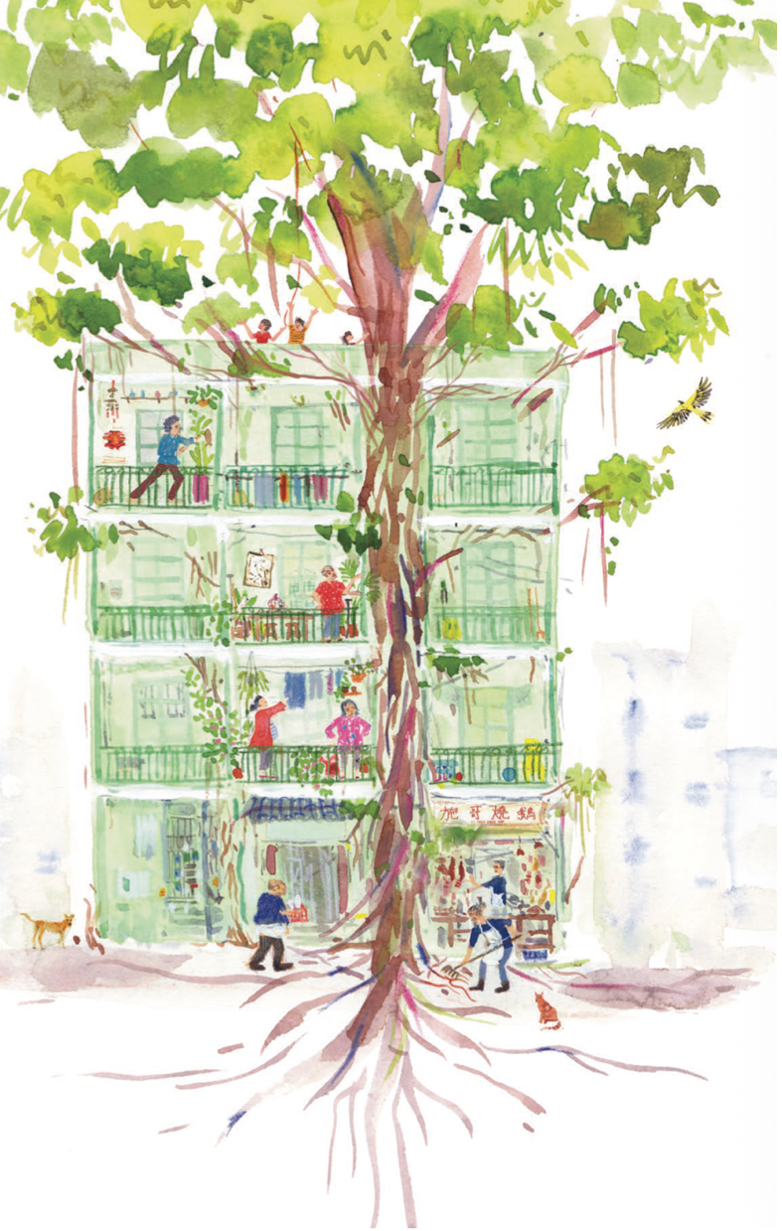
Until this point, the tong lau has been shown only in sections: a balcony, a door, a floor, a shop. Similarly, the tree has been revealed only in parts: shoots, leaves, branches and roots. However, at the end of the first act, a wordless double-page spread presents a striking illustration revealing the full scale and magnificence of the tree alongside a complete view of the green tong lau.

Here, we observe the green tong lau, its residents and the tree existing in harmony. Children play on the rooftop, people go about their activities on the balconies, practising tai chi or hanging clothes, a shopkeeper works, and a street cat and dog loiter nearby. Until this page, the tree might also have been considered a silent witness. It could have silently watched the children grow up or quietly observed the victories and defeats of mahjong games.
Despite the enormous tree growing in front of the green tong lau, none of the residents interact with it or even acknowledge its presence. This reminds us of the sovereign, discreet manner in which the tree has slowly grown: “(Nobody noticed.)”, “(Still, nobody noticed.)”, “(And yet, nobody noticed.)” This apparent indifference also foreshadows what is to come.
In the following pages, humans and nature become physically entangled. We move beyond the notion of the tree as a silent witness and towards a consideration of ecopoetics.
Entangled Lives
When the characters finally notice the magnificent banyan, the rising action unfolds through a mixture of opinions. The adults find the tree’s proximity irritating because it blocks sunlight, frightens their pet bird and interferes with their shopfront. “It must come down!” the uncles declare. The next day, the women even bring tools and a ladder and begin pruning the tree. Only the children, Nick, Leon and Kitty, delight in the tree’s presence and the wildlife it attracts.
In this story, the tree exists alongside concrete. Indeed, its roots and branches extend across every storey of the tong lau, with human and plant life sharing nearly every floor and frame of the book. This integration of people, trees and urban development is a key characteristic of ecopoetics, a modern literary movement that acknowledges the coexistence and interdependence of nature and human life in urban spaces.
For this reason, the entwining nature of the banyan tree offers a distinctive example of ecopoetics, in which humans and nature are understood as members of a cooperative community. This contrasts with traditional nature writing, in which trees are often portrayed as passive objects onto which humans project their thoughts and feelings.
Consider, for example, John Muir’s “A Wind-Storm in the Forests”. After climbing a 100-foot Douglas spruce in 1874, he writes:
The waving of a forest of the giant Sequoias is indescribably impressive and sublime, but the pines seem to me to be the best interpreters of winds. They are mighty waving goldenrods, ever in tune, singing and writing wind-music all their long century lives.
Here, Muir romanticises the trees he encounters at a high point in the valley near the Yuba River, observing them in the midst of a storm. He depicts this wilderness as terrain untouched by human civilisation, despite the fact that the Indigenous Nisenan people had inhabited the area for approximately 6,000 to 10,000 years before the arrival of European settlers. Muir writes about this remote wilderness even though, just 20 to 30 years earlier, between 1848 and 1855, Nisenan people had been hunted and enslaved during the Gold Rush on the very land where he stood and wrote.
Muir’s erasure of human inhabitants, state violence and industrial mining, an omission that may be understood as ecological amnesia, reflects a common convention of nature writing, in which idealised nature is depicted as separate and distant from humanity, and where humans interpret nature for their own artistic expression. For example, Muir describes the windstorm as a “high festival, and every fiber of the most rigid giants thrilled with glad excitement.” He goes on to describe his experience of the storm:
I drifted on through the midst of this passionate music and motion, across many a glen, from ridge to ridge; often halting in the lee of a rock for shelter, or to gaze and listen. Even when the grand anthem had swelled to its highest pitch, I could distinctly hear the varying tones of individual trees, Spruce, and Fir, and Pine, and leafless Oak, and even the infinitely gentle rustle of the withered grasses at my feet. Each was expressing itself in its own way, singing its own song, and making its own peculiar gestures, manifesting a richness of variety to be found in no other forest I have yet seen.
Muir perceives the trees swaying in the storm as a symphony for his own delight. This human-centred, or anthropocentric, view of nature is a hallmark of nineteenth-century Western nature writing and stands in direct contrast to the central message of The Magnificent Banyan and the Green Tong Lau.
Perhaps it is the densely populated spaces of Hong Kong, or the Confucian values of filial piety, but individual solitude and physical seclusion might themselves be considered modern urban luxuries.
❧
In an exchange of messages with me, author Stephanie Sy writes: “When I wrote the story my initial idea was the simple question of, Why can’t we all just get along?”
While writing this piece, I also spoke to my mother about growing up in a Hong Kong tenement house during the 1950s and 1960s. She had previously told me about, and drawn a diagram of, the single room she shared with her parents and six siblings. Outside their door, a blind woman slept on a mattress in the hallway. In another room lived a letter writer, and next to her, a police officer, his wife and their daughter. At the back of the flat, the shower and toilet were located within the communal kitchen.

My mother often tells me that “姓余係好隨便.” What she means is that her side of the family tends to be easy-going because they all grew up sharing a single room in a communal apartment in Hong Kong.
In The Magnificent Banyan and the Green Tong Lau, multiple families across different generations must share a low-rise apartment building with their neighbours, pets and, now, the magnificent banyan tree and its wildlife. This close, overlapping proximity between the tree and the tong lau gives rise to the tensions and discord that emerge when nature becomes entwined with an urban landscape.
Ecopoetics as
Modern Fable
On a “scorching day”, the children manage to persuade the adults to postpone cutting down the tree, pleading for “Just one more day!” The adults concede and instead enjoy watermelon beneath the tree’s shade. The following day, “smog curled through the streets like a dragon’s breath”, and the adults experience the effects of pollution through coughing and sniffling. Once again, the children succeed in persuading the adults to delay cutting down the tree.
The scorching heat and suffocating smog present obstacles that the characters must overcome, but the inclusion of these two environmental threats also reflects a central concern of ecopoetics. The Magnificent Banyan and the Green Tong Lau does not portray nature and the environment as pure and untouched. Rather, it draws attention to the tangible ways in which humans may have damaged and compromised a shared ecosystem. This stands in direct contrast to the romantic notion, common in traditional nature writing, of nature as a remote spiritual sanctuary serving human emotional or intellectual needs.
The disagreements between the children and adults also reflect the generational tensions explored through ecopoetics. While the older generation regards the banyan tree as an intrusion into its human environment (an anthropocentric perspective), the children delight in the shared space, embracing the tree’s presence by climbing, swinging and marvelling at it (an ecocentric perspective).
At the climax of the story, a storm arises, and the banyan tree is metaphorically described as “wrapping it’s branches around the tong lau”, accompanied by an illustration of a nest. In a thought-provoking image, this comparison gently invites readers to imagine themselves as the birds and the banyan tree as their shelter, much like a nest. It challenges the anthropocentric belief that human lives are inherently superior to, or more significant than, those of birds or trees.

In these scenes, the tree is shown to possess agency rather than merely existing as a passive spectator. Instead, the banyan tree becomes an active member of a shared ecosystem, one that not only requires protection from humans but can also protect them. And the tree does far more. It also “steadied the singing shop signs caught the flowerpots in flight, blocked flyaway mailboxes, and sheltered the dogs all night.”
This scene ends with another aside, echoing the human indifference depicted at the beginning of the book. Only this time, it reveals something different: “(This time, everyone noticed.)”
Through this dramatic, perhaps Shakespearean, reversal, readers may finally recognise what the adults had failed to see. It was the adults who sought to cut down the tree, and the children who saved it from them. Yet, in the end, it was the tree that saved them all.
❧
Given that this picture book is described as a modern fable, likely most suitable for younger readers and their parents, I cannot help but interpret its message as an effort to instil greater ecological empathy and awareness in a new generation. Or perhaps the book was intended for readers like me, drawn in by a humble story of Hong Kong.
Trees have long been celebrated in literature for their beauty and mystery, dating as far back as the Tang dynasty poem “詠柳” (“Ode to a Willow”) by 賀知章 (He Zhizhang, 659 to 744 CE). They have also served as vehicles for metaphor, been cast as silent spectators or become markers of time through which to better understand human consciousness. This is also true for the author of The Magnificent Banyan and the Green Tong Lau. In her author’s note, Sy writes: “Wind and birds carry its seeds to the most unexpected places… There, they sprout roots…”
Sy’s family were also immigrants to Hong Kong. Originally from Fujian, China, they arrived in Hong Kong by way of the Philippines. Sy would eventually go on to live in America, Italy and Canada. While she draws upon the tree’s resilience to reflect her own experience of “put[ing] down roots in unexpected places”, she also uses the way its seeds are carried and dispersed as a metaphor for her journey of migration.
The tong lau, a form of tenement housing built specifically for the early underprivileged populations arriving in Hong Kong, also acknowledges the city’s history of migration, particularly those who arrived under duress, endured hardship and sought better lives. Tong lau, alongside stone wall trees, are also nostalgic symbols of old Hong Kong and markers of cultural distinctiveness worth preserving amid the city’s ever-changing identity.
The Magnificent Banyan and the Green Tong Lau is an ecological fable that asks us to reconsider how we perceive and interact with nature, especially in urban landscapes. Yet it is also a modern ode to the banyan tree, which Sy calls a “living landmark in the heart of Hong Kong.” Ultimately, the book is a love letter to Hong Kong, to anyone who calls this crowded city home, and especially to those who have left and must somehow begin again.
How to cite: Chan, Rebekah. “The Metaphor of Trees: Stephanie Ellen Sy’s The Magnificent Banyan Tree and the Green Tong Lau.” Cha: An Asian Literary Journal, 22 Oct. 2026, chajournal.com/2026/10/22/banyan.


Rebekah Chan is from Toronto and has also lived in Singapore, Tokyo, and Hong Kong, where she completed her MFA at City University in Hong Kong. While in Hong Kong she served as Editor-in-Chief for her MFA legacy anthology, Afterness: Literature from the News Transnational Asia, and held the position of Community Manager for the Hong Kong Writers Circle. In Japan she wrote for the lifestyle magazine Tokyo Weekender. Her literary work appears, or is forthcoming, in Tupelo Quarterly, Blood Orange Review, Wild Roof Journal, Reed Magazine, and more. Rebekah is currently based in Toronto and writes about loss and belonging. Her writing is also supported by the Canada Council for the Arts. You can find her at @bx_writenow on Instagram. [All contributions by Rebekah Chan.]