
茶 FIRST IMPRESSIONS
茶 REVIEW OF BOOKS & FILMS
[REVIEW] “Witness and Knowledge: Reading Victoria Chang’s Trees” by Anna Nguyen
Also read Anna Nguyen’s reivew of
Ildikó Enyedi’s Silent Friend
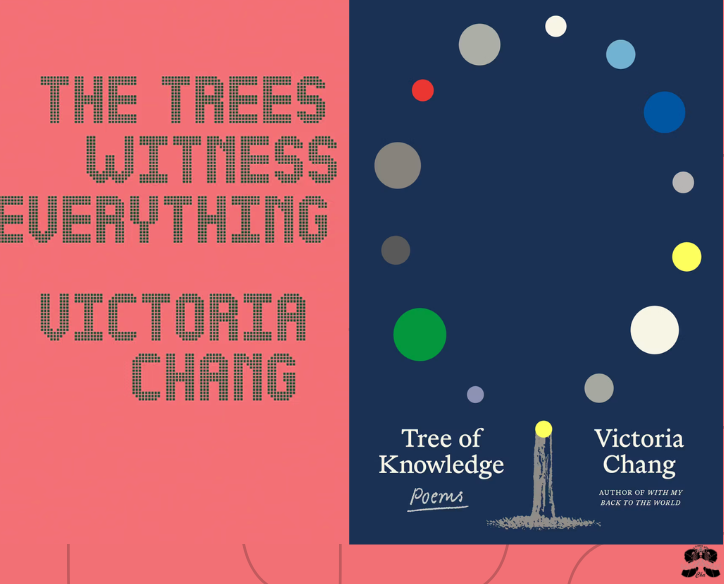
🌻 Victoria Chang. The Trees Witness Everything, Copper Canyon Press, 2022. 125 pages.
🌻 Victoria Chang. Tree of Knowledge, Farrar, Straus and Giroux, 2026. 130 pages.


Whenever my earmarked copy of The Trees Witness Everything, Victoria Chang’s sixth poetry collection, is out of my bag, everyone compliments its striking cover, which conjures a sense of contrast. While it is minimalist, the cover is bright, a reddish-orange; it is narrow and tall, unlike the conventional book we might expect. Perhaps it is unsurprising, then, that the poems in the collection are also striking, as they vary in length.
In the author’s notes, Chang shares that her poems are written in various Japanese syllabic forms known as wakas and are based on W. S. Merwin’s poem titles. “Occasionally, I broke the form… I chose to doubly constrain myself because formal constraints often have the opposite effect on my writing process” (2022, p. 118). These formal constraints work beautifully as a contrast, elevating the compressed, melancholic language within the spatial arrangements.
Despite its titular character, the witnessing trees as characters seem more secondary to the collection’s exploration of memory, grief, and death. The poem “Losing a Language” suggests as much:
We were born with a
large door on our backs. When will
we know if it opens? (2022, p. 5)

In Obit, Chang had written extensively on the inefficacy of language after the death of her parents. She wrote obituaries on abstract concepts such as language and grief. In one, she writes, “Language, died, brilliant and beautiful on August 1, 2009 at 2:46 p.m.” (2020, p. 10). One of the most striking lines is a plainspoken one, “Language fails us”, a reminder of the poet’s attempt to capture something, anything, about the world around us. But Chang’s use of language and words is economical, something that the narrator shares with the silent trees.
The title comes from the penultimate line of “In the Open”:
Weather is wet, it
doesn’t have joints. How snow just
becomes rain, what’s that
change called? Trees witness everything,
but they always look away. (2022, p. 30)
The use of trees as witnesses is a metaphor that works, as they are depicted as largely silent and observant, connected and detached. The poem “Witness” offers similarly devastating lines:
If you listen closely,
you can almost hear
the leaves in your body fall.
Maybe nothing dies,
things just get lost. Memory
convalesces on our skin. (p. 106)
The collection takes an interesting turn with the inclusion of the longer poems in the second and fourth sections, another striking contrast. In particular, the prose poem “Marfa, Texas” reads like a kind of nature writing, but with beautiful meditations on lost loves during the speaker’s surveying of the isolated, desert-like landscape. There are more words in these longer poems, but the poems, read as a whole, appear to be a general reflection on how one moves through daily life and how to capture that process through writing. In “Words”, the speaker declares:
I struck a bargain
with language. That I would not
abuse it or sell it, that
I would use it for
beauty. In exchange, I will
die, while words live together. (p. 45)
Tree of Knowledge is an obvious arboreal companion book to The Trees Witness Everything. As referenced by the ending list of artworks, the poems are ekphrastic, perhaps suggesting a connection to the scientific phenomenon of seeing as knowledge. For example, in “Three Musicians”, there is a recurring eucalyptus tree that stands on the speaker’s street and is being assessed by men who will cut it down. “The crane came and stopped next to the tree. A man / climbed up the tree. The tree, the man, and the crane / became a still life of green, orange, and yellow” (2026, p. 10). Yet the idea of affective knowing is constantly called upon. In “Trees [Studies], 1944”, the narrator declares, “I knew something the eucalyptus tree did not. Someone knows when the / earth will end… To be alive is to accept perception but to use the perceived” (2026, p. 8).
Especially poignant are the political analyses of the art the experiential speaker describes. In “The Bird Cage”, the speaker states:
They couldn’t imagine their experiences with
the tree were different than mine. That maybe the
painting was never about a bird or a cage, but about
a country. That this tree couldn’t be the same as the
trees on their streets. Because hope has density. It is
my dead parents’ memories. Some people have to
leave countries they were born in. Other people
have to leave countries they’ve never seen. Others
have to install their own countries. (p. 24)
The binary of the state and the stateless are then expressed in the longer poem “Eureka”, the only poem in the second section. A reflection of the 1885 expulsion of Chinese workers from Eureka, California, the nearly 20-page poem contains many references to violence. But the final line may express hope: “it’s possible we can outlive violence” (2026, p. 67).
And perhaps the thematic question of the collection comes from “Three Musicians”, in which the speaker asks, “Why does so much knowledge / come at the end of something? I have so many last questions for the tree. Is there more than one afterlife” (2026, p. 10)? Yes, indeed. What happens to the language we elevate and celebrate as knowledge when nature and life can be destroyed?
Bibliography
▚ Chang, Victoria. Obit. Copper Canyon Press, 2020.
How to cite: Nguyen, Anna. “Witness and Knowledge: Reading Victoria Chang’s Trees.” Cha: An Asian Literary Journal, 14 Sept. 2026, chajournal.com/2026/09/14/victoria-chang.


Anna Nguyen left her PhD programme and reworked her dissertation into a work of creative non-fiction while studying for an MFA at Stonecoast, University of Southern Maine. Her work brings together literary analysis, science and technology studies, and social theory to examine institutions, language, expertise, citation practices, and food. She is currently undertaking a second MFA in poetry at New England College, where she also teaches first-year composition. She is the host of the podcast Critical Literary Consumption. [All contributions by Anna Nguyen.]